For new energy targets, the core risk is rarely a single day's price action—it's whether "rules and progress can be consistently delivered over time." When tracking SK Eternix, it pays to shift from narrative-driven analysis to an indicator-driven framework for greater consistency.
SK Eternix's risk checklist should reflect the essential traits of an operational new energy company. Policy defines the settlement rules, project progress determines when assets become operational, financial quality dictates long-term holding capacity, and exchange rates along with trading dimensions shape the final conversion results in cross-border accounts.
Layer 1: Policy and Market Rule Metrics
Key areas to watch:
- Changes in new energy subsidies or incentive structures
- Adjustments to electricity market trading mechanisms
- Updates to safety or access rules for energy storage and grid interconnection
When rule changes affect how settlements are calculated, the quality of returns may need revaluation—even if the project itself stays unchanged.
Policy risk isn't limited to subsidy shifts; it also encompasses structural changes in the electricity market. If grid connection rules, dispatch protocols, storage access standards, or settlement terms are adjusted, the cash flow quality of new energy assets can shift. For a company like SK Eternix, which holds assets long-term, regulatory stability is a foundational variable for assessing business sustainability.
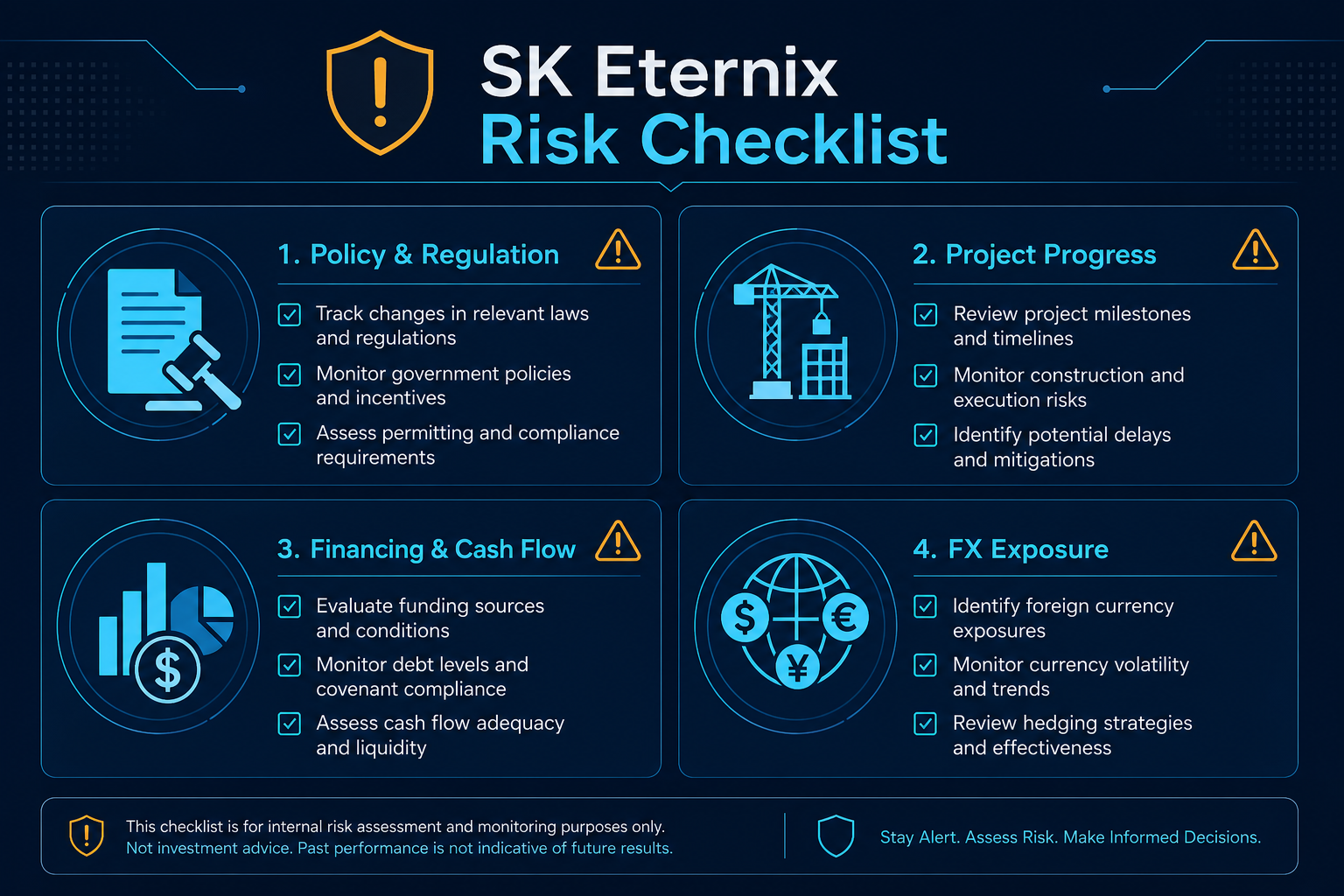 Figure 1. SK Eternix Risk Checklist: Policy, Project Progress, Financing, and FX Exposure as the Four Core Observation Layers
Layer 2: Project Progress and Commissioning Metrics
The biggest fear for a new energy company is "great plans, delayed commissioning." This is directly tied to the Build-to-Own business model. Prioritize tracking:
| Metric |
Focus |
| Progress of projects under construction |
Whether milestones are being met |
| Grid connection cadence |
Deviation between planned and actual grid connection |
| Operational availability rate |
Whether persistent low efficiency arises |
| CapEx execution |
Whether investment pace aligns with project milestones |
Project delays typically hit both revenue timing and funding pressure simultaneously.
The key to project progress metrics lies in the gap between "planned" and "actual." If deviations occur at any stage—construction, permitting, grid connection, or operational ramp-up—revenue recognition, cash recovery, and funding schedules all come under pressure. For an operational company, each step from project reserve to commissioning influences long-term asset quality.
Layer 3: Financial and Financing Quality Metrics
Operational companies are highly sensitive to financing quality. Watch these ongoing indicators:
- Changes in asset-liability structure
- Trends in interest expenses and cost of capital
- Alignment between operating cash flow and net profit
- Short-term debt service pressure and refinancing arrangements
If profit grows but cash flow doesn't follow, further unpacking is required.
| Financial Metric |
Question to Examine |
Implication for SK Eternix |
| Operating cash flow |
Can profit be converted into cash? |
Indicates operational asset quality |
| CapEx |
Is investment pace too fast or delayed? |
Reflects project execution pressure |
| Debt structure |
Short-term vs. long-term debt ratio |
Indicates refinancing risk |
| Interest expense |
Is cost of capital eating into returns? |
Determines long-term holding viability |
This table breaks down financial risk into four dimensions: cash flow, investment pace, debt, and cost of capital. Looking solely at revenue or net profit can mask the funding strain inherent in an asset-holding model—so the income statement, cash flow statement, and CapEx must be read together.
Layer 4: Exchange Rate and Cross-Border Trading Metrics
Cross-border investors often overlook exchange rate impact:
- The target's local currency performance may diverge from the account's settlement currency
- FX fluctuations can alter conversion results at the account level
- Trading fees and conversion rules can affect final net value
When reviewing returns, split "underlying asset return" from "FX conversion return" to avoid misreading strategy effectiveness.
FX risk also complicates result comparisons across accounts. As a Korean stock, SK Eternix involves currency conversion between the underlying asset and the account's settlement currency. Focusing only on the stock's local-currency performance may fail to explain the final change at the account level.
Five-Minute Quick Checklist: What to Verify Before Trading?
- Have there been any key rule changes within the past disclosure period?
- Are major projects under construction progressing on schedule?
- Is operating cash flow consistent with net profit trends?
- Has the cost of capital increased significantly?
- Could the exchange rate environment alter return conversion results?
If you can't answer two or more of these, your information check is incomplete. First gather more disclosure, project, and financial data; then use the Gate Trading Process to verify the target code, order type, and account funding dimension.
Which Signals Suggest Risk Needs Reassessment?
Reassessment typically comes from four signal types: policy shift, project progress deviation, rising financing costs, and cash flow–profit decoupling. Any single signal alone may not change the overall view; but when multiple signals appear together, the analysis framework must be recalibrated.
For SK Eternix, the most critical factor is the linkage between projects and finances. If project progress lags while CapEx or interest expenses rise, the funding pressure under the long-term holding model intensifies. Even if projects are commissioned on time, a change in settlement rules still demands a fresh look at cash flow quality.
How Does the Risk Checklist Combine with Peer Comparison?
The risk checklist and peer comparison work together but serve different purposes. Peer comparison answers "How does SK Eternix differ from other new energy companies?" The risk checklist answers "What observable variables do these differences create?" Start with peer classification, then apply the risk checklist—this avoids mixing operational companies with engineering companies in a direct comparison.
For example: operational companies focus on commissioning pace, cost of capital, and operating cash flow; engineering companies focus on project delivery, order-to-cash cycles, and construction timelines; equipment companies focus on shipments, inventory, and gross margins. Without first differentiating the type, risk indicators can become unfocused.
What Are the Limitations of the Risk Checklist?
The risk checklist is not a predictive tool, nor does it replace company disclosures or trading page rules. Its purpose is to standardize the information verification process: which variables to check, which dimensions to confirm, and which signals could shift the analytical framework. The clearer the checklist, the easier it is to spot information gaps.
Another limitation is data update cadence. Policy, project, and financial information come from different disclosure channels with inconsistent update frequencies. Avoid stitching data from different time dimensions into a single conclusion; instead, first confirm whether the disclosure period and statistical dimensions are aligned.
Summary
When analyzing SK Eternix, a more effective approach is not to forecast short-term price moves but to build a four-layer risk checklist—Policy, Project, Finance, and Exchange Rate—and review it consistently. Running the same checklist repeatedly is generally more stable than chasing hot topics on the fly.
FAQ
Why is project progress more important than news hype?
Because operational companies ultimately generate cash flow through commissioned assets, and project delays directly affect earnings timing.
How important is exchange rate risk for Korean stocks?
Very important for cross-border accounts. It can produce different actual returns even when the stock's local-currency price stays flat.
Can SK Eternix be assessed using PE or PB alone?
No. New energy operational companies must also incorporate project and cash flow metrics.
Why include the trading dimension in the risk checklist?
Because the trading dimension affects code verification, fund transfers, order execution, and account conversion results. Fundamental analysis and trading page review should be handled separately—but both matter for a full understanding.