In recent years, the rapid growth of artificial intelligence, high-performance computing, and cloud computing has sent the global semiconductor industry into a new expansion cycle. As a critical piece of AI infrastructure, memory chips—especially HBM (High Bandwidth Memory)—have become indispensable core components for AI servers.
SK Hynix is not only a world-leading memory chip manufacturer but also one of the most valuable core assets of SK Group. Since joining the SK Group, the company has received sustained investment in capital, R&D, and global expansion, while establishing synergies with the group's energy, telecom, and digital infrastructure businesses. This model—using a holding platform to pool resources and leveraging core enterprises to drive innovation—has become a key strategy for large Korean conglomerates seeking to boost their international competitiveness.
What Is the Relationship Between SK Hynix and SK Group?
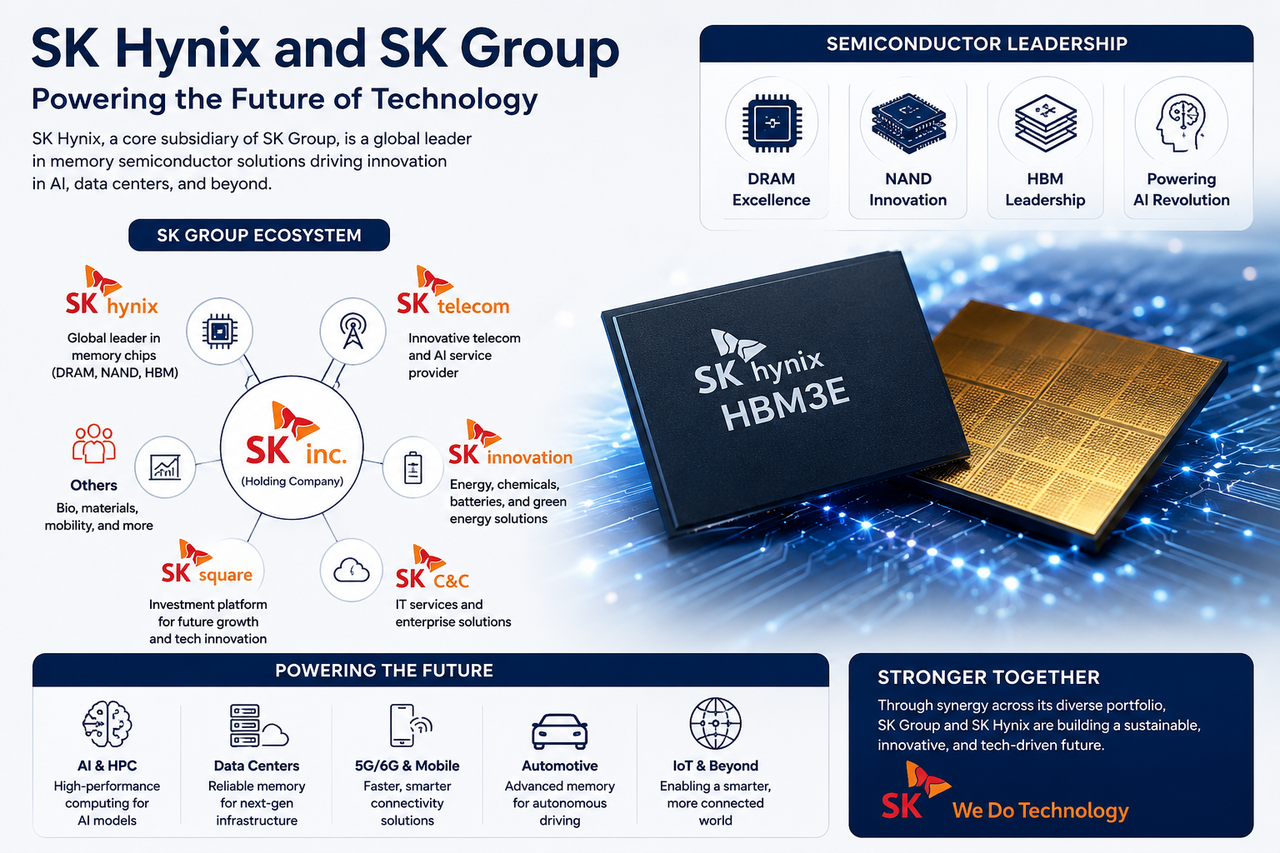
SK Hynix is a major semiconductor subsidiary of SK Group and a central pillar of the group's technology portfolio. In 2012, SK Group acquired a controlling stake in what was then Hynix Semiconductor, formally integrating it into the group and renaming it SK Hynix. This acquisition not only marked SK Group's entry into the global semiconductor arena but also became a landmark case in Korean M&A history.
Since joining SK Group, SK Hynix has continued to operate independently. A dedicated management team handles product development, production, and market expansion, while SK Group provides capital, long-term strategic direction, and cross-industry resource integration through its holding structure. This approach preserves operational efficiency while unlocking the benefits of group-level synergy.
Why Is SK Hynix SK Group's Most Valuable Asset?
For SK Group, semiconductors are the bedrock of future tech competitiveness, and SK Hynix plays the lead role in the group's global chip ambitions.
On one front, SK Hynix has consistently ranked among the top players in the global DRAM and NAND Flash markets, with unmatched R&D and manufacturing capabilities in memory chips. On the other, its aggressive push into HBM products has paid off handsomely, as surging AI server demand has amplified its market influence.
Compared to mature businesses like energy and telecom, the semiconductor sector offers higher technological barriers and greater growth potential. That's why SK Group continues to channel resources into chip R&D and advanced manufacturing, making SK Hynix a primary driver of the group's value growth.
How Does Korea's Semiconductor Supply Chain Build Synergistic Advantage?
Korea's semiconductor industry isn't driven by a single company—it's built on a complete, interconnected ecosystem.
Structurally, Samsung Electronics and SK Hynix form the twin pillars of Korea's memory chip industry. Behind them, equipment makers, materials suppliers, packaging and testing firms, and research institutions all work together to keep the chain running. The government also plays a role, providing sustained support in R&D funding, industrial policy, and talent development.
SK Group's unique advantage lies in its vertical integration beyond chips. By also controlling energy, telecom, and digital infrastructure assets, the group provides a more comprehensive support system for semiconductor production and application.
| Industry Segment |
SK Group's Related Holdings |
Synergistic Value |
| Memory Chips |
SK Hynix |
Supplies DRAM, NAND, and HBM products |
| Energy |
SK Innovation |
Powers manufacturing bases and supports green transition |
| Telecom |
SK Telecom |
Drives AI, 5G, and cloud computing adoption |
| IT Services |
SK C&C |
Delivers enterprise digitalization and cloud services |
| Investment Platform |
SK Inc. |
Provides strategic capital and resource allocation |
This cross-sector footprint gives SK Group a powerful competitive edge in the global tech supply chain.
Why Is the AI Era Accelerating SK Hynix's Growth?
Generative AI has dramatically boosted demand for high-performance computing. AI servers need faster data processing and more memory bandwidth, which has made HBM an essential part of AI chip architecture.
SK Hynix has invested heavily in advanced memory technology for years, building a clear lead in HBM and forging close ties with the world's top GPU and AI chip makers. As large language models and AI data centers continue to expand, the need for high-performance memory keeps rising, further solidifying SK Hynix's strategic position worldwide.
For SK Group, AI isn't just a boon for its semiconductor business—it also creates new synergy opportunities across telecom networks, data centers, and digital infrastructure.
How Does SK Group Support SK Hynix's Growth?
As a holding company, SK Group doesn't directly manufacture chips. Instead, it fuels SK Hynix's progress through long-term capital allocation and resource coordination.
First, the group provides stable financing for cutting-edge fabs, R&D initiatives, and international expansion. Second, its affiliate companies create operational synergies in energy supply, digital management, and AI applications. Finally, SK Group leverages its global investment network to strengthen ties with international tech firms, paving the way for SK Hynix to enter new overseas markets.
This "professional operations + group empowerment" model lets SK Hynix focus on innovation while tapping into the scale benefits of a large conglomerate.
Summary
SK Hynix is the cornerstone of SK Group's technology strategy and a flagship player in Korea's semiconductor industry. Since joining SK Group, the company has used the group's capital, strategic guidance, and industrial synergies to sharpen its technical edge and global competitiveness, building a formidable lead in DRAM, NAND Flash, and HBM.
As AI continues to fuel worldwide demand for memory, SK Hynix's importance keeps growing. Meanwhile, SK Group's integrated ecosystem—spanning semiconductors, energy, telecom, and digital infrastructure—provides a durable source of long-term competitive advantage. Going forward, as AI, high-performance computing, and green manufacturing accelerate, the synergy between SK Hynix and SK Group is set to deepen even further.
FAQs
Does SK Hynix belong to SK Group?
Yes. SK Hynix is a key semiconductor subsidiary of SK Group and a core asset of its technology business. SK Group provides strategic support through its holding structure, while SK Hynix operates independently.
When did SK Group acquire SK Hynix?
SK Group completed the acquisition of a controlling stake in the former Hynix Semiconductor in 2012, renaming it SK Hynix. The deal marked SK Group's formal entry into the global semiconductor industry.
What products does SK Hynix mainly produce?
SK Hynix primarily manufactures DRAM, NAND Flash, HBM (High Bandwidth Memory), and other memory chips, widely used in smartphones, PCs, servers, data centers, and AI computing platforms.
Why is HBM so important to SK Hynix?
HBM offers higher bandwidth and lower power consumption, making it a critical component for AI servers and high-performance GPUs. With the rapid rise of generative AI, HBM has become a key growth driver for SK Hynix.
How does SK Group help boost SK Hynix's competitiveness?
SK Group supports SK Hynix through capital support, strategic planning, global resource integration, and industrial synergies, leveraging its strengths in energy, telecom, and digital infrastructure to enhance the company's long-term competitiveness.
What is the relationship between SK Hynix and Samsung Electronics?
SK Hynix and Samsung Electronics are major competitors in the global memory chip market. Together, they underpin Korea's leadership in semiconductors, competing across DRAM, NAND Flash, and HBM.