Although neither product grants holders traditional shareholder status, their sources of returns, dividend treatment, and product positioning differ significantly. Understanding these distinctions helps clarify the divergent development paths currently shaping the tokenization of real-world assets.
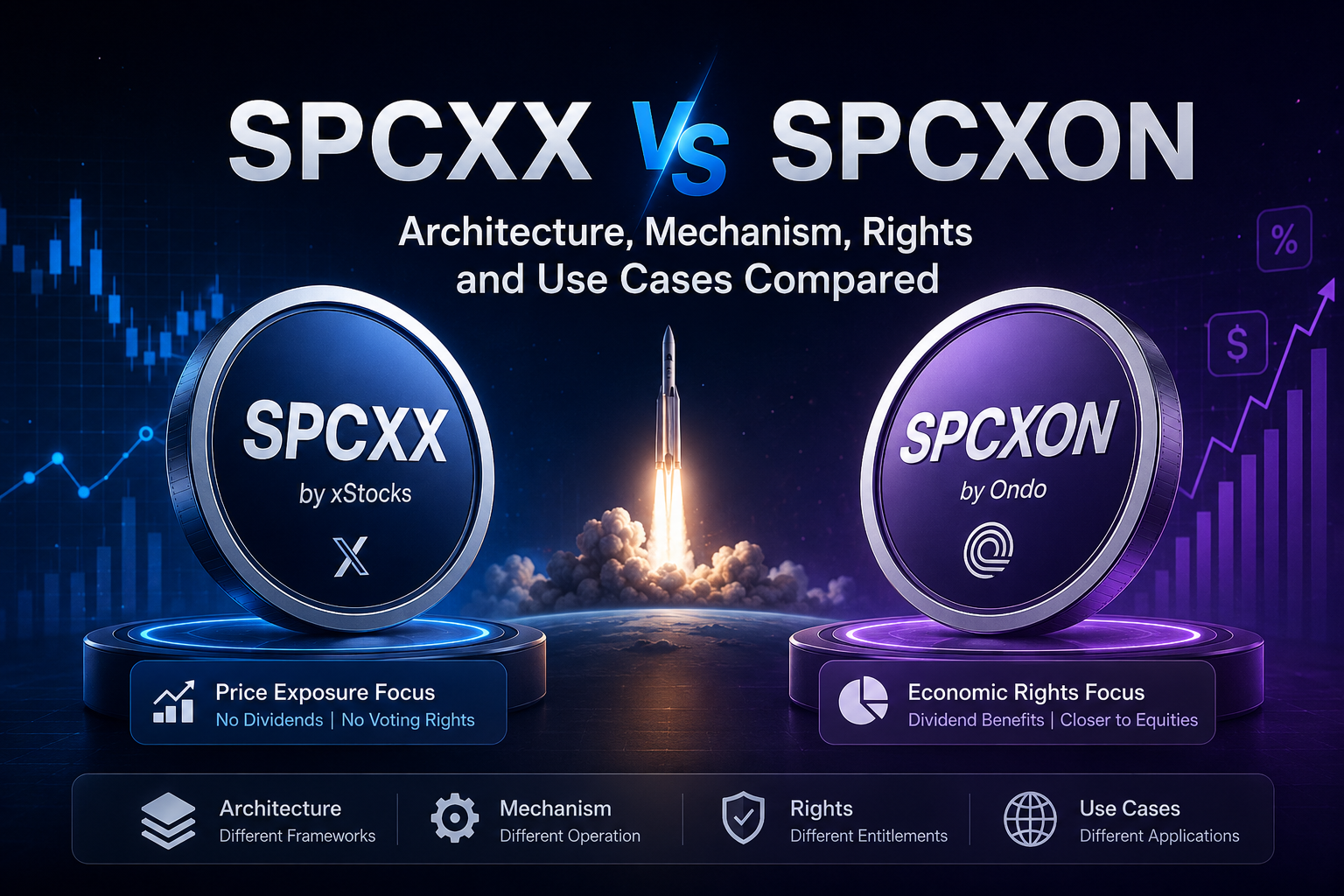
What Is SPCXX?
SPCXX is a SpaceX equity tokenization product launched under the xStocks initiative. Backed by 1:1 underlying assets, it offers investors price exposure linked to SpaceX's stock price.
SPCXX's core objective is to map the stock price onto the blockchain, allowing the asset to be held and transferred on-chain like a cryptocurrency. Holding SPCXX does not mean owning SpaceX stock directly, nor does it grant a place in the company's shareholder registry.
From a product standpoint, SPCXX functions more like an on-chain price asset, with its value primarily derived from changes in the underlying SpaceX equity price.
What Is SPCXON?
SPCXON is a SpaceX equity tokenization product launched by Ondo Global Markets.
Unlike SPCXX, SPCXON not only tracks price performance but also aims to replicate the economic returns of traditional stocks. Corporate actions such as dividends and stock splits from the underlying asset are reflected in the token's value through a reinvestment mechanism.
While SPCXON holders similarly do not possess traditional shareholder status, SPCXON is closer to a traditional security in terms of economic rights.
Thus, SPCXON can be understood as an on-chain security product rather than just a price tracking tool.
Architectural Differences Between SPCXX and SPCXON
Although both products fall under real-world assets (RWA), their underlying design approaches differ.
SPCXX is built on the xStocks framework, aiming to enhance the on-chain liquidity and composability of stock assets. The product focuses on price tracking, enabling users to hold the corresponding assets via wallets and digital asset infrastructure.
SPCXON, in contrast, belongs to the Ondo Global Markets tokenized securities system. Beyond price performance, SPCXON also seeks to replicate the economic attributes of traditional stocks, making its overall architecture closer to that of a security.
From a long-term development perspective, the two represent distinct paths:
- SPCXX leans more toward an on-chain price asset.
- SPCXON leans more toward an on-chain security asset.
Neither model is inherently superior; they serve different market needs.
Operational Mechanism Differences Between SPCXX and SPCXON
Both products are backed by underlying assets, but their return compositions differ clearly.
SPCXX's value changes primarily stem from the price of SpaceX equity itself, so its overall performance resembles a price index. When the underlying asset rises or falls, SPCXX's price moves accordingly.
SPCXON's return structure is closer to that of a traditional stock. In addition to price changes, dividends and other corporate actions from the underlying asset are retained within the asset system via reinvestment.
Consequently, even though both track the same company, their long-term return curves may vary.
| Comparison Item |
SPCXX |
SPCXON |
| Issuance Platform |
xStocks |
Ondo Global Markets |
| Price Exposure |
Yes |
Yes |
| Dividend Economic Returns |
No |
Yes |
| Reinvestment Mechanism |
No |
Yes |
| Product Positioning |
On-chain Price Asset |
On-chain Security |
| Return Structure |
Price Return |
Total Return |
In terms of return sources, SPCXX is more akin to a price index, while SPCXON follows the total return model of a traditional stock.
Comparison of Rights Mechanisms Between SPCXX and SPCXON
Neither SPCXX nor SPCXON grants traditional shareholder status. Holders do not enter SpaceX's shareholder registry and have no voting rights, shareholder meeting participation rights, or corporate governance rights.
However, the two products differ significantly in economic rights.
Holders of SPCXX only bear the gains and risks from price fluctuations and do not share in dividend distributions. Thus, SPCXX is more of a price mapping tool, with its value concentrated on asset price changes.
SPCXON, through its reinvestment mechanism, retains part of the economic returns generated by the underlying asset within the token system. Although holders still lack voting rights, SPCXON is closer to a traditional stock in terms of economic returns.
In short, SPCXX addresses how to bring stock prices on-chain, while SPCXON addresses how to bring stock economic returns on-chain.
Data and Control Rights Differences Between SPCXX and SPCXON
By nature, neither SPCXX nor SPCXON provides corporate control.
Holders of both products cannot participate in corporate governance, nor can they influence director elections, shareholder proposals, or major corporate decisions. For SpaceX, a clear line remains between token holders and traditional shareholders.
From a control rights perspective, both products offer a mapping of asset value, not corporate ownership.
Therefore, the biggest difference between tokenized stocks and traditional stocks lies not in price performance but in the legal rights structure.
Application Scenario Differences Between SPCXX and SPCXON
Due to their different positioning, the two assets also differ in application.
SPCXX emphasizes on-chain liquidity, making it suitable for on-chain trading, multi-asset portfolio management, and integration with the DeFi ecosystem. For users seeking SpaceX price exposure while valuing liquidity, SPCXX's attributes are closer to those of a digital asset.
SPCXON is more oriented toward long-term asset allocation. Because it can indirectly reflect economic returns such as dividends, SPCXON is closer to a traditional security and better suited as a long-term hold asset.
Looking at the trend in real-world assets, the future market will likely see both models coexist:
- Price-type assets, represented by SPCXX.
- Economic rights-type assets, represented by SPCXON.
The two models are not substitutes but play different roles in the on-chain capital market.
Summary
SPCXX and SPCXON both offer investors exposure to SpaceX equity, but they represent different directions in the development of tokenized stocks.
SPCXX belongs to the xStocks system, focusing on price tracking, on-chain liquidity, and asset composability, with returns mainly coming from stock price changes.
SPCXON belongs to the Ondo Global Markets system. In addition to price performance, it indirectly reflects the economic returns generated by the underlying asset through a reinvestment mechanism, thus providing more complete economic rights.
As real-world assets continue to enter the blockchain, price-type assets and economic rights-type assets will likely coexist for the long term, jointly driving the growth of the on-chain capital market.
FAQ
What Are SPCXX and SPCXON?
SPCXX and SPCXON are both tokenized stock products offering exposure to SpaceX equity. They are launched by xStocks and Ondo Global Markets, respectively, but adopt different product architectures and economic rights models.
Which One Has Dividend Returns: SPCXX or SPCXON?
SPCXON indirectly reflects dividend returns from the underlying asset through its reinvestment mechanism, while SPCXX does not offer dividend economic returns. Therefore, the total return structures of the two products are not identical.
Do SPCXX and SPCXON Have Voting Rights?
Holders of neither SPCXX nor SPCXON have voting rights or corporate governance rights. Neither product represents direct ownership of SpaceX stock, so they do not confer traditional shareholder status.
Which One Is Closer to a Traditional Stock: SPCXX or SPCXON?
SPCXON is closer to a traditional stock in terms of economic rights compared to SPCXX. SPCXON indirectly reflects dividend returns, while SPCXX is more of a price tracking tool.
Can SPCXX and SPCXON Be Used for On-Chain Finance?
Both SPCXX and SPCXON have on-chain attributes and can be integrated with digital asset infrastructure. However, SPCXX emphasizes liquidity, while SPCXON is more suited to long-term asset allocation.
What Is the Biggest Difference Between SPCXX and SPCXON?
The biggest difference lies in the scope of economic rights. SPCXX provides price exposure, while SPCXON, in addition to price performance, indirectly shares in the economic returns generated by the underlying asset.