As the tokenization of real-world assets, or RWA, and decentralized finance, or DeFi, continue to develop, more traditional financial assets are beginning to appear on-chain. Among them, tokenized stocks and synthetic assets are two of the most common stock-related on-chain products.
In the on-chain financial system, tokenized stocks represent an important direction for bringing real-world assets onto blockchain networks, while synthetic assets are a major result of DeFi derivatives innovation. Although both are linked to stock prices, their asset sources, operating logic, and risk structures are fundamentally different.
What Are Tokenized Stocks?
Tokenized stocks are a form of digital asset that uses blockchain technology to represent real-world shares.
In most models, the issuer first purchases actual shares and places them in custody with a regulated institution. It then issues on-chain tokens according to a set ratio. For example, if a custodian holds one Apple share, the issuer may issue one corresponding stock token.
As a result, the value of tokenized stocks comes from real underlying equity assets. Although investors hold on-chain tokens, their value foundation comes from actual shares in the real-world securities market.
This model is essentially a form of real-world asset tokenization and is one of the most important use cases in the RWA sector today.
What Are Synthetic Assets?
Synthetic assets are on-chain financial products that use smart contracts and collateral mechanisms to simulate the price performance of real-world assets.
Unlike tokenized stocks, synthetic assets usually do not require the system to actually hold the corresponding shares.
The system uses collateral assets, oracle price data, and smart contract rules to create an on-chain asset linked to the price of a particular stock. For example, a user may hold a synthetic asset that tracks Apple’s stock price, while the system itself may not hold any Apple shares.
At their core, synthetic assets are on-chain derivatives. Their goal is to replicate price performance, not to map ownership of real assets.
What Is the Core Difference Between the Two Models?
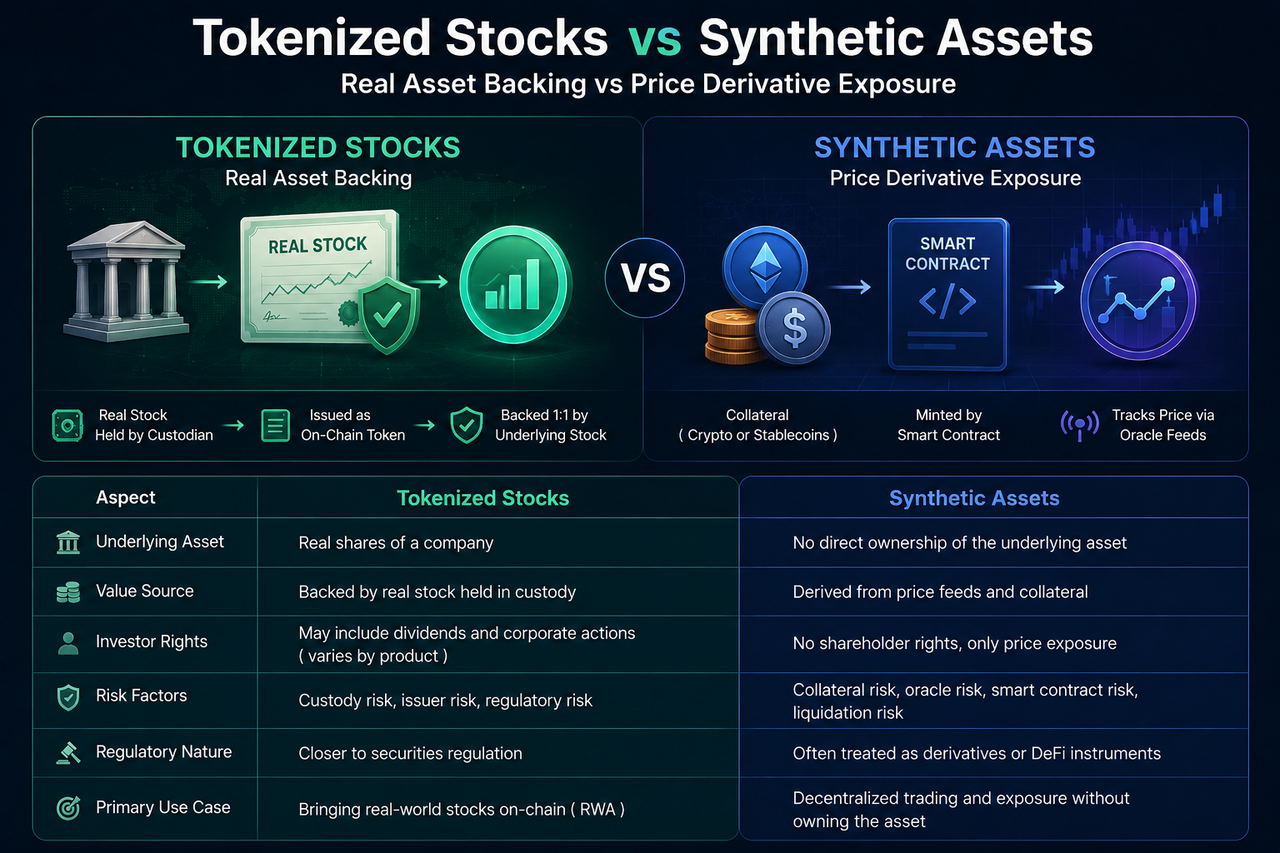
The biggest difference between tokenized stocks and synthetic assets is whether real assets provide backing.
Tokenized stocks are usually built on the custody of real shares, creating a corresponding relationship between on-chain tokens and real-world stocks. Investors gain a mapped exposure to the value of real assets, and the market operation of these products depends on actual stock reserves and custody systems.
Synthetic assets, by contrast, are built on price-tracking mechanisms. Their value comes from market prices supplied by oracles, not from stocks that are actually held. Investors gain exposure to returns from price movements, rather than to the real-world shares themselves.
Put simply, tokenized stocks address the question of how to bring real shares on-chain, while synthetic assets address the question of how to replicate stock prices on-chain.
How Do the Asset Backing Methods Differ?
The asset backing structure determines how each type of product operates.
Tokenized stocks usually use a real stock custody model. The issuer first holds the underlying shares, then issues on-chain tokens in a corresponding amount. In theory, the number of tokens is therefore limited by the size of the real assets. If a custody account holds 1,000 shares, the system can usually issue only the corresponding number of tokens.
Synthetic assets, on the other hand, operate through a collateral mechanism. Users deposit crypto assets or stablecoins as collateral, then use smart contracts to generate synthetic assets linked to stock prices. Their issuance scale depends on the value of the collateral and the system’s risk parameters, rather than the number of real shares.
Therefore, tokenized stocks rely on real-world assets to support their value, while synthetic assets rely on financial engineering mechanisms to maintain their price linkage.
Do Investors Receive the Same Rights?
Investor rights are one of the key differences between the two.
Because tokenized stocks have a mapping relationship with real shares, some products may provide investors with economic rights such as dividend income and stock split adjustments. Although they may not carry full shareholder rights, their rights structure is usually linked in some way to the underlying shares.
Synthetic assets, however, are essentially price-tracking instruments. Investors receive gains or losses from price movements, not the economic rights attached to the stock itself.
For example, when a listed company pays a dividend, a tokenized stock product may distribute the corresponding income to investors according to its issuance rules. A synthetic asset that tracks the price of the same stock usually does not automatically receive dividend income.
As a result, the two differ clearly in their investment attributes and sources of return.
How Do the Risk Sources Differ?
Although tokenized stocks and synthetic assets can both provide stock market exposure, their risk structures are clearly different.
Tokenized stocks mainly depend on real stock custody and issuer operations, so their risks are usually concentrated in asset custody, reserve transparency, the issuer’s ability to perform its obligations, regulatory compliance, and related areas. If there are problems with the management of the underlying assets, or if the issuer cannot continue maintaining the mapping between tokens and shares, investor interests may be affected.
By contrast, synthetic asset risks come more from the on-chain system itself. Because their value depends on collateral mechanisms, smart contracts, and price oracles, sharp fluctuations in collateral assets, abnormal oracle prices, or smart contract vulnerabilities may lead to forced liquidations, price depegging, insufficient liquidity, and other problems.
In essence, tokenized stocks carry real asset management risk, while synthetic assets carry on-chain financial engineering risk.
Why Do Regulators Take Different Approaches?
Regulators usually apply different approaches to tokenized stocks and synthetic assets.
Because tokenized stocks directly involve real securities assets, they are often managed under securities regulatory frameworks. Issuers need to address asset custody, investor eligibility checks, information disclosure, and other issues. Their regulatory logic is relatively close to that of traditional securities markets.
Synthetic assets do not necessarily hold real shares, which makes their legal nature more complex. In some regions, regulators tend to view them as financial derivatives. In other markets, they may be classified as innovative digital asset products. Due to the lack of a unified standard, the regulatory environment for synthetic assets is usually more varied than that for tokenized stocks.
This difference is also an important reason why the RWA sector and the DeFi sector are following different regulatory paths.
How Do Their Roles in the RWA Sector Differ?
Although tokenized stocks and synthetic assets are both related to stock prices, they belong to different development paths.
The core goal of tokenized stocks is to bring real-world equity assets into blockchain networks, enabling asset digitization and on-chain circulation. For this reason, they are seen as an important part of the RWA sector. Their focus is asset mapping, custody mechanisms, and compliant issuance.
Synthetic assets place greater emphasis on on-chain native financial innovation. They do not need to bring real assets on-chain. Instead, they use smart contracts to build price-tracking tools. As a result, synthetic assets belong more to the DeFi derivatives system, with development focused on collateral models, oracle mechanisms, and on-chain liquidity design.
From an industry perspective, tokenized stocks represent real assets moving on-chain, while synthetic assets represent on-chain financial innovation. They solve different problems.
Tokenized Stocks vs Synthetic Assets
| Comparison Dimension |
Tokenized Stocks |
Synthetic Assets |
| Underlying Asset |
Real shares |
No real shares required |
| Value Source |
Backed by equity assets |
Price-tracking mechanism |
| Asset Structure |
RWA mapping |
On-chain derivatives |
| Custody Requirement |
Requires a custodian |
Usually does not require stock custody |
| Dividend Rights |
Supported by some products |
Usually not supported |
| Issuance Limit |
Limited by the amount of real assets |
Limited by collateral scale |
| Risk Source |
Custody and issuer |
Collateral and oracle systems |
| Regulatory Attribute |
Closer to securities regulation |
Closer to derivatives regulation |
| Industry Positioning |
RWA sector |
DeFi sector |
Conclusion
Although tokenized stocks and synthetic assets can both provide investors with stock price exposure, the logic behind them is completely different. Tokenized stocks rely on real stock custody and use on-chain tokens to map the value of real-world assets. Synthetic assets rely on collateral mechanisms and price oracles to simulate changes in stock prices.
From an industry positioning perspective, tokenized stocks are an important part of the RWA sector, while synthetic assets belong to the DeFi derivatives system.
FAQs
Are Tokenized Stocks and Synthetic Assets the Same Thing?
No. Tokenized stocks usually correspond to real equity assets, while synthetic assets mainly track price performance. Their underlying structures and sources of value are completely different.
Do Synthetic Assets Need to Be Backed by Real Shares?
Usually, no. Synthetic assets generally use collateral mechanisms, smart contracts, and price oracles to simulate stock prices. They do not actually hold the corresponding shares.
Are Tokenized Stocks Part of RWA?
Yes. Tokenized stocks are an important use case for real-world asset, or RWA, tokenization. Their core feature is bringing real equity assets on-chain.
Why Are Synthetic Assets Considered DeFi Products?
Because synthetic assets mainly operate through smart contracts, oracles, and on-chain collateral mechanisms. In essence, they belong to the decentralized finance derivatives system.
Which Product Has Lower Risk?
The two have different risk structures. Tokenized stocks mainly face custody and regulatory risks, while synthetic assets mainly face oracle, liquidation, and smart contract risks. For that reason, their risk levels cannot be compared in a simple way.