Traditional brokers have long been the main channel for global investors to access the U.S. securities market. Opening an account with a securities broker, completing currency conversion, and connecting to securities exchanges have been the standard path for international investors participating in the U.S. stock market for decades. As global capital markets have developed, traditional brokers have gradually built mature systems for account management, trade execution, and asset custody.
In recent years, the digital asset industry has begun exploring ways to connect crypto assets with traditional financial markets. New services represented by Gate Stocks allow users to invest in U.S. stocks and ETFs with USDT, while managing digital assets and securities assets on the same platform. This model represents an important direction in the integration of traditional finance, or TradFi, and crypto finance. It has also become a key use case in the broader development of real world assets, or RWA.
Traditional brokerage platforms are financial institutions licensed to conduct securities business. They provide investors with trading services for stocks, ETFs, bonds, and other securities products.
Under the traditional model, investors usually need to open a separate securities account and deposit or withdraw funds through a bank account. For international investors, the process may also involve cross border remittances, foreign exchange conversion, and tax information reporting.
Traditional brokers form an important part of modern capital market infrastructure. Their core function is to connect investors with securities exchanges while providing order execution, asset custody, and account management services.
Buying U.S. stocks through a crypto platform refers to a model in which a digital asset platform connects to securities market infrastructure and provides users with trading services for U.S. stocks and ETFs.
Taking Gate Stocks as an example, users can open a stock account through their digital asset account and use USDT as the funding entry point to invest in the U.S. securities market. Stock assets and digital assets can be managed together on the same platform.

This model does not change how the stock market itself operates. Instead, it innovates the way users access the market.
Traditional brokers use a “bank account plus securities account” structure. Investors usually need to transfer funds from a bank account into a securities account before trading stocks.
Crypto platforms use a “digital asset account plus stock account” structure. Users can manage funds through their existing digital asset accounts and complete stock trading related operations within the platform.
Both models ultimately require identity verification and compliance review, but the design logic behind their account systems is clearly different. Traditional brokers are built around the fiat financial system, while crypto platforms are built on digital asset infrastructure.
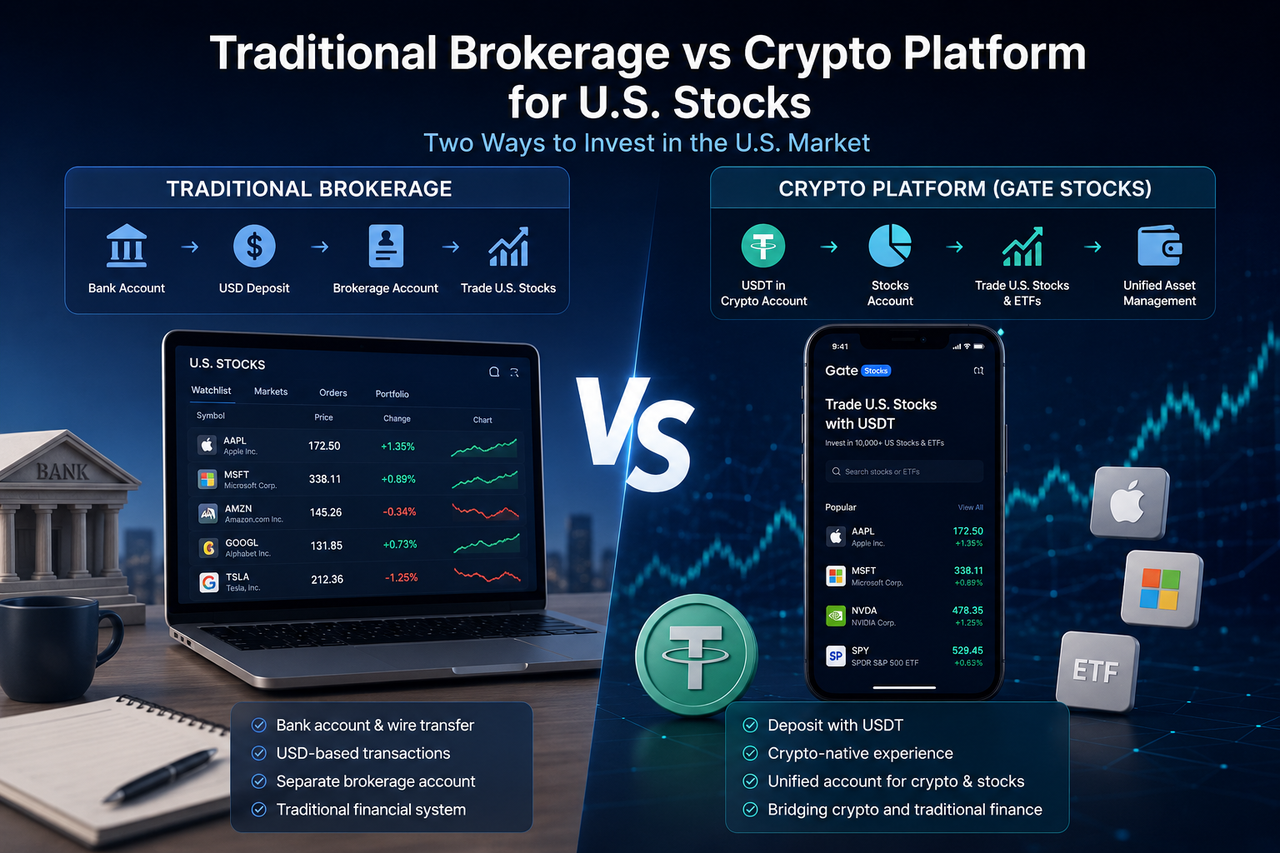
Fund management is one of the differences users can most easily notice between the two models.
Traditional brokers usually require investors to deposit funds through bank transfers or wire transfers, with U.S. dollars serving as the main trading currency. For international users, funds often need to go through currency conversion before entering the market.
Crypto platforms allow users to use digital assets such as USDT as fund management tools. Fund transfers are usually completed within the digital asset account system, without requiring a separate U.S. dollar conversion process.
This difference reflects the fact that the two models are built on different foundations, one on the fiat financial system and the other on the digital asset system.
Although the user entry points are different, both models ultimately need to connect to the securities market to complete trades.
When investors submit buy or sell orders, the orders must enter the securities market for execution and be matched and filled according to market rules. Stock prices are still determined by market supply and demand, while trading hours, liquidity, and quotation mechanisms also follow the relevant market rules.
Therefore, buying U.S. stocks through a crypto platform does not mean a separate stock market is being created. In essence, it still connects users to existing securities market infrastructure.
Under the traditional brokerage model, stock assets and digital assets are usually held on different platforms and in separate accounts.
If investors hold both stocks and cryptocurrencies, they need to manage securities accounts and digital asset accounts separately, checking their asset status across different platforms.
Crypto platforms, by contrast, aim to provide a unified asset management experience. Users can view stock, ETF, and digital asset holdings within the same ecosystem and manage overall asset allocation in one place.
This unified management model is one of the key features of digital asset platforms entering the traditional finance space.
Traditional brokers have long focused on securities markets, so their product systems are usually more extensive, covering stocks, ETFs, bonds, funds, options, and other financial derivatives.
Crypto platforms, by contrast, often cover both digital assets and selected traditional financial products. Taking Gate Stocks as an example, users can invest in U.S. stocks and ETFs while also accessing the digital asset market on the same platform.
From an asset class perspective, traditional brokers emphasize securities market coverage, while crypto platforms emphasize integration across different asset classes.
Both traditional brokers and crypto platforms are exposed to the price volatility of the stock market itself.
However, the sources of risk still differ between the two models. Investors using traditional brokers may face issues such as exchange rate fluctuations, cross border capital flows, and international settlement.
Crypto platform users, in addition to stock market risk, may also be affected by digital asset market volatility, stablecoin liquidity, and changes in the digital asset ecosystem.
Understanding these different sources of risk helps users assess the characteristics of each investment model more accurately.
| Comparison Dimension |
Traditional Brokerage Platforms |
Crypto Platforms for U.S. Stocks |
| Funding Entry Point |
Bank account |
Digital asset account |
| Trading Currency |
U.S. dollars |
Digital assets such as USDT |
| Deposit Method |
Bank transfer, wire transfer |
Digital asset transfer |
| Account Structure |
Securities account system |
Digital asset account plus stock account |
| Asset Management |
Stock assets managed separately |
Stocks and digital assets managed together |
| Product Range |
Stocks, ETFs, bonds, etc. |
Stocks, ETFs, digital assets, etc. |
| User Base |
Traditional investors |
Digital asset users |
As the digital asset market has gradually matured, users’ demand for diversified asset allocation has continued to grow.
At the same time, the development of real world assets, or RWA, and the integration of traditional finance with blockchain have encouraged more platforms to explore ways to connect digital assets with securities markets.
At its core, offering U.S. stock trading on crypto platforms is about breaking down the boundaries between different asset classes, allowing users to manage a broader investment portfolio within a unified account system.
Conclusion
Traditional brokerage platforms and crypto platforms can both provide access to U.S. stock investing, but their underlying logic is clearly different. Traditional brokers are built on bank accounts and securities account systems, while crypto platforms use digital asset accounts as the funding entry point and integrate stock investing with digital asset management in the same ecosystem.
From a trade execution perspective, both models ultimately need to connect to securities markets and follow the corresponding market rules. From a user experience perspective, however, they differ significantly in account opening, fund management, and asset allocation methods.
FAQs
The biggest difference lies in the funding entry point and account system. Traditional brokers mainly rely on bank accounts and the U.S. dollar system, while crypto platforms use digital asset accounts and digital assets such as USDT as the funding entry point.
Is Gate Stocks a Traditional Broker?
Gate Stocks is not a traditional overseas brokerage model in the conventional sense. It is a new type of trading service in which a digital asset platform connects to the U.S. securities market.
Is Buying U.S. Stocks with USDT the Same as Buying Tokenized Stocks?
No. Gate Stocks provides trading access to the U.S. securities market, while tokenized stocks are digital securities representations on a blockchain. Their underlying structures are different.
Yes. Whether users access the market through a traditional broker or a crypto platform, stock trading must follow the relevant market rules, trading hours, and quotation mechanisms.
The two are different ways of accessing the market, and there is no single answer that applies to every user. Understanding their account structures, fund management methods, and asset allocation features is more useful than simply comparing which one is better.