À medida que o Agente de IA evolui de ferramenta de chat para entidade digital com capacidades autônomas, o cenário da infraestrutura de IA se divide em caminhos de desenvolvimento distintos. Alguns projetos focam em taxa de hash e modelos; outros miram colaboração de longo prazo e sistemas econômicos para agentes.
Unibase e Virtuals representam duas rotas típicas na infraestrutura de Agentes de IA: uma Camada de Memória Descentralizada e um Mercado de Agentes de IA.
Unibase vs. Virtuals: uma visão geral rápida
Unibase pende mais para a infraestrutura fundamental de Agentes de IA, com foco central em memória de longo prazo, sincronização de estado e colaboração multiagente.
Em sua arquitetura, o Membase armazena o contexto de longo prazo e o estado de conhecimento de um agente. O Protocolo AIP gerencia identidade e comunicação do agente, enquanto o Unibase DA oferece armazenamento de dados e disponibilidade de estado. Ou seja, o Unibase prioriza que a IA persista no tempo, aprenda continuamente e coordene com outros agentes, em vez de apenas facilitar o lançamento de agentes.
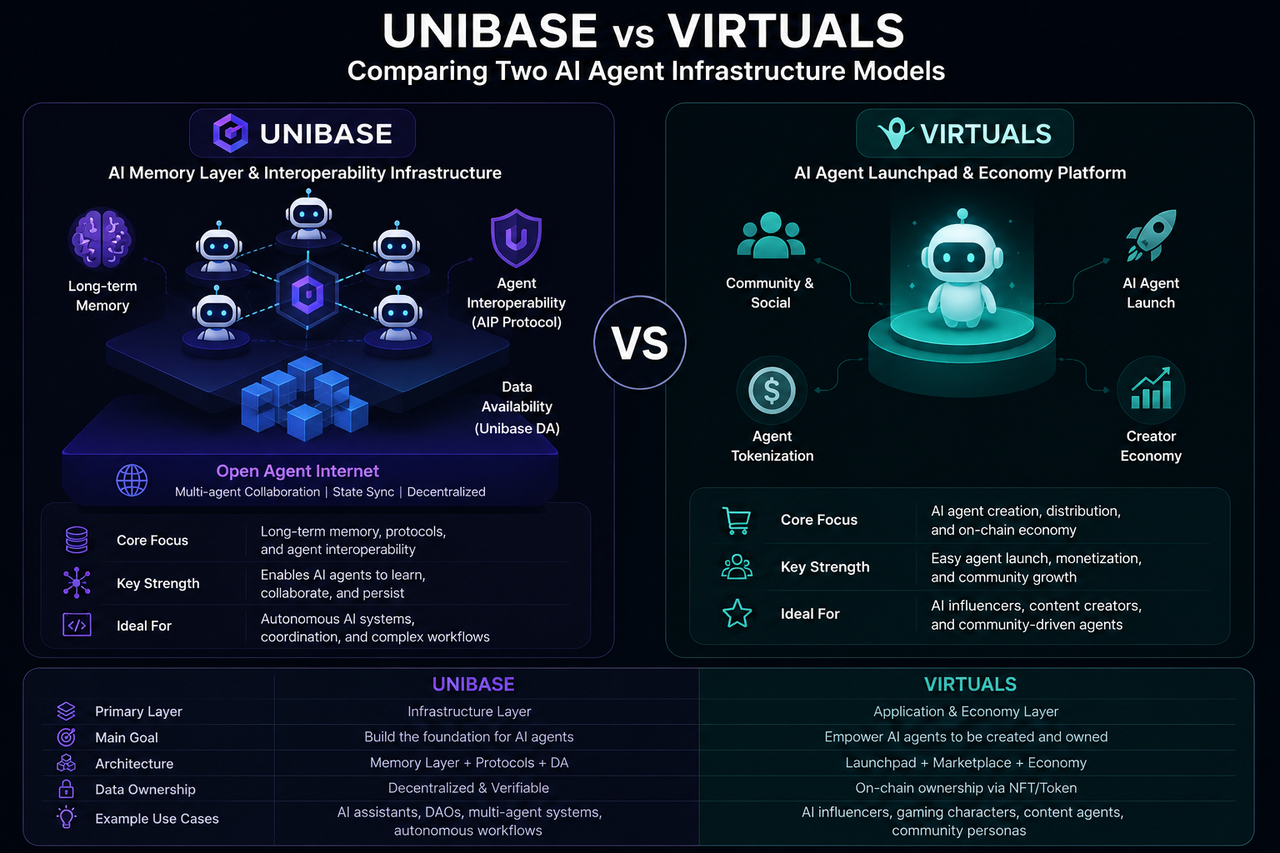
Virtuals, por sua vez, gira em torno de Persona de IA, interação social e um Mercado de Agentes. Em seu ecossistema, usuários criam Agentes de IA e constroem comunidades, conteúdo e economias on-chain ao redor deles. Alguns agentes carregam seus próprios tokens, identidades sociais e operações de conteúdo.
Camada de Memória de IA vs. Mercado de Agentes: diferenças-chave
Uma diferença fundamental entre Unibase e Virtuals está na camada da infraestrutura de IA que cada um ocupa.
Unibase fica mais próximo da camada de infraestrutura, respondendo à pergunta: Como os Agentes de IA podem executar e colaborar a longo prazo? Virtuals é mais orientado a aplicações e mercado: Como criar, operar e distribuir Agentes de IA?
Essa distinção significa que, embora ambos os projetos girem em torno de Agentes de IA, eles resolvem problemas diferentes.
| Comparação |
Unibase |
Virtuals |
| Posição Central |
Camada de Memória de IA |
Mercado de Agentes de IA |
| Foco Principal |
Memória de longo prazo e interoperabilidade |
Lançamento e operação de agentes |
| Objetivo Central |
Autonomia de IA de longo prazo |
Monetização de agentes |
| Estrutura de Rede |
Internet Aberta de Agentes |
Ecossistema social de IA |
| Foco do Produto |
Infraestrutura |
Aplicações e mercado |
Mecanismos de Memória de Longo Prazo: como diferem?
Memória de longo prazo é recurso central para Unibase, enquanto Virtuals não a tem como foco principal.
O Membase do Unibase permite que Agentes de IA retenham histórico de tarefas, preferências do usuário e contexto estendido. Assim, os agentes podem se basear em experiências passadas e acumular estado ao longo do tempo.
Em contraste, Virtuals enfatiza persona de IA e interação com o usuário. Embora alguns agentes tenham memória limitada, uma camada dedicada de memória de longo prazo não faz parte de sua infraestrutura central.
Essa diferença reflete uma divergência conceitual mais profunda: Unibase se importa se a IA pode crescer continuamente; Virtuals se importa se a IA pode operar continuamente.
| Capacidade de Memória |
Unibase |
Virtuals |
| Contexto de longo prazo |
Recurso central |
Não central |
| Compartilhamento de memória multiagente |
Suportado |
Limitado |
| Sincronização de estado |
Enfatizada |
Principalmente na camada de aplicação |
| Memória descentralizada |
Arquitetura central |
Não é foco |
| Aprendizado de longo prazo |
Enfatizado |
Mais interação social |
Comunicação e Colaboração entre Agentes: diferenças estruturais
O Protocolo AIP do Unibase é construído para comunicação entre agentes. Em seu design, diferentes Agentes de IA podem compartilhar estado, sincronizar memória e trocar tarefas — assemelhando-se a uma "rede de IA" focada em coordenar múltiplos agentes autônomos.
Virtuals, por outro lado, enfatiza interações agente-usuário: geração de conteúdo, distribuição social e gerenciamento de comunidade. O foco está na capacidade operacional de uma persona de IA, não na colaboração multiagente.
Assim, as estruturas de rede diferem significativamente: Unibase defende um protocolo aberto de agentes, enquanto Virtuals constrói um ecossistema social de IA.
Modelos Econômicos: como se comparam?
Virtuals dá forte ênfase à monetização de agentes e operações de mercado. Em alguns designs, Agentes de IA podem possuir comunidades, ecossistemas de conteúdo e estruturas de token — assemelhando-se a uma economia criadora de IA propensa à viralidade social.
Em comparação, o token UB do Unibase suporta operações de protocolo, como armazenamento de dados, governança de rede, incentivos a nós e coordenação de infraestrutura de agentes.
Essas diferenças econômicas refletem o foco de produto de cada um.
| Modelo Econômico |
Unibase |
Virtuals |
| Uso Principal |
Operações de protocolo |
Ecossistema econômico de agentes |
| Foco do Produto |
Governança de infraestrutura |
Social e mercado |
| Tokenização de Agentes |
Não central |
Enfatizada |
| Incentivos a Nós |
Presentes |
Relativamente poucos |
| Economia Criadora |
Limitada |
Direção central |
Cenários de Aplicação: onde cada um se destaca
Unibase é mais adequado para casos de uso que exigem memória de longo prazo e colaboração multiagente — assistentes de IA autônomos, coordenação de fluxo de trabalho de IA, DAOs de IA e gerenciamento de estado de longa duração, aplicações onde os agentes precisam reter contexto e compartilhar estado.
Virtuals é mais apropriado para operações de agentes voltadas ao consumidor: personagens sociais de IA, criadores de conteúdo de IA e comunidades de IA on-chain.
No nível da aplicação, Unibase funciona como "infraestrutura de rede de IA", enquanto Virtuals atua como "plataforma de conteúdo e mercado de agentes de IA".
O Ecossistema de Agentes de IA: uma visão em camadas
O setor de cripto IA ainda é incipiente, e muitos projetos compartilham a narrativa de "Agente de IA", o que pode gerar confusão. No entanto, conforme a infraestrutura de IA se estratifica, as diferenças entre os projetos ficam mais claras.
O ecossistema de Agentes de IA pode ser categorizado aproximadamente assim:
| Tipo de Infraestrutura de IA |
Direção Representativa |
| Computação de IA |
Taxa de hash descentralizada |
| Dados de IA |
Mercado de dados |
| Estrutura de Agentes de IA |
Estrutura de desenvolvimento de agentes |
| Camada de Memória de IA |
Sistema de memória de longo prazo |
| Mercado de Agentes de IA |
Lançamento e operação de agentes |
Unibase e Virtuals representam duas rotas distintas: Camada de Memória de IA e Mercado de Agentes. À medida que o ecossistema de Agentes de IA se expande, essa estratificação tende a se acentuar.
Resumo
Tanto Unibase quanto Virtuals são partes importantes do ecossistema de Agentes de IA, mas suas posições centrais diferem. Unibase foca em memória de longo prazo, sincronização de estado e protocolos abertos, visando construir infraestrutura para IA autônoma que cresce com o tempo. Virtuals enfatiza emissão de agentes, distribuição social e operações econômicas, mirando o lado do consumidor dos Agentes de IA.
Sob a ótica da infraestrutura de IA, eles representam dois caminhos divergentes: uma "Camada de Memória de Longo Prazo" e um "Mercado de Agentes".
Perguntas Frequentes
Qual é a maior diferença entre Unibase e Virtuals?
Unibase foca em memória de longo prazo e infraestrutura de interoperabilidade para Agentes de IA; Virtuals foca em emissão de agentes, interação social e monetização.
Unibase é considerado infraestrutura de IA?
Sim. Unibase opera como Camada de Memória de IA e infraestrutura de comunicação entre agentes.
Qual é a direção central do Virtuals?
Virtuals enfatiza um Mercado de Agentes de IA, personas de IA e uma economia de agentes.
O que é a Camada de Memória de IA?
É a infraestrutura que fornece aos Agentes de IA contexto de longo prazo e gerenciamento de estado.
Unibase suporta colaboração multiagente?
Sim. Seu Protocolo AIP permite comunicação entre agentes e sincronização de estado.
Virtuals e Unibase são concorrentes?
Há alguma sobreposição, mas é melhor entendê-los como camadas e direções de desenvolvimento diferentes dentro do ecossistema mais amplo de Agentes de IA.