As the tokenization of Real World Assets (RWA) advances, U.S. Treasury bonds have entered the blockchain ecosystem, evolving on-chain dollar-denominated assets from simple stablecoins into yield-bearing products. USDY represents the direction of on-chain yield assets, while USDT and USDC remain the most critical liquidity infrastructure in the digital asset market.
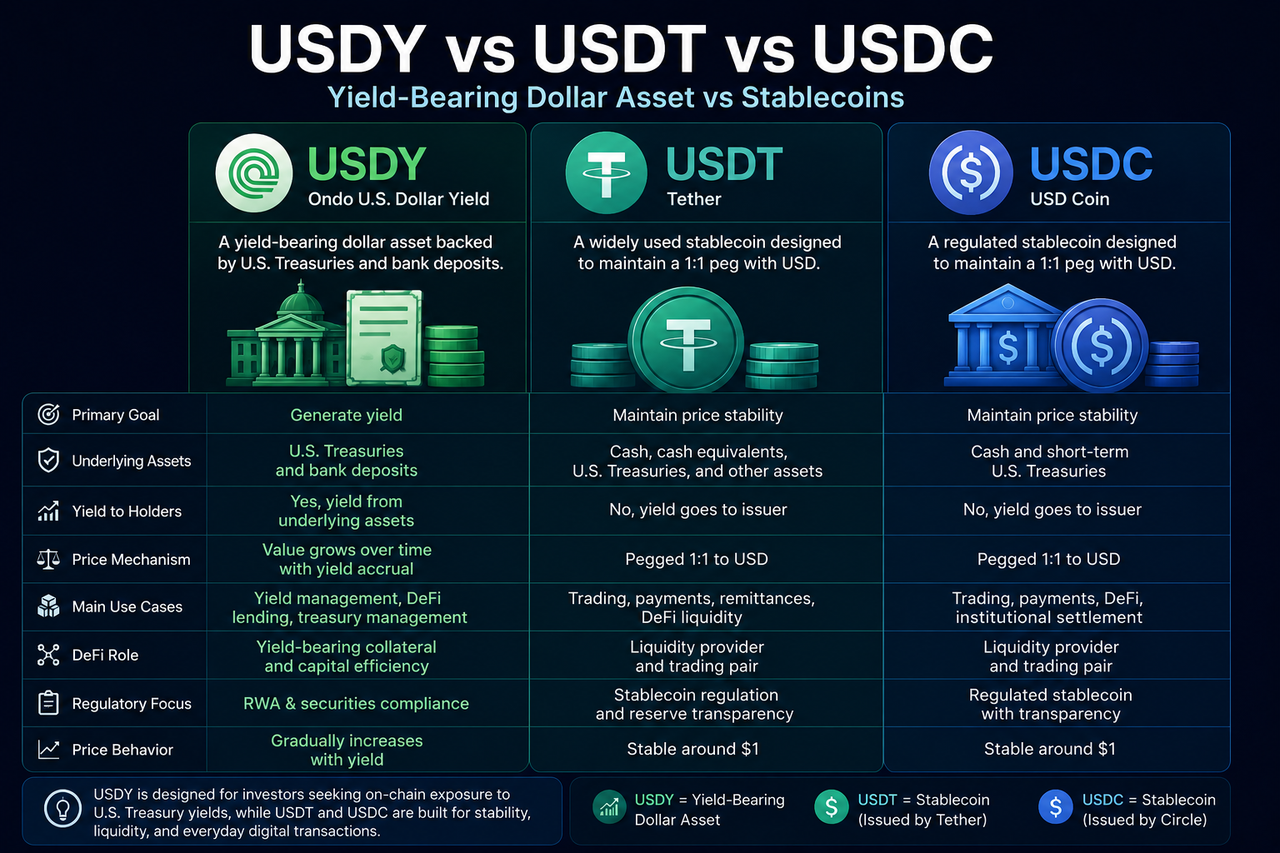
What Is USDY?
A yield-bearing tokenized asset backed by short-term U.S. Treasury bonds and bank deposits, USDY is designed to bring dollar-denominated yields from traditional financial markets onto the blockchain. It allows users to earn real-world returns while holding on-chain dollar assets.
Unlike stablecoins, USDY does not aim to maintain a fixed price over the long term. Instead, it generates yield through its underlying U.S. Treasury holdings, which is gradually reflected in the token's net asset value (NAV). As such, USDY is closer to an on-chain yield certificate than a payment instrument.
What Is USDT?
Issued by Tether, USDT is one of the largest stablecoins by market capitalization. Backed by reserve assets, it seeks to maintain a value relationship close to 1:1 with the U.S. dollar.
USDT's primary uses include digital asset trading, cross-border transfers, on-chain payments, and DeFi liquidity management. Its core value lies in providing a stable unit of account and settlement medium, rather than generating returns for holders.
What Is USDC?
USDC, a dollar-pegged stablecoin issued by Circle, also aims to maintain a value of $1. It follows a reserve-backed model where the issuer supports circulating tokens with assets such as cash and short-term U.S. Treasury bonds.
Thanks to its strong compliance profile, USDC is widely used in institutional settlements, DeFi protocols, and on-chain payments. Its positioning is similar to USDT, making it a key component of the payment stablecoin ecosystem.
What Are the Core Differences Between USDY and USDT/USDC?
The biggest difference between USDY and USDT/USDC lies in whether the underlying asset yield is passed on to holders.
USDY's underlying assets are primarily allocated to U.S. Treasury bonds, generating ongoing yield that is reflected to holders through NAV growth. By holding USDY, users effectively gain exposure to U.S. Treasury yields.
Although USDT and USDC are also backed by reserve assets, the yield generated from those reserves typically accrues to the issuer and is not distributed to stablecoin holders. Therefore, USDT and USDC primarily serve payment and liquidity functions rather than yield management.
How Do the Underlying Asset Structures Differ?
USDY, USDT, and USDC all rely on real-world asset backing, but their asset compositions differ.
USDY primarily holds short-term U.S. Treasury bonds and bank deposits, focusing on generating stable yields.
USDT's reserves typically include cash, cash equivalents, short-term Treasuries, and other financial instruments, with the core goal of ensuring redeemability.
USDC's reserves are mainly composed of cash and short-term U.S. Treasury bonds, emphasizing transparency and liquidity management.
While all three are tied to dollar-denominated assets, USDY focuses on yield generation, whereas USDT and USDC focus on value stability.
How Do the Price Mechanisms Differ?
Price mechanism is a key factor distinguishing yield-bearing dollar assets from stablecoins.
USDY operates under a NAV growth model. As U.S. Treasury bonds continuously accrue interest, USDY's value gradually increases; therefore, its price is not fixed.
USDT and USDC aim to maintain a price close to $1. When the market price deviates from the peg, arbitrage and issuance/redemption mechanisms drive the price back into a stable range.
Consequently, USDY is more akin to a yield-bearing asset, while USDT and USDC resemble digital cash.
How Do the Use Cases Differ?
USDY is better suited for capital management and yield generation.
In DeFi, USDY can be used for yield reserves, lending collateral, and DAO treasury management. When users want to maintain dollar exposure while earning yield, USDY typically offers advantages.
USDT and USDC are mainly used for trading pair pricing, cross-chain transfers, payment settlements, and liquidity provision. They are among the most important settlement assets in the crypto market and serve as the foundational liquidity source for most DeFi protocols.
From a usage perspective, USDY emphasizes yield, while USDT and USDC emphasize liquidity.
How Do the Risk Profiles Differ?
All three asset types face risks related to real-world assets and on-chain infrastructure, but their risk sources differ.
USDY, in addition to smart contract and custody risk, is also exposed to changes in U.S. Treasury market interest rates. Although U.S. Treasury bonds are generally considered low risk, yield levels and asset NAV can still be affected by market conditions.
The primary risks for USDT and USDC center on reserve transparency, issuer operational capability, and the stablecoin regulatory environment. Since their price target is to maintain the peg, the market focuses more on their redeemability and liquidity.
Comparison Table: USDY vs USDT vs USDC
| Dimension |
USDY |
USDT |
USDC |
| Product Type |
Yield-bearing dollar asset |
Stablecoin |
Stablecoin |
| Core Objective |
Generate dollar yield |
Value stability |
Value stability |
| Underlying Assets |
U.S. Treasury bonds & bank deposits |
Reserve asset portfolio |
Cash & short-term Treasuries |
| Generates Yield |
Yes |
No |
No |
| Price Mechanism |
NAV growth |
Pegged to $1 |
Pegged to $1 |
| Primary Use |
Yield management |
Payment & trading |
Payment & trading |
| DeFi Role |
Yield asset |
Liquidity asset |
Liquidity asset |
| Key Risks |
Interest rate & operational risk |
Reserve & redeemability risk |
Reserve & regulatory risk |
Summary
Although USDY, USDT, and USDC are all on-chain dollar-denominated assets, their positioning differs completely. USDY generates yield through U.S. Treasury bonds and bank deposits, making it a yield-bearing dollar asset. USDT and USDC maintain price stability through a stablecoin mechanism, serving as payment and settlement tools.
From the perspective of on-chain finance trends, stablecoins address the problem of dollar liquidity, while RWA products such as USDY address the problem of dollar yield.
FAQs
Why can USDY generate yield?
USDY's yield comes from the short-term U.S. Treasury bonds and bank deposits it holds. Interest income from U.S. Treasury bonds is gradually reflected in changes to USDY's NAV.
Do USDT and USDC distribute yield to holders?
Generally, no. The reserve assets backing USDT and USDC may generate yield, but these returns typically belong to the issuer and are not distributed to stablecoin holders.
Is USDY similar to a money market fund?
USDY shares certain similarities with money market funds: both generate returns by holding low-risk dollar assets. However, USDY is issued as a blockchain token, giving it stronger on-chain circulation and composability.
Which asset is better suited as a medium of exchange?
USDT and USDC are better suited as a medium of exchange and for payments, as they aim to maintain price stability. USDY is more appropriate for long-term holding and capital management scenarios.