Vanar Chain and the "Modular L1 + External AI" approach represent two distinct strategies for integrating AI with Web3. Vanar Chain advocates for a closed loop where semantic data, reasoning, and execution are all handled within a unified infrastructure. In contrast, the modular approach keeps the blockchain’s neutral settlement function while delegating AI capabilities to external service systems.
These two strategies are not direct substitutes; rather, they reflect different engineering trade-offs. Choosing the integrated model of Vanar Chain (VANRY) depends on the project’s actual requirements for auditability, consistency, and the complexity of cross-system interactions.
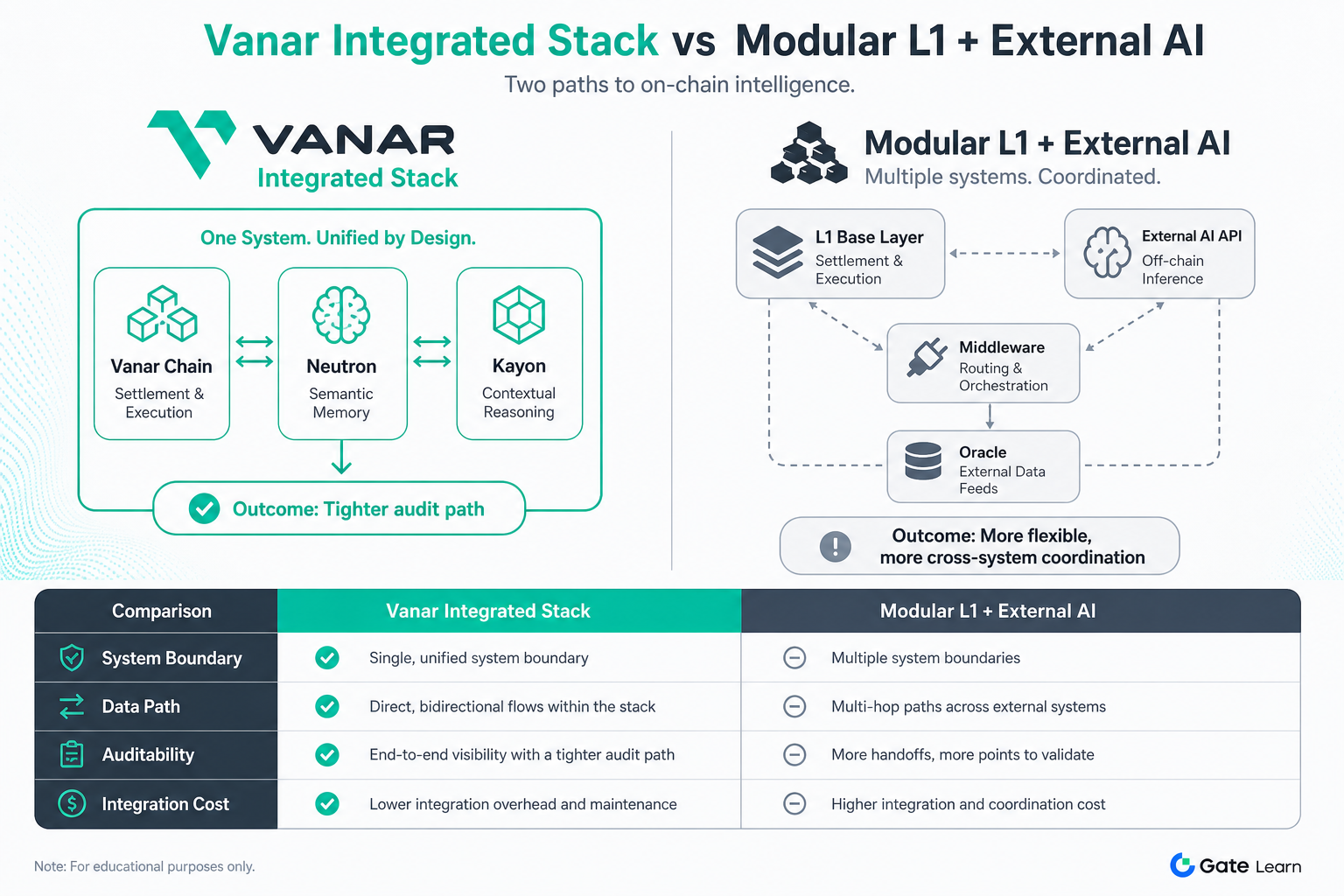
Figure 1. Architectural and auditability comparison: Vanar’s integrated approach vs. modular L1 with external AI.
What Is Approach A? Understanding Vanar’s Integrated AI Native Architecture
The Vanar approach unifies “on-chain state, semantic memory, and reasoning/execution” within a single technology stack. Typically, the Chain handles settlement, Neutron manages the transformation of semantic data into objects, and Kayon is responsible for contextual decision-making and action triggers. All these layers operate within a cohesive ecosystem, minimizing the need for cross-system integration.
The key advantage of this integrated approach is end-to-end continuity: input, judgment, and execution all occur within consistent technical and governance boundaries, making it easier to track the chain of responsibility. For process-driven businesses, this continuity is often more important than isolated performance benchmarks.
What Is Approach B? Typical Model for Modular L1 + External AI
The modular L1 + external AI model generally consists of a “general-purpose chain, external model services, and middleware orchestration.” The chain focuses on settlement and state attestation, with AI reasoning performed off-chain. Results are relayed back on-chain during execution via oracles, service gateways, or middleware.
This model offers high flexibility in component selection, enabling rapid integration with different models and data services. However, as the architecture grows more complex, it introduces challenges such as version drift, data consistency issues, permission synchronization, and unclear responsibility boundaries.
Key Differences in Architecture and Cost at a Glance
| Dimension |
Vanar Integrated Approach |
Modular L1 + External AI |
| System Boundaries |
Relatively centralized |
Relatively decentralized |
| Data Path |
Semantic objectification before reasoning |
Often requires multi-system conversion |
| Reasoning-Execution Coupling |
Tighter within unified stack |
More intermediate layers |
| Integration Cost |
Upfront learning is concentrated |
Flexible at first, later coordination costs rise |
| O&M Complexity |
Relies on maturity of single stack |
Relies on multi-component collaboration |
| Auditability |
Stronger path consistency |
Requires cross-system evidence |
| Vendor Risk |
Potential for ecosystem lock-in |
Potential for vendor coupling |
| Migration Difficulty |
High for unified stack migration |
Frequent component swaps, but overall migration is complex |
From a cost perspective, the modular approach is often faster for proof-of-concept, but governance and coordination costs can rise sharply in production. The integrated approach imposes stricter constraints early on, but may lower repeated integration costs over time in rule-intensive scenarios.
Why Is Auditability So Important? Who Has an Advantage in Compliance and Review?
Auditability isn’t just about having logs—it’s about being able to clearly reconstruct the decision-making process. Integrated architectures typically maintain continuous references among inputs, rules, and execution results, making it easier to answer why a given action was triggered.
While modular approaches can also be auditable, they require consistent identifiers and timelines across multiple systems, which raises the bar for engineering governance. Without robust data governance and observability, audit costs can quickly escalate as systems scale.
Which Scenarios Are Best for Vanar? Which Fit the Modular Approach?
Vanar’s integrated model is ideal for scenarios with strict rules, long processes, and clear lines of responsibility—such as compliance-driven payments, asset transfer approvals, and credential-based execution. These scenarios demand a single, verifiable chain of events and are particularly sensitive to integrated architectures.
The modular approach is better suited for highly experimental, fast-iterating, or multi-model environments. If your business is focused on exploring AI model capabilities rather than ensuring on-chain execution consistency, the flexibility of external integration is an advantage. The key is to define business goals first, then select the architecture—never the other way around.
What Are the Risks and Limitations of Each Approach?
Vanar’s main limitation lies in its dependence on ecosystem maturity and a single stack. If key components can’t keep pace with business needs, replacement and migration costs can be high. The modular approach is prone to system fragmentation, making cross-component management difficult and long-term maintenance costs hard to anticipate early on.
| Risk Type |
Vanar Integrated Approach |
Modular L1 + External AI |
| Technical Risk |
Dependent on single stack maturity |
Multi-system coupling and drift |
| Governance Risk |
Ecosystem lock-in |
Dispersed responsibility |
| O&M Risk |
Centralized upgrade path |
Longer monitoring and troubleshooting |
| Cost Risk |
Concentrated upfront investment |
Accumulating coordination costs over time |
For teams, the real question isn’t “which is more advanced,” but “which aligns best with your organization’s capabilities and business constraints.”
Summary
The core difference between Vanar and modular L1 + external AI lies in system boundary design. Vanar emphasizes an integrated, verifiable chain of events, while the modular approach prioritizes the flexibility of component combination. The former can lower long-term coordination costs in rule-heavy environments; the latter offers greater agility for rapid experimentation. Ultimately, architecture choices should be driven by business objectives, governance capabilities, and lifecycle cost considerations.
FAQ
Which Is Better: Vanar or the Modular AI Approach?
There’s no universal answer. If your business needs traceable execution chains and rule consistency, Vanar’s integrated approach is advantageous. If you need rapid experimentation and frequent model changes, the modular approach is more flexible.
Why Is Auditability a Key Comparison Factor?
Because AI + Web3 systems must answer: “What data, under what rules, triggered which actions?” High auditability makes compliance and review feasible, and lowers the cost of diagnosing issues.
Is Modular L1 + External AI Always Cheaper?
Not always. While initial integration may be less expensive, as the number of components grows, coordination, monitoring, and governance costs increase. Total cost depends on system lifecycle, not just initial setup speed.
What Must Be Clarified Before Choosing an Architecture?
First, determine if your business needs an end-to-end verifiable decision chain, whether your organization can govern multiple systems, and what your maintenance boundaries will be over the next three to five years. With these clarified, your architecture decisions will be much more robust.







