As on-chain commodity narratives and the Meme market gradually converge, more projects are using concepts such as energy, gold, and reserve assets to attract market attention. Compared with traditional Meme Coins, these commodity narrative tokens often find it easier to create market associations with “real world assets,” making it easier for liquidity to gather quickly during trend driven cycles.
In the current crypto market, GDOR is a typical high volatility narrative token. Its price is not entirely determined by the value of real world commodities, but is influenced more by market sentiment, on-chain liquidity, and social media circulation. Because such assets usually lack mature asset audit systems and long term value anchoring mechanisms, their risk structure differs clearly from that of traditional financial commodities and more stable RWA tokens.
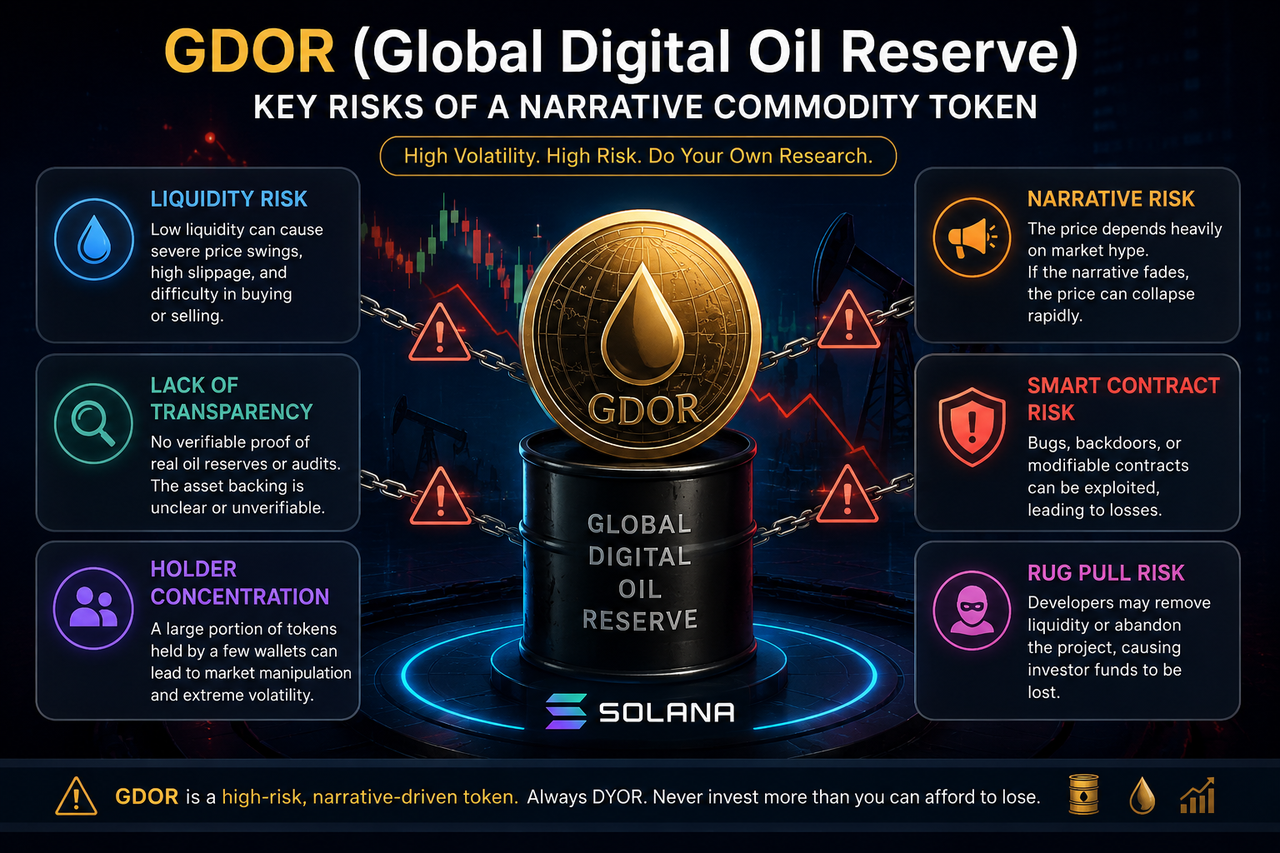
Liquidity risk is one of the most important issues for on-chain narrative tokens.
GDOR is mainly traded through DEXs, or decentralized exchanges, on Solana, and its price usually depends on AMM, or automated market maker, liquidity pools. When a liquidity pool is small, large trades can easily trigger sharp price movements.
For example, when many users buy at the same time, changes in the token ratio inside the pool can quickly push the price higher. During concentrated selling, the price may also experience significant slippage.
Compared with large mainstream assets, narrative tokens usually lack deep liquidity, so the market is more likely to see:
Sharp rises and falls within a short period
High slippage trades
Sudden disappearance of liquidity
Rapid widening of bid ask spreads
When market sentiment weakens, insufficient liquidity often further amplifies downside risk.
GDOR uses the name “Global Digital Oil Reserve,” so the market often associates it with support from real world oil reserves or energy assets.
For real world asset, or RWA, projects, however, one of the most important questions is whether the asset actually exists and whether it can be verified.
Typical RWA tokens usually disclose:
| Core Information | Typical RWA Project |
|---|---|
| Amount of reserve assets | Publicly verifiable |
| Custodian | Clearly disclosed |
| Third party audit | Provided regularly |
| Legal structure | Relatively clear |
| on-chain mapping mechanism | Traceable |
Based on publicly available information, GDOR has not yet established a complete verification system for real world oil reserves. As a result, whether there is a real mapping relationship between its narrative and real world assets remains an important issue for the market.
Without a transparent reserve mechanism, market price is more likely to depend entirely on sentiment.
Many highly volatile on-chain assets face holder concentration risk, meaning that a large share of tokens is held by a small number of wallet addresses.
When token distribution is highly concentrated, large wallets, or whales, may have a noticeable impact on market price. For example:
Concentrated buying may push the price up quickly
Concentrated selling may cause the price to crash almost instantly
Some wallets may control both liquidity and token supply
This structure increases market instability.
For narrative based commodity tokens, if liquidity is already low and holder concentration is also high, market prices may become even easier to manipulate.
For this reason, holder distribution, the share held by the top ten wallets, and liquidity lockup status are usually important indicators when assessing the risk of on-chain assets.
The market value of a narrative token largely comes from whether the market continues to believe the story.
When a concept is in a hot market cycle, the market will keep reinforcing the related narrative. Examples include:
“Digital oil reserve”
“on-chain energy assets”
“The next RWA trend”
“The next popular Solana asset”
These labels can spread quickly across social media.
However, trends in the crypto market usually shift very fast. Once narrative momentum fades, market attention and trading volume may fall at the same time.
For tokens that lack long term cash flow and real asset support, narrative decline often means lower liquidity and falling prices.
This is why many trending assets experience intense volatility within short cycles.
Commodity based narratives have a natural advantage in market communication.
Compared with ordinary Meme Tokens, concepts such as “oil reserves,” “gold reserves,” and “energy assets” make it easier for users to associate the token with real world value, so the narrative can build credibility more easily.
At the same time, highly active on-chain ecosystems such as Solana offer:
Extremely low transaction costs
Rapid capital rotation
A high frequency Meme market
Social media driven liquidity
These structures further amplify how quickly a narrative spreads.
When narrative meets a high frequency speculative market, price volatility usually increases significantly.
When assessing the risks of on-chain narrative tokens, the market usually focuses on the following areas:
| Risk Dimension | Key Focus |
|---|---|
| Liquidity | Whether LP depth is sufficient |
| Holder distribution | Whether it is overly concentrated |
| Narrative | Whether it depends entirely on market trends |
| Reserve transparency | Whether real verification exists |
| Contract security | Whether it has been audited |
| Team structure | Whether it is public and transparent |
| Market cycle | Whether it is near the end of a trend cycle |
Narrative based assets usually do not have a fixed valuation model, so changes in market sentiment directly affect price volatility.
GDOR, or Global Digital Oil Reserve, is a typical narrative driven on-chain commodity token. Its market attention mainly comes from the concepts of a “digital oil reserve” and RWA, rather than from a real commodity anchoring structure in the traditional sense.
Compared with mature RWA projects, GDOR is currently more vulnerable to insufficient liquidity, holder concentration, shifts in narrative trends, and fluctuations in market sentiment. At the same time, limited reserve transparency and a highly volatile on-chain trading structure further increase its overall risk level.
GDOR’s core risks usually come from its narrative driven structure, including insufficient liquidity, market sentiment volatility, and the lack of a real asset verification mechanism.
GDOR uses narratives related to RWA and energy assets, but based on publicly available information, no complete and verifiable proof of real world oil reserves has been seen so far.
A rug pull usually refers to a situation where developers withdraw liquidity or use contract privileges in a way that causes a project to collapse quickly. It is one of the major risk types for high risk on-chain assets.
Solana offers low fees, high transaction speed, and an active Meme market ecosystem, making it easier to form a short cycle, highly volatile trading environment for narrative assets.