Unlike NAS100, which is heavily concentrated in technology companies, EUSTX50 is more like a map of the European economy. The index covers French luxury groups, German industrial giants, major European banks, energy companies, and globally leading software and healthcare businesses, allowing it to reflect the overall competitiveness of European companies in a relatively comprehensive way.
Understanding the corporate composition of EUSTX50 not only helps analyze index movements, but also helps identify which industries and companies drive European economic growth.
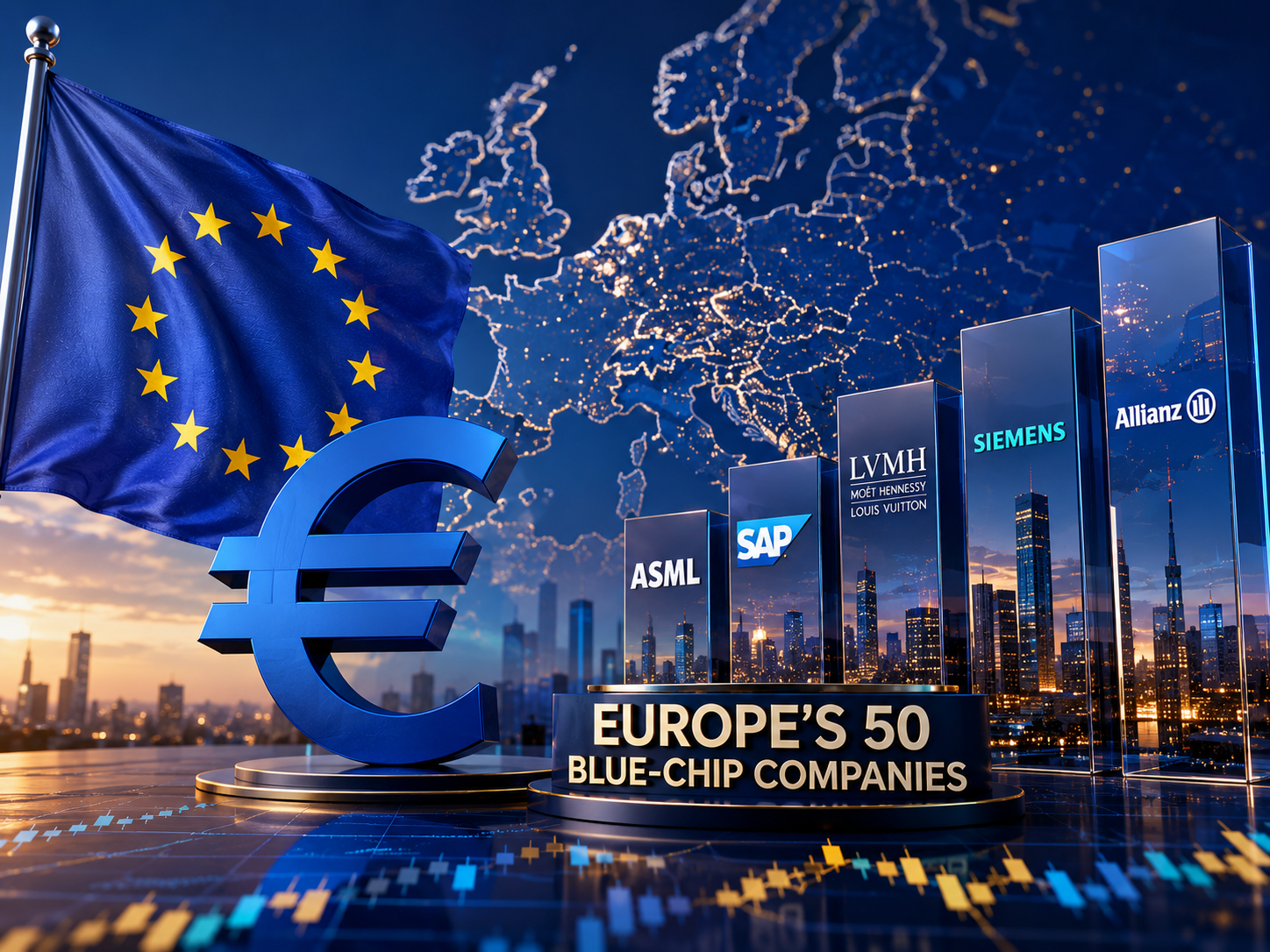
EUSTX50 Tracks 50 of the Most Representative Blue Chip Companies in the Eurozone.
Index providers select companies based on free float market capitalization, trading activity, and market representativeness. As a result, companies included in EUSTX50 are usually European leaders in their respective industries.
From an industry perspective, EUSTX50 is not simply made up of technology companies. It includes multiple sectors, including finance, industry, consumption, energy, healthcare, and technology.
Some representative companies include:
| Company |
Country |
Industry |
| ASML |
Netherlands |
Semiconductor equipment |
| SAP |
Germany |
Enterprise software |
| LVMH |
France |
Luxury goods |
| Hermès |
France |
Luxury goods |
| Siemens |
Germany |
Industrial automation |
| Airbus |
France |
Aerospace |
| Allianz |
Germany |
Financial insurance |
| Sanofi |
France |
Healthcare |
| Schneider Electric |
France |
Energy management |
| TotalEnergies |
France |
Energy |
These companies all have strong competitiveness in global markets. Therefore, EUSTX50 performance is affected not only by the European economy, but also by global consumption, industrial investment, and technology development cycles.
From an investment logic perspective, EUSTX50 is more like a basket of European champion companies.
What Are the Key Features of EUSTX50’s Country Distribution
Country distribution is one of the biggest differences between EUSTX50 and other indices.
Because the index only covers Eurozone countries, U.K. companies do not appear in the index. This is a clear distinction from some indices that cover the broader European market.
France and Germany usually hold the highest weights in the index.
France has Europe’s largest consumer brand and luxury goods groups, while Germany has Europe’s strongest industrial and manufacturing system.
Overall, the distribution looks like this:
| Country |
Representative Industries |
| France |
Luxury goods, energy, industry |
| Germany |
Industry, software, finance |
| Netherlands |
Semiconductors, finance |
| Spain |
Banking, telecommunications |
| Italy |
Finance, energy, manufacturing |
| Belgium |
Healthcare, consumer goods |
This country structure means EUSTX50 is not the representative index of a single economy. Instead, it is a combined reflection of economic activity across the Eurozone.
Therefore, when investors analyze EUSTX50, they need to pay attention not only to Germany’s manufacturing cycle, but also to France’s consumer market and the broader European economic environment.
Why French Companies Hold an Important Weight
French companies have long been among the most important components of EUSTX50.
This is not simply because France has the largest number of companies, but because France is home to some of Europe’s most globally influential brand groups.
LVMH, Hermès, L'Oréal, Schneider Electric, Airbus, Sanofi, and TotalEnergies are all major leaders in European capital markets.
Among them, LVMH and Hermès are especially important representatives of the global luxury goods industry.
The luxury goods industry is highly globalized. Asian consumer demand, the recovery of international tourism, and growth in high end consumption all affect the earnings performance of these companies.
As a result, when global consumer markets perform strongly, French companies often help drive the entire EUSTX50 higher.
From an index weight perspective, French companies not only have an advantage in number, but their market capitalization has also remained at a leading level in the European market over the long term.
This makes French companies an important force shaping the long term performance of EUSTX50.
Why German Companies Affect Index Movements
German companies are the second largest source of weight in EUSTX50 and an important representation of Europe’s industrial competitiveness.
If French companies are more closely associated with consumption and brand value, German companies represent manufacturing, industrial automation, engineering technology, and enterprise software capabilities.
The most representative German companies in EUSTX50 include:
| Company |
Main Field |
| SAP |
Enterprise software |
| Siemens |
Industrial automation |
| Allianz |
Insurance and finance |
| Deutsche Telekom |
Telecommunications services |
| BMW |
Automobile manufacturing |
| Mercedes-Benz |
Luxury automobiles |
| BASF |
Chemical materials |
Among them, SAP is one of Europe’s largest software companies by market capitalization and one of the few European companies able to compete with U.S. technology firms in the global software market.
Siemens is an important participant in industrial automation and smart manufacturing, with businesses spanning energy management, industrial control, digital factories, and other areas.
The influence of German companies on EUSTX50 is mainly reflected in three areas.
The first is global manufacturing activity.
German companies’ revenue is highly dependent on global industrial investment cycles, so expansion in global manufacturing usually supports earnings growth for German companies.
The second is the export trade environment.
Germany’s economy has long relied on export markets, and changes in international demand directly affect order levels for large German companies.
The third is corporate digital transformation.
As demand grows for industrial automation, artificial intelligence, and enterprise software, companies such as SAP and Siemens are gradually becoming important representatives of Europe’s digital economy.
Therefore, German companies often serve as important indicators for judging the European economic cycle.
Which Luxury and Consumer Brand Companies Are Represented
The luxury goods sector is one of the most distinctive parts of EUSTX50.
Unlike U.S. indices, which are mainly driven by technology giants, European capital markets have the world’s strongest luxury goods industry cluster.
The most representative consumer brands in EUSTX50 currently include:
-
LVMH
-
Hermès
-
L'Oréal
-
Adidas
-
Kering
These companies cover luxury goods, cosmetics, sporting goods, and high end consumer markets.
From a global market share perspective, French luxury groups have long dominated the global industry.
LVMH owns a number of international brands, including Louis Vuitton, Dior, and Tiffany.
Hermès has become one of the world’s most valuable luxury goods companies by market capitalization thanks to its high end leather goods and scarce brand value.
The impact of the consumer brand sector on EUSTX50 mainly comes from global consumer demand.
When Asian consumption grows, international tourism recovers, or the high end consumer market expands, related companies often achieve revenue and profit growth.
Therefore, the luxury goods sector is not only a distinctive European industry, but also an important source of difference between EUSTX50 and U.S. indices.
In a sense, EUSTX50 reflects not only the European economy, but also the development trend of the global high end consumer market.
The Role of Financial and Industrial Leaders in the Index
The financial and industrial sectors together form the underlying support of EUSTX50.
Compared with technology companies with stronger growth characteristics, these sectors usually offer higher earnings stability.
Representative companies in the financial sector include:
-
Allianz
-
BNP Paribas
-
Santander
-
ING
-
Intesa Sanpaolo
The profitability of financial companies is closely related to interest rate levels, credit demand, and economic growth.
When the European economy expands, financial institutions can usually benefit from higher loan demand and asset management income.
Representative companies in the industrial sector include:
-
Siemens
-
Schneider Electric
-
Airbus
-
Vinci
-
Safran
These companies cover industrial automation, aerospace, infrastructure construction, energy management, and other fields.
Industrial companies are relatively sensitive to the global capital expenditure cycle.
When companies increase equipment investment, governments expand infrastructure construction, or aviation demand grows, related companies often benefit.
Therefore, the financial and industrial sectors together improve the stability of EUSTX50.
Compared with NAS100, which relies heavily on the technology sector, EUSTX50 has a more balanced industry structure and is better able to reflect changes in traditional economic activity.
Conclusion
EUSTX50 consists of 50 of Europe’s most representative blue chip companies. Its constituents span multiple Eurozone countries, including France, Germany, the Netherlands, Spain, and Italy.
In terms of industry structure, the core strength of EUSTX50 comes from luxury goods, finance, industry, energy, healthcare, and technology. French companies contribute many leading consumer and luxury goods names, while German companies represent the competitiveness of European industry and manufacturing.
Unlike NAS100, which focuses on technology growth stocks, EUSTX50 better reflects the overall structure of the European economy. As a result, its movements are influenced not only by corporate earnings, but also by European economic growth, European Central Bank policy, and the global consumption cycle.
FAQs
How Many Companies Are in EUSTX50?
EUSTX50 consists of 50 large blue chip companies from the Eurozone. These companies are selected based on free float market capitalization and market liquidity, making them one of the most representative groups of listed companies in Europe’s capital markets.
Which Companies Usually Have the Highest Weights in EUSTX50?
The highest weights in EUSTX50 are usually concentrated among large companies such as ASML, SAP, LVMH, Hermès, Siemens, and Schneider Electric. Specific weights may change as market capitalization shifts and the index is rebalanced.
Why Do French Companies Have a High Share in EUSTX50?
France has Europe’s largest luxury goods, consumer goods, and energy groups. Companies such as LVMH, Hermès, L'Oréal, and TotalEnergies have relatively large market capitalizations, giving them important positions in the index.
German companies represent the core competitiveness of European industry and manufacturing. The operating performance of companies such as SAP, Siemens, and Allianz often reflects changes in European economic activity and the global industrial cycle.
How Is EUSTX50 Different from Other European Indices?
EUSTX50 only covers large blue chip companies in the Eurozone, while some European indices include non Eurozone markets such as the U.K. and Switzerland. Therefore, EUSTX50 more directly reflects Eurozone economic and corporate performance.
Which Industries Are Most Important in EUSTX50?
Finance, industry, luxury goods, energy, healthcare, and technology are the core industries in EUSTX50. Among them, luxury goods and industrial sectors are some of the most distinctive parts of the European market and are important drivers of the index’s long term performance.