Unlike traditional DAO tools that mainly focus on voting or organization management, DAOBase aims to provide a broader infrastructure layer covering DAO creation, governance, data analysis, and community operations. Within this ecosystem, BEE Token serves as an economic mechanism that aligns user participation with long-term platform development.
DAOBase’s token model combines fixed supply, ecosystem rewards, community incentives, and long-term vesting mechanisms. Together with Points, NFTs, and community programs, BEE Token creates a participation framework that allows users to contribute to and engage with the DAOBase ecosystem.
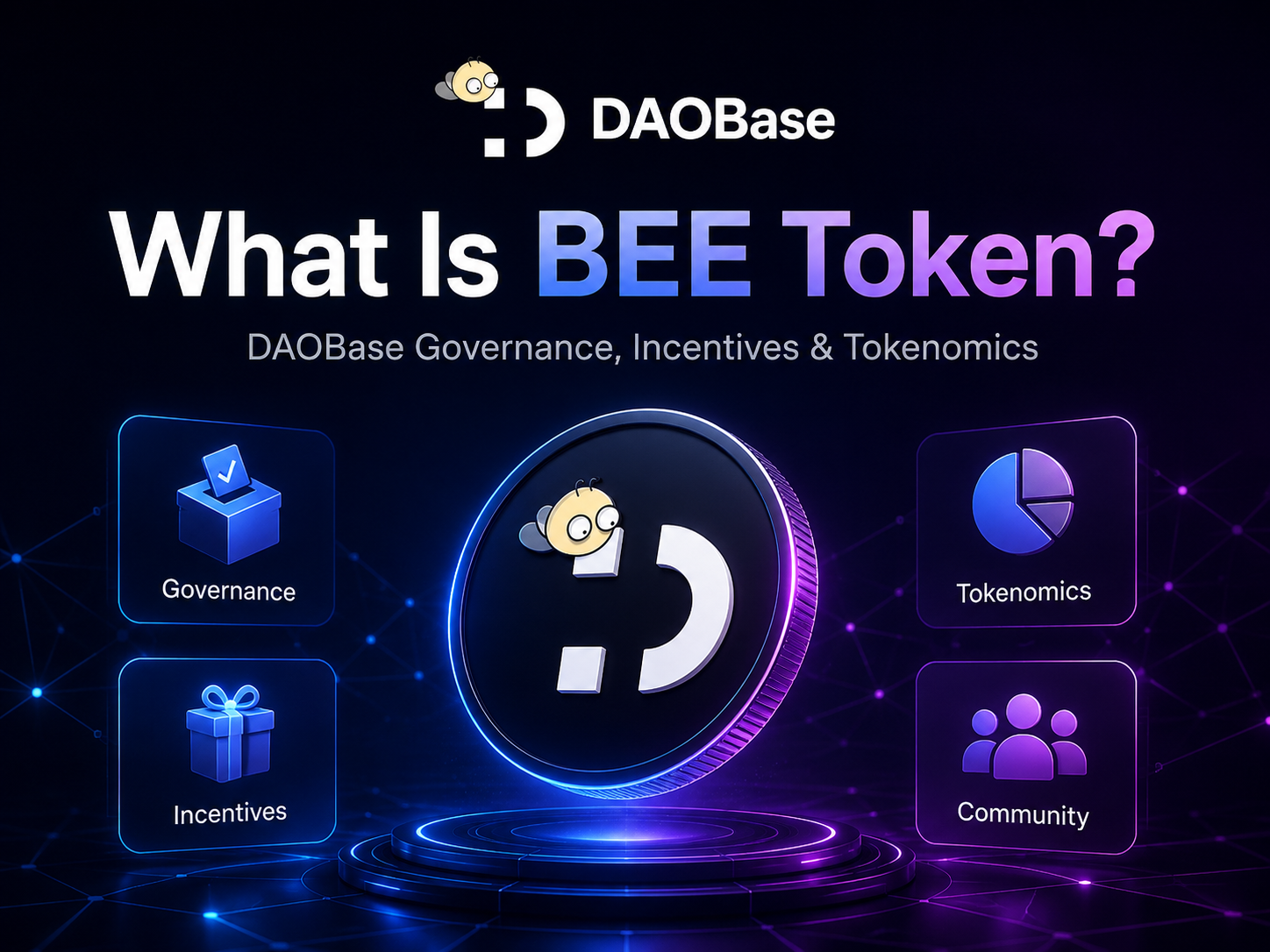
What Is the Role of BEE Token in the DAOBase Ecosystem?
BEE Token is the core economic asset of the DAOBase ecosystem, designed to support governance participation, utility functions, and ecosystem incentives. Rather than serving only as a tradable digital asset, BEE Token connects different participants across the DAOBase ecosystem.
DAOBase focuses on providing infrastructure for decentralized organizations, including DAO creation, governance management, and ecosystem coordination. BEE Token supports this ecosystem by aligning the interests of users, DAO participants, and contributors.
The role of BEE Token can be summarized into three key areas:
| Role |
Function |
| Governance |
Supports participation in DAOBase ecosystem decisions |
| Utility |
Connects users with DAOBase ecosystem functions |
| Incentives |
Rewards community participation and contributions |
Through this structure, BEE Token helps DAOBase build a community-driven ecosystem where users can participate beyond simply using the platform.
How Does BEE Token Support DAOBase Governance and Ecosystem Incentives?
BEE Token supports DAOBase governance and incentive mechanisms by providing a framework for community participation and ecosystem contribution.
In decentralized organizations, governance mechanisms determine how communities participate in decision-making, while incentive systems encourage users to contribute resources, activities, and feedback. BEE Token is designed to support both aspects within the DAOBase ecosystem.
DAOBase combines Token incentives with additional participation mechanisms, including Points and NFT-based community systems. These tools help measure user contributions and create different pathways for users to engage with the ecosystem.
Rather than relying only on platform usage, DAOBase aims to build a broader participation model where community activity can contribute to ecosystem growth.
How Is DAOBase Tokenomics Designed? Supply, Allocation, and Vesting Mechanism Explained
According to DAOBase’s official Token Overview, BEE Token has a maximum supply of 1,000,000,000 BEE and is deployed on both Base and BNB Smart Chain (BSC).
| Item |
Details |
| Token Name |
BEE |
| Symbol |
BEE |
| Networks |
Base and BNB Smart Chain (BSC) |
| Total Supply |
1,000,000,000 BEE |
| Decimals |
18 |
DAOBase’s Tokenomics structure distributes BEE across multiple categories, including ecosystem rewards, treasury management, community incentives, team allocation, liquidity, and early contributors.
| Allocation Category |
Percentage |
Token Amount |
| VC Round |
12% |
120,000,000 BEE |
| Pre-launch Round |
1% |
10,000,000 BEE |
| IDO |
2% |
20,000,000 BEE |
| Airdrop |
5% |
50,000,000 BEE |
| Team |
15% |
150,000,000 BEE |
| Ecosystem Rewards |
20% |
200,000,000 BEE |
| DAO Treasury |
16% |
160,000,000 BEE |
| Marketing & Growth |
15% |
150,000,000 BEE |
| Liquidity Provision |
9% |
90,000,000 BEE |
| Advisors |
5% |
50,000,000 BEE |
The allocation structure shows that DAOBase places significant emphasis on ecosystem expansion, with Ecosystem Rewards, DAO Treasury, and Marketing & Growth receiving substantial portions of the total supply.
These allocations are designed to support long-term ecosystem development rather than short-term distribution.
How Does BEE Token Vesting Work and Support Long-Term Ecosystem Development?
DAOBase uses different vesting schedules for each BEE Token allocation category to manage token distribution over time and support sustainable ecosystem growth. Instead of releasing all allocated tokens immediately, DAOBase applies cliff periods and linear vesting mechanisms based on the purpose of each allocation.
The vesting design separates short-term liquidity needs from long-term ecosystem development. Categories such as Team, Advisors, Ecosystem Rewards, and DAO Treasury have longer release periods, while allocations designed for early ecosystem participation may have faster availability.
| Allocation Category |
Vesting Schedule |
| Team |
12-month lock, followed by linear vesting over 24 months |
| Advisors |
12-month lock, followed by linear vesting over 24 months |
| VC Round |
6-month cliff, followed by linear vesting over 24 months |
| Ecosystem Rewards |
10% unlocked at TGE, remaining tokens released linearly over 48 months |
| DAO Treasury |
6-month cliff, followed by linear release over 48 months |
| Marketing & Growth |
10% unlocked at TGE, 5-month cliff, followed by linear release over 48 months |
| Airdrop |
50% unlocked at TGE, remaining 50% released linearly over 6 months after a 1-month cliff |
| Liquidity Provision |
50% unlocked at TGE, remaining 50% released in Month 2 |
Among these categories, Ecosystem Rewards and DAO Treasury represent important parts of DAOBase’s long-term growth strategy. Their extended vesting periods allow resources to be distributed gradually as the ecosystem develops.
The vesting mechanism also provides transparency for community members by showing how different groups receive and unlock BEE Tokens over time.
How Do Points, NFTs, and BEE Token Build the DAOBase Participation System?
DAOBase does not rely only on BEE Token to encourage ecosystem participation. The project also combines Points, NFTs, and community programs to create a broader participation framework.
Points function as a way to record user engagement within the DAOBase ecosystem. Users can earn Points through activities such as interacting with DAOBase products, participating in community activities, and completing ecosystem-related actions.
NFT-based mechanisms, including DAOBase’s DAO BadgeX system, provide another layer of participation by representing user identity and contribution history. Instead of acting only as collectibles, these NFTs can serve as community credentials within the DAOBase ecosystem.
The relationship between these mechanisms can be summarized as follows:
| Component |
Primary Function |
Relationship With BEE Token |
| Points |
Records user participation and contribution |
Provides a basis for ecosystem rewards |
| NFTs |
Represents identity and community status |
Creates participation credentials |
| Airdrop |
Distributes community rewards |
Includes BEE Token allocation |
| BEE Token |
Governance and ecosystem incentives |
Connects economic value with participation |
According to DAOBase’s community program information, community users are included in the ecosystem reward design through Airdrop allocation, with 5% of the total BEE supply allocated for Airdrop distribution.
This creates a participation pathway where users can contribute to the ecosystem before directly interacting with the Token economy.
How Does BEE Token Connect Users, DAO Creators, and Ecosystem Contributors?
BEE Token connects different participants within the DAOBase ecosystem by providing a shared incentive mechanism.
For users, BEE-related programs create opportunities to participate in DAOBase activities and receive ecosystem recognition. For DAO creators, DAOBase provides infrastructure tools while the Token model supports community coordination around decentralized organizations.
For ecosystem contributors, including community members and potential developers, BEE Token creates a framework where contributions can be recognized through governance participation and incentive mechanisms.
This model reflects a broader trend in Web3 infrastructure: successful ecosystems require not only technical tools but also sustainable participation systems that encourage users to contribute over time.
Through BEE Token, Points, NFTs, and community programs, DAOBase attempts to combine product usage, community activity, and ecosystem growth into a unified participation model.
What Are the Current Limitations of BEE Token?
BEE Token’s long-term utility depends on the adoption of DAOBase products, ecosystem growth, and the development of real-world DAO use cases.
Although BEE Token has defined roles in governance and ecosystem incentives, the practical impact of these mechanisms depends on how actively users, DAO creators, and communities adopt DAOBase infrastructure.
Another consideration is that many Token functions are connected to the broader development of the DAO ecosystem. As DAO adoption continues to evolve, the demand for DAO infrastructure and related incentive models may also change.
Users should refer to DAOBase’s official announcements for updates regarding governance functions, ecosystem programs, and future Token utilities.
Summary
BEE Token is the native Utility and Governance Token of the DAOBase ecosystem, designed to support governance participation, ecosystem incentives, and community coordination.
DAOBase’s Tokenomics model includes a fixed supply of 1 billion BEE, with allocations distributed across Ecosystem Rewards, DAO Treasury, Team, Liquidity Provision, Airdrop, and other categories. Different allocation groups follow separate vesting schedules to support long-term ecosystem development.
Beyond the Token itself, DAOBase combines Points, NFTs, and community programs to create multiple participation paths. These mechanisms allow users to contribute to the ecosystem, build reputation, and participate in future reward structures.
Through this combination of Token economics and community infrastructure, DAOBase aims to create a participation model that supports the growth of decentralized organizations.
FAQ
What is the total supply of BEE Token?
BEE Token has a maximum supply of 1,000,000,000 BEE. According to DAOBase’s official Token Overview, BEE is deployed on Base and BNB Smart Chain (BSC).
How much BEE Token is allocated for Airdrop?
DAOBase allocates 5% of the total BEE supply for Airdrop distribution, representing 50,000,000 BEE tokens dedicated to community reward distribution.
What is the relationship between DAOBase Points and BEE Token?
DAOBase Points record user participation and ecosystem contributions, while BEE Token provides governance and incentive functions within the DAOBase ecosystem.
DAOBase uses NFT mechanisms to represent user identity and contribution records, helping establish community reputation and participation credentials.
No. DAOBase uses different vesting schedules for different allocation categories, including cliff periods and linear releases to manage long-term token distribution.
What role does BEE Token play in DAOBase governance?
BEE Token supports DAOBase governance participation and ecosystem coordination, with specific governance functions determined by the project’s official mechanisms.