Berkshire Hathaway (BRK.B) is a U.S. equity stock representing Class B common shares of Berkshire Hathaway Inc. The ticker confers a proportional economic claim on the holding company—not a crypto token and not an index ETF share. On Gate Stocks, the display name is typically BERKSHIRE HATHAWAY Class B and the trading code is BRK.B.
Separating Class A / Class B structure first, then holding-company economics, then ticker and order checks on Gate Stocks · BRK.B keeps company research distinct from trade execution.
What Is Berkshire Hathaway (BRK.B)? How Does It Relate to Buffett?
Berkshire Hathaway Inc. is a U.S.-listed diversified holding company, often called Berkshire. BRK.B is the Class B common-stock ticker; Class A trades as BRK.A. Holding BRK.B means a proportional economic claim on Berkshire Hathaway Inc., not direct ownership of any single subsidiary.
Berkshire and Warren Buffett are tightly linked in public perception: historically, Buffett has served as chairman and chief executive and has explained capital-allocation principles in shareholder letters. Management and succession details change with public filings; research should return to the company website and shareholder-info page rather than treating a personal brand as the sole analytic lens. The practical path is company–share class–ticker: issuer Berkshire Hathaway Inc., share classes Class A and Class B, and ticker BRK.B for Class B on public markets and Gate Stocks.
How Do BRK.B and BRK.A Differ? What Does Class B Represent?
BRK.A and BRK.B are both common shares of Berkshire Hathaway Inc., but they differ in unit size, voting rights, and market accessibility. Class B offers a smaller share unit while preserving a proportional economic claim relative to Class A; Class A corresponds to a larger economic unit and fuller per-share voting rights. Per Berkshire Hathaway’s shareholder-info disclosures, the classes map on a fixed economic ratio, and each Class B share carries a stated fraction of one Class A vote. Exact ratios should be read from current disclosures—not inferred from a single market quote.
| Dimension |
Class A (BRK.A) |
Class B (BRK.B) |
| Positioning |
Larger-unit common stock |
Smaller-unit common stock |
| Economic claim |
Proportional claim on company value |
Proportional claim (mapped to A on a fixed ratio) |
| Voting rights |
Full votes per share |
A stated fraction of one Class A vote per share |
| Market access |
Higher per-share unit size |
Smaller unit; more common for retail and multi-platform access |
The table stresses share-class design, not which class is “better.” Many users focus on BRK.B because the smaller unit is easier to search and size; voting and unit-size gaps are structural facts, not investment conclusions.
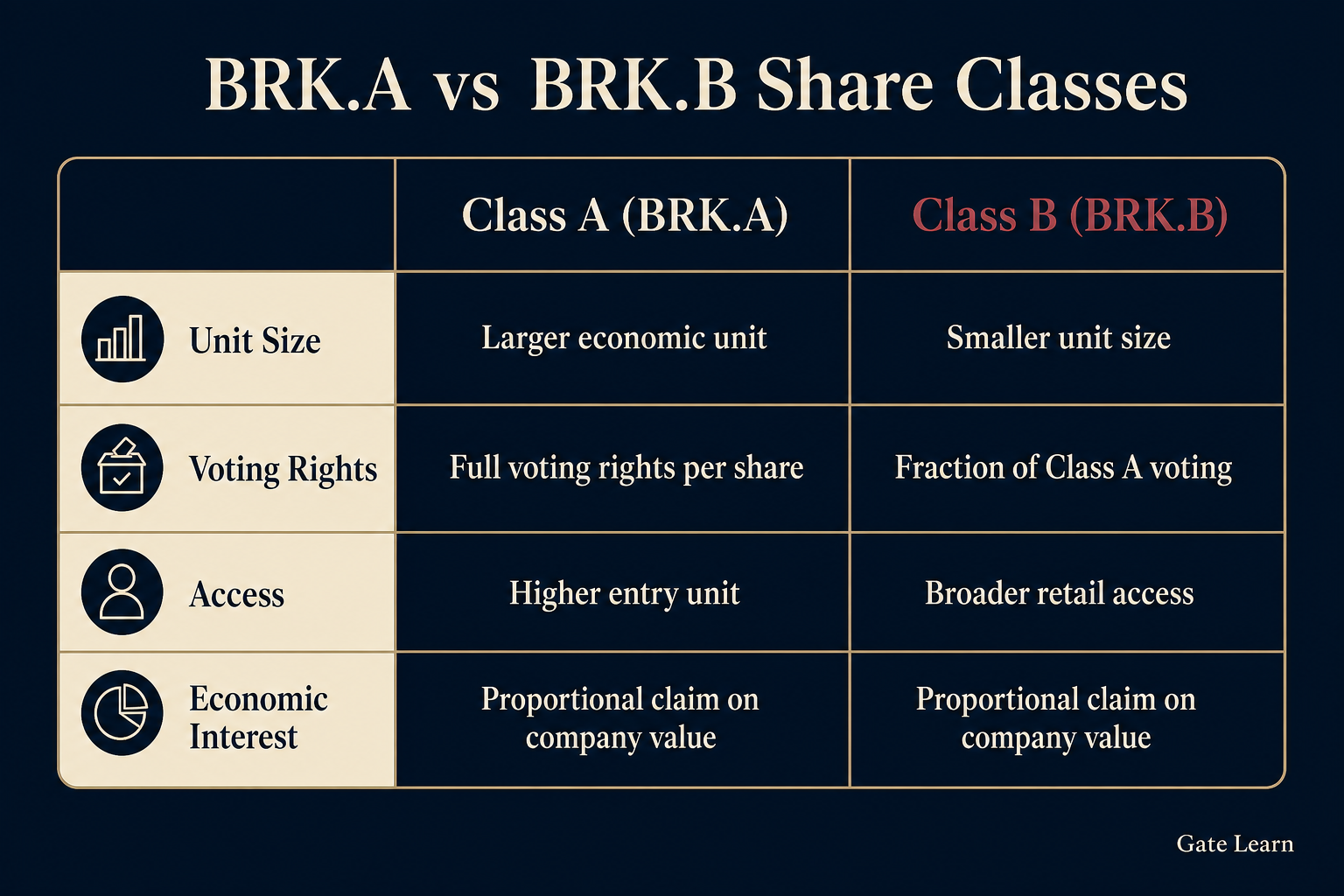 Figure 1. BRK.A vs BRK.B share classes: unit size, voting rights, market access, and proportional economic claims.
How Does Berkshire Hathaway Make Money? Insurance, Subsidiaries, Equity Portfolio
Berkshire Hathaway’s economics can be framed as three parallel pillars: insurance float, operating-subsidiary profits, and a public equity portfolio. Float can fund investment and acquisitions; subsidiaries generate operating cash flow; the equity book reflects holdings in listed companies.
Insurance float is capital created when premiums are collected before claims are paid—not “free money,” and sustainability depends on underwriting and reinvestment quality. Operating subsidiaries across railroad, utilities and energy, manufacturing, retail, and services run largely independently while the holding company allocates capital. The equity portfolio is financial exposure to public stocks, distinct from wholly owned subsidiaries. Research should separate operating profit from mark-to-market moves in public holdings.
| Earnings pillar |
Core mechanism |
Reading tip |
| Insurance float |
Premiums collected before claims create deployable capital |
Depends on underwriting quality and investment use |
| Operating subsidiaries |
Profits from railroad, energy, manufacturing, retail, services, and related lines |
Focus on operating cash flow and capital spending |
| Equity portfolio |
Public-stock positions |
Financial investment exposure, not wholly owned ops |
The table builds a holding-company checklist: identify cash and profit sources, then verify segment and holdings disclosures. Per Berkshire Hathaway’s long-standing capital-allocation practice, the company has historically not paid a cash dividend, preferring retained earnings for reinvestment and acquisitions—a structural description, not a buy or hold recommendation.
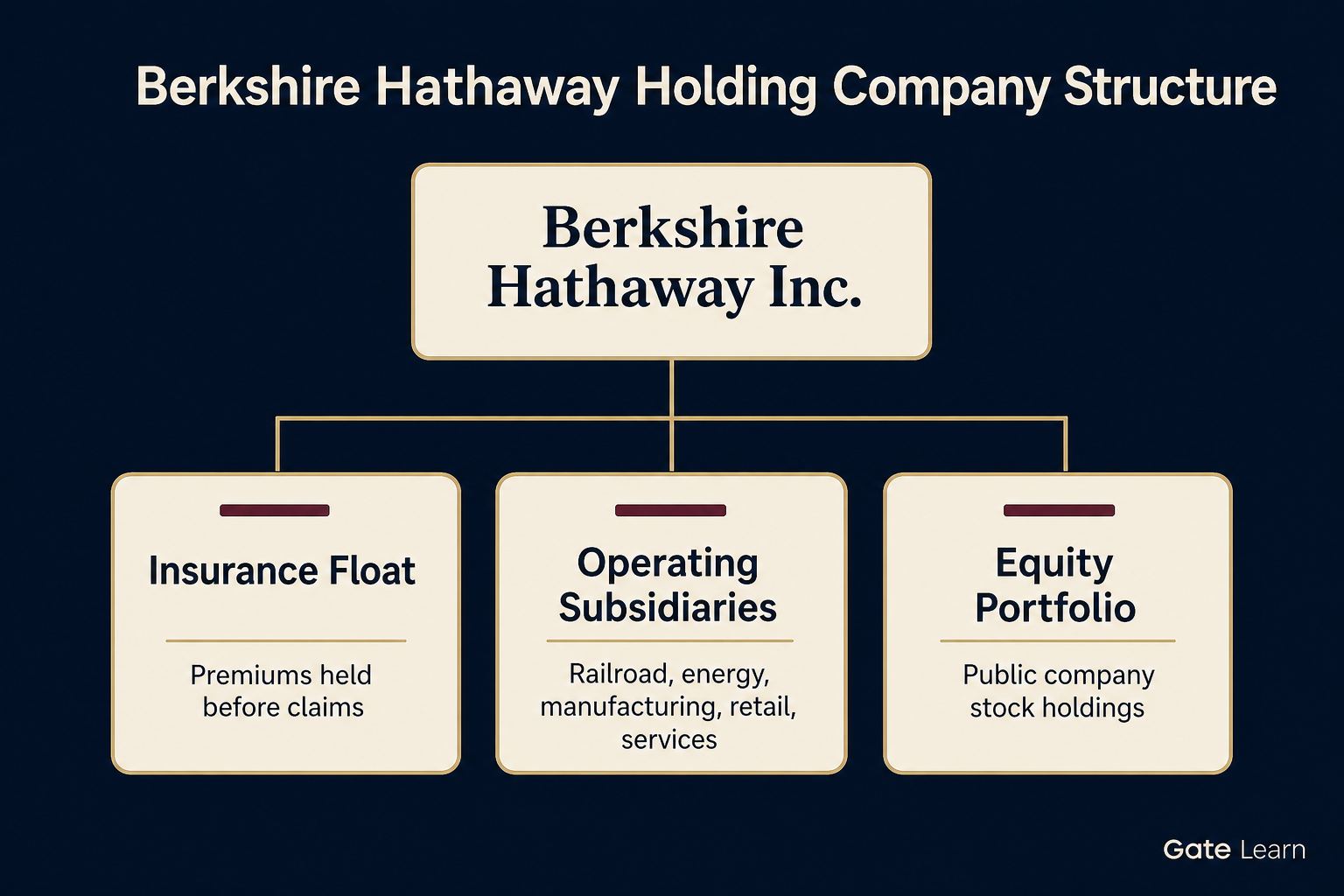 Figure 2. Berkshire Hathaway holding-company structure: insurance float, operating subsidiaries, and public equity portfolio.
How Do You View and Trade BRK.B Stock on Gate Stocks?
On Gate Stocks, BRK.B can be located by searching the ticker. Gate Stocks · BRK.B is the page for verifying the legal name, display name BERKSHIRE HATHAWAY Class B, and on-page fields. When the goal is to complete buy and sell flows with stablecoins, trade BRK.B with USDT walks through funding preparation, symbol search, order fields, and fee checks.
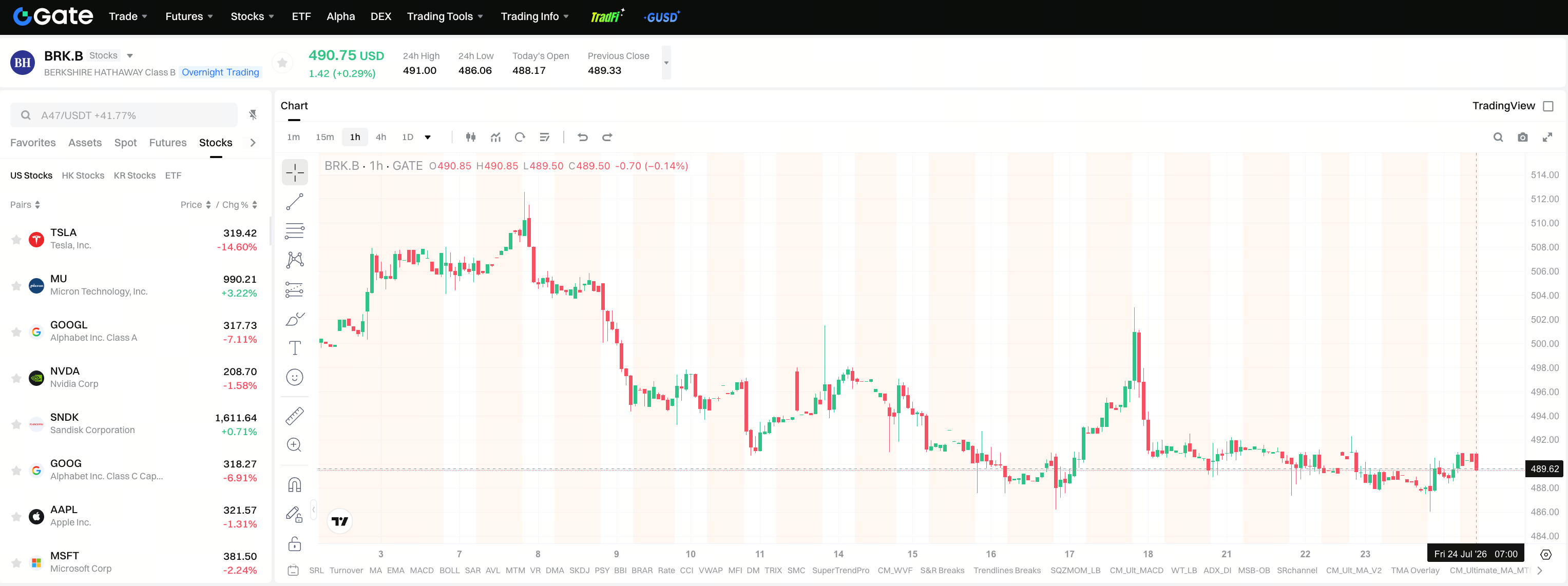
Before any order, confirm the page ticker is BRK.B, the issuer maps to Berkshire Hathaway Inc. Class B, and order type plus available funding match the intended arrangement. Gate Stocks may differ from a traditional brokerage in account structure, settlement display, and funding currency; company research does not replace field-level checks on the order ticket.
| Check item |
Focus |
Notes |
| Ticker and issuer |
BRK.B / BERKSHIRE HATHAWAY Class B |
Avoid mix-ups with BRK.A or nearby codes |
| Funding basis |
Available USDT or other supported balances |
Separate account cash from order-available buying power |
| Order rules |
Type, validity, fees |
Reconfirm against fields shown on the page |
The table layers “understanding the holding company” above “completing trade execution.” Path descriptions outline a repeatable operating framework only; they are not buy or sell guidance.
What Are the Advantages, Risks, and Limits of Trading or Holding BRK.B Stock?
Structural advantages include: BRK.B delivers equity exposure to a large diversified holding company in a smaller share unit; business mix spans insurance, operating subsidiaries, and public equities; and Gate Stocks allows searching and trading BRK.B inside one account framework. Relative to Class A, Class B’s smaller unit also lowers the accessibility barrier of a very large per-share unit size.
Risks and limits should be stated separately. Market risk covers rates, underwriting cycles, subsidiary conditions, and public-holdings volatility. Concentration risk rises if the equity book tilts toward a few large public names. Structural limit: the historical absence of cash dividends means return paths lean more on company value growth and capital allocation than on distributions. Execution risk includes selecting BRK.A by mistake, session rules, fee definitions, and settlement-display differences. Risk notes identify variables; they are not trading advice or return promises.
Summary
Berkshire Hathaway (BRK.B) is Class B common stock of Berkshire Hathaway Inc., conferring a proportional economic claim on the holding company. Understanding the ticker means holding three threads at once: unit-size and voting differences versus BRK.A; insurance float, operating subsidiaries, and equity-portfolio economics; and ticker plus order-field checks on Gate Stocks.
FAQ
What is Berkshire Hathaway / BRK.B?
Berkshire Hathaway Inc. is a U.S.-listed diversified holding company; BRK.B is its Class B common-stock ticker. BRK.B represents a proportional economic claim on company value and appears on Gate Stocks as BERKSHIRE HATHAWAY Class B. It is a U.S. equity stock, not a crypto token.
What is the difference between BRK.A and BRK.B?
BRK.A (Class A) and BRK.B (Class B) are both common shares of Berkshire Hathaway Inc. Class A has a larger unit size and fuller per-share voting rights; Class B has a smaller unit, a fraction of one Class A vote per share, and economic rights mapped on the company’s disclosed fixed ratio.
How does Berkshire Hathaway make money?
Berkshire Hathaway earns mainly through insurance float, operating profits from subsidiaries (railroad, energy, manufacturing, retail, services, and related lines), and a public equity portfolio. Analysis should separate operating profit from mark-to-market moves in public holdings.
Does Berkshire Hathaway pay a dividend?
Per Berkshire Hathaway’s long-standing capital-allocation practice, the company has historically not paid a cash dividend, preferring retained earnings for reinvestment and acquisitions. That is a capital-structure feature, not investment advice; specific corporate actions should be verified in public disclosures.
How do you buy BRK.B with USDT on Gate?
On Gate Stocks, search ticker BRK.B, confirm display name BERKSHIRE HATHAWAY Class B and issuer details, then check available USDT, order type, and fee fields before submitting. The full USDT funding, search, order, and risk path is covered in the trade-BRK.B-with-USDT cluster.
What risks apply when trading BRK.B?
Main risks include market and valuation volatility, insurance and subsidiary operating cycles, equity-portfolio concentration, the structural limit of historically not paying cash dividends, and execution risks such as ticker mix-ups, order rules, and fee definitions on Gate Stocks. Risk notes identify variables; they are not trading advice.