Source: Bitlight Official Website
As the Bitcoin ecosystem continues to expand across Ordinals, Runes, RGB, and BTCFi, demand for high-performance infrastructure is growing rapidly. While Bitcoin offers the highest level of blockchain security and liquidity in the world, it has historically lacked a mature smart contract and DeFi environment. Layer 2 technology has emerged as a key path to unlocking Bitcoin's financial potential, and Bitlight was built precisely for this purpose—to bridge Bitcoin's security layer with on-chain applications.
From a blockchain industry evolution standpoint, Bitlight is not merely tackling transaction scaling—it is building a native financial infrastructure for Bitcoin. By leveraging the RGB client-side validation mechanism, the Lightning payment network, and stablecoin settlement capabilities, Bitlight aims to create a foundational layer that balances security, scalability, and asset programmability. This provides underlying support for payments, lending, asset issuance, on-chain trading, and future BTCFi applications.
What is Bitlight (LIGHT)? Project Background and Development History
Bitlight is a project focused on Bitcoin Layer 2 infrastructure, primarily developing around the RGB Protocol and the Lightning Network.
Although the traditional Bitcoin network offers exceptional security, it faces significant limitations in transaction throughput, smart contract capabilities, and asset issuance. Bitlight's objective is to enable client-side validation via the RGB protocol and combine it with the instant payment capabilities of the Lightning Network, allowing digital assets to circulate within the Bitcoin ecosystem with low costs and high efficiency.
In 2025, Bitlight Labs completed a $9.6 million Pre-A funding round, with investors including Amber Group, Fundamental Labs, Gate Ventures, and Signum Capital, valuing the company at $170 million. The funds are primarily allocated to RGB protocol development, Lightning integration, and native stablecoin payment network infrastructure.
Since 2026, Bitlight has continued to roll out RLN node upgrades, developer toolkits, and an RGB-Lightning desktop client, gradually strengthening the developer ecosystem.
LIGHT Token Economics and Ecosystem Incentive Model
LIGHT is the native utility token of the Bitlight network, with a total supply of 420 million tokens. Over 50% of the tokens are allocated to ecosystem development, developer incentives, and community growth initiatives to drive RGB applications and Layer 2 network expansion.
Primary use cases for LIGHT include:
- Network fee payments
- Node staking and security maintenance
- Governance voting
- Developer incentives
- User reward programs
- Ecosystem project support
In terms of design logic, LIGHT functions similarly to gas tokens on Layer 1 blockchains, with its value capture directly tied to network usage. As payment volume, stablecoin adoption, DeFi protocol activity, and asset issuance grow, demand for LIGHT is expected to increase correspondingly.
How Bitlight Builds a Bitcoin-Native Layer 2 Network
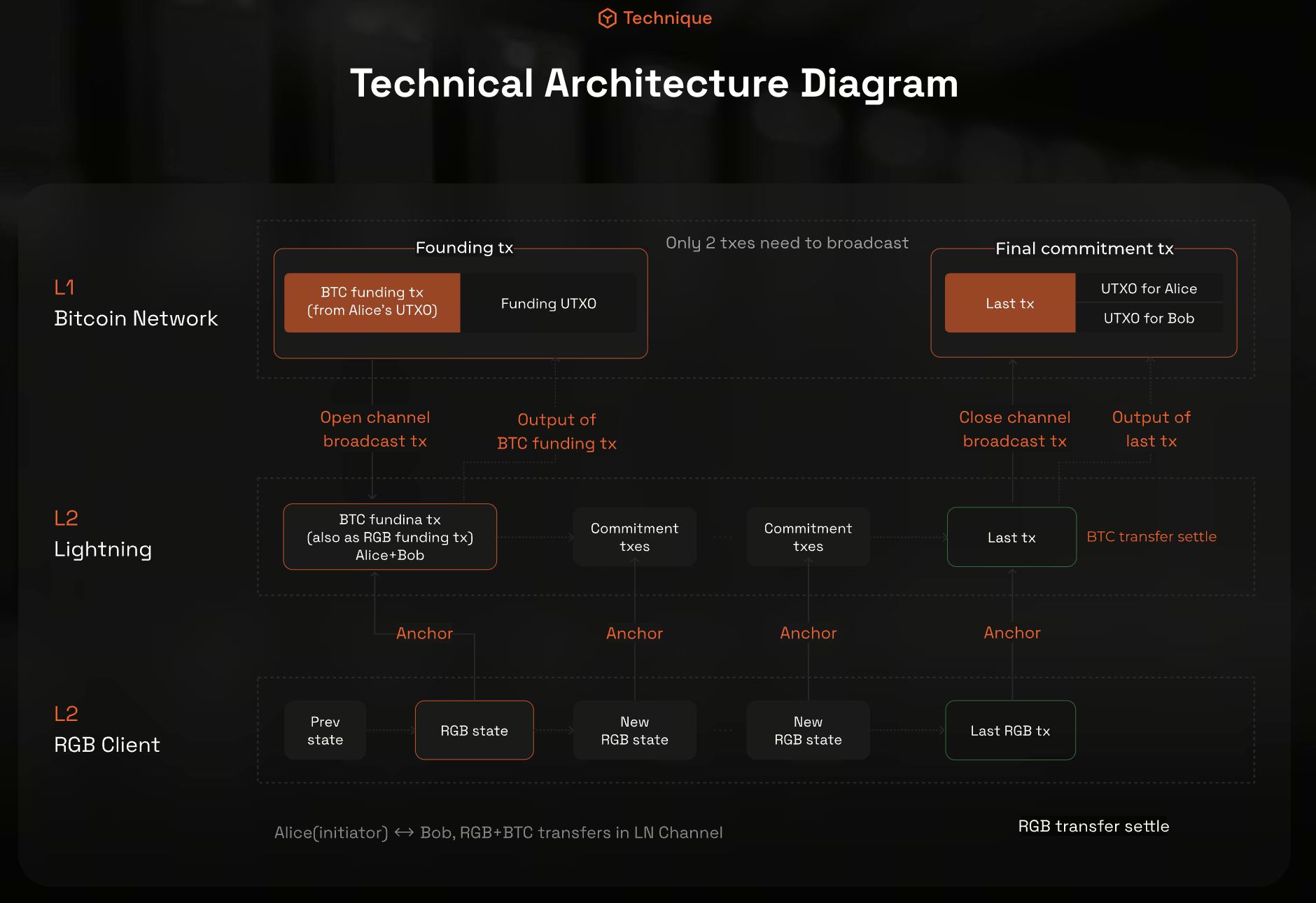
Bitlight's core philosophy is "native Bitcoin Layer 2." Unlike cross-chain bridge solutions that map BTC to other blockchains, Bitlight directly extends Bitcoin's asset management capabilities using the RGB protocol.
The overall flow can be summarized as: Bitcoin Mainchain → RGB Asset Layer → Lightning Network → Application Layer
Under this architecture:
- Bitcoin provides the ultimate security guarantee
- RGB manages asset state
- Lightning Network delivers instant payment capabilities
- Bitlight provides development frameworks and application interfaces
This design preserves Bitcoin's decentralized nature while significantly improving transaction efficiency and asset programmability.
Bitlight's Core Technical Architecture and Settlement Mechanism
Bitlight's technical architecture consists of four main components:
Bitcoin Settlement Layer
All asset final states are confirmed on the Bitcoin network.
This means Bitlight does not require an independent consensus mechanism—it directly inherits Bitcoin's security model.
RGB Smart Contract Layer
RGB is a client-side validation protocol built on Bitcoin's UTXO model.
Its key features include:
- Off-chain data storage
- Off-chain state verification
- Minimal mainchain burden
- Enhanced privacy
Compared to traditional on-chain smart contracts, RGB reduces network congestion and improves scalability.
Lightning Execution Layer
The Lightning Network enables sub-second payments.
Assets can be transferred without waiting for Bitcoin block confirmations, dramatically improving user experience.
Application Layer
Includes:
- Wallets
- DEXs
- Stablecoin protocols
- Lending platforms
- Payment applications
Developers can quickly deploy applications using the Bitlight SDK and RLN nodes.
How Bitlight Powers the Bitcoin DeFi Ecosystem
Bitcoin's DeFi ecosystem has long lagged behind Ethereum's.
Key reasons include:
- Lack of smart contracts
- Insufficient asset liquidity
- High barriers to application development
Bitlight aims to address these challenges by combining RGB and Lightning.
Potential supported BTCFi use cases include:
- Decentralized exchanges (DEXs)
- Stablecoin systems
- Collateralized lending
- Yield aggregation
- On-chain payments
- Derivatives markets
Once BTC can be rapidly transferred and programmed within its native network, Bitcoin's liquidity can be more fully unleashed.
Bitlight's Application Scenarios in Payments, Asset Issuance, and On-Chain Finance
Stablecoin Payments
Bitlight is currently prioritizing the development of its RGB Stablecoin payment system. Following the funding round, the stablecoin payment network was confirmed as a core development focus.
Digital Asset Issuance
Developers can use the RGB protocol to issue on the Bitcoin network:
- Stablecoins
- Points-based assets
- RWA tokens
- Gaming assets
Cross-Border Payments
When combined with the Lightning Network, the cost of micropayments and cross-border settlements drops significantly.
Bitcoin-Native DeFi
In the future, users may directly use BTC or RGB assets to participate in:
- Lending
- Liquidity mining
- Decentralized trading
- Yield management
How Bitlight Differs from Lightning Network, Stacks, and Other Bitcoin Scaling Solutions
| Project |
Bitlight |
Lightning Network |
Stacks |
| Core Goal |
BTCFi and asset issuance |
Payment scaling |
Smart contracts |
| Smart Contracts |
RGB support |
Mostly unsupported |
Supported |
| Asset Issuance |
Supported |
Limited |
Supported |
| Payment Capability |
Strong |
Very strong |
Moderate |
| Security Source |
Bitcoin |
Bitcoin |
Bitcoin |
| DeFi Support |
Relatively strong |
Weak |
Strong |
- Lightning Network is primarily a payment network.
- Stacks is primarily a smart contract platform.
Bitlight aims to combine the strengths of both, unifying payment, asset issuance, and DeFi infrastructure within Bitcoin's native ecosystem.
Key Risks to Consider When Investing in LIGHT Tokens
While Bitlight is innovative, investors should be aware of several risk factors.
Technology Implementation Risk
The RGB protocol is still relatively early stage. Developer activity and application maturity have not yet reached the level of ecosystems like Ethereum.
Market Competition Risk
The Bitcoin Layer 2 space is highly competitive.
Key competitors include:
- Stacks
- Bitlayer
- Rootstock
- Lightning ecosystem projects
All are vying for a share of the BTCFi market.
Token Unlock Risk
Market analysis suggests that the current circulating supply is limited. Future unlock schedules may exert dilution pressure on the market.
Regulatory Risk
Stablecoins and on-chain financial services may continue to be affected by changes in global regulatory policies.
Future Directions and Market Potential of the Bitlight Ecosystem
Based on the roadmap, Bitlight's key focus areas include:
- Completing RGB mainnet infrastructure
- Deep Lightning integration
- Building the stablecoin payment network
- Expanding the developer ecosystem
- Incubating BTCFi applications
Since 2026, the project has launched RLN Node updates, a developer sandbox environment, and a desktop client, demonstrating continued product development momentum. If the Bitcoin DeFi market can achieve the same scale of growth as Ethereum DeFi, infrastructure projects with payment, asset issuance, and smart contract capabilities are likely to attract significant attention.
However, BTCFi remains in its early stages. Ecosystem scale, user adoption, and real application demand still need further validation.
Summary
Bitlight (LIGHT) is one of the most representative infrastructure projects in the Bitcoin Layer 2 space. Its core value lies in combining the RGB Protocol and Lightning Network to bring smart contracts, asset issuance, stablecoin payments, and DeFi capabilities to the Bitcoin ecosystem. Through a client-side validation architecture and Bitcoin's native security model, Bitlight aims to solve Bitcoin's long-standing lack of programmable financial infrastructure.
As BTCFi, RGB assets, and the Bitcoin Layer 2 market continue to develop, Bitlight has the potential to become critical infrastructure bridging Bitcoin liquidity and on-chain financial applications. However, investors should continue to monitor technology maturity, ecosystem growth speed, competitive landscape, and token economics.
FAQs
What is Bitlight (LIGHT)?
Bitlight is a Bitcoin Layer 2 infrastructure built on the RGB Protocol and Lightning Network, designed to support Bitcoin-native asset issuance, payments, and DeFi applications.
What is the function of the LIGHT token?
LIGHT is used for fee payment, governance voting, node staking, ecosystem incentives, and developer rewards.
How is Bitlight different from the Lightning Network?
The Lightning Network focuses on payment scaling, while Bitlight adds RGB asset issuance and smart contract capabilities on top of Lightning, targeting a broader range of BTCFi use cases.
Does Bitlight support stablecoins?
Yes. The stablecoin payment network is a key development priority for Bitlight, and part of its funding is allocated to RGB stablecoin infrastructure.
Is LIGHT a good investment?
LIGHT is a high-risk crypto asset. Its value is closely tied to Bitcoin Layer 2 ecosystem development, project execution, and market competition. Investors should fully understand the associated risks and manage their capital accordingly.