Caldera (ERA) is an Ethereum-oriented rollup network and Rollup-as-a-Service (RaaS) platform: builders deploy dedicated app chains with Rollup Engine, then move assets across those chains with Metalayer instead of forcing every product onto one shared L2. That split—custom execution on one side, shared interoperability on the other—is what “what is Caldera ERA” usually refers to in practice.
Two modules define the product. Rollup Engine covers framework choice, identifiers, hosting, and optional custom gas tokens. Metalayer covers bridge aggregation and Metatoken (hub-and-spoke, deterministic addresses, unified supply). $ERA appears in public docs mainly around cross-chain fees, staking or validation, and governance; always verify contracts and disclosures before treating any ticker as the official asset.
What Is Caldera? How Is It Different From One Shared Chain?
Caldera is built for many purpose-built rollups that interconnect and commonly settle to Ethereum—not one chain that hosts every application. Each app chain can tune throughput, fees, gas token, and governance, then reuse Metalayer routes for messaging and liquidity.
Official site language frames Caldera as interconnected purpose-built blockchains settling on Ethereum. Metalayer materials also cite connectivity across dozens of networks as an order-of-magnitude figure from public disclosures—not a live inventory. Compared with peers such as AltLayer and Conduit, Caldera vs AltLayer and Conduit usually hinges on framework mix, how deep interop is productized, and how Mainnet launches work.
| Dimension |
Single shared chain |
Caldera rollup network |
| Execution |
One shared L1 or L2 |
Many dedicated rollups in parallel |
| Settlement |
Depends on the chain |
Commonly settles to Ethereum |
| Cross-chain |
Third-party or point-to-point bridges |
Metalayer aggregation + Metatoken |
| Go-live |
Deploy apps onto an existing network |
Rollup Engine deploys or hosts custom chains |
Shared chains optimize for a single deployment surface. Caldera trades that simplicity for app-level control and isolation—and accepts more work on bridging, messaging, and multi-stack operations.
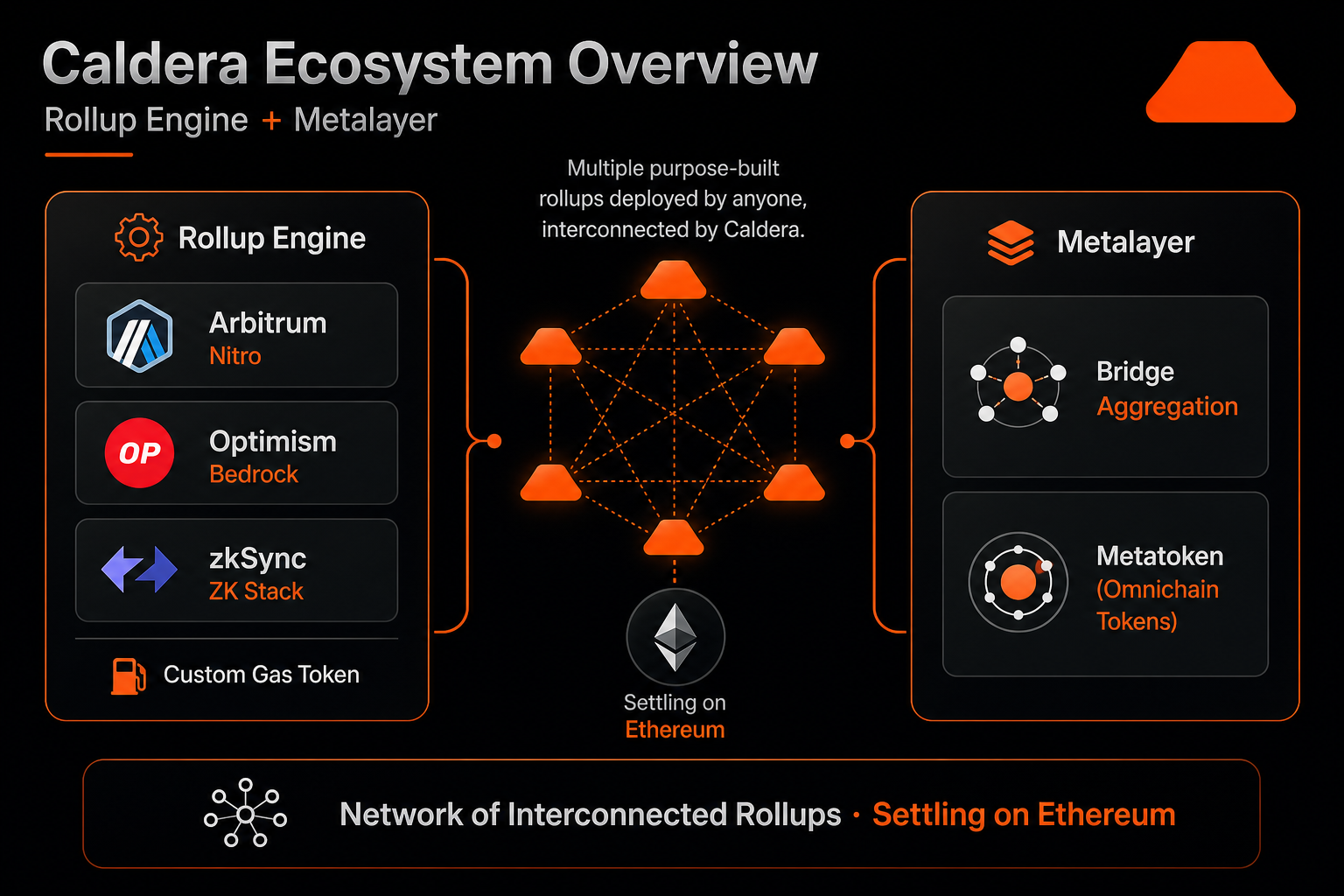 Figure 1. Caldera stack overview: Rollup Engine launches custom chains; Metalayer links them with bridge aggregation and Metatoken.
How Does Caldera’s Rollup Engine Work?
Rollup Engine is the deploy-and-host path for a Caldera chain. Teams pick a framework, network type (Testnet or Mainnet), identifiers, and gas token settings in a repeatable flow. Publicly supported stacks include Arbitrum Nitro, Optimism Bedrock, and zkSync ZK Stack. Under eligible frameworks, most standard ERC-20s can serve as the native gas token; elastic-supply tokens are typically excluded.
Testnet is self-serve in the Dashboard: sign in → Manage Rollups → choose framework and Testnet → set name, subdomain, Chain ID, and gas token → deploy. Mainnet usually starts after a scoped engagement (for example, a demo booking): Caldera launches the production rollup, then teams port the app. Docs often describe Ethereum app ports as relatively quick; actual time still depends on dependencies. For a full checklist, see Deploy a custom rollup on Caldera.
| Stage |
What happens |
Watch for |
| Testnet |
Self-serve framework and params |
Chain ID, subdomain, and gas token lock later integrations |
| Mainnet |
Caldera launches production after alignment |
Settlement chain, framework, and security params in writing |
| App onboarding |
Port contracts and RPC |
Prove gas-token and bridge behavior before open traffic |
Treat “the chain boots” and “safe to onboard users” as different milestones.
Metalayer is Caldera’s interoperability layer. It turns a fragmented set of rollups into one quoting and routing surface for cross-chain transfers. Two product capabilities matter most:
- Bridge aggregation — query native bridges, intent-style protocols, and specialist providers in parallel, then route by cost, speed, security, and liquidity.
- Metatoken — an omnichain token standard for same-address, unified-supply assets across domains.
Public architecture describes three layers: Execution (quotes, routing, tx assembly, status), Bridge providers (intent networks, native bridges, specialist paths such as Metatoken or OFT), and Settlement (Hyperlane-based messaging and finality, including an independent validator set among other controls).
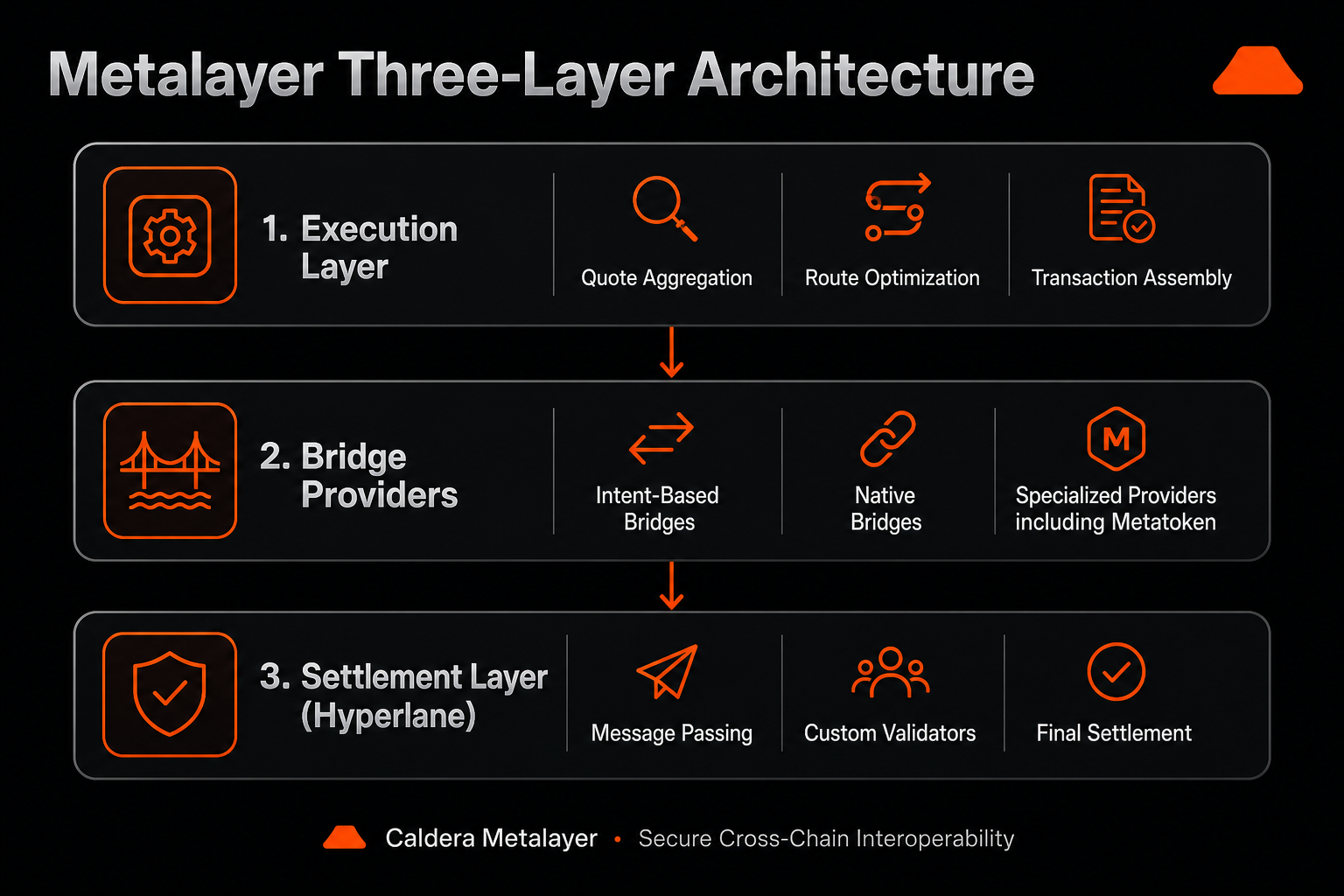 Figure 2. Metalayer layers: Execution aggregates routes, bridge providers fulfill, Settlement finalizes on Hyperlane-backed messaging.
A typical request flows: SDK, widget, or API → parallel quotes → user signs → provider fulfills on the destination → external protocols settle themselves, while Metalayer-powered routes are checked at settlement. Teams can favor faster finality or fuller finality, with route limits and monitoring as controls.
Metatoken (also written MetaToken) is Metalayer’s hub-and-spoke token design: one canonical supply, deterministic addresses across domains, and fewer “wrapped version per chain” fragments. The hub locks and unlocks the canonical asset; spokes mint and burn representations. Large spoke-to-spoke transfers can buffer through the hub and require VALIDATOR_ROLE approval.
Common flows include Hub→Spoke (lock then mint), Spoke→Hub (burn then unlock), low-value Spoke→Spoke (direct burn/mint), and high-value Spoke→Spoke via SecurityRelay. User entry is often transferRemote, with fees quoted up front. Production setups are commonly Caldera-managed so validators and router config stay aligned.
What Is the ERA Token Used For?
$ERA is the publicly discussed native token of the Caldera ecosystem. Materials commonly associate it with Metalayer-related fees, staking or validation arrangements, and governance. Allocation, unlocks, and contract addresses belong in official and on-chain disclosures—tickers alone are easy to spoof.
$ERA does not rewrite Ethereum settlement security for each rollup, and it does not replace an app chain’s gas token. Keep network-level fee or governance roles separate from execution fees on a single rollup, and verify bridges, validators, and upgrade keys independently.
Who Is Caldera For? Gaming, AI, and DeFi Examples
Caldera fits teams that need their own execution environment—fee and gas-token control included—while still reaching Ethereum and peer rollups. Games can isolate peak load and event economies; AI apps can put on-chain orchestration on a tuned chain; DeFi can deploy on an app rollup and pull liquidity through Metalayer with fewer wrapper variants.
It is a poor fit if the expectation is “RaaS means zero ops,” “bridges are risk-free,” or “disclosed connection count equals deep liquidity on every pair.” Selection still comes down to framework, settlement anchor, bridge trust assumptions, and operating capacity.
Advantages, Limits, and Risks of Caldera
Advantages: multi-framework entry and custom gas tokens; one Metalayer integration across many bridge providers, with product claims of near day-zero connectivity for new rollups; Metatoken reducing wrapper sprawl.
Limits: Mainnet is not fully self-serve; UX still depends on underlying providers and finality settings; multi-stack fleets widen monitoring and incident surface area.
Risks (mechanism-level, not advice): smart-contract and upgrade-key risk; different trust and liquidity models per bridge provider; solver or validator failures that delay or drop routes; spoofed $ERA or fake dashboards; centralized sequencers and data-availability assumptions on app chains.
How to Find ERA on Gate
On Gate, match the trading page’s ticker, contract, and network to official disclosures before comparing depth or fees. Gate Learn explains mechanisms; trading pages list assets—neither replaces on-chain checks. Prefer contract address when names collide, and confirm the destination Chain ID is a supported Caldera or Metalayer path before bridging.
Summary
Caldera answers “what is Caldera ERA?” as two coupled layers: Rollup Engine to launch dedicated Ethereum-settling rollups, and Metalayer to interconnect them with bridge aggregation and Metatoken. $ERA shows up in fee, staking or validation, and governance narratives. The useful mental model is always three checks—app-chain parameters, cross-chain trust assumptions, and token identity.
FAQ
What is Caldera (ERA)?
Caldera is a RaaS and interconnected rollup network oriented around Ethereum settlement, built from Rollup Engine and Metalayer. ERA ($ERA) is the ecosystem’s publicly discussed native token, often linked to cross-chain fees, staking or validation, and governance.
What is the ERA token used for?
Public materials commonly cite Metalayer-related fees, staking or validation, and governance. Confirm parameters and contracts from official and on-chain sources; names and symbols can be copied.
Metalayer aggregates quotes across many bridge types and adds Metatoken for unified, same-address assets. A single bridge usually offers one path and one security model.
Is Caldera a Layer 2?
Caldera itself is closer to RaaS plus a network of rollups. The L2 or app chain users interact with is the specific chain launched through Rollup Engine. “Caldera” is not one single L2.
How does Caldera compare to AltLayer or Conduit?
Compare frameworks, whether interop is built in (Metalayer), Testnet vs Mainnet process, and gas-token flexibility. There is no universal “best”—match interop depth and ops handoff to the product.
What are the main risks of using Caldera?
Smart contracts and upgrade keys, divergent bridge trust models, route delays or failures, spoofed tokens, and sequencer or DA assumptions on app chains. Verify contracts, networks, and bridge paths independently.







