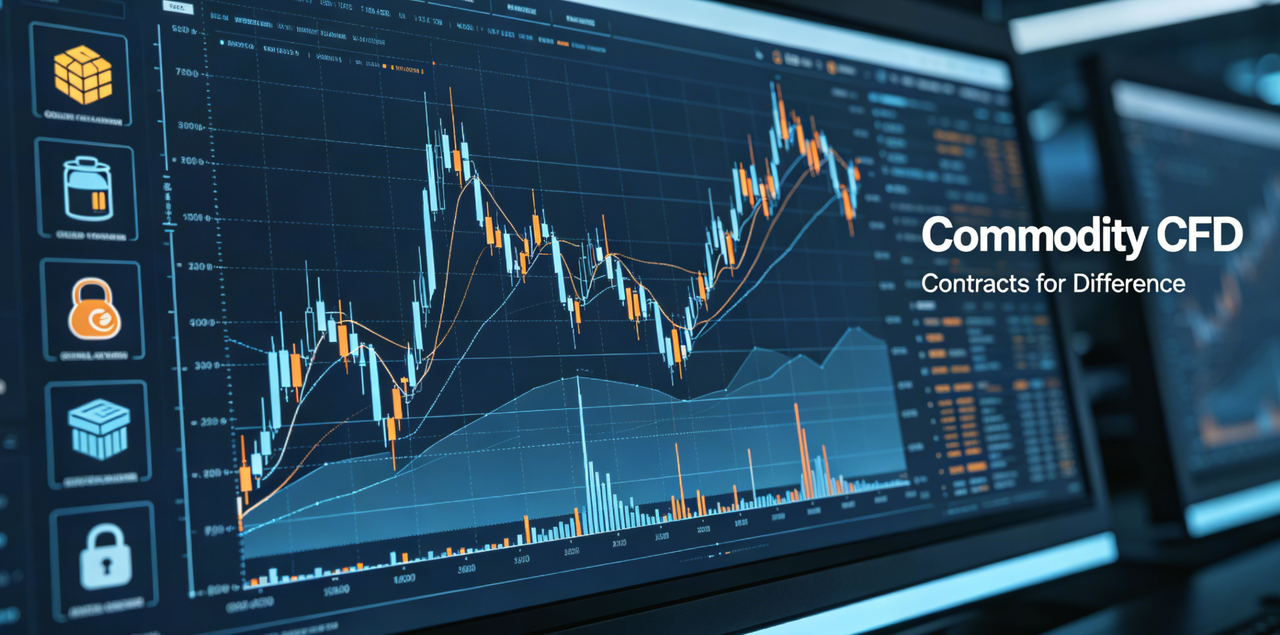
Commodity CFD, or Commodity Contract for Difference, is a financial derivative settled based on changes in commodity prices. Traders do not need to physically hold commodities such as gold, silver, crude oil, or natural gas to participate in market movements. Commodity CFDs usually use margin and leverage mechanisms, allowing users to create larger market exposure with less capital.
With the development of global online trading platforms, commodity CFDs are widely used across precious metals such as gold, as well as energy and agricultural markets. Compared with traditional spot commodity trading, commodity CFDs, including gold CFDs, focus more on trading price movements than on holding or delivering physical commodities. As a result, they have gradually become an important trading format in the retail derivatives market.
As digital assets become more closely connected with global macro markets, commodity CFDs are also being used by more traders for risk hedging, short term trading, and cross market asset allocation.
What Is Commodity CFD?
A Commodity CFD, or Commodity Contract for Difference, is a financial derivative that allows traders to seek gains from changes in commodity prices. During the trading process, users do not actually hold commodities such as gold, silver, crude oil, or natural gas. Instead, profits and losses are settled based on the price difference between opening and closing a position.
What Assets Can Be Traded Through Commodity CFDs?
The underlying assets of commodity CFDs usually cover precious metals, energy products, and some agricultural markets.
Gold CFDs and silver CFDs are among the most common types of commodity CFDs in the market. Because precious metals have long been viewed as safe haven assets, their prices are usually affected by inflation, interest rates, and movements in the US dollar.
Crude oil CFDs mainly follow volatility in the international energy market, including major benchmarks such as WTI crude oil and Brent crude oil. Energy markets are often highly volatile, so crude oil CFDs are relatively active in short term trading.
Some platforms also offer commodity CFD products such as natural gas, copper, wheat, and coffee, allowing traders to access a wider range of global commodity markets.
How Do Commodity CFDs Work?
The core logic of commodity CFDs is “settlement by price difference.” Traders open positions based on their expectations of whether a commodity price will rise or fall, and profits or losses are calculated according to the price change when the position is closed.
If a trader expects the price of gold to rise, they can open a long position. If they believe the price of crude oil will fall, they can open a short position. Because CFDs support two way trading, both rising and falling markets may create trading opportunities.
Commodity CFDs usually use a margin mechanism. Traders do not need to pay the full value of the commodity. Instead, they only need to set aside a certain proportion of funds to establish a larger trading position.
For example, with 10x leverage, a margin of 1,000 US dollars may correspond to a commodity position worth 10,000 US dollars.
What Is the Difference Between Commodity CFDs and Commodity Futures?
Commodity CFDs and commodity futures are both commodity derivatives, so they are often compared with each other. However, they differ clearly in market structure and trading mechanisms.
Commodity CFDs are usually quoted by brokers, and traders trade directly with the platform. Most products do not have a fixed expiration date. Commodity futures, by contrast, are standardized exchange traded contracts that usually have clear expiration dates and delivery rules.
In addition, commodity CFDs place more emphasis on retail access and flexible trading, while commodity futures are more often used for institutional risk management and large scale market hedging.
Comparison Dimension
Commodity CFD
Commodity Futures
Market Structure
Broker market
Exchange market
Expiration Date
Usually none
Yes
Physical Delivery
Usually not involved
Involved in some cases
Leverage Structure
Set by the broker
Set by the exchange
User Type
More common among retail traders
More common among institutional participants
Holding Cost
Overnight financing fees
Rollover costs
Why Do Commodity CFD Prices Fluctuate?
Commodity prices are usually affected by global macroeconomic conditions, supply and demand, and geopolitical factors.
Gold prices are often related to movements in the US dollar, interest rate policy, and market demand for safe haven assets. When global economic uncertainty increases, gold price volatility often rises as well.
The crude oil market is more easily affected by production changes, geopolitical conflicts, and global economic demand. For example, production cuts by major oil producing countries may push crude oil prices higher, while expectations of economic recession may weaken energy demand.
Because commodity markets are closely linked to the global economy, commodity CFDs often have relatively high volatility.
What Are the Main Risks of Commodity CFDs?
Commodity CFDs are high risk leveraged derivatives. Their risks mainly come from price volatility and the amplifying effect of leverage.
Because commodity markets are already volatile, leverage may further magnify changes in account profits and losses. In highly volatile markets such as crude oil, sharp price movements over a short period may cause margin levels to fall quickly.
In addition, long term positions usually incur overnight financing fees. When severe market volatility causes account equity to fall below the maintenance margin requirement, the platform may trigger forced liquidation.
Regulatory policies for commodity CFDs also differ across countries and regions. Some markets impose limits on leverage ratios.
The Role of Commodity CFDs in Global Markets
Commodity CFDs give retail traders a way to participate in global commodity markets without directly handling physical commodities or dealing with complex futures delivery systems.
For some traders, commodity CFDs can be used for short term volatility trading. For some institutions or companies, they may also be used to hedge price risk. For example, energy related companies may pay close attention to the impact of crude oil price fluctuations on their operations.
As global macro markets become more interconnected, commodity CFDs have gradually become one of the important tools linking traditional commodity markets with online derivatives trading systems.
Conclusion
Commodity CFD is a financial derivative settled based on commodity price movements. It allows traders to participate in markets such as gold and crude oil without holding the physical commodities.
Compared with traditional commodity futures, commodity CFDs place more emphasis on flexibility and lower entry barriers. Their core structure revolves around margin, leverage, spreads, and risk control mechanisms. Because commodity markets are naturally volatile, commodity CFDs are also high risk trading instruments.
FAQs
Do Commodity CFDs Require Holding Physical Commodities?
No. Commodity CFDs are derivatives settled by price difference, and no physical commodity delivery takes place during trading.
Why Do Commodity CFDs Support Leverage?
Commodity CFDs use a margin mechanism, so traders can establish larger market exposure with less capital.
What Is the Difference Between Gold CFDs and Crude Oil CFDs?
Gold CFDs are more easily affected by safe haven sentiment and interest rates, while crude oil CFDs are usually more affected by supply and demand and geopolitical factors.
Are Commodity CFDs the Same as Commodity Futures?
Both are commodity derivatives, but commodity CFDs are more oriented toward the retail market, while commodity futures are standardized exchange traded products.
Why Are Commodity CFDs High Risk?
Because commodity markets can be highly volatile, and leverage may magnify losses, commodity CFDs are considered high risk trading products.
Do Commodity CFDs Have an Expiration Date?
Most commodity CFDs do not have a fixed expiration date, but long term positions usually incur overnight financing fees.
Author: Jayne
Translator: Jared
Disclaimer
* The information is not intended to be and does not constitute financial advice or any other recommendation of any sort offered or endorsed by Gate.
* This article may not be reproduced, transmitted or copied without referencing Gate. Contravention is an infringement of Copyright Act and may be subject to legal action.
DEX aggregators integrate order data, price information, and liquidity pools from multiple decentralized exchanges, helping users find the optimal trading path in the shortest time. This article delves into 8 commonly used DEX aggregators, highlighting their unique features and routing algorithms.