As Web3 ecosystems continue to expand, DAOs have evolved beyond simple token voting mechanisms into broader organizational structures involving community management, treasury coordination, contributor collaboration, and ecosystem operations. However, many DAO communities still face challenges such as fragmented tools, complex governance processes, and limited data visibility.
DAOBase focuses on addressing these challenges by providing infrastructure that combines DAO management tools, blockchain data analysis, and AI-driven capabilities. Through its platform, users can explore DAO activities, participate in governance processes, and better understand decentralized organization operations.
The DAOBase ecosystem is also supported by BEE Token, which functions as the platform’s native Utility and Governance Token. BEE Token connects ecosystem participation, community incentives, and DAOBase’s long-term development framework.
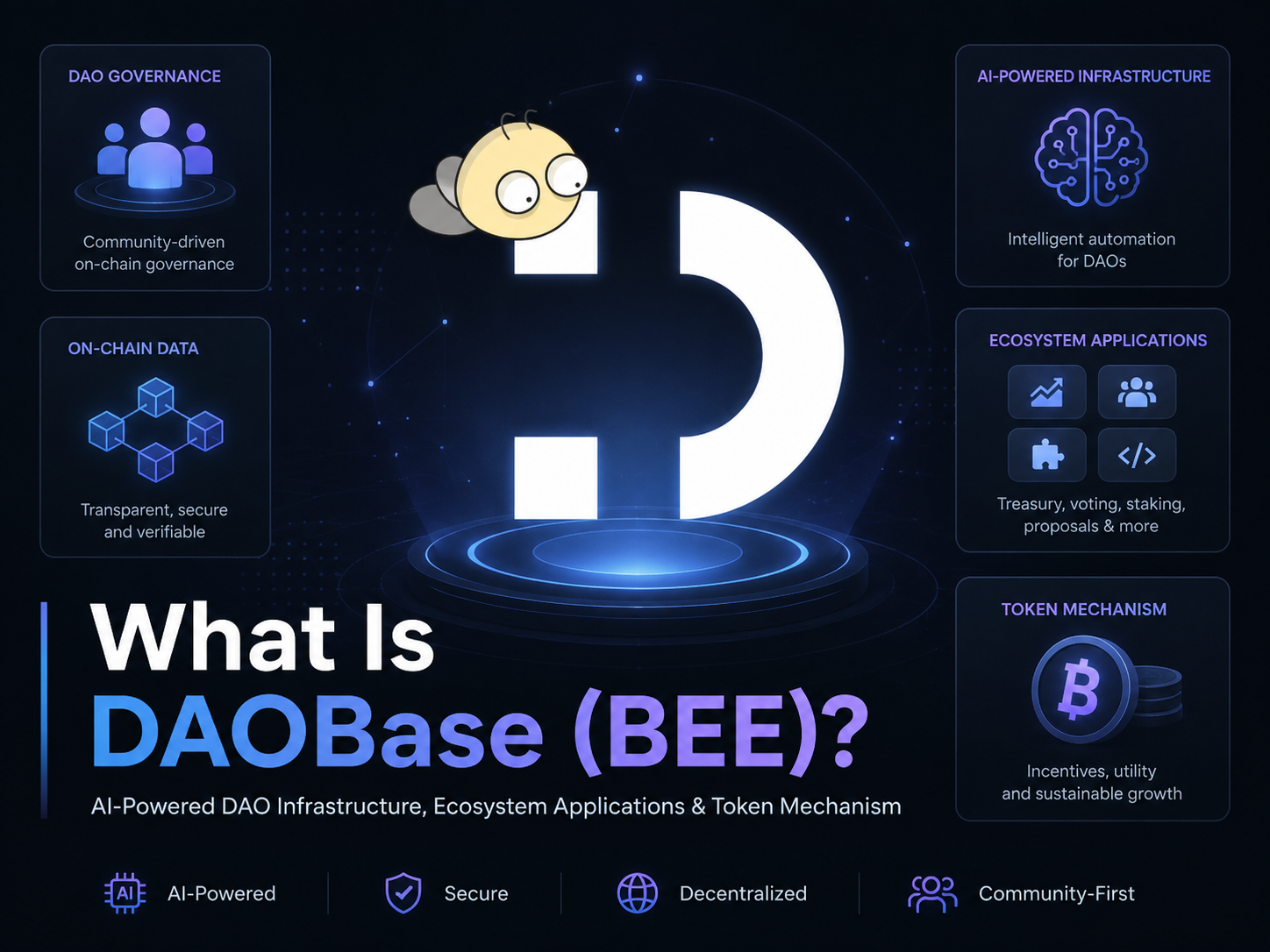
What Is DAOBase (BEE)? How Does the AI-Powered DAO Infrastructure Position Itself?
DAOBase is a DAO infrastructure platform designed to support the creation, management, and analysis of decentralized autonomous organizations. The platform focuses on providing tools that help communities and organizations operate more efficiently through governance systems, blockchain data, and automation capabilities.
Unlike traditional DAO tools that mainly provide individual governance functions such as proposal voting, DAOBase aims to offer a broader infrastructure layer covering DAO lifecycle management. This includes supporting DAO creation, community coordination, governance activities, and ecosystem analysis.
DAOBase positions itself as a platform connecting different participants in the DAO ecosystem, including DAO creators, community members, developers, and researchers. By combining governance tools with data-driven insights, DAOBase aims to reduce the complexity of managing decentralized organizations.
How Does DAOBase Solve Problems in DAO Creation, Governance, and Community Management?
DAOBase addresses several common challenges faced by decentralized organizations, including complicated setup processes, fragmented governance tools, and inefficient community coordination.
Traditional DAOs often rely on multiple independent platforms for governance voting, treasury management, community communication, and data tracking. This fragmented approach can increase operational complexity and make it harder for members to understand organizational activities.
DAOBase integrates different DAO-related functions into a unified infrastructure environment. By combining governance tools, blockchain data, and community management features, DAOBase provides users with a more structured way to participate in decentralized organizations.
The main challenges DAOBase focuses on include:
| Challenge |
DAOBase Approach |
| Complex DAO creation |
Provides infrastructure tools for launching DAO organizations |
| Fragmented governance tools |
Integrates governance-related functions |
| Limited data visibility |
Uses blockchain data analysis capabilities |
| Low community engagement |
Supports community participation mechanisms |
What Are the Core Features of DAOBase?
DAOBase provides several infrastructure components designed to support different stages of DAO development, from organization creation to governance management and ecosystem analysis.
The platform’s core features include DAO creation tools, governance systems, DAO search capabilities, blockchain data analysis, and community-oriented functions. These features allow users to explore existing DAOs, understand governance activities, and manage decentralized organizations.
Key DAOBase features include:
| Feature |
Function |
| DAO Creation Tools |
Helps users establish and organize DAO structures |
| Governance Tools |
Supports community decision-making processes |
| DAO Search Engine |
Helps users discover and analyze DAO ecosystems |
| On-chain Data Analysis |
Provides blockchain-based insights |
| Community Tools |
Supports contributor interaction and participation |
Through these features, DAOBase attempts to provide a complete infrastructure layer for users who want to participate in or build decentralized organizations.
How Do DAOBase’s AI and On-Chain Data Capabilities Improve DAO Governance Efficiency?
DAOBase combines AI capabilities with blockchain data analysis to improve how decentralized organizations manage information and coordinate community activities.
Traditional DAOs often require members to manually review proposals, governance records, contributor activity, and on-chain transactions. As DAO ecosystems grow, processing large amounts of governance data becomes increasingly difficult, which can reduce participation efficiency.
By integrating AI-driven tools and blockchain data insights, DAOBase aims to help users better understand DAO activities, identify ecosystem trends, and improve decision-making processes. AI capabilities can assist with organizing complex information, while on-chain data provides transparent records of community behavior and governance activity.
The combination of AI and blockchain analytics allows DAOBase to move beyond basic voting infrastructure and explore a more data-driven approach to decentralized organization management.
What Are the Main Use Cases of DAOBase? How Can DAOs and Web3 Organizations Use It?
DAOBase can support different types of decentralized organizations, including community DAOs, investment DAOs, Web3 projects, and other blockchain-based organizations.
For community DAOs, DAOBase provides tools for managing governance activities, tracking participation, and organizing community information. These functions help communities coordinate members and improve transparency.
For Web3 projects and ecosystem builders, DAOBase can serve as infrastructure for creating and managing decentralized communities. By combining governance tools, data analysis, and participation mechanisms, DAOBase helps organizations build stronger relationships with contributors.
| Use Case |
How DAOBase Can Support It |
| Community DAOs |
Governance management and member coordination |
| Investment DAOs |
Community decision-making and organization management |
| Web3 Projects |
Building decentralized communities and contributor systems |
| DAO Researchers |
Analyzing governance activities and ecosystem data |
As DAO adoption expands, infrastructure platforms like DAOBase aim to simplify the process of creating and operating decentralized organizations.
What Is the Role of BEE Token in the DAOBase Ecosystem?
BEE Token is the native Utility and Governance Token of the DAOBase ecosystem, designed to support governance participation, ecosystem incentives, and community coordination.
Rather than functioning only as a tradable asset, BEE Token connects different participants within the DAOBase ecosystem, including users, DAO creators, developers, and community contributors.
The role of BEE Token can be divided into three main areas:
| Role |
Function |
| Governance |
Supports participation in DAOBase ecosystem decisions |
| Utility |
Connects users with DAOBase ecosystem functions |
| Incentives |
Rewards community participation and ecosystem contributions |
Through BEE Token, DAOBase creates an incentive layer that links user participation with ecosystem development. The Token model is designed to encourage long-term community involvement rather than relying only on platform usage.
How Do DAOBase NFTs, Points, and Community Programs Support Ecosystem Participation?
DAOBase uses NFTs, Points, and community programs to create multiple participation paths beyond simply holding BEE Token.
Points serve as a mechanism for recording user engagement within the DAOBase ecosystem. Users can accumulate participation records through activities such as using DAOBase products, joining community activities, and completing ecosystem-related actions.
DAOBase also introduces NFT-based identity mechanisms, including DAO BadgeX, which are designed to represent user identity and contribution history within the Web3 governance ecosystem.
These mechanisms work together as different layers of participation:
| Component |
Purpose |
| Points |
Tracks user activities and ecosystem contributions |
| NFTs |
Represents identity, reputation, and community status |
| Community Programs |
Encourages participation and ecosystem growth |
| BEE Token |
Provides governance and incentive functions |
This structure allows DAOBase to create a broader community economy where users can participate through different channels before directly engaging with the Token ecosystem.
DAOBase differs from traditional DAO platforms by focusing on a broader infrastructure approach that combines DAO discovery, governance support, blockchain data analysis, and community participation mechanisms.
Platforms such as Snapshot primarily focus on governance voting, while Aragon focuses on DAO creation frameworks and organizational management. DAOBase aims to combine multiple aspects of DAO operations into a more integrated ecosystem.
| Comparison |
DAOBase |
Snapshot |
Aragon |
| Core Focus |
DAO infrastructure and ecosystem management |
Governance voting |
DAO creation framework |
| DAO Creation |
Supported through infrastructure tools |
Limited |
Supported |
| Governance |
Supported |
Core feature |
Supported |
| Data Analysis |
Focus on blockchain data insights |
Limited |
Limited |
| Community Features |
Includes participation mechanisms |
Mainly governance-focused |
Organization-focused |
DAOBase’s differentiation comes from combining governance, data, and community participation into one ecosystem rather than focusing on a single DAO function.
What Are DAOBase’s Advantages, Limitations, and Future Development Directions?
DAOBase’s main advantage is its attempt to provide a broader infrastructure layer for decentralized organizations. By combining DAO creation tools, governance functions, blockchain data analysis, and community mechanisms, DAOBase addresses multiple stages of DAO development.
Another advantage is the integration of AI and data capabilities. As DAOs become larger and more complex, tools that help communities understand information and coordinate activities may become increasingly important.
However, DAOBase also faces challenges common among DAO infrastructure projects. The adoption of DAO tools depends on overall ecosystem growth, user participation, and whether decentralized organizations achieve wider practical adoption.
The long-term development of DAOBase will depend on how effectively its infrastructure, Token model, and community mechanisms support real-world DAO operations.
Summary
DAOBase (BEE) is an AI-powered DAO infrastructure platform designed to support decentralized organization creation, governance management, blockchain data analysis, and community participation.
Unlike traditional DAO tools that mainly focus on individual functions such as voting or organization deployment, DAOBase aims to provide a broader ecosystem covering DAO operations, data insights, and community coordination.
BEE Token serves as the native Utility and Governance Token within this ecosystem, connecting governance participation, incentives, and community activities. Through additional mechanisms such as Points, NFTs, and community programs, DAOBase creates multiple ways for users to participate in ecosystem development.
As DAO adoption continues to evolve, DAOBase’s growth will depend on ecosystem expansion, user adoption, and the practical application of decentralized organization infrastructure.
FAQ
What is DAOBase used for?
DAOBase is used to support DAO creation, governance management, blockchain data analysis, and community coordination. The platform provides infrastructure tools designed to help decentralized organizations operate more efficiently.
What is BEE Token in DAOBase?
BEE Token is the native Utility and Governance Token of DAOBase, supporting ecosystem incentives, governance participation, and community coordination within the DAOBase ecosystem.
Does DAOBase use AI technology?
Yes. DAOBase incorporates AI and blockchain data capabilities to help users analyze DAO activities, organize information, and improve decentralized organization management.
How can users participate in the DAOBase ecosystem?
Users can participate through DAOBase products, community programs, Points systems, NFT-based identity mechanisms, and other ecosystem activities.
What makes DAOBase different from Snapshot?
Snapshot mainly focuses on DAO proposal voting, while DAOBase aims to provide broader DAO infrastructure including governance tools, data analysis, and community participation features.
What problems does DAOBase solve for DAOs?
DAOBase addresses challenges such as fragmented DAO tools, complex governance processes, limited data visibility, and inefficient community coordination.