As blockchain technology extends beyond crypto assets into real-world finance, a growing number of institutions are exploring how distributed ledgers can optimize lending, bonds, securitized products, and credit asset management. Figure is widely recognized as a major player in U.S. on-chain financial infrastructure, operating across loan services, a capital markets platform, and a blockchain network designed specifically for financial institutions.
Figure was founded in 2018 by an experienced fintech team with the goal of leveraging blockchain to tackle persistent inefficiencies in traditional financial markets. Conventional loan and capital market transactions often involve numerous intermediaries, complex data synchronization, and high operational costs.
As digital finance evolves, the market has turned its attention to using automation to reduce manual intervention. Figure adopted blockchain as its core technology, digitizing loan origination, asset management, and securitization through on-chain records, smart contracts, and automated settlement.
Unlike most crypto projects, Figure's focus isn't on issuing a cryptocurrency, but on building infrastructure networks for institutions and financial market participants.
Figure's business model revolves around the financial asset lifecycle, including creation, registration, trading, and management.
In its lending business, after a user submits an application, asset information is reviewed and recorded digitally. Once an asset is formed, it can enter the capital market for financing or securitization.
The blockchain network keeps asset data unified and traceable, reducing data silos between legacy systems. Smart contracts execute certain business rules, lowering costs from manual operations and repeated reviews.
Provenance Blockchain serves as the critical underlying network for the Figure ecosystem, purpose-built to support on-chain management and trading of financial assets.
Unlike open public blockchains, Provenance Blockchain is designed specifically for financial applications. It supports asset registration, ownership records, trade settlement, and audit trails, enabling institutions to use blockchain while staying compliant with regulatory requirements.
For loans, securitized products, and other RWA assets, Provenance Blockchain provides a unified data layer, ensuring transparency and verifiability throughout the asset's entire lifecycle.
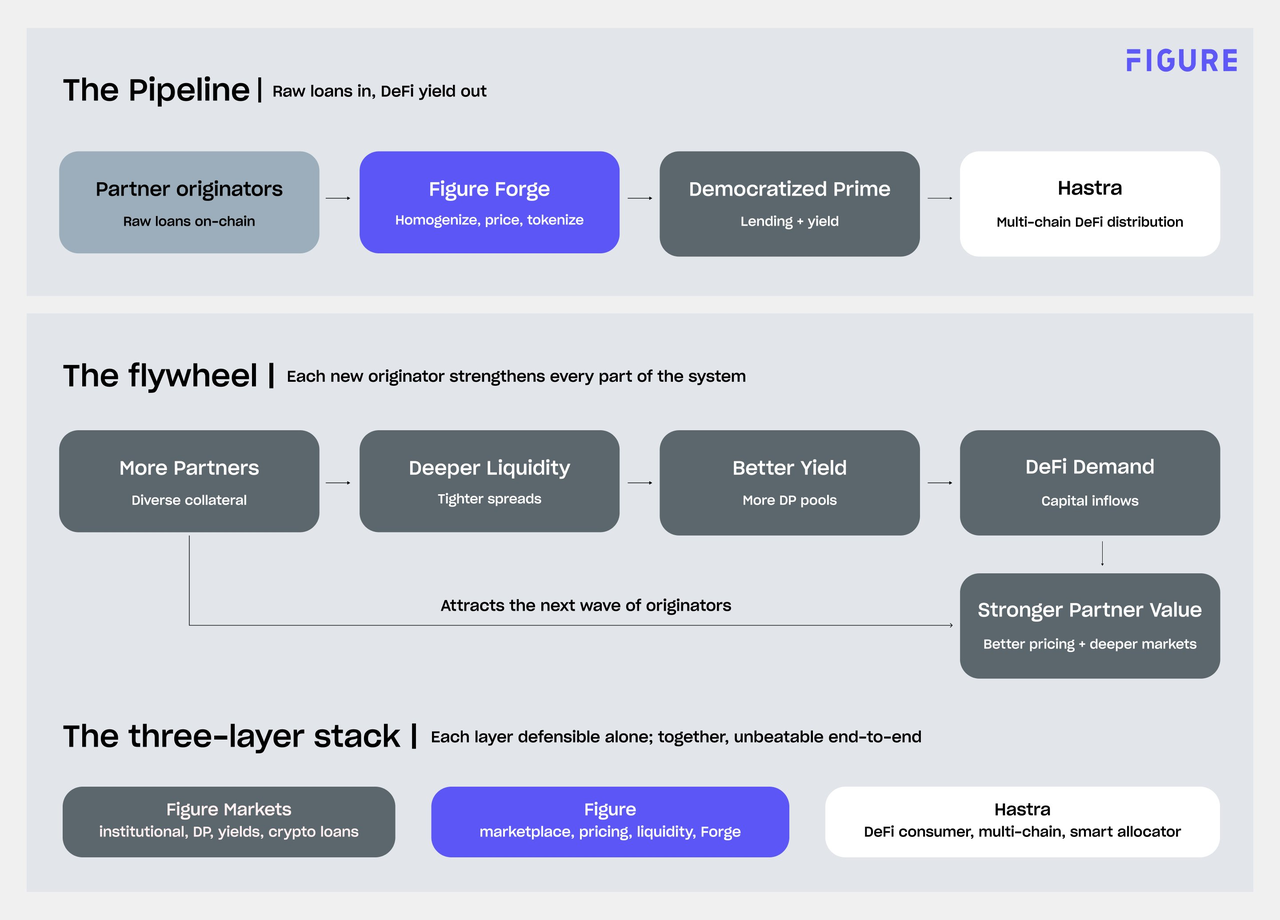
Figure Connect is an on-chain capital markets network launched by Figure, designed to connect loan originators, financial institutions, and asset investors.
In traditional loan markets, after origination, loans typically pass through multiple intermediaries for transfer, pooling, and securitization. Figure Connect integrates these steps into a single, unified platform through digitization and on-chain processes.
Within this network, loan assets can be transferred and priced more quickly, while also boosting market transparency. For institutional participants, this means improved asset management efficiency and liquidity.
Real-world assets (RWAs) refer to assets from real economic activity that are mapped onto a blockchain for management and trading.
Figure's business is inherently tied to RWAs, as its core assets include mortgages, consumer loans, and other credit products — all key components of real-world financial markets.
By leveraging blockchain, Figure digitizes asset creation, registration, transfer, and securitization, enhancing overall asset management efficiency.
Figure and traditional banks both offer loan-related services, but their underlying architectures are fundamentally different.
Traditional institutions rely on centralized databases and manual processes, while Figure emphasizes digital and automated operations.
In asset transfer, legacy systems often involve multiple independent platforms and intermediaries. Figure, by contrast, builds a unified data environment on a blockchain network for end-to-end asset lifecycle management.
| Comparison Dimension |
Figure |
Traditional Financial Institutions |
| Technology Foundation |
Blockchain network |
Centralized systems |
| Data Management |
On-chain records |
Fragmented across multiple systems |
| Asset Transfer |
Automated processes |
Multiple intermediaries |
| Settlement Model |
Digital settlement |
Traditional clearing |
| Transparency |
Traceable records |
Siloed information |
It's important to note that Figure isn't replacing traditional financial institutions — it's using technology to improve the efficiency of financial market infrastructure.
As the RWA market grows, more institutions are paying attention to blockchain's real-world asset management potential.
Figure's on-chain loan network and capital markets infrastructure offer a proven model for financial asset digitization. As asset volumes and institutional participation increase, its network effects could strengthen further.
At the same time, Figure faces challenges around regulatory compliance, industry standards, institutional adoption, and system interoperability. Building on-chain financial infrastructure requires both technological innovation and seamless integration with existing financial systems.
Summary
Figure is a fintech company focused on blockchain financial infrastructure. Through loan digitization, Provenance Blockchain, Figure Connect, and the RWA network, it drives the migration of traditional financial assets on-chain. Its core value lies in using blockchain to optimize lending, securitization, and capital market processes, improving asset transfer efficiency, transparency, and automation.
FAQ
Which blockchain network does Figure use?
The Figure ecosystem primarily runs on Provenance Blockchain. This network is designed specifically for financial asset management and capital market applications, supporting on-chain registration, trading, and settlement.
What is the main purpose of Figure Connect?
Figure Connect is an on-chain capital markets network that connects loan originators, financial institutions, and investors, improving loan asset transfer efficiency and enhancing market transparency.
How does Figure relate to RWA?
Figure's core business involves real-world assets like mortgages and credit loans, making it highly relevant to the RWA space. Its infrastructure helps bring real financial assets into digital, on-chain circulation.
What is the difference between Provenance Blockchain and ordinary public blockchains?
Provenance Blockchain is more focused on financial use cases, emphasizing asset registration, compliance management, audit trails, and institutional-grade applications, whereas ordinary public blockchains are typically geared toward broader, open ecosystems.







