The development of the digital asset industry is reshaping how global capital markets are accessed. The rise of stablecoins, on-chain financial infrastructure, and Real World Assets (RWA) has deepened the connection between traditional financial assets and digital asset markets. Gate Stocks has introduced a Korean Stock Zone within its global stock market system, offering users a new way to participate in the Korean stock market using USDT while further enriching global asset allocation opportunities.
Buying Korean Stocks with USDT on Gate: A Complete Beginner’s Guide
Gate Korea Stocks is a Korean stock trading service available through Gate Stocks that allows users to invest in the Korean stock market via their digital asset accounts.
After activating their stock account, users can use stablecoins like USDT as a funding gateway to buy and sell shares of Korean listed companies. The entire process takes place within the unified account system, enabling centralized management of digital assets and stock holdings.
Compared to traditional cross-border securities investments, Gate Korea Stocks emphasizes the connection between digital asset accounts and global stock markets, delivering a more seamless cross-market investment experience.
How to Buy Korean Stocks with USDT: A Step-by-Step Guide
Using USDT to buy Korean stocks typically involves several straightforward steps.
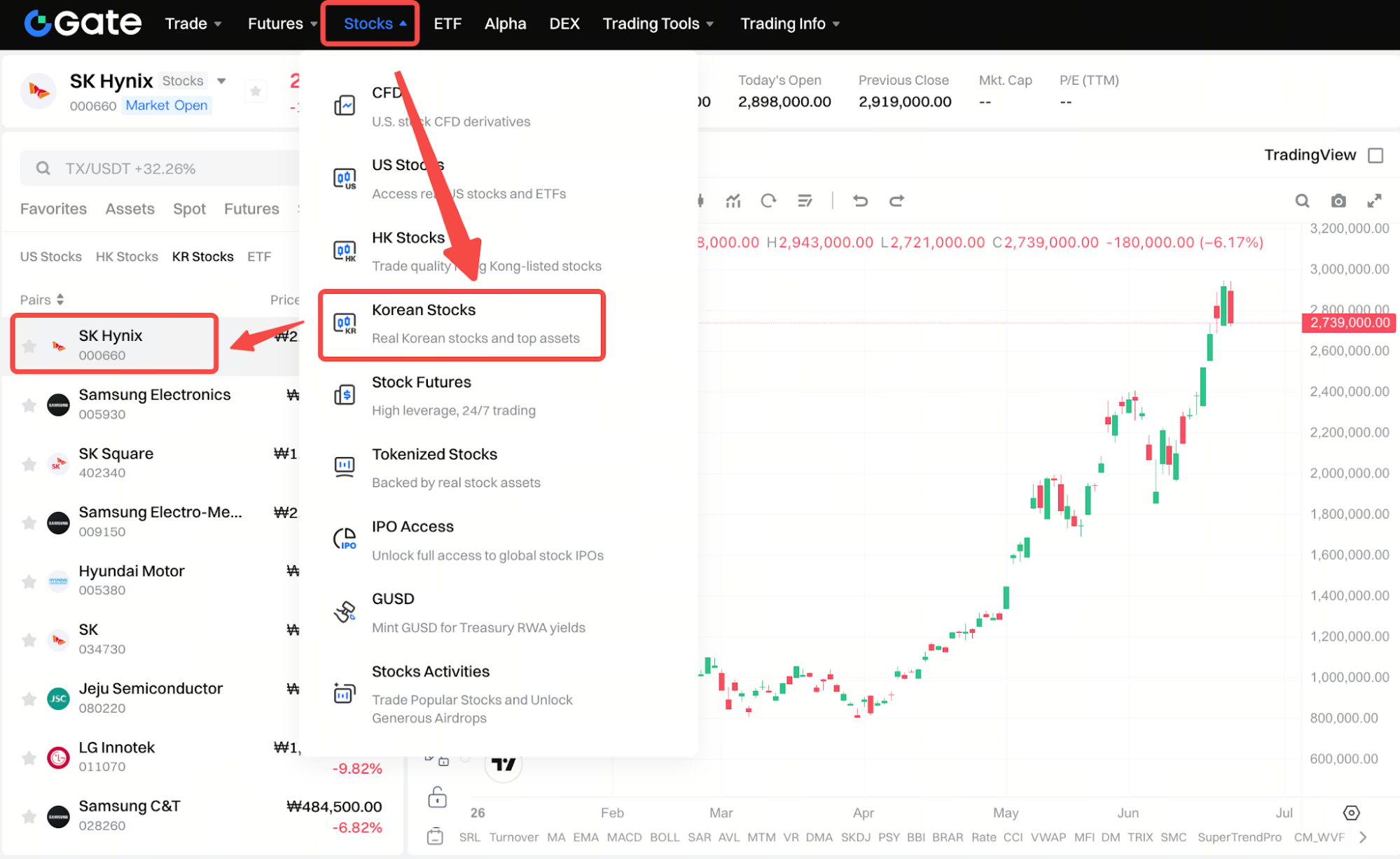
First, complete your Gate account registration and identity verification. After verification, activate your Gate Stocks account and navigate to the Korean Stock Zone.
Next, transfer USDT from your spot account to your stock account. In the Korean Stock Zone, search for the desired stock name or code, enter the trading page, and input the purchase quantity.
Once the order is executed, the corresponding stock assets will appear in your holdings page, where you can monitor position changes and account information at any time.
How Does the Korean Stock Trading Mechanism Work?
The Korean stock market is primarily operated by the Korea Exchange (KRX).
The KRX oversees trading, clearing, and settlement for the stock market, and manages key market segments including KOSPI and KOSDAQ.
When investors submit buy and sell orders through the trading system, the market executes trades based on matching rules and completes asset delivery within the designated settlement cycle.
Gate Korea Stocks provides users with a unified entry point to access the Korean stock market, allowing digital asset accounts to connect directly with the Korean capital market.
Buying Samsung Stock with USDT: A Gate Korea Stocks Tutorial
Samsung Electronics is one of the most representative listed companies in the Korean stock market and a global leader in consumer electronics and semiconductors.
After entering the Korean Stock Zone, users can search for Samsung Electronics stock, view relevant market data, stock details, and trading options.
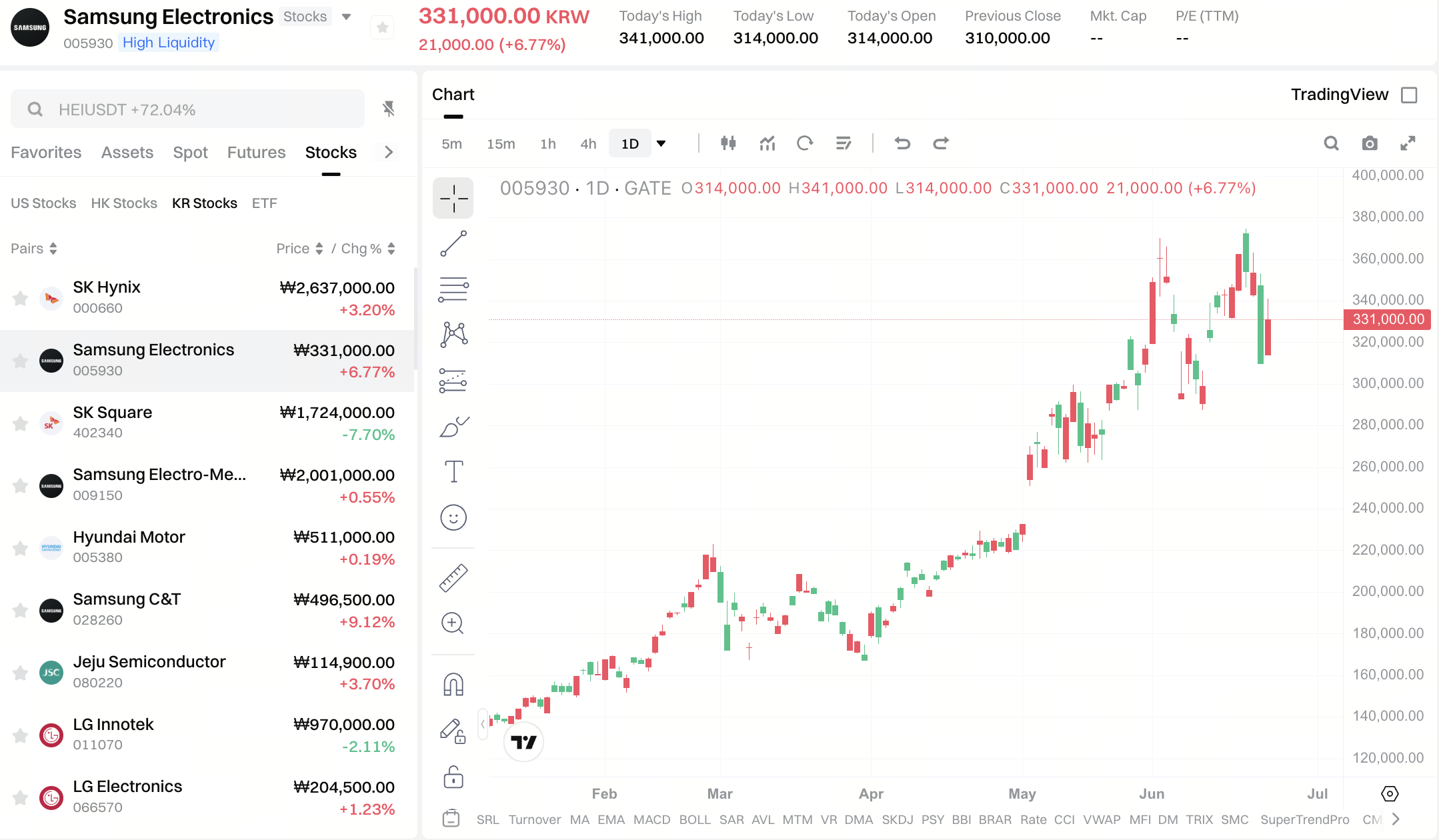
Once your funds are ready, enter the purchase quantity and confirm the order to submit the trade request. After execution, the Samsung Electronics shares will appear in your stock account holdings.
This process is essentially the same as buying any other Korean stock.
Buying SK Hynix / Hyundai Motor with USDT: A Guide to Popular Korean Stocks
SK Hynix is a global leader in memory chip manufacturing and a flagship company in Korea’s semiconductor industry.
Hyundai Motor is a major force in the global automotive industry, with significant influence in electric vehicles, smart mobility, and worldwide manufacturing operations.
Users can search for these stocks in the Korean Stock Zone, review market data and trading information, and complete the purchase process using the standard trading workflow.
For investors focused on Korean technology and manufacturing, these companies are key observations within the Korean stock market.
Investing in the KOSPI Index on the Korean Stock Market: A Gate Korea Stocks Zone Overview
The KOSPI index is one of the most important benchmark indices for the Korean stock market, reflecting the overall performance of large-cap Korean listed companies.
Because the KOSPI index covers core companies in the Korean economy, it is frequently used to gauge the health of the Korean capital market. Many international investors also rely on KOSPI as a key reference for analyzing the Korean market.
Through the Gate Stocks Korean Stock Zone, users can not only track individual stock performance but also gain insights into broader Korean market trends via index-related products.
How Do Korean Stocks Differ from Hong Kong and US Stocks?
The Korean, Hong Kong, and US stock markets are all major global capital markets, but each has a distinct industrial makeup.
The Korean market excels in semiconductors, consumer electronics, and automotive manufacturing. The Hong Kong market covers finance, internet, and China-linked companies. The US market houses the world’s largest concentration of technology firms.
For global asset allocation purposes, these three markets offer different sector exposures and regional economic characteristics, making them common components in cross-market portfolios.
| Comparison Dimension |
Korean Stocks |
Hong Kong Stocks |
US Stocks |
| Representative Index |
KOSPI |
Hang Seng Index |
S&P 500 |
| Core Industries |
Semiconductors, Automotive |
Finance, Internet |
Technology, Healthcare |
| Primary Market |
Korea Exchange (KRX) |
Hong Kong Exchanges (HKEX) |
Nasdaq, NYSE |
| Regional Attribute |
East Asian Market |
Asian International Market |
Global Market |
| Representative Companies |
Samsung, SK Hynix |
Tencent, Alibaba |
Apple, Microsoft |
Why Are Korean Stocks Suitable for Global Asset Allocation?
Korea’s economy is strongly export-oriented, and its listed companies occupy pivotal positions in the global technology manufacturing chain.
The development of semiconductors, consumer electronics, and automotive industries closely ties the Korean stock market to global supply chains. Additionally, the Korean market has extensive linkages with major economies such as the US, China, and Japan.
For investors following global technology trends and Asian economic growth, the Korean stock market offers distinctive sector allocation opportunities.
Summary
Gate Korea Stocks bridges the Korean stock market with stablecoins like USDT, enabling digital asset users to trade shares of Korean listed companies within a unified account system. Compared to traditional cross-border securities investment models, Gate Korea Stocks leverages digital asset infrastructure to simplify funding and provide global users with a more accessible gateway to the Korean market.
FAQs
Do I need Korean Won to buy Korean stocks with USDT?
Users can typically enter the Korean stock trading system using USDT without needing to complete a separate Korean Won conversion process. The specific settlement mechanism is subject to platform rules.
Which companies are the most representative in the Korean stock market?
The Korean stock market features globally renowned companies such as Samsung Electronics, SK Hynix, Hyundai Motor, and LG Electronics, with the semiconductor and automotive sectors being the most represented.
What is the KOSPI index?
The KOSPI index is a key benchmark for the Korean stock market, reflecting the overall performance of large-cap Korean listed companies. It serves as an important indicator for assessing the Korean economy and capital market.
Can I use the same account for trading Korean, Hong Kong, and US stocks on Gate?
Gate Stocks uses a unified stock account system, allowing users to manage Korean, Hong Kong, US stocks, and other supported stock assets on a single platform.
Is Gate Korea Stocks considered a Real World Asset (RWA) application?
Korean stocks are traditional financial assets. The model of connecting the Korean stock market through digital asset infrastructure is widely regarded as a significant application direction within the Real World Asset (RWA) ecosystem.







