Interlink Network (also styled InterLink) is a human-centric blockchain built around Proof of Personhood: users complete face scan and liveness detection to receive an InterLink ID, then join as a Human Node so one person maps to one credential. Cryptographic hashing and zero-knowledge proofs support Sybil resistance without publishing raw face images as public ledger fields. The stack ties identity, InterLink App, InterLink Chain, and the ITLG / ITL token roles into one participation model.
Unlike most public chains that treat a wallet address as a freely copyable default identity, Interlink Network treats “unique human” as a participation precondition. Verification emphasizes irreversible biometric hashes and privacy-preserving proofs rather than raw imagery on a public ledger. Understanding Interlink Network means separating identity verification, node roles, and token functions—and treating large user-scale claims in public materials as project statements, not proof of realized network size.
What Is Interlink Network?
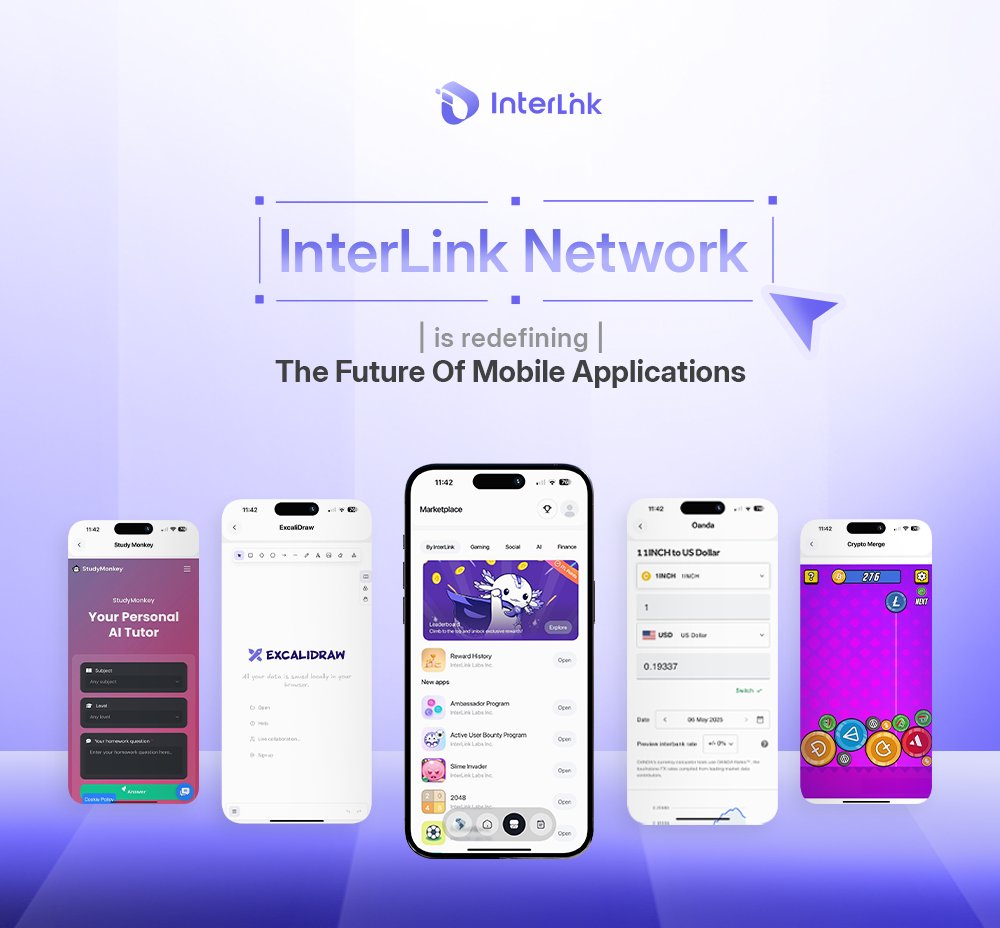
Interlink Network positions itself as a Human Network that connects identity, applications, and chain infrastructure. InterLink ID answers whether a participant is a unique human. InterLink App provides the Mini-App surface where people interact. InterLink Chain anchors identity, reputation, and economic coordination. Together those layers define a human-centric blockchain rather than a system that ranks participation mainly by hash power or stake weight.
In crypto terms, Proof of Personhood replaces “one wallet equals one identity” with “one person equals one credential.” That shift matters for governance, incentives, and access control whenever bot farms or cloned wallets can dilute outcomes. Interlink Network productizes the idea as InterLink ID plus Human Node: anonymous addresses can still exist, but entering the Human Node role requires biometric verification and deduplication. The design goal is Sybil resistance—raising the cost of spinning up many fake humans—not a claim that forgery is impossible.
| Component |
Role |
| InterLink ID |
Unique human identity layer after biometric verification |
| Human Node |
Network participation identity for verified users |
| InterLink App |
User entry point and Mini-App interface |
| InterLink Chain |
Chain layer anchoring identity, reputation, and coordination |
The table shows why “network” is not a single product screen. The identity layer confirms a human, the application layer carries day-to-day use, and the chain layer records and coordinates outcomes. Beginners can hold three anchors: unique human credentials, liveness-backed checks, and publicly verifiable proofs that are not the same as uploading a raw face gallery to a transparent ledger.
Readers comparing Interlink Network with generic L1 explainers should note the scarce object: unique personhood, not energy or capital alone. That framing shapes how Human Nodes, apps, and tokens interact later in the stack.
How Does Proof of Personhood / Human Node Work?
The practical path is “verify a live human → irreversible representation → verifiable proof → Human Node.” A Human Node is a participant who has completed InterLink ID issuance and can take part in network integrity, app interaction, and governance coordination as a unique human—without needing a dedicated mining machine as the entry barrier.
InterLink ID generation and personhood proof typically follow five steps:
- Face scan: Capture a live facial image with the device camera under controlled prompts.
- Liveness / deepfake detection: Screen photos, masks, or pre-recorded video so the check confirms a real person is present.
- Biometric hashing: Convert features into an irreversible hash used for deduplication rather than storing a replayable raw face library as a public field.
- Privacy proofs and storage commitments: Use zero-knowledge proofs and related commitments to assert “unique human” without exposing underlying features; hashes or commitments enter decentralized storage and node pools while raw biometric data is not treated as a public ledger entry.
- Issue InterLink ID and become a Human Node: The unique ID can gate dApps and governance flows; the user enters the Human Node role.
Sybil attacks rely on cheap fake identities. Personhood proof raises the cost of copying a real human through live presence checks and hash-based deduplication. That raises friction; it does not equal absolute unforgeability. Liveness detection and model updates are described as tools against deepfakes, but real security depends on implementation quality and the threat model. Biometric verification is a control surface, not a warranty that “biometrics equal absolute safety.”
Public materials also describe Delegated Proof of Personhood paths where Human Nodes participate in validation and governance with stake and reputation combined. Completing a face scan once is not the same layer as ongoing delegated participation. Readers should keep those layers distinct when evaluating what a Human Node can do after InterLink ID issuance.
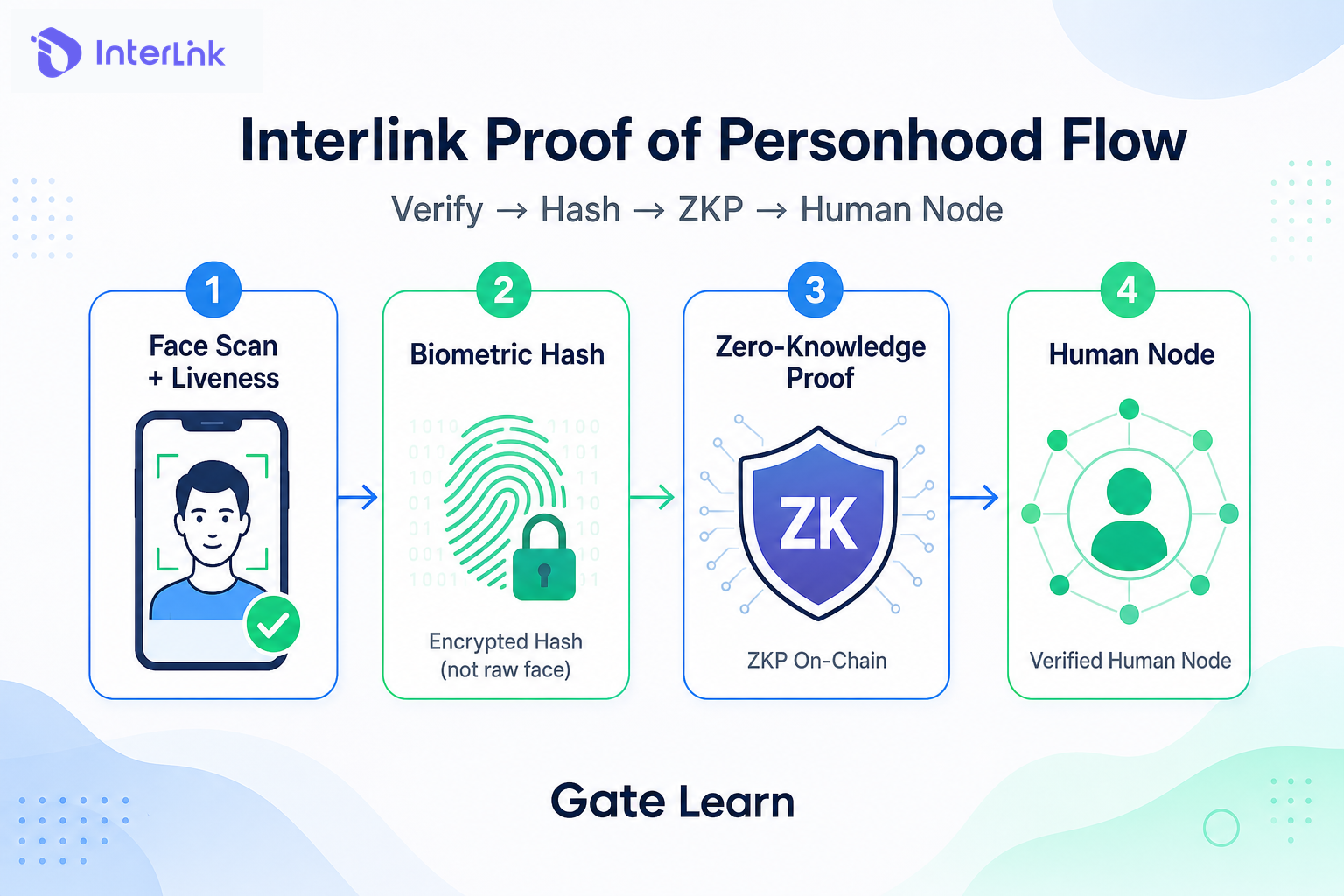
Figure 1. Interlink Proof of Personhood flow: face scan and liveness → biometric hash → zero-knowledge proof → Human Node.
What Makes Up the Ecosystem? What Do ITLG and ITL Do?
The ecosystem layers by function. The identity layer covers InterLink ID, face and liveness checks, and privacy-preserving hashes. The application layer covers InterLink App, Mini-Apps, MDK / SDK tooling, and Human Auth-style SDKs that external platforms can use as a “human gate.” The chain layer covers InterLink Chain, Human Node participation, Sybil resistance goals, and Delegated Proof of Personhood. The token layer separates mechanism roles rather than treating one ticker as a catch-all utility label.
Dual-token boundaries below are mechanism-only descriptions—not market performance:
| Token |
Typical holder / participant side |
Mechanism role (summary) |
| ITLG (InterLink Genesis) |
Human Nodes and other verified participants |
Governance voting, ecosystem incentive coordination, in-Mini-App utility exchange |
| ITL (InterLink Token) |
Institutions, partners, and longer-alignment holders |
Staking / access into the Human Layer, foundation reserves, ecosystem-level coordination |
ITLG sits closer to verified-human participation, governance, and in-app utility. ITL sits closer to institutional partner access and reserve coordination. They are not two names for the same job. Allocation percentages and unlock schedules are outside this explainer’s scope; manuals and disclosures remain the place to verify utility language for the ITLG token and the ITL token.
Human Auth-style interfaces matter because they export personhood as a reusable check. A dApp or partner surface can require proof of unique humanity without rebuilding the full biometric stack. That pattern keeps InterLink ID as the identity source while apps remain the interaction surface and InterLink Chain remains the coordination layer. Readers learning what is Interlink Network should map each surface—ID, App, Chain, token—to a different failure mode: identity fraud, client compromise, chain coordination bugs, or confusing token roles.
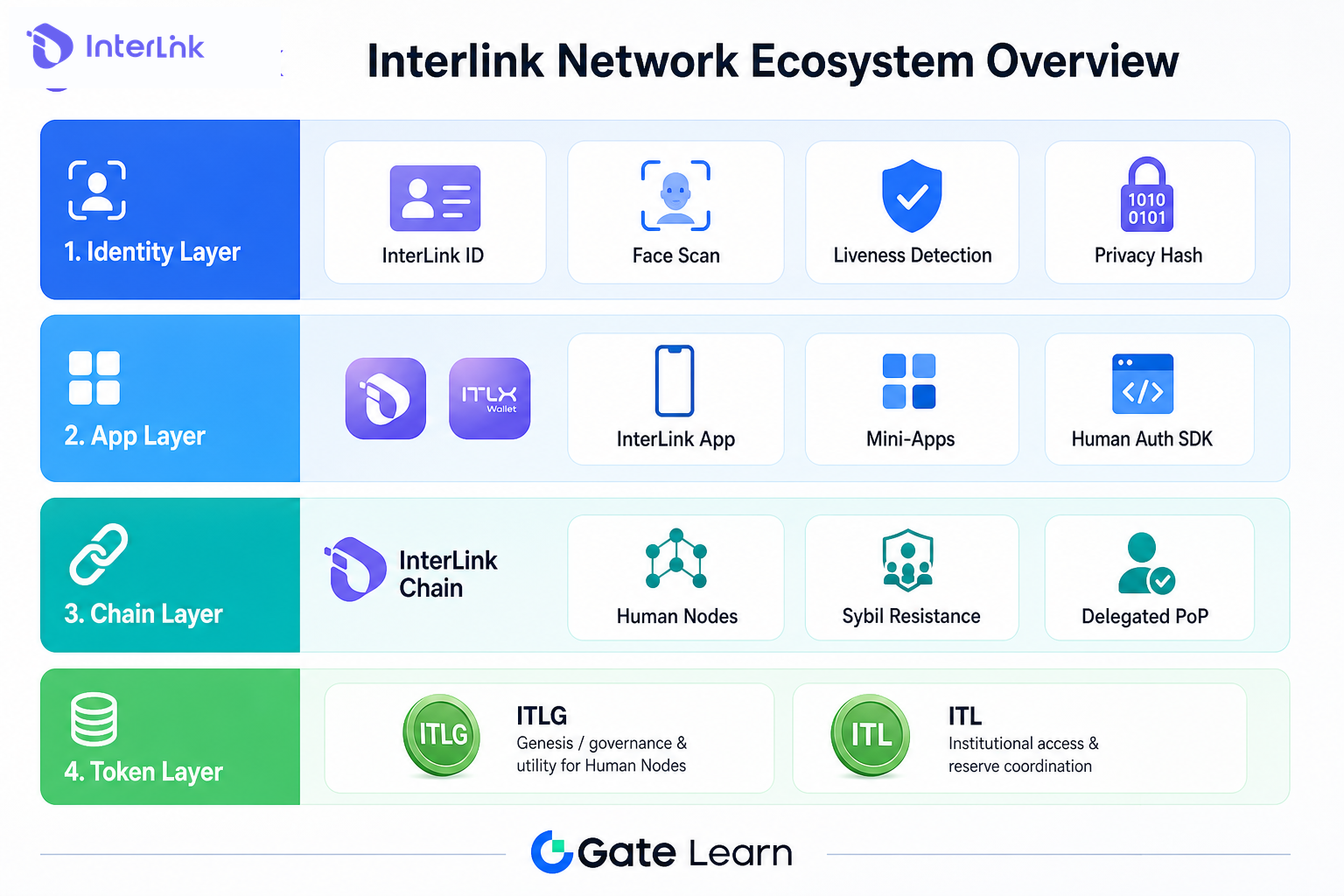
Figure 2. Interlink Network ecosystem layers: Identity / App / Chain / Token (ITLG and ITL).
How Does Interlink Differ From PoW, PoS, and Common PoP Designs?
Proof of Work (PoW) competes with hash power for block production. Proof of Stake (PoS) weights validation influence with staked capital. Both raise the cost of certain attacks, yet neither requires a unique human by default: the same actor can spawn many wallets or split stake across addresses. Proof of Personhood shifts the scarce object toward unique personhood so one-person-one-vote style coordination is harder for robot farms to dilute.
| Dimension |
PoW |
PoS |
Interlink-style PoP |
| Core scarcity |
Hash power / energy |
Staked capital |
Unique human identity |
| Typical risk focus |
Hash-rate concentration |
Capital concentration |
Biometric privacy, dedupe false accepts/rejects |
| Sybil constraint |
Weak (addresses copy cheaply) |
Weak (wallets copy cheaply) |
Strong by design goal (one person, one credential) |
The table summarizes orientation, not a scorecard for absolute safety. Interlink’s public materials also describe Human Node participation in validation and governance under Delegated Proof of Personhood, where eligibility can combine stake and reputation—again, a different layer from a single enrollment scan.
Projects that share the PoP label still diverge sharply on capture hardware, privacy claims, and dependency on specialized devices. Interlink vs Worldcoin contrasts two common personhood paths on capture flow and privacy posture so “both use a face check” is not mistaken for “same product.” When evaluating Sybil resistance claims, compare the scarce object, the proof format, and what data never leaves the client versus what commitments become public.
What Risks and Caveats Come With Using Interlink?
Biometrics and privacy need a separate risk review. The published path emphasizes feature extraction, hashing or commitments, and zero-knowledge proofs of uniqueness, with the goal of avoiding replayable imagery as a public on-chain field. Even then, camera permissions, client integrity, node or operator logs, and recovery workflows can still create exposure. “Raw face not on the public ledger” is not the same as “zero residual data anywhere in the pipeline.”
Other limits include false rejects and false accepts in liveness and deduplication, continuously evolving deepfake techniques, recovery misconfiguration that locks credentials or enables social engineering, and revocation or expiry rules that affect long-term safety. Regional rules on biometric verification differ; cross-border users should check local law and the product’s data-processing notices before enrollment.
Install InterLink App only from the official site and trusted store listings. Watch for lookalike domains and scams that demand seed-phrase “sync” to finish a face check—normal personhood proof does not require surrendering on-chain private keys. Human Node status and token holdings are mechanism roles, not return promises, and they do not constitute investment advice. Treat ITLG and ITL token descriptions as utility and coordination language until primary disclosures say otherwise.
Operational hygiene still matters after enrollment. Device compromise can undermine liveness assumptions; shared devices raise enrollment ambiguity; and phishing pages that clone enrollment UI can harvest credentials unrelated to InterLink ID itself. Zero-knowledge proofs reduce how much feature data must be revealed to assert uniqueness, yet they do not remove the need to trust client software and update channels. Readers asking whether Interlink Network is “safe” should separate three questions: Is the proof format privacy-preserving by design? Is the client distribution channel authentic? Does local law allow the biometric collection described?
Summary
Interlink Network uses Proof of Personhood to write “unique human” into the participation rule set: face scan and liveness detection produce an InterLink ID; hashing and zero-knowledge proofs support deduplication; verified users become Human Nodes that raise Sybil costs and support identity, app, and on-chain coordination. The ecosystem spans ID, App, Chain, and distinct ITLG / ITL roles. Relative to PoW and PoS, scarcity shifts toward personhood while introducing biometric privacy and client-security risks. Understanding Interlink Network means checking the verification flow, token function boundaries, and different exposure levels for biometric data on device, at nodes, and on chain.
FAQ
What is Interlink Network?
Interlink Network (InterLink) is a human-centric blockchain infrastructure built around Proof of Personhood. Users obtain an InterLink ID through face scan and liveness detection, become Human Nodes, and use that unique-human credential to raise Sybil costs while connecting App, Chain, and token mechanism layers.
What is Proof of Personhood in crypto?
Proof of Personhood proves a participant is a unique human with one person, one credential. That design makes governance, incentives, and access control harder for bots or cloned wallets to manipulate. Relative to PoW (hash power) and PoS (stake), the scarce object is personhood uniqueness.
How does Interlink identity verification work?
A typical path is on-device face scan → liveness / deepfake detection → irreversible biometric hashing → zero-knowledge or related uniqueness proofs → InterLink ID issuance and Human Node entry. Public materials emphasize verifying unique humanity without treating raw face images as public ledger fields.
What is a Human Node?
A Human Node is the network participation identity after InterLink ID verification. Human Nodes take part in network integrity, app interaction, and governance coordination as unique humans. Public materials describe Human Nodes as basic units of the Human Network rather than hash-power miners that require dedicated hardware.
What is the difference between ITLG and ITL?
ITLG (InterLink Genesis) maps to verified Human Node–side governance, ecosystem incentive coordination, and Mini-App utility. ITL maps to institutional and partner access into the Human Layer plus reserve and ecosystem-level coordination. The two tokens have different function boundaries in public materials and are not interchangeable labels.
Does Interlink put face data on-chain? Is biometric identity safe?
The published goal is to verify uniqueness proofs or commitments on chain—not to publish raw face images. Biometrics still involve device permissions, client security, node processing, and false accepts/rejects. Privacy-oriented design is not absolute safety. Read the product’s data-processing notices before use, and avoid fake apps or any flow that demands a seed phrase to “complete” face verification.