As the on-chain derivatives market grows, decentralized perpetual contract protocols have gradually become an important part of Solana DeFi.
In the Jupiter Perps system, when users trade long or short positions, they do not rely on a traditional order book for matching. Instead, they interact directly with the protocol’s liquidity pool. This means the liquidity pool must continuously provide sufficient asset depth to support opening positions, closing positions, and leveraged trading. JLP holders, in turn, earn protocol fees and potential return distributions by taking on market risk.
How JLP Works
The operating logic of JLP is similar to that of some on-chain Perps protocols. After users deposit designated assets into the Jupiter liquidity pool, they receive a corresponding amount of JLP based on their share of the pool.
When traders open leveraged positions on Jupiter Perps, the protocol liquidity pool acts as their counterparty. For example, if a user goes long on an asset and makes a profit, the pool may bear the corresponding loss. Conversely, when traders lose money, the pool may generate gains.
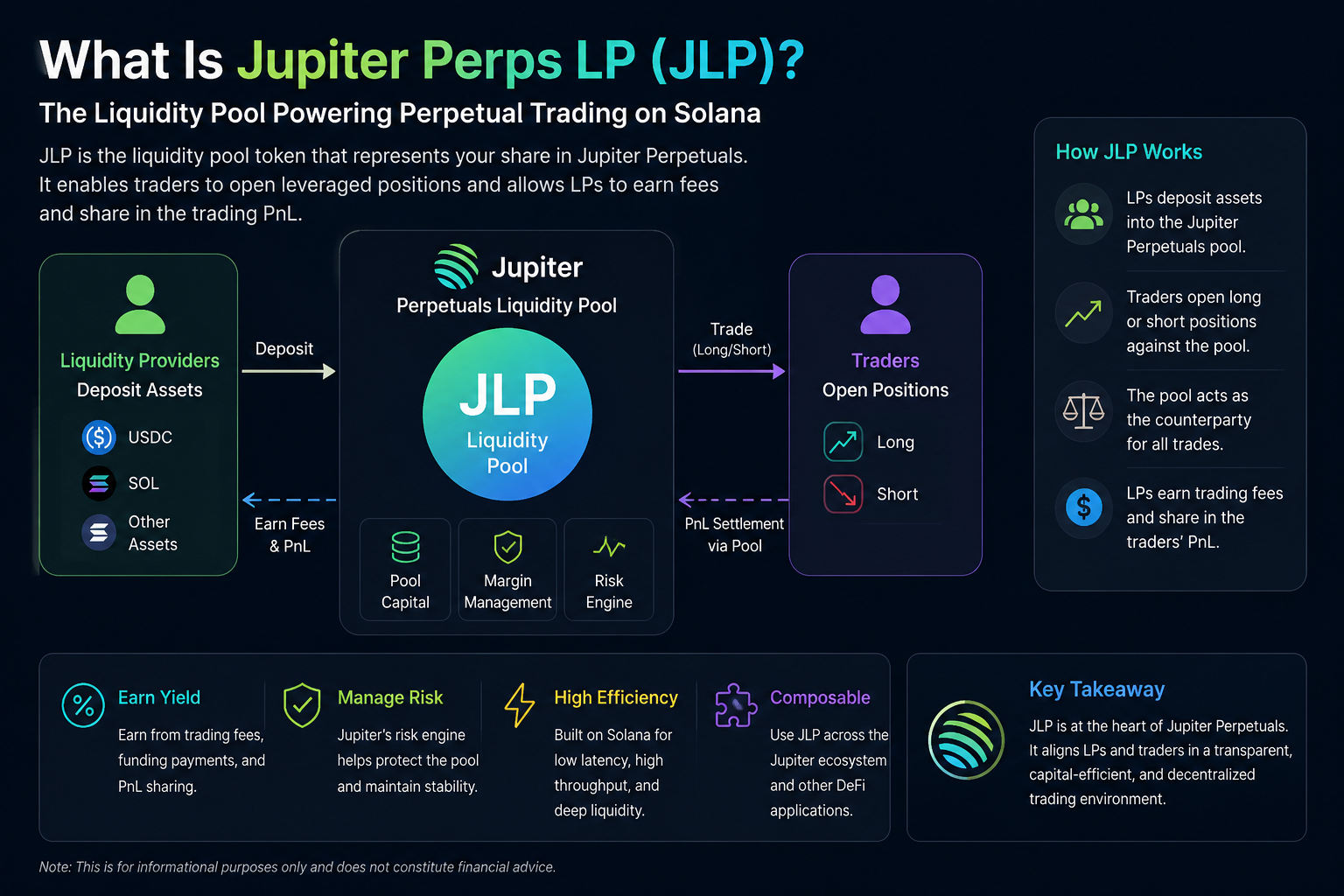
As a result, returns for JLP holders do not come only from trading fees. They are also tied to overall trading outcomes in the market. If most traders lose money, the liquidity pool may see higher returns. If market movements allow many traders to profit, the pool may come under pressure.
This model makes JLP closer to a “protocol market making pool” than a standard liquidity mining asset.
Where Do JLP Returns Come From?
JLP returns mainly come from protocol fees, funding rates, and the profit and loss structure of traders.
In the perpetual contract market, users usually pay certain fees whenever they open positions, close positions, or adjust leverage. Part of these fees flows to the liquidity pool, creating a source of returns for JLP holders.
In addition, the funding rate mechanism in perpetual contract markets may also affect the pool’s overall returns. When market sentiment becomes imbalanced between longs and shorts, funding rates help rebalance capital flows between the two sides.
Another key factor is the overall profit and loss performance of traders. Because the liquidity pool acts as the counterparty, traders’ long term profitability directly affects the performance of the JLP pool.
How Is JLP Different from Traditional LP Tokens?
Although JLP is also a liquidity pool asset, it differs clearly from LP tokens in traditional AMMs.
Traditional DEX liquidity pools are usually used to support spot swaps, and their returns mainly come from trading fees. JLP, however, is exposed to the perpetual contract market, so it involves not only fee income, but also leveraged trading risk and the impact of market volatility.
In addition, traditional LPs are more vulnerable to impermanent loss, while JLP’s risks are more closely tied to trader profit and loss structure and directional market risk.
| Comparison Dimension |
JLP |
Traditional LP Token |
| Use case |
Perpetual contracts |
Spot AMM |
| Return source |
Fees + trader profits and losses |
Fees |
| Risk structure |
Directional market risk |
Impermanent loss |
| Liquidity role |
Counterparty |
Asset swap pool |
| Leverage connection |
Yes |
No |
What Role Does JLP Play in the Jupiter Ecosystem?
JLP is not only the core liquidity layer of Jupiter Perps. It is also gradually becoming an important asset component within the Jupiter ecosystem.
Because Jupiter itself has strong trade aggregation capabilities and deep connectivity across Solana DeFi, JLP can be more easily integrated into lending, yield strategies, and on-chain asset management scenarios. This means JLP is not just a single protocol asset. Over time, it may also evolve into a yield bearing base asset within Solana DeFi.
What Risks Does JLP Face?
Although JLP can offer potential returns, its risk structure is also more complex than that of ordinary stable yield assets.
First, JLP is affected by market volatility. If the market moves sharply in one direction and a large number of traders profit, the liquidity pool may face significant loss pressure.
Second, the perpetual contract market itself is highly leveraged. When market liquidity is insufficient or volatility is intense, the protocol may face liquidation pressure and risk management challenges.
In addition, JLP also carries smart contract risk, protocol governance risk, and Solana network layer risk. For on-chain derivatives protocols, risk control mechanisms are usually more important than they are for ordinary DeFi protocols.
How Are Jupiter Perps Different from Protocols Such as GMX?
Jupiter Perps and on-chain Perps protocols such as GMX share some design similarities, such as using a liquidity pool to act as the counterparty to trades.
However, they operate in different ecosystems. GMX is mainly deployed on Arbitrum and Avalanche, while Jupiter relies deeply on Solana’s high performance trading environment. Solana’s lower transaction costs and faster confirmation speed make Jupiter better suited to high frequency trading scenarios.
In addition, Jupiter already has a mature DEX Aggregator system, so its Perps product can create stronger synergy with spot liquidity, routing systems, and other Solana DeFi protocols.
Conclusion
As the core liquidity asset in Jupiter’s perpetual contract ecosystem, JLP supports leveraged trading and the operation of on-chain derivatives markets on Solana.
Unlike traditional LP tokens, JLP does more than provide liquidity. It also acts as a counterparty to trades, which makes its return and risk structure more complex. Protocol fees, funding rates, and trader profit and loss conditions all affect JLP’s overall performance.
FAQs
Where Do JLP Returns Come From?
JLP returns mainly come from trading fees, funding rates, and the overall profit and loss structure of traders.
How Is JLP Different from a Regular LP Token?
Regular LP tokens are usually used in spot AMMs, while JLP is mainly used in the perpetual contract market and carries counterparty risk.
Does JLP Have Risks?
JLP is affected by factors such as market volatility, trader profitability, protocol mechanisms, and smart contract risk.
Is Jupiter Perps a DEX?
Jupiter Perps is an on-chain perpetual contract protocol. Unlike a traditional spot DEX, it mainly provides leveraged derivatives trading.
Is JLP Similar to GMX’s GLP?
Both use liquidity pools to act as counterparties to trades, but they differ in deployment ecosystem, liquidity structure, and protocol synergy mechanisms.