At the market structure level, shifting AI computing paradigms are reshaping the semiconductor value chain. The old compute model, once centered on general-purpose GPUs, is now evolving toward a hybrid architecture of "GPU + ASIC + high-speed interconnect + advanced packaging." This shift has made data transmission and network communication the primary bottleneck, rather than a pure compute deficit. As a result, Marvell's optical interconnect and data center networking chips have become indispensable to AI infrastructure.
From an industry evolution standpoint, AI is driving a system-level upgrade that integrates compute, networking, and storage. Marvell sits at a key node in this structural transformation. Its technology path not only serves cloud computing giants but also plays a deep role in the AI ASIC customization trend, providing chip-level support for hyperscale data centers. The following sections analyze Marvell across multiple dimensions: business structure, technological advantages, competitive landscape, and investment thesis.
What Is Marvell Technology (MRVL)? Company Background and Development History
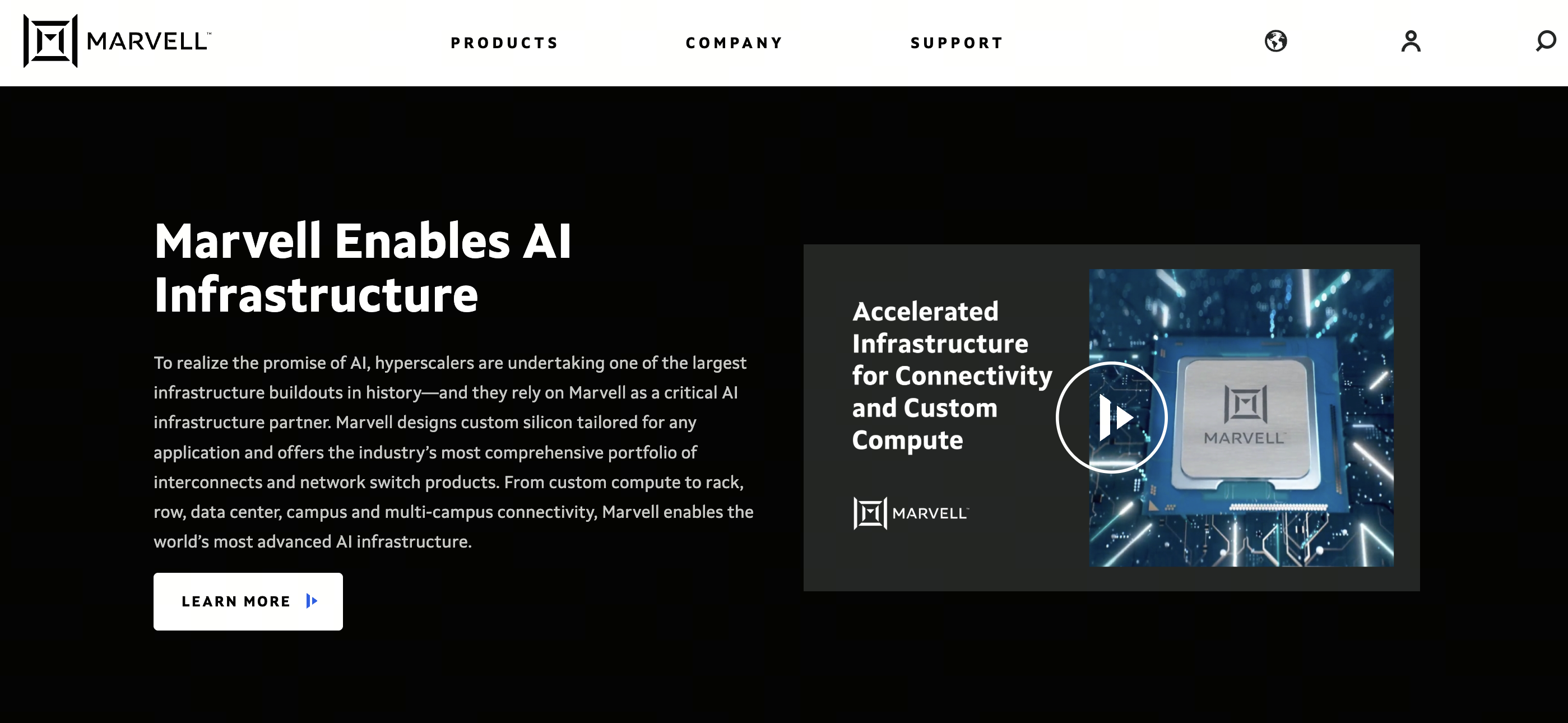
Founded in 1995 and headquartered in the United States, Marvell is a design company focused on data infrastructure semiconductors. Unlike traditional CPU or GPU makers, Marvell does not produce general-purpose compute chips. Instead, it addresses the fundamental question of "how data flows" by building comprehensive solutions that span networking, storage, and interconnect.
In its early days, Marvell concentrated on storage controllers and consumer electronics chips. Over the past decade, however, the company has strategically pivoted toward cloud computing and data center infrastructure. The acquisition of Inphi was a turning point, delivering a quantum leap in high-speed optical interconnect and data center connectivity technology, and giving Marvell stronger system-level capabilities for the AI era.
Today, Marvell's customer base includes global cloud hyperscalers, telecom operators, and large enterprise data centers. These clients impose extremely high demands on chip performance, bandwidth, and energy efficiency, pushing Marvell to continuously evolve toward customization and high-performance solutions.
What Are Marvell's Core Business Segments?
Marvell's business structure can be divided into four core segments:
- Data Center Business (Core Growth Engine): Covers AI network chips, switch ASICs, DPUs, and custom compute chips. This is currently its fastest-growing line.
- Storage and Controller Business: Provides SSD controllers, HDD-related chips, and storage interface solutions, primarily serving the enterprise storage market.
- Enterprise and Carrier Network Business: Includes routers, switches, 5G base stations, and telecom infrastructure chips.
- Custom ASIC Business: Delivers dedicated AI chip designs for cloud providers. This is Marvell's most strategically valuable direction in the AI era.
Overall, Marvell is moving from a "component supplier" to a "system-level chip architecture designer."
Why Has the AI Data Center Become Marvell's Growth Engine?
The core bottleneck in AI data centers has shifted from "insufficient compute" to "insufficient data transfer and interconnect." As training models reach trillion-parameter scale, communication costs between GPUs, servers, and data centers surge.
Marvell offers three key technologies to address this:
- High-speed Ethernet and switching chips
- Optical interconnect solutions
- AI-optimized network architectures for data flow
As AI inference demand explodes, data center traffic patterns are shifting from centralized training to distributed inference, further elevating the importance of network chips. Marvell is a direct beneficiary of this transition.
How Do Custom ASICs, Optical Interconnect, and Network Chips Build a Competitive Edge?
In AI infrastructure, Marvell's core moat rests on three pillars:
Custom ASIC Capability
Unlike general-purpose GPUs, custom ASICs can optimize performance and power efficiency for specific AI workloads. Marvell designs dedicated chips for cloud vendors, giving them cost and efficiency advantages.
Optical Interconnect Technology (Inphi Ecosystem)
High-speed optical modules and interconnect technology significantly reduce data center latency and boost bandwidth density—critical for large-scale AI training.
Network Chip System Capability
Marvell provides a complete network architecture from switch chips to DPUs, enabling efficient data flow within AI clusters.
This combination of "compute + network + interconnect" transforms Marvell from a simple chip supplier into an integral part of the AI data center architecture.
In AI scenarios, Marvell is used primarily for GPU cluster interconnection and intra-data-center traffic management. In cloud computing, its chips support hyperscale server network architectures. In telecom, they are widely deployed in 5G base stations and core network equipment.
Especially during the AI inference phase, edge computing demand grows. Marvell's low-power network chips and DPU architecture offer superior adaptability, expanding its addressable market.
Compared to NVIDIA, Broadcom, and AMD, Marvell's positioning leans more toward the "infrastructure connectivity layer."
- NVIDIA: Core AI training compute (GPU-centric)
- AMD: General-purpose CPU + GPU alternatives
- Broadcom: Strong player in networking + custom ASICs
- Marvell: AI data center interconnect and system-level chip architecture
In simple terms: NVIDIA provides the "compute engine," while Marvell provides the "data flow system." Together, they build the backbone of AI infrastructure.
What Risks Should You Consider when Investing in MRVL Stock?
Despite strong AI demand, Marvell faces several risks:
- High customer concentration (heavy reliance on large cloud providers)
- Order volatility from AI cycle fluctuations
- Direct competition with rivals like Broadcom in the ASIC market
- Rapid technology cycles and heavy R&D investment pressure
- The semiconductor industry's inherent cyclicality
Moreover, if AI capital expenditure slows down, network chip demand may decline in tandem.
Marvell's Future Direction and Long-Term Growth Potential

Marvell's future growth remains centered on AI data center upgrades:
- Growing demand for AI ASIC customization
- Rising penetration of optical interconnect technology
- Data center evolution from GPU clusters to heterogeneous computing
- Edge AI expanding network chip demand
In the current AI infrastructure investment landscape, a single market or asset often fails to capture the full industry chain shift. Take Marvell Technology (MRVL) in the network chip and data center interconnect space: its stock price drivers go beyond its own fundamentals—they are tightly linked to AI capital spending, cloud vendor expansion rhythms, and semiconductor cycles. This creates clear cross-market co-movement and rotation patterns for related assets.
Given this cross-market structure, investors increasingly need to monitor multiple dimensions simultaneously—US-listed semiconductors, Hong Kong-listed tech stocks, and Korean memory stocks—to map the AI value chain's migration from compute to storage to network interconnect. Gate stock trading supports 7×24 hour trading of US, Hong Kong, and Korean stocks, enabling investors to track price movements and capital flows of AI-related assets across different market sessions, offering greater flexibility to participate in the global AI infrastructure cycle rotation.
Summary
Marvell's core value in the AI era does not lie in single-chip performance but in its "connectivity and orchestration capability" within the data center architecture. As AI computing scales continue expanding, networking and interconnect importance approaches—and in some scenarios surpasses—raw compute power. Marvell stands at a critical juncture of this structural shift, with its long-term growth thesis deeply intertwined with AI infrastructure buildout.
FAQs
- Q1: Does Marvell primarily make GPUs?
No. Marvell does not produce GPUs. Its focus is on network chips, storage controllers, and custom ASICs.
- Q2: What is Marvell's biggest advantage?
Its system-level capability in data center networking and optical interconnect.
- Q3: Does Marvell compete with NVIDIA?
They are not direct competitors; their relationship is complementary—compute power and network infrastructure go hand in hand.
- Q4: How important is AI for Marvell?
AI data centers are currently its most critical growth engine.
- Q5: Is MRVL a cyclical stock?
It retains cyclical traits, but AI is fortifying its structural growth characteristics.







