As artificial intelligence rapidly transforms the global internet landscape, NAVER is shifting its technology strategy from a traditional internet platform to an AI-driven infrastructure company. At the heart of this evolution is the HyperCLOVA X large model system, positioning NAVER as a major force in the “Sovereign AI” movement.
From an industry perspective, internet platforms are moving beyond traffic competition toward integrated competition based on “data + models + hashrate.” NAVER not only controls South Korea’s largest domestic user data pool, but also continually expands its ecosystem through AI and cloud computing capabilities. This article provides a comprehensive analysis of NAVER’s business structure, AI strategy, competitive landscape, and investment rationale.
What Is NAVER (035420)? Company Background and Evolution
Founded in 1999 as a search engine, NAVER quickly became South Korea’s leading internet gateway. With the rise of mobile internet, NAVER expanded into content, advertising, e-commerce, and fintech, creating a highly integrated ecosystem. Its core approach is “platformization + ecosystem” rather than single-line business expansion. NAVER has long dominated the South Korean internet market, forming a duopoly with Kakao.
In the AI era, NAVER’s strategic focus has shifted to large models and cloud infrastructure. By developing proprietary AI technology and leveraging data assets, NAVER has evolved from a traditional internet company into an AI-driven tech leader.
NAVER’s Core Business Segments
NAVER’s business structure consists of four main segments:
- Search and advertising, which provide the most stable cash flow. NAVER Search commands a dominant market share in South Korea, and its advertising system delivers targeted campaigns through user behavior data.
- Content ecosystem, including Webtoon (digital comics), blogs, news, and community content. Webtoon has become a key asset for global expansion.
- E-commerce and fintech, building a closed-loop transaction ecosystem with products like NAVER Pay, converting user traffic into financial and transactional value.
- AI and cloud computing, which serve as the core engines for future growth, featuring HyperCLOVA X and NAVER Cloud.
How Search, AI, Cloud, and Content Drive Growth
NAVER’s core strength lies in the synergy among search, content, AI, and cloud. Search offers user access and behavioral data; the content ecosystem boosts user engagement; and AI technology further enhances content distribution and ad targeting.
NAVER Cloud not only supports local enterprises but also powers AI model training and deployment, making it a critical component of NAVER’s AI infrastructure.
This integrated structure enables NAVER to build a closed loop across data, models, and applications, continually strengthening its competitive moat.
What Are HyperCLOVA X and Sovereign AI?
HyperCLOVA X is NAVER’s proprietary large language model and the cornerstone of its AI strategy. It is optimized for Korean language and local data, making it better suited to the South Korean market than generic global models. This “localized AI” capability is central to the concept of Sovereign AI.
Sovereign AI refers to a country or region developing independent AI capabilities based on local data and infrastructure, reducing reliance on foreign models and cloud services.
By combining HyperCLOVA X with NAVER Cloud, the company is building South Korea’s domestic AI infrastructure and expanding into enterprise APIs, enhanced search, and content generation.
NAVER’s Competitive Advantages in AI, E-commerce, Fintech, and Webtoon
In AI, NAVER’s edge lies in local data and language model optimization.
In e-commerce, NAVER Pay and its content platforms create a closed-loop ecosystem, driving higher conversion rates.
In the Webtoon sector, NAVER operates a world-leading digital comics platform and has successfully expanded internationally.
Unlike traditional internet firms, NAVER’s competitive advantage is rooted in a multi-ecosystem structure, which is further amplified in the AI era.
How NAVER Differs from Google, Kakao, and Microsoft
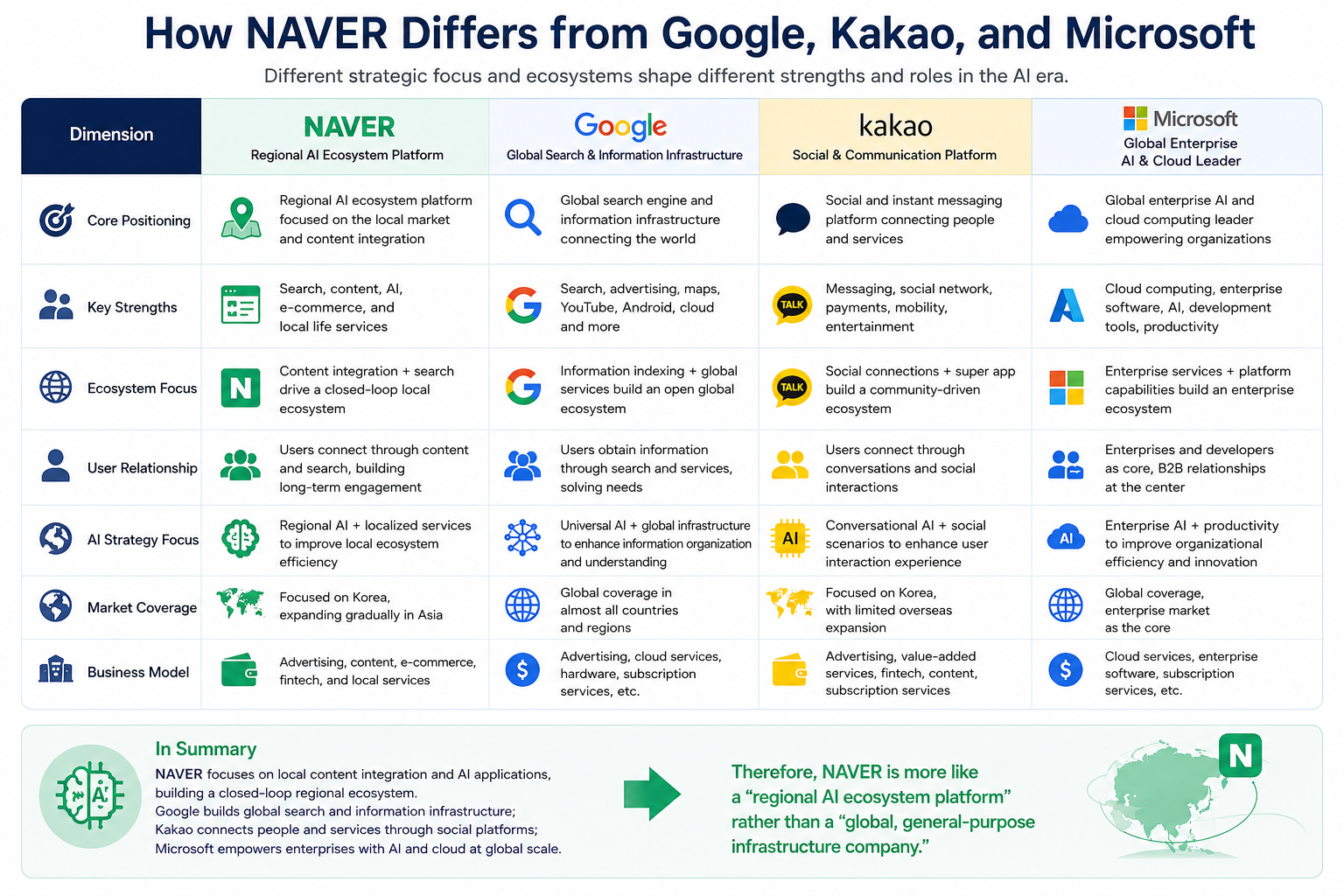
Compared to Google, NAVER focuses on local ecosystem and content integration, not global search infrastructure.
Compared to Kakao, NAVER emphasizes search and content platforms, while Kakao is centered on social networking and messaging.
Compared to Microsoft, NAVER targets consumer internet and regional AI, whereas Microsoft is a global leader in enterprise AI and cloud computing.
These distinctions position NAVER as a “regional AI ecosystem platform” rather than a global infrastructure provider.
Key Risks for NAVER Investors
NAVER’s primary risks include:
Limited growth potential in the domestic market, leading to long-term reliance on overseas expansion. Fierce competition in AI requires continuous investment in hashrate and R&D. Competitive threats from global tech giants, including potential displacement in search and AI model sectors.
Additionally, regulatory changes and advertising market cycles could impact NAVER’s revenue structure.
NAVER’s Future Direction and Long-Term Growth Potential
NAVER’s long-term strategy is to transition from an “internet platform company” to an “AI infrastructure company.”
Key growth drivers include:
- Commercializing HyperCLOVA X for enterprise use, expanding revenue through APIs and industry solutions.
- Reinventing search with generative AI, transforming traditional search into an AI-powered information gateway.
- Globalizing Webtoon and content, leveraging digital content to capture international markets.
With the rise of Sovereign AI, NAVER is poised to become a foundational AI infrastructure provider in South Korea.
Summary
NAVER (035420) stands at a pivotal moment, transforming from an internet platform into an AI infrastructure leader. Its core strength lies in the deep integration of search data, content ecosystems, and AI models.
Driven by HyperCLOVA X and Sovereign AI strategies, NAVER is building a regional AI ecosystem and fostering synergistic growth across content, e-commerce, and fintech.
FAQs
Q1: What does NAVER do?
NAVER is a leading South Korean internet company, with businesses spanning search, content platforms, e-commerce, fintech, and AI cloud computing.
Q2: What is HyperCLOVA X used for?
HyperCLOVA X is NAVER’s proprietary large model, powering search enhancement, content generation, and enterprise AI services.
Q3: How does NAVER differ from Google?
Google is a global search and AI infrastructure company, while NAVER is focused on South Korea’s local ecosystem and content platform.
Q4: What are NAVER’s main revenue sources?
NAVER’s primary revenues come from advertising, search services, e-commerce commissions, and enterprise cloud and AI services.
Q5: What drives NAVER’s growth?
Key drivers include AI transformation (HyperCLOVA X), globalizing content (Webtoon), and expanding cloud computing.