Stablecoins offer significant benefits in terms of speed, cost-efficiency, and programmability. However, enterprises seeking to scale stablecoin usage still face barriers such as high mint/redeem fees, limited ability to return reserve yield to the ecosystem, and misalignment between issuer roadmaps and business needs. Open Standard addresses these challenges by reengineering the economic model and governance structure of stablecoins through independent corporate governance and a partner board framework.
From a blockchain perspective, OUSD serves as a foundational value layer for on-chain payments, settlements, and DeFi integrations, circulating across multiple public blockchains and Layer 2 solutions. To assess OUSD’s role within the stablecoin ecosystem, it is critical to understand Open Standard’s governance model and the three core design principles underpinning OUSD.
What is Open USD (OUSD)? How does it relate to Open Standard?
Open USD (OUSD) is a USD-pegged stablecoin that acts as a unified value unit for both on-chain and off-chain capital flows. Open Standard is an independent operating company responsible for OUSD’s design, regulatory compliance, and ecosystem coordination, with governance led by a partner board focused on collective—not single-entity—interests.
In summary, Open Standard defines the rules, manages operations, and oversees partner onboarding, while OUSD is the core asset for network settlement and circulation. Unlike traditional stablecoins dominated by a single issuer, Open Standard decentralizes governance to more than 140 founding partners, creating a collaborative and open infrastructure.
| Concept |
Positioning |
Core Function |
| OUSD |
USD-pegged stablecoin |
1:1 USD peg, on-chain circulation and settlement |
| Open Standard |
Independent operating company |
Design, compliance, partner coordination, and governance |
| Partner Board |
Governance body |
Collective decision-making for OUSD design and operations |
| Founding Partners |
Ecosystem participants |
Drive adoption, share yield, participate in governance |
OUSD and Open Standard are interdependent: Open Standard provides the regulatory and operational framework, while OUSD acts as the unified value layer supporting a broad range of ecosystem applications.
How does Open Standard operate? What is its governance structure and ecosystem division of labor?
Open Standard utilizes a dual-layer governance structure, combining an independent management team with a parallel partner board. The management team handles day-to-day technology, compliance, and operations, while the partner board—composed of ecosystem representatives—holds collective authority over design direction, fee structures, and expansion policies.
The ecosystem includes six key roles: financial institutions manage regulated reserves and on-chain trading integration; payment processors, card issuers, and merchants handle acquiring and settlement; fintech firms drive payment and transfer use cases; exchanges and DeFi platforms use OUSD as a neutral trading base asset; platforms and marketplaces provide on/off-ramp channels; and intelligent commerce agents enable programmatic, instant payments.
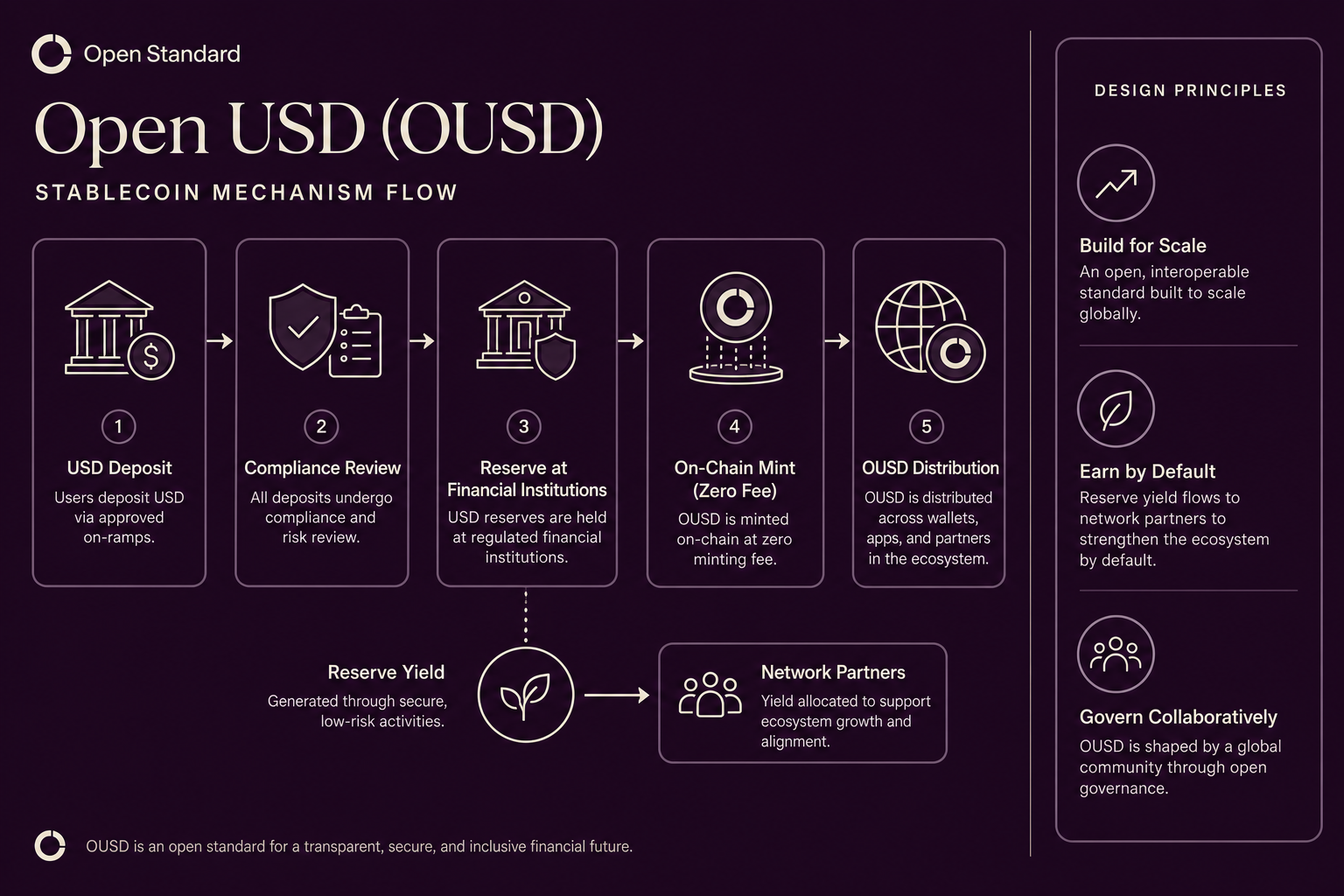 Figure 1. OUSD core mechanism flow: zero-fee minting and redemption, reserve yield distribution, and alignment with three design principles.
This structure establishes a complete value chain for OUSD, from issuance to end-use, with each partner contributing liquidity, use cases, or technical integration according to their role.
What are OUSD’s core design principles? How do minting, yield, and governance interact?
OUSD is built on three core principles: Build for scale, Earn by default, and Govern collaboratively, forming a closed operational loop as detailed in the OUSD mint and redeem process.
Build for scale means zero mint/redeem fees and no artificial limits on transaction volume. Earn by default ensures that reserve yield, after a modest management fee, is distributed to ecosystem partners. Govern collaboratively means the partner board collectively determines the roadmap and compliance strategy, reflecting the interests of all stakeholders. Minting lowers entry barriers, yield distribution incentivizes network growth, and collaborative governance ensures adaptable rules. Compared to OUSD vs. USDC and USDT, OUSD stands out through its unique fee and yield distribution mechanisms.
| Design Principle |
English Expression |
Key Mechanism |
| 面向规模 |
Build for scale |
Zero mint/redeem fees, no artificial volume limits |
| 默认获益 |
Earn by default |
Reserve yield goes to partners, minus a management fee |
| 协作治理 |
Govern collaboratively |
Collective decisions by the partner board |
Are OUSD reserves secure? How is transparency and compliance ensured?
OUSD reserves are held at leading US financial institutions, adhering to US regulatory standards and managed in cash and cash equivalents with segregated accounts for user protection. Transparency is assured through regular reserve disclosures and independent third-party attestations, enabling public verification of the 1:1 on-chain to off-chain reserve ratio. Compliance covers AML, KYC, and US stablecoin regulations, with licensing and custody arrangements disclosed by Open Standard.
Reserve security and transparency are the foundation of OUSD’s enterprise-grade trust. Both partners and users can independently verify the match between circulating supply and underlying reserves.
How is OUSD yield allocated? How do partners share reserve returns?
OUSD’s yield model follows the Earn by default principle: after deducting a small management fee, reserve interest is distributed to ecosystem partners who drive adoption, targeting network partners rather than individual on-chain holders. The Open Standard partner yield mechanism ties rewards to Hold, Mint, and Accept activities: holding balances participate in yield sharing by scale, authorized minting earns proportional shares, and accepting payments is incentivized by inbound flow.
This model ensures that platforms contributing to network growth receive reserve returns proportional to their impact. Compared to alternatives like the Global Dollar Network (GDN), OUSD vs. USDG (GDN) comparison highlights differences in governance, fee structure, and partner eligibility.
What are OUSD’s application scenarios? How do payments, remittances, and on-chain ecosystems integrate?
OUSD is designed for cross-border payments and remittances, B2B/B2C acquiring, corporate treasury management, DeFi lending and trading, and intelligent commerce. It is set to circulate on Solana, Base, Sui, Tempo, and other chains, with wallets and DeFi protocols able to mint, redeem, and transfer via standard interfaces. The enterprise integration path for Open USD includes technical documentation, integration support, and partner onboarding, lowering barriers from evaluation to deployment. All use cases share the OUSD value layer, with interoperability governed by Open Standard network rules.
Who are OUSD’s founding partners? What does a network of 140+ enterprises signify?
Open Standard brings together over 140 founding partners: payment and card networks like Visa, Stripe, Mastercard, and Adyen; financial institutions such as BlackRock, BNY, Standard Chartered, and DBS; technology and commerce leaders like Google, Shopify, and Mercado Libre; and blockchain ecosystem players including Coinbase, Solana, Base, Sui, Tempo, and Fireblocks.
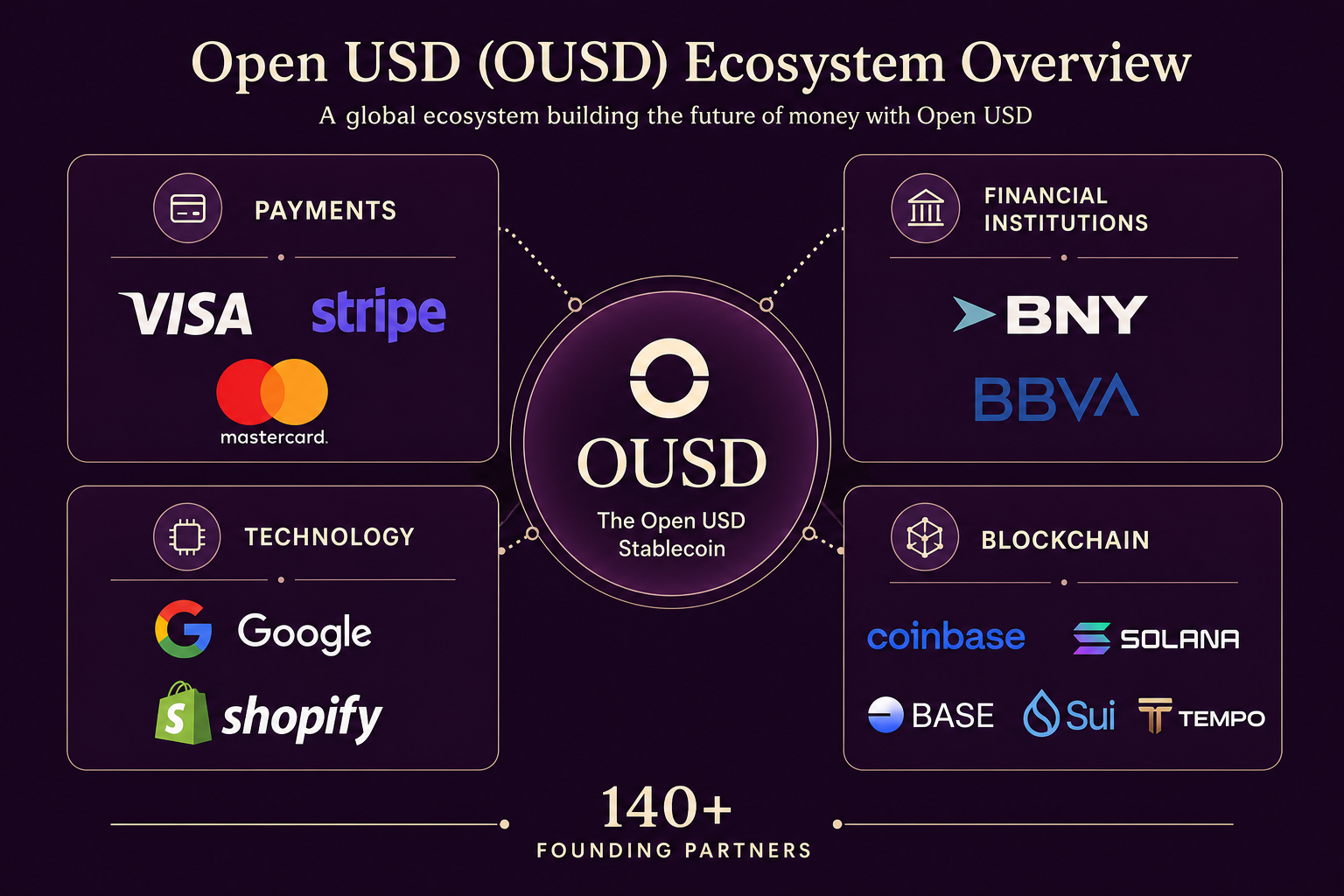 Figure 2. OUSD ecosystem overview: 140+ founding partners spanning payment networks, financial institutions, technology platforms, and blockchain.
A network of 140+ enterprises means OUSD is launch-ready with extensive adoption scenarios, liquidity, and compliance infrastructure. Partners are both adopters and participants in governance and yield sharing. Qualified companies may apply to join and participate in Hold, Mint, Accept, and other activities to share reserve returns.
What are the advantages and risks of using or holding OUSD?
Advantages: Zero mint/redeem fees reduce costs for large-scale transfers; reserve yield is returned to partners, aligning incentives across the ecosystem; collaborative governance mitigates the risk of misalignment from a single issuer; a network of 140+ partners ensures broad adoption and compliance; and multi-chain deployment supports payments, DeFi, and intelligent commerce use cases.
Risks and limitations: OUSD is scheduled for launch within the year, with contract addresses and reserve disclosures subject to actual public release; ordinary holders do not receive reserve yield directly; smart contract, custody, and regulatory changes present compliance risks; counterfeit tokens must be verified via joinopenstandard.com; and multi-chain deployment increases cross-chain and liquidity fragmentation risks. Benefits and risks should be evaluated separately, and organizations or individuals should make independent decisions based on their business needs and compliance requirements.
Summary
Open USD (OUSD) is a 1:1 USD-pegged stablecoin initiated by Open Standard, redefining fee, yield, and governance structures through the principles of Build for scale, Earn by default, and Govern collaboratively. Open Standard is governed by a partner board, and its 140+ founding partners span payments, finance, technology, and blockchain. OUSD reserves are held at major regulated US financial institutions, with plans to launch this year and circulate on multiple public blockchains, targeting cross-border payments, remittances, acquiring, and DeFi.
FAQ
What is the relationship between Open USD (OUSD) and Open Standard?
Open USD (OUSD) is a 1:1 USD-pegged stablecoin. Open Standard is an independent operating company responsible for OUSD’s design, compliance, and ecosystem coordination. The partner board participates in governance, with decisions oriented toward collective interests.
What are the three core design principles of OUSD?
Build for scale means zero mint/redeem fees and no artificial volume limits; Earn by default means reserve yield is distributed to ecosystem partners after deducting a small management fee; Govern collaboratively means the partner board collectively determines OUSD’s design and operational direction.
How is OUSD reserve yield distributed to partners?
After deducting a small management fee, reserve yield is distributed to network partners driving adoption, linked to Hold, Mint, Accept, and other participation metrics. Ordinary on-chain holders do not receive reserve interest directly.
When is OUSD expected to launch? On which blockchains will it circulate?
OUSD is expected to launch within the year and will circulate on blockchains such as Solana, Base, Sui, and Tempo. Contract addresses and deployment timelines will be publicly disclosed at launch.
What does joining Open Standard entail?
Joining means using OUSD as a core trading asset, gaining access to technical documentation, integration support, and usage-based yield distribution, as well as participating in governance decisions.
What are the main risks of using OUSD?
Key risks include mechanisms subject to public disclosure prior to launch, ordinary holders not directly receiving reserve yield, compliance risks from changes in smart contracts and regulations, the need to verify against counterfeit tokens via the official website, and cross-chain risks from multi-chain deployment.