As the blockchain industry enters the multi-chain era, ecosystems such as Ethereum, Solana, BNB Chain, and Avalanche continue to expand, with on-chain asset scale growing steadily. However, persistent issues like liquidity fragmentation, independent identity systems, and inefficient cross-chain communication across different networks remain. Users often rely on complex cross-chain bridges and third-party services to transfer assets, which limits the collaborative potential between blockchain networks.
To build an information transmission system akin to the internet, Openverse has introduced the concept of the "Value Internet," aiming to provide a unified value transmission layer for different blockchains through a Layer 0 network. In this architecture, BTG, as the network’s native asset, handles transaction fees, validator incentives, governance voting, and ecosystem settlement—making it a critical component of the Openverse network.
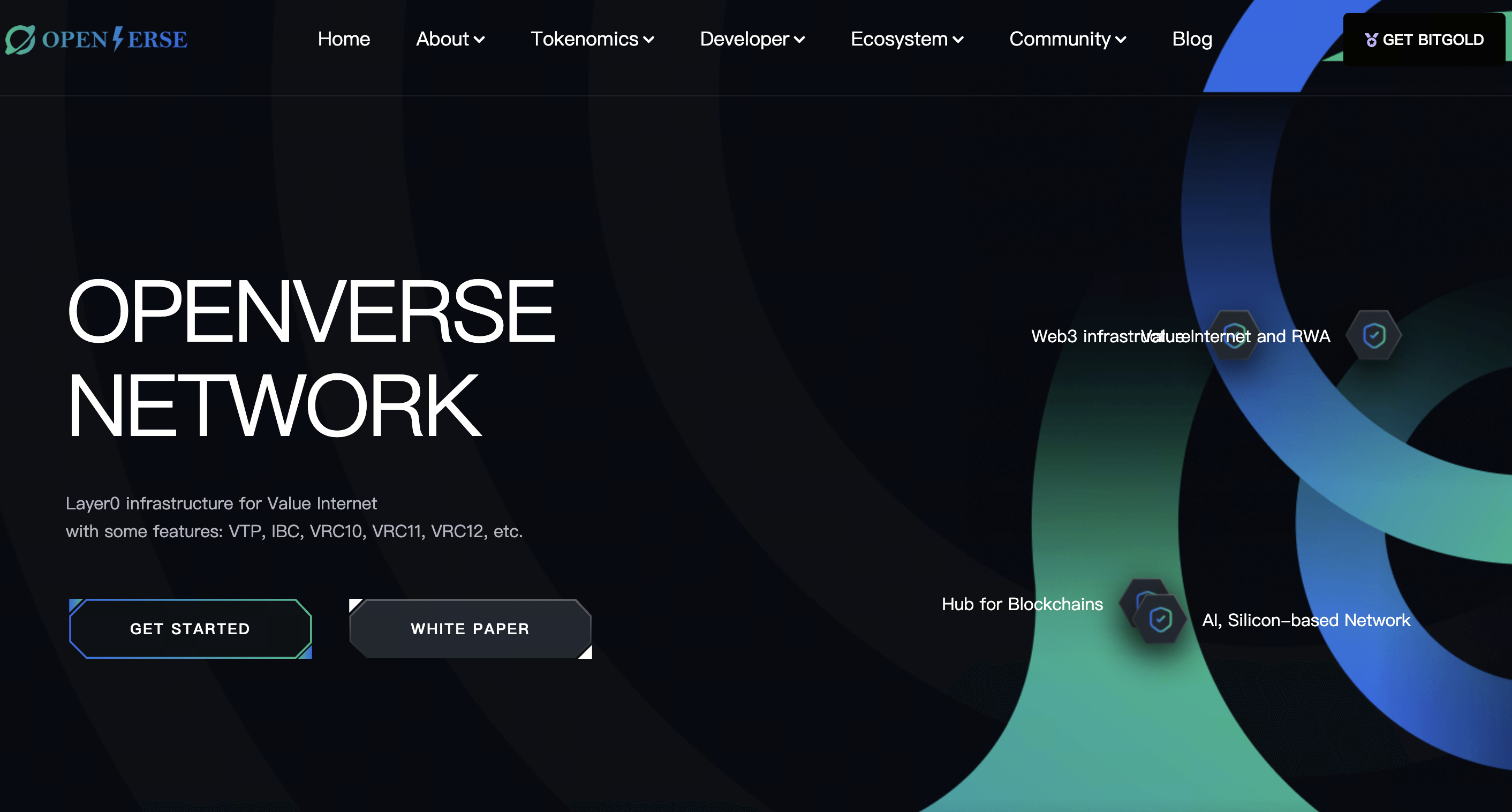
Source: openverse.network
What Is Openverse Network (BTG)?
By design, Openverse is more of a cross-chain protocol network than a traditional smart contract platform. Users and developers don’t need to migrate all applications to Openverse; instead, they leverage its cross-chain communication capabilities to enable collaboration between different ecosystems. Just as the TCP/IP protocol connects different computer networks on the internet, Openverse aims to become the connection layer for the value internet, establishing a unified value transmission standard for the multi-chain world.
Within the Openverse network, BTG is the native functional token. It is used not only for paying network transaction fees but also for validator node incentives, staking governance, and ecosystem settlement. As the network scales, BTG’s role will expand to cover various aspects of value internet operations.
Why Does the Blockchain Industry Need a Layer 0 Network?
Early blockchain development primarily revolved around single public chains. Whether Bitcoin or later smart contract platforms, most networks focused on building their own ecosystems. However, with the growth in application numbers, independent asset and user systems gradually formed across different chains, leading to new information and value silos in the blockchain world.
Layer 1 networks can solve intra-chain transaction and application operation issues, but they cannot inherently address cross-chain collaboration. When users want to transfer assets from one ecosystem to another, they usually need to use cross-chain bridges or third-party services. This not only increases operational complexity but also introduces additional security risks.
Layer 0 networks emerged precisely to solve this problem at the infrastructure level. They don’t directly compete with terminal applications; instead, they act as a connection layer between different blockchains, providing unified standards for asset circulation, data exchange, and cross-chain communication. By choosing the Layer 0 route, Openverse aims to become one of the key infrastructures of the future value internet.
What Problems Does Openverse Aim to Solve?
After years of development, the blockchain industry has formed a vast number of public chains and application ecosystems. However, behind the multi-chain prosperity, obvious problems have emerged—namely, the lack of unified value exchange and communication mechanisms between different networks. Openverse’s core goal is to address these long-standing infrastructure issues in cross-chain environments.
First is the asset silo problem. Users’ digital assets are often locked within specific blockchains, and the cost of transferring between ecosystems is high. Even when using cross-chain bridges, users may face risks like insufficient liquidity, high fees, or security vulnerabilities. The inability of assets to flow freely limits capital efficiency across the industry.
Second is the identity silo problem. Users’ wallet addresses, reputation records, and on-chain behaviors on different chains are typically independent, lacking a unified identity system. This means that the credit and data a user builds in one ecosystem cannot be directly transferred to another.
Additionally, the message silo limits the development of multi-chain applications. Many cross-chain solutions support only asset transfers but cannot achieve complex data communication and smart contract collaboration. Openverse hopes to solve interoperability issues at the asset, identity, and message levels through a unified protocol, establishing a more open collaborative environment for the multi-chain world.
How Does Openverse’s Cross-Chain Architecture Work?
Openverse’s core infrastructure is built on the Fully Open Protocol Cross-Chain (open cross-chain protocol). The goal of this architecture is not to build a single cross-chain bridge but to establish an open standard that allows different blockchains to exchange value and transmit information through unified rules.
At the asset level, Openverse supports Token Cross-Chain. Users can transfer digital assets between different blockchains without relying on a single centralized institution for custody and settlement. Value mapping and state synchronization at the protocol layer help improve cross-chain asset flow efficiency.
In the field of digital collectibles, Openverse supports NFT Cross-Chain. As the NFT ecosystem evolves, many assets are no longer limited to a single blockchain. Cross-chain capability enables NFTs to circulate across multiple ecosystems, enhancing their usability and market reach.
Beyond assets, Openverse also supports Message Cross-Chain. Message cross-chain allows applications on different chains to interact with data and call smart contracts, expanding cross-chain scenarios from simple asset transfers to complex business collaboration. This is also an important foundation for the future interconnection of multi-chain applications.
What Is the Value Internet?
The internet solves the problem of information transmission. Through the TCP/IP protocol, people can freely transmit text, images, audio, video, and other information globally. The success of the information internet proves that unified protocols can significantly reduce communication costs and promote global collaboration.
The Value Internet concept proposed by Openverse extends this logic to the field of value transmission. Its core idea is to allow assets, property rights, securities, digital identities, and various quantifiable rights to flow freely like information, without being limited by any single platform or network.
From Openverse’s perspective, blockchain is not just a database technology but also a value transmission technology. If the internet solved the problem of information asymmetry, then the Value Internet will aim to solve the problem of value flow efficiency. In the future, digital currencies, real-world assets (RWA), and on-chain identities may all become important components of the Value Internet.
Openverse hopes to provide underlying infrastructure support for the Value Internet through its Layer 0 network, cross-chain protocols, and digital asset issuance system, enabling different blockchains to collectively participate in the construction of the global value network.
What Is the Role of BTG in the Openverse Network?
BTG is the native token of the Openverse Network and a key part of its economic system. Unlike many tokens that are only used to pay fees, BTG takes on multiple roles in network operation, governance, and incentives.
First, BTG is used to pay network transaction fees and cross-chain communication fees. When users perform transfers, cross-chain operations, or smart contract interactions, they need to consume BTG as network Gas. The Gas mechanism prevents resource abuse and provides economic incentives for network participants.
Second, BTG can be used for Staking. Users can participate in network security maintenance by staking BTG and receive corresponding rewards. The staking mechanism enhances network resistance to attacks while increasing long-term token engagement.
BTG also serves validator node incentives and governance voting functions. Validators receive BTG rewards for running nodes, while token holders can participate in decisions on protocol upgrades, parameter adjustments, and ecosystem development direction. This makes BTG not only a medium of value exchange but also an important tool for network governance.
How Does Openverse’s Consensus Mechanism Ensure Network Security?
Network security is a core issue for all infrastructure projects. For cross-chain networks, security is even more critical than for ordinary public chains, as cross-chain systems typically need to maintain value flow across multiple ecosystems simultaneously.
Openverse introduces the Delegated Proof of Stake (DPoS) mechanism as its core consensus model. Token holders can vote to elect validator nodes, which are responsible for transaction validation and block production. This mechanism improves network efficiency while maintaining decentralization.
Additionally, Openverse incorporates the Proof of History (PoH) time-ordering mechanism. PoH establishes a trusted chronological order, improving transaction sorting efficiency and reducing synchronization costs between nodes, thereby enhancing overall throughput.
The validator node network forms the security foundation of Openverse. Nodes must assume operational responsibilities and are subject to economic incentives and penalty mechanisms. Through the combination of staking, voting, and slashing models, Openverse aims to establish a long-term, stable security system.
How Does Openverse Support Digital Asset Issuance?
Openverse focuses not only on cross-chain communication but also on building a value issuance system covering multiple asset types. The project believes that the future value internet needs to support digital expressions of various forms, including currencies, securities, points, and real-world assets.
Bitcurrency is a basic module for digital currency issuance scenarios, designed to support the creation and circulation of different types of value units. Through a standardized issuance mechanism, developers can build digital assets suitable for specific scenarios.
Privcurrency focuses more on enterprise-level and private asset issuance needs. In certain business environments, asset circulation must meet permission management and compliance requirements, so a private issuance system has certain application value.
Bitsecurity is mainly for securitized assets and equity proof scenarios, while Tokenized Assets extends to the real-world assets (RWA) field. Whether stocks, bonds, real estate equity, or corporate points, they can all be digitized and enter the on-chain circulation system, thereby improving value transfer efficiency.
What Is the Difference Between Openverse, Cosmos, and Polkadot?
Openverse, Cosmos, and Polkadot are all important directions in the cross-chain infrastructure field, but their design goals are not the same.
| Project |
Openverse |
Cosmos |
Polkadot |
| Core Positioning |
Value Internet |
App Chain Network |
Relay Chain Network |
| Main Goal |
Value Interconnection |
Application Chain Interconnection |
Shared Security |
| Cross-Chain Method |
Open Protocol |
IBC |
Relay Chain |
| Native Asset |
BTG |
ATOM |
DOT |
| Identity System |
Supported |
Partially Supported |
Partially Supported |
| Asset Issuance System |
Emphasizes Value Assets |
Relatively Limited |
Relatively Limited |
Cosmos focuses more on building an app chain ecosystem, Polkadot emphasizes shared security and relay chain architecture, while Openverse focuses on the value internet and circulation systems for multiple asset types. From a positioning perspective, Openverse aims to build a unified value layer rather than just a technical connection between chains.
What Are the Application Scenarios of Openverse?
As the multi-chain ecosystem continues to develop, the application scope of cross-chain infrastructure is expanding. Openverse’s design goals mean its use cases go beyond digital asset transfers to cover a wider field of value circulation.
Cross-chain payments are one of the most direct application scenarios. Users can complete value transfers between different blockchains without frequently switching networks or relying on complex bridging tools. This helps improve digital asset liquidity and user experience.
NFT circulation is also an important application direction. Cross-chain capability enables NFTs to circulate across multiple ecosystems, expand market coverage, and enhance digital asset composability.
Additionally, on-chain identities, real-world assets (RWA), and Web3 commercial applications are seen as potential future scenarios. When identity data, securities assets, and commercial rights can flow across chains, the practical application scope of the value internet will expand further.
Openverse’s Advantages and Challenges
Openverse’s advantages are mainly reflected in its Layer 0 positioning and value internet concept. By starting from the underlying infrastructure, the project attempts to solve the long-standing problems of asset, identity, and message silos in the multi-chain era. At the same time, its open protocol and digital asset issuance system provide more possibilities for future ecosystem expansion.
From a long-term development perspective, the value internet concept has strong forward-looking potential. If cross-chain communication, RWA, and on-chain identity continue to grow, infrastructure projects like Openverse may gain more development space.
However, the project also faces challenges. The cross-chain infrastructure field is highly competitive, with projects like Cosmos, Polkadot, and LayerZero already establishing significant market influence. Additionally, cross-chain networks naturally have high security requirements, and any protocol vulnerabilities could affect the stable operation of the entire ecosystem.
The future development of Openverse will depend on developer ecosystem building, actual application implementation, and the growth rate of network adoption.
Summary
Openverse Network (BTG) is a Layer 0 cross-chain infrastructure project built with the Value Internet as its core vision. Through open cross-chain protocols, a digital asset issuance system, and a unified value transmission layer, Openverse aims to connect different blockchain ecosystems and enable the free flow of assets, identities, and messages.
In this system, BTG handles Gas payments, staking, governance, and node incentives, making it an important part of the network’s economic model. As the multi-chain ecosystem and the digitization trend of real-world assets continue to develop, the value internet model explored by Openverse provides a new direction for blockchain infrastructure.
FAQ
What is the Openverse Network?
The Openverse Network is a Layer 0 cross-chain infrastructure project designed to connect assets, identities, and messages between different blockchains and build a value internet.
What is the role of BTG?
BTG is the native token of Openverse, used for paying network fees, participating in Staking, governance voting, and validator node incentives.
Is Openverse Layer 0 or Layer 1?
Openverse is primarily positioned as a Layer 0 network. Its core function is to connect different blockchains, not to run a single ecosystem application.
How does Openverse achieve cross-chain?
Openverse supports cross-chain transmission of Tokens, NFTs, and Messages through an open cross-chain protocol, achieving multi-chain interoperability.
Can BTG be staked?
Yes. Users can stake BTG to participate in network security maintenance and receive corresponding network rewards.







