In the AI Gaming ecosystem, Prompt-to-Game is considered a critical infrastructure connecting creativity with game products. Portal is one of the key pioneers in this field, integrating creative parsing, content generation, and game construction into a unified platform through the AI Agent workflow. This approach gradually moves the concept of "generating a game from a single sentence" from theory to practical application.
What Is Prompt-to-Game
Prompt-to-Game is a development model that uses natural language prompts to generate game content. Creators input text descriptions, and the AI system responds by producing characters, scenes, gameplay rules, and even some interactive logic.
Unlike traditional game development, which relies on manual coding and asset creation, Prompt-to-Game emphasizes the collaborative relationship between humans and AI. Creators focus on expressing their ideas, while AI handles technical implementation and content production.
The emergence of Prompt-to-Game brings the game development process closer to a content creation model, lowering the barrier that specialized skills impose on creative ability.
How Portal Implements Prompt-to-Game
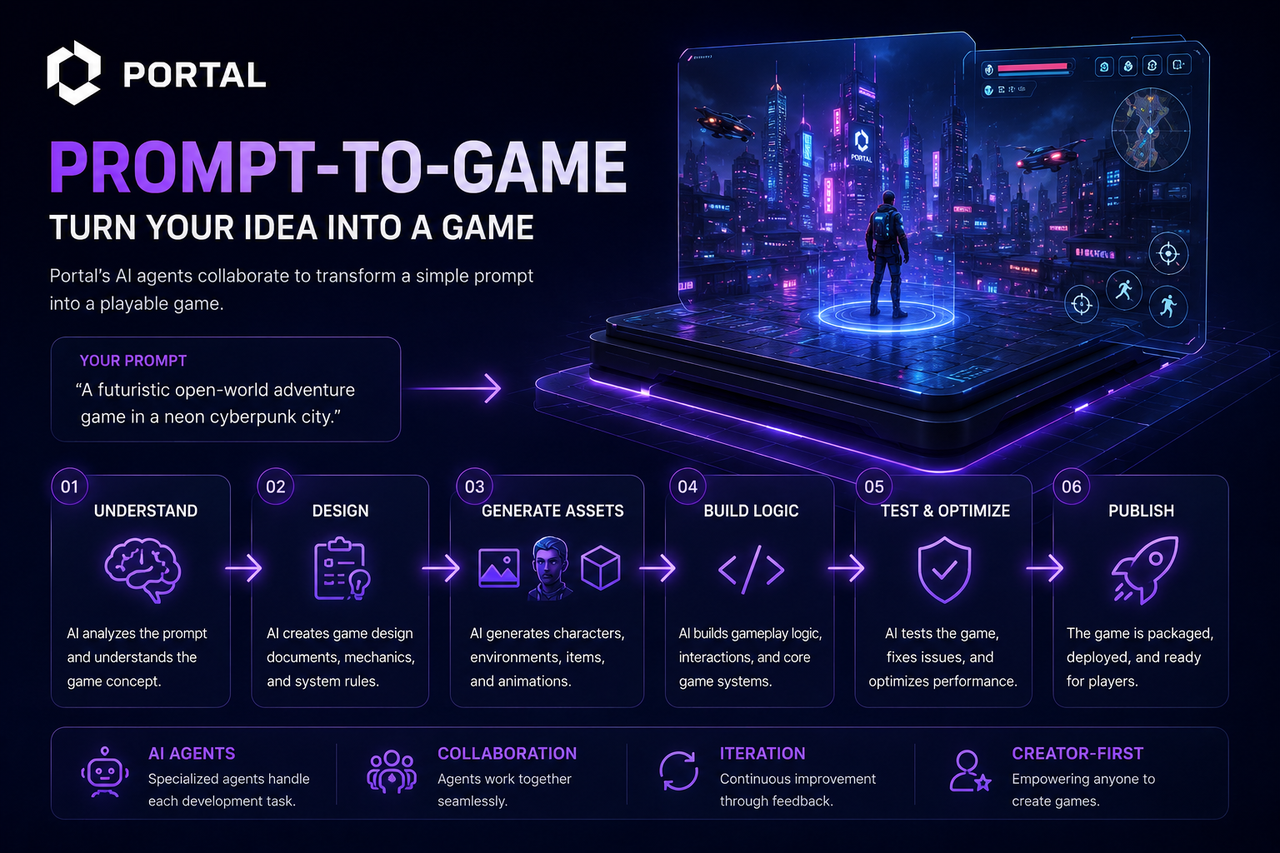
Portal builds Prompt-to-Game on an AI Agent collaborative architecture. When a user inputs a game idea, the system does not directly generate the final product. Instead, it launches multiple Agents to cooperatively complete the development process.
Portal first analyzes the user input, identifying the game type, theme style, target players, and core gameplay. The system then breaks down the requirements into independent tasks and assigns them to different Agents for execution.
This approach allows Portal to handle design, resource generation, and logic development simultaneously, thereby improving overall generation efficiency and content consistency.
The starting point of Prompt-to-Game is typically a natural language description. For example, when a user inputs "Create a sci-fi open-world exploration game," the system first performs semantic understanding of the text.
The requirement parsing module identifies keywords, game type, scene style, and core gameplay, and generates a corresponding development plan. The system then establishes a basic project framework, including world setting, character system, and mission structure.
This stage resembles requirement analysis and planning in traditional game development, but most of the work is completed automatically by AI.
How AI Generates Game Scenes and Characters
After requirement analysis, the resource generation Agent begins creating visual content. AI can automatically generate character design images, map structures, architectural styles, and item resources based on the prompts.
The generated content is not random output. Instead, it is built consistently based on the world setting and design logic established earlier. This ensures coherence among characters, scenes, and narrative background.
Compared to traditional art production, AI generation can quickly provide multiple versions for creators to review and refine.
How AI Constructs Game Logic and Gameplay
Games require both visual content and complete interaction mechanisms. The logic development Agent converts design concepts into playable gameplay systems.
Based on the game type, AI automatically builds mission systems, character growth mechanics, combat rules, and user interaction logic. For simple projects, the system can even generate some basic code automatically.
While complex gameplay still requires developer optimization, AI can already handle a significant amount of repetitive logic construction.
How AI Agent Completes Automated Testing
Testing is a crucial part of the Prompt-to-Game process. After game content is generated, the testing Agent simulates player behavior to verify the game's operational status.
The testing Agent can check whether mission flows function correctly, interaction logic is complete, and resources load without errors. At the same time, the system automatically records potential issues and feeds them back to the development module.
This automated testing mechanism helps creators identify problems more quickly, thereby improving the usability of game prototypes.
How Prompt-to-Game Differs From Traditional Game Development
The biggest difference between Prompt-to-Game and traditional development lies in the creative approach. Traditional development relies on developers building all content step by step, while Prompt-to-Game emphasizes content production driven by natural language.
In the traditional model, a game prototype may take weeks or even months to complete. In contrast, with Prompt-to-Game, creators can obtain a playable prototype in a relatively short time and iterate continuously.
This mode does not replace development teams entirely, but it can significantly reduce development costs and improve the efficiency of idea validation.
What Challenges Does Prompt-to-Game Face
Although Prompt-to-Game lowers the creative barrier, it still has limitations. Complex game systems, large-scale multiplayer online gameplay, and highly innovative mechanics still require the involvement of professional development teams.
Content quality control is also a major challenge. AI-generated results may suffer from logic inconsistencies, insufficient gameplay depth, or inconsistent resource styles, requiring manual further optimization.
Additionally, computational resource consumption, Agent collaboration efficiency, and model capability boundaries affect the final output.
Summary
Prompt-to-Game is an AI development model that uses natural language to generate game content. Its core goal is to lower the barrier to game creation and improve content production efficiency. Portal integrates requirement analysis, resource generation, logic development, and automated testing into a unified platform through an AI Agent workflow, enabling creators to quickly obtain a playable game prototype from a single sentence.
FAQs
What is Prompt-to-Game?
Prompt-to-Game is a development model that uses natural language prompts to generate game content. After a user inputs a textual description of a game, the AI system automatically produces scenes, characters, gameplay, and some interactive logic.
How does Prompt-to-Game work?
Prompt-to-Game typically involves steps such as requirement parsing, content generation, logic development, and testing optimization. AI first understands the meaning of the prompt, then uses different models to generate corresponding game content.
How does Portal generate a game from a single sentence?
Portal uses multiple AI Agents working collaboratively to break down the user's natural language input into tasks such as design, resource generation, logic development, and testing, and automatically builds a game prototype.
Does Prompt-to-Game require programming skills?
The primary goal of Prompt-to-Game is to lower the programming barrier. Creators can express their ideas through natural language, but complex projects usually still require some development knowledge for optimization and adjustment.
Can Prompt-to-Game completely replace traditional development?
Prompt-to-Game can improve development efficiency and shorten the prototype creation cycle, but complex game systems and high-quality commercial products still require the involvement of professional development teams.