As the blockchain industry shifts from a simple value transfer network toward long-term infrastructure, consensus mechanism energy efficiency and hardware fairness have become critical industry issues. Bitcoin’s PoW model offers extremely high security, but has long faced controversy over ASIC centralization and high energy consumption. PoS reduces energy use but introduces staking power concentration.
In this context, Chia Network’s PoST represents a novel path between PoW and PoS, embodying a design strongly aligned with green blockchain and sustainable infrastructure.
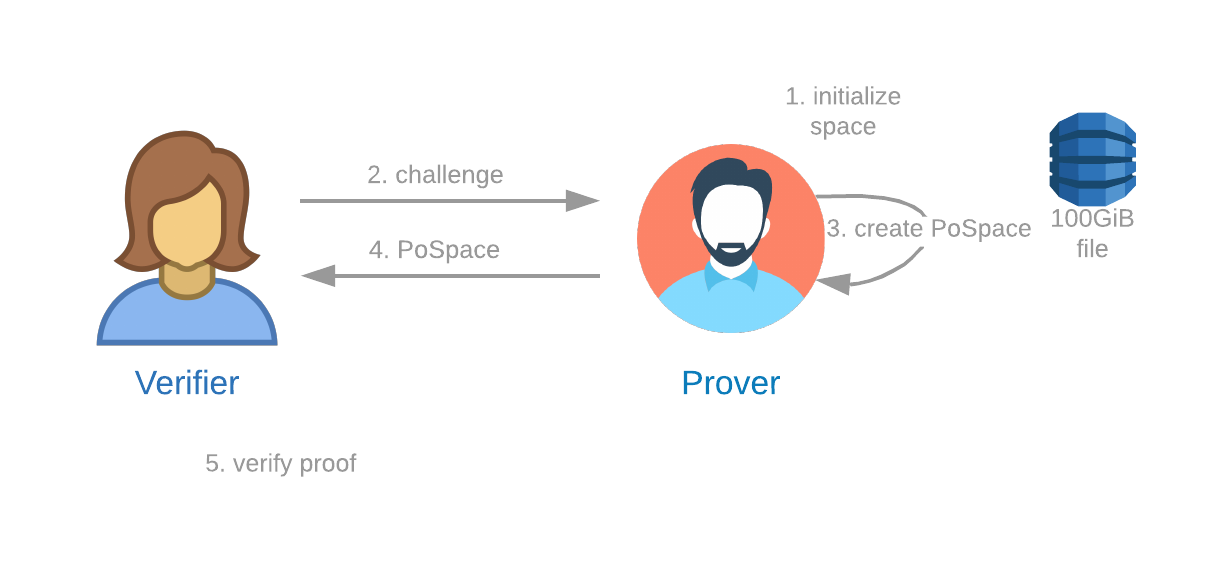
Proof of Space (PoS—not to be confused with Proof of Stake) is the first component of PoST. Its core logic uses hard drive storage space to participate in block validation.
In the Chia network, users must generate Plot files in advance. A Plot is a pre-computed cryptographic data structure stored on the hard drive. When the network issues a new block challenge, nodes rapidly search local Plots and submit the Proof closest to the target value.
The network determines block reward probability based on a node’s proportion of effective storage space.
$P(\text{block reward}) \propto \frac{\text{Allocated Storage Space}}{\text{Total Network Space}}$
Unlike traditional PoW, Proof of Space does not require continuous high-frequency computation, so nodes consume significantly less power during normal farming phases.
However, Proof of Space has potential issues. For example, an attacker who can quickly reconstruct large volumes of storage proofs could compromise network security. Therefore, Chia introduces a second-layer mechanism: Proof of Time.
Proof of Time is the time verification component of PoST. Its primary objective is ensuring blocks are generated in real chronological order.
Chia uses a cryptographic structure called Verifiable Delay Function (VDF) to implement time proof. VDF characteristics:
This means even an attacker with massive hardware resources cannot quickly generate multiple time proofs through parallel computation.
In the Chia network, nodes generating VDFs are called Timelords. Timelords do not determine block proposers; they provide a unified time order for the entire network, enhancing chain reorganization resistance.
Structurally, Proof of Space determines “who can generate a block,” while Proof of Time determines “the chronological order in which blocks must be finalized.”
PoST operation typically comprises four stages:
Users first generate Plot files. This process involves extensive pre-computation and writing to the local hard drive. Once generated, Plot files remain usable long-term.
When the network issues a new block challenge, Farmers search their local Plot files and submit the Proof closest to the challenge target.
The Timelord generates a VDF time proof based on the current block result, ensuring blocks cannot be quickly reconstructed in parallel.
The network ultimately confirms the new block based on the combined Proof of Space and Proof of Time result, distributing XCH rewards to the Farmer.
Throughout this process, sustained energy consumption comes primarily from Plotting, not daily Farming. Consequently, Chia’s long-term operational power usage is typically lower than traditional PoW networks.
PoST is widely considered a green consensus mechanism because it does not rely on continuous high-hashrate competition.
Bitcoin mining requires ASICs to run continuously, consuming substantial electricity. In contrast, Chia’s Farming phase mainly involves hard drive reads, making daily energy consumption significantly lower.
Additionally, PoST allows ordinary HDD devices to participate, reducing the risk of high-performance mining machine monopolies.
However, “green” does not mean zero resource consumption. The early Chia craze caused massive SSD usage for high-frequency Plotting, leading some consumer-grade SSDs to wear out quickly from write pressure. This has prompted market re-evaluation of PoST’s long-term environmental benefits.
Thus, PoST’s green attributes are more evident in its long-term operational phase than in the initial Plotting phase.
PoST is often compared to Bitcoin’s PoW and Ethereum’s PoS.
| Comparison Dimension | PoST | PoW | PoS |
|---|---|---|---|
| Core Resource | Storage space | Hashrate | Staked assets |
| Energy Consumption | Lower | Higher | Lower |
| Security Source | Space + Time proofs | Hashrate competition | Economic penalties |
| Representative Network | Chia | Bitcoin | Ethereum |
| Hardware Requirement | HDD / SSD | ASIC / GPU | Validator nodes |
| Centralization Risk | Storage resource concentration | ASIC concentration | Large investor staking concentration |
PoW’s core advantage is long-verified security, but with high energy consumption. PoS improves efficiency but relies more on economic incentives and governance structures.
PoST attempts to use low-power storage resources to achieve a security model resembling Nakamoto Consensus, earning it the label of a “third consensus path.”
PoST reduces ASIC centralization but does not fully eliminate resource concentration risks.
As the Chia network grows, large data centers and professional storage farms join, meaning storage resources can also achieve economies of scale.
Additionally, Timelord nodes require higher-performance CPUs, creating a technical barrier.
Therefore, PoST redistributes costs among different resources rather than eliminating centralization entirely.
However, compared to ASIC-dominated PoW networks, PoST still improves ordinary user participation opportunities.
Proof of Space and Time (PoST), the blockchain consensus mechanism used by Chia Network, maintains network security through storage space and time proofs. Its core structure includes Proof of Space, Proof of Time, VDF, and Timelord nodes, aiming to find a new balance between security, decentralization, and energy efficiency.
No. Proof of Space uses storage space; Proof of Stake uses staked assets. They are different mechanisms.
Because relying solely on storage space cannot effectively prevent certain time-based attacks and chain reorganizations. VDF provides a unified time order.
VDF (Verifiable Delay Function) is a cryptographic time-proof structure that cannot be parallelized for acceleration.
The Timelord generates VDF time proofs and maintains a unified time order for the network.
Compared to traditional PoW, PoST has lower long-term operational energy consumption, but the Plotting phase still generates high SSD write pressure.