As blockchain technology evolves beyond cryptocurrency into traditional finance, financial institutions are increasingly exploring how distributed ledgers can streamline asset management and capital market operations. As a cornerstone of the Figure ecosystem, Provenance Blockchain stands out as a prime example of a financial-purpose blockchain network, engineered to boost transparency, automation, and operational efficiency in financial markets.
The Background of Provenance Blockchain
In traditional financial markets, asset issuance, trading, and settlement typically involve a web of independent systems, service providers, and intermediaries. With data scattered across disparate platforms, synchronizing information, verifying assets, and confirming trades can be time-consuming.
Blockchain technology offers a unified method for recording and sharing data, drawing the attention of the financial sector. However, most public blockchains were initially built for digital asset trading, not tailored to the compliance and operational demands of financial institutions.
Against this backdrop, Provenance Blockchain was purpose-built as a blockchain network for financial applications, aiming to simplify complex processes in capital and lending markets through digital infrastructure.

How Provenance Blockchain Works
Provenance Blockchain’s core approach is to record essential financial asset data on a distributed ledger and leverage smart contracts to automate certain business rules.
When loans, securitized products, or other assets are created, relevant information is recorded on-chain. Subsequent transfers, holdings, settlements, and audits can all be executed through a single, unified network.
With all participants sharing the same data records, redundant verification and data synchronization tasks that plague traditional finance are reduced. Meanwhile, blockchain’s immutability enhances transparency in asset management, allowing assets to remain traceable and verifiable throughout their entire lifecycle.
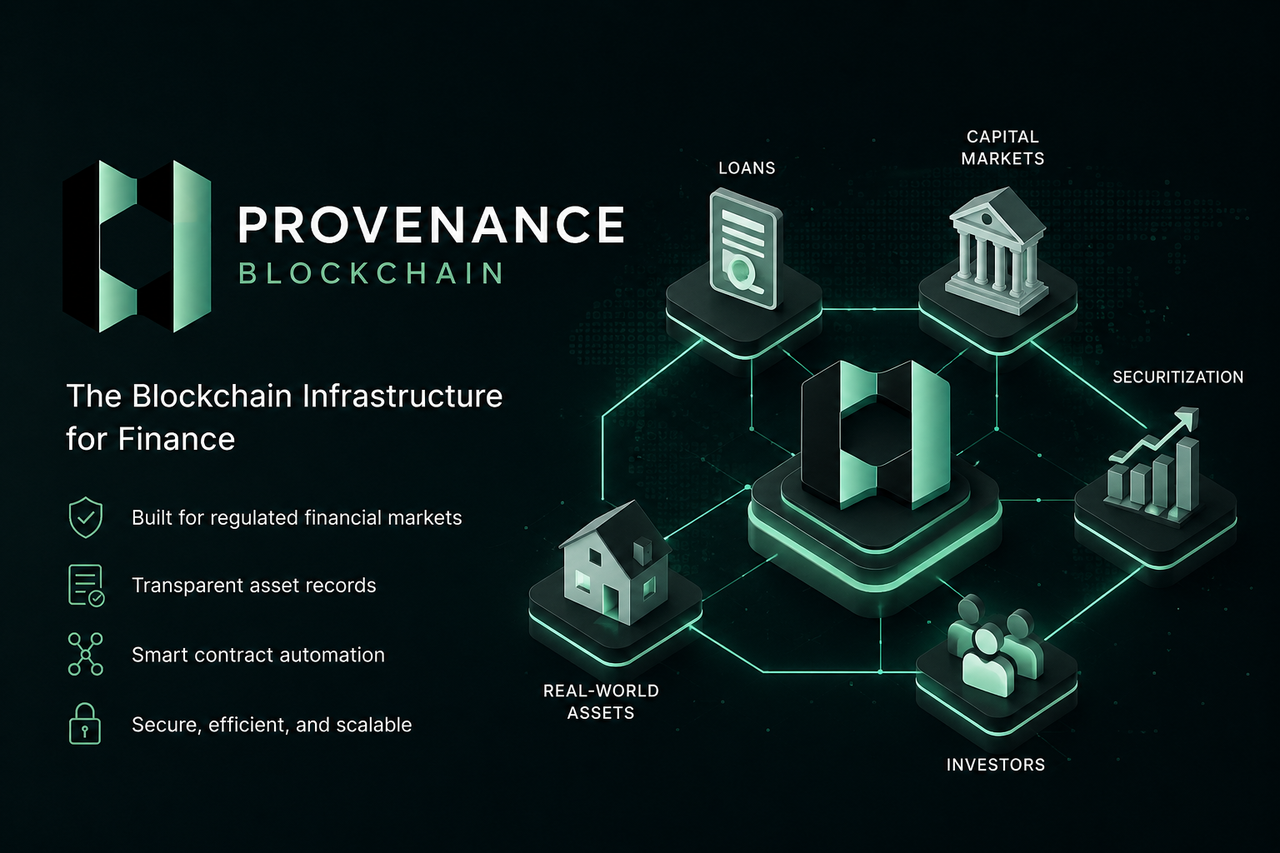
Core Architecture of Provenance Blockchain
Provenance Blockchain’s architecture is built around the needs of asset management and capital markets.
The network comprises validator nodes, smart contract modules, an asset registry system, and a data management layer. Validator nodes maintain network security and data consistency, while smart contracts execute predefined business logic. The asset registry records ownership and key data, and the data management layer ensures participating institutions access a single, trusted source of information.
This infrastructure enables seamless on-chain creation, management, trading, and settlement of financial assets.
Why Financial Institutions Need Dedicated Blockchain Networks
While open public blockchains offer high transparency, financial institutions must meet stringent regulatory and compliance requirements.
Financial operations involve identity verification, audit trails, risk management, and data governance—needs that often exceed the design scope of general-purpose public blockchains.
A dedicated financial blockchain can establish rules and permission systems tailored to industry requirements while retaining blockchain’s advantages in data sharing and automation.
As a result, networks like Provenance Blockchain have become a leading direction for the financial industry’s blockchain exploration.
Figure is a key driver of the Provenance Blockchain ecosystem.
Figure’s lending business, capital market platform, and RWA-related services are all built on Provenance Blockchain’s infrastructure. Through this network, Figure digitally manages loan assets, securitized products, and other financial instruments.
For Figure, Provenance Blockchain is not just a technology platform—it is a critical pillar of its on-chain capital market strategy.
Provenance Blockchain in the RWA Space
Real World Assets (RWA) represent a major development direction in blockchain today.
The core goal of RWA is to bring real-world financial assets onto blockchain networks for management and circulation. Loans, bonds, real estate assets, and private credit products are all typical RWA types.
Provenance Blockchain provides on-chain registration, ownership records, and transaction support for these assets, enabling full lifecycle management digitally. This model enhances asset transparency and lays the infrastructure foundation for future on-chain capital markets.
How Provenance Blockchain Supports Asset Securitization
Asset securitization involves pooling loans or other financial assets into investable products.
In the traditional model, securitization requires multiple institutions and complex data interactions. Provenance Blockchain simplifies asset management and information sharing through a unified ledger and digital records.
On-chain records improve transparency, while smart contracts automate certain business logic, reducing manual work and operational costs. Consequently, Provenance Blockchain is widely used in the digital securitization of loan assets and credit products.
How Provenance Blockchain Differs from Traditional Public Blockchains
Though both Provenance Blockchain and open public blockchains use blockchain technology, their design goals differ significantly.
| Comparison Dimension |
Provenance Blockchain |
General Public Blockchain |
| Core Positioning |
Financial infrastructure |
General-purpose blockchain |
| Primary Users |
Financial institutions and capital market participants |
Developers and the general public |
| Asset Types |
Loans, securitized products, RWA |
Digital assets, application tokens |
| Compliance Design |
Emphasizes regulatory requirements |
Emphasizes openness |
| Main Use Cases |
Financial asset management and trading |
Decentralized application ecosystems |
These differences make Provenance Blockchain more suitable for capital markets and institutional-grade finance.
Opportunities and Challenges for Provenance Blockchain
As RWA and on-chain finance grow, market demand for specialized financial blockchain infrastructure is rising. Provenance Blockchain has already established mature applications in lending, asset securitization, and capital markets, offering a practical foundation for financial asset digitization.
At the same time, the industry faces challenges such as evolving regulatory frameworks, increasing institutional adoption, and achieving interoperability across different blockchain networks.
The future of financial infrastructure depends not only on technological innovation but also on building more efficient coordination mechanisms with the existing financial system.
Summary
Provenance Blockchain is a blockchain network designed specifically for financial institutions and capital markets. Through on-chain registration, smart contracts, and digital settlement, it supports the management and circulation of loans, securitized products, and real-world assets. As a key infrastructure in the Figure ecosystem, Provenance Blockchain aims to enhance transparency, automation, and operational efficiency across the entire lifecycle of financial assets.
FAQs
What are the main use cases for Provenance Blockchain?
Provenance Blockchain is primarily used for loan management, asset securitization, real-world asset (RWA) management, capital market trading, and financial asset registration and settlement.
What is the relationship between Provenance Blockchain and Figure?
Figure is a key driver of the Provenance Blockchain ecosystem. Its lending services, Figure Connect, and multiple capital market businesses all run on Provenance Blockchain infrastructure.
How does Provenance Blockchain support RWA?
Provenance Blockchain supports the digital management of real-world financial assets through on-chain registration, ownership management, and digital transaction mechanisms, enabling loans, bonds, and other assets to circulate in a blockchain environment.
What is the difference between Provenance Blockchain and Ethereum?
Ethereum is primarily oriented toward an open, decentralized application ecosystem, while Provenance Blockchain focuses on serving financial institutions and capital markets, with a stronger emphasis on asset management, compliance, and financial scenario adaptation.