Samsung Electronics’ significance extends far beyond the smartphones and TVs familiar to consumers—it lies in its foundational role within the global technology supply chain. Whether in memory chips, display panels, or mobile devices, core capabilities from Samsung Electronics underpin countless digital services and electronic devices. As demand grows for AI, high-performance computing, and global digital infrastructure, Samsung Electronics’ position is drawing increasing market attention.
From an industrial structure perspective, Samsung Electronics operates across three critical layers: semiconductors, consumer electronics, and terminal ecosystems. This vertical integration means it can produce core components while delivering complete product systems to end users. Understanding Samsung Electronics, therefore, is not just about grasping a consumer brand—it is about understanding how the modern tech industry functions collaboratively.
What Is Samsung Electronics
The evolution of Samsung Electronics is essentially a microcosm of South Korea’s modern tech industry rise. In its early days, the company focused on consumer electronics and home appliance manufacturing. However, as the global electronics industry advanced, Samsung gradually moved into semiconductors, display panels, and mobile communications, building a comprehensive structure from basic components to finished products. This long-term investment allowed Samsung Electronics to move beyond a purely manufacturing role and into the core of global technology competition.
Entering the 21st century, the global tech industry began shifting toward platformization and ecosystem building. Many companies chose to focus on software, platforms, or design, while Samsung Electronics continued to strengthen its manufacturing and hardware integration capabilities. This path means it can participate in multiple industry cycles simultaneously, reducing the impact of volatility in any single product.
From a global market perspective, Samsung Electronics has long held a critical position in consumer electronics and memory chips. In certain niche markets, it serves as both a product provider and a supply chain participant. This dual identity clearly distinguishes Samsung Electronics from traditional tech brands.
At the same time, Samsung Electronics has become one of South Korea’s most representative global enterprises, and its business performance is often regarded as a key indicator of the global electronics industry’s health.
How Samsung Electronics’ Core Business Structure Works
To understand Samsung Electronics, one must first recognize that it is not a single-business company but a comprehensive system composed of multiple technology segments.
Currently, Samsung Electronics’ business can be broadly understood as two core directions: the Device eXperience business, targeting end users, and the Device Solutions business, serving industrial clients. The former focuses on the consumer market, while the latter caters to the supply chain and enterprise customers.
The Device eXperience direction covers smartphones, consumer electronics, home appliances, and terminal ecosystems. The Galaxy series devices, TVs, and home electronics familiar to users all fall under this category.
The other part is underlying technology capabilities, including memory chips, wafer manufacturing, and display technology. Although users have less direct interaction with this part, it holds significant influence in the global technology industry.
| Business Segment |
Main Products |
Revenue Logic |
Industry Role |
| Device eXperience (DX) |
Phones, TVs, Home Appliances |
End-user sales |
Consumer ecosystem |
| Device Solutions (DS) |
Chips, Memory, Foundry |
Technology supply |
Infrastructure |
| Display |
OLED, Display Panels |
Corporate supply |
Terminal support |
This structure means Samsung Electronics does not rely on a single blockbuster product for growth but instead leverages synergies between multiple segments.
For example, terminal devices help build the ecosystem, while chip and display capabilities in turn strengthen product competitiveness. This closed-loop capability is a defining characteristic of Samsung Electronics.
Why Samsung Electronics Holds Significant Influence in the Semiconductor Industry
The semiconductor business is often regarded as the most industrially influential part of Samsung Electronics. Unlike ordinary electronics manufacturers, Samsung Electronics has long been involved in chip R&D, production, and supply chain development, with particularly outstanding capabilities in memory chips. Modern data centers, cloud services, mobile devices, and AI infrastructure all heavily depend on high-performance memory.
In recent years, rising AI computing demand has refocused market attention on the semiconductor industry. Model training, high-performance computing, and data processing require higher bandwidth, lower latency, and stronger hashrate, with memory technology as a key component.
At the same time, Samsung Electronics also participates in wafer manufacturing and advanced process capabilities. This means it not only provides chip products but also engages in the production process itself.
From an industry structure perspective, the global semiconductor ecosystem typically consists of design, manufacturing, and end-use applications. Samsung Electronics relies less on a single link and instead aims to form a more complete technology capability system.
This is why many people misunderstand Samsung Electronics. On the surface, it appears as a mobile phone brand; but from an industry perspective, it is also a major global semiconductor player.
As AI hardware demand continues to grow, the importance of semiconductor capabilities may increase further, and Samsung Electronics will remain at the center of this evolution.
How Samsung Electronics Builds Its Consumer Electronics and Technology Ecosystem
Samsung Electronics’ competitive logic is not merely about launching new hardware products continuously; it is about forming long-term ecosystem synergies around devices, software, connectivity, and underlying technologies.
Traditional consumer electronics companies typically rely on a single blockbuster product for growth, such as smartphones or personal computers. However, as the global hardware market matures, relying solely on single-product innovation becomes increasingly difficult to sustain a competitive edge. Consequently, large tech companies are shifting from product competition to ecosystem competition.
Samsung Electronics’ approach is to build a user network through multi-device synergy. Smartphones, tablets, TVs, display devices, home appliances, and wearables together form a unified experience system, allowing users to leverage the same ecosystem capabilities across multiple scenarios.
Importantly, this device synergy does not exist in isolation.
Connectivity between devices requires display technology, chip capabilities, network infrastructure, and software coordination. Therefore, Samsung Electronics not only produces terminal devices but also continuously invests in underlying capability building.
From an industry perspective, this model represents a classic vertical integration structure. Compared to a single terminal brand, it can more directly influence supply chain efficiency, product iteration speed, and long-term technology planning.
As smart devices enter the AI era, the importance of terminal ecosystems is further strengthening. Future competition may no longer center on who has more devices, but on who can make those devices work together seamlessly.
Where Do Samsung Electronics, Apple, and TSMC Stand Respectively
Samsung Electronics, Apple, and TSMC are all core global technology companies. However, the biggest difference among them is not product category but the industry level they occupy: Apple is more focused on terminal ecosystem operations, TSMC is more focused on chip manufacturing infrastructure, and Samsung Electronics covers both terminal devices and underlying technology capabilities, making it a typical vertically integrated tech company.
Many users tend to classify these three as "tech companies," but from a business structure perspective, their roles differ significantly. Apple’s core goal is to connect users through a unified experience of hardware, software, and services; TSMC primarily serves corporate clients, supporting the global chip industry with advanced processes; Samsung Electronics aims to cover both technology supply and consumer markets.
This difference means that even when facing the same industry trends—such as AI, mobile devices, or computing power growth—their paths to benefit can be entirely distinct. Apple focuses on terminal application deployment, TSMC is driven by chip demand, while Samsung Electronics participates in both basic capability building and end-product output.
| Dimension |
Samsung Electronics |
Apple |
TSMC |
| Core Positioning |
Vertically integrated tech company |
Consumer tech ecosystem platform |
Semiconductor manufacturing infrastructure |
| Core Customers |
Consumers + Enterprises |
Consumers |
Chip design companies |
| Main Revenue Sources |
Phones, Semiconductors, Display, Consumer Electronics |
Hardware, Service ecosystem |
Wafer foundry |
| Produces Chips? |
Yes |
Designs primarily |
Manufactures primarily |
| Has Terminal Products? |
Yes |
Yes |
No |
| Has Operating System Ecosystem? |
Partial presence |
Strong ecosystem capability |
None |
| Relationship with AI |
Chip + device dual participation |
AI application gateway |
AI computing power foundation |
| Industry Position |
Spans infrastructure and terminals |
Near user side |
Near manufacturing side |
From an industry structure perspective, Apple resembles a digital consumption gateway, TSMC acts as a global chip factory, and Samsung Electronics sits between the two, forming a synergistic system by simultaneously controlling core components, manufacturing capabilities, and terminal devices.
This model’s advantage lies in its ability to connect multiple growth nodes. For example, when the consumer market shifts, some infrastructure businesses may provide a buffer; when chip demand rises, the terminal ecosystem can help form an application loop for technology capabilities.
However, the cross-layer layout also demands higher capital investment, more complex resource allocation, and longer-term technology accumulation. Understanding the differences among Samsung Electronics, Apple, and TSMC is essentially about understanding how the modern technology industry divides labor and collaborates across design, manufacturing, and terminals.
Asset Attributes of Samsung Electronics Stock
Samsung Electronics stock is typically classified as a tech stock, but from an underlying structure perspective, its asset attributes are more complex than those of traditional tech companies.
First, Samsung Electronics has a clear global manufacturing attribute. The company’s revenue is not dependent on a single region but is influenced by changes in global electronics demand.
Second, its business covers both consumer electronics and semiconductors, making it subject to both consumer spending cycles and technology infrastructure cycles.
This means Samsung Electronics is not exactly equivalent to an internet platform tech company.
For example, when consumer demand slows, some terminal businesses may face pressure; when AI infrastructure demand grows, chips and related capabilities may have different impacts. Therefore, its business performance often reflects the combined dynamics of multiple industry cycles.
From an asset allocation perspective, many investors view Samsung Electronics as an important barometer for observing the global electronics industry, South Korea’s tech sector, and semiconductor industry changes.
It should be noted that understanding stock attributes is not about predicting price trends. Stock prices are influenced by multiple factors including the macro environment, industry cycles, market sentiment, and company operations. Therefore, it is more appropriate to understand Samsung Electronics from an industry structure perspective rather than focusing on short-term fluctuations.
How to Buy Samsung Electronics Stock on Gate
As digital asset infrastructure and global market connectivity strengthen, more users are exploring convenient ways to participate in global stocks. Through Gate’s stock trading feature, users can directly trade stocks including Samsung Electronics without needing a traditional overseas brokerage account.
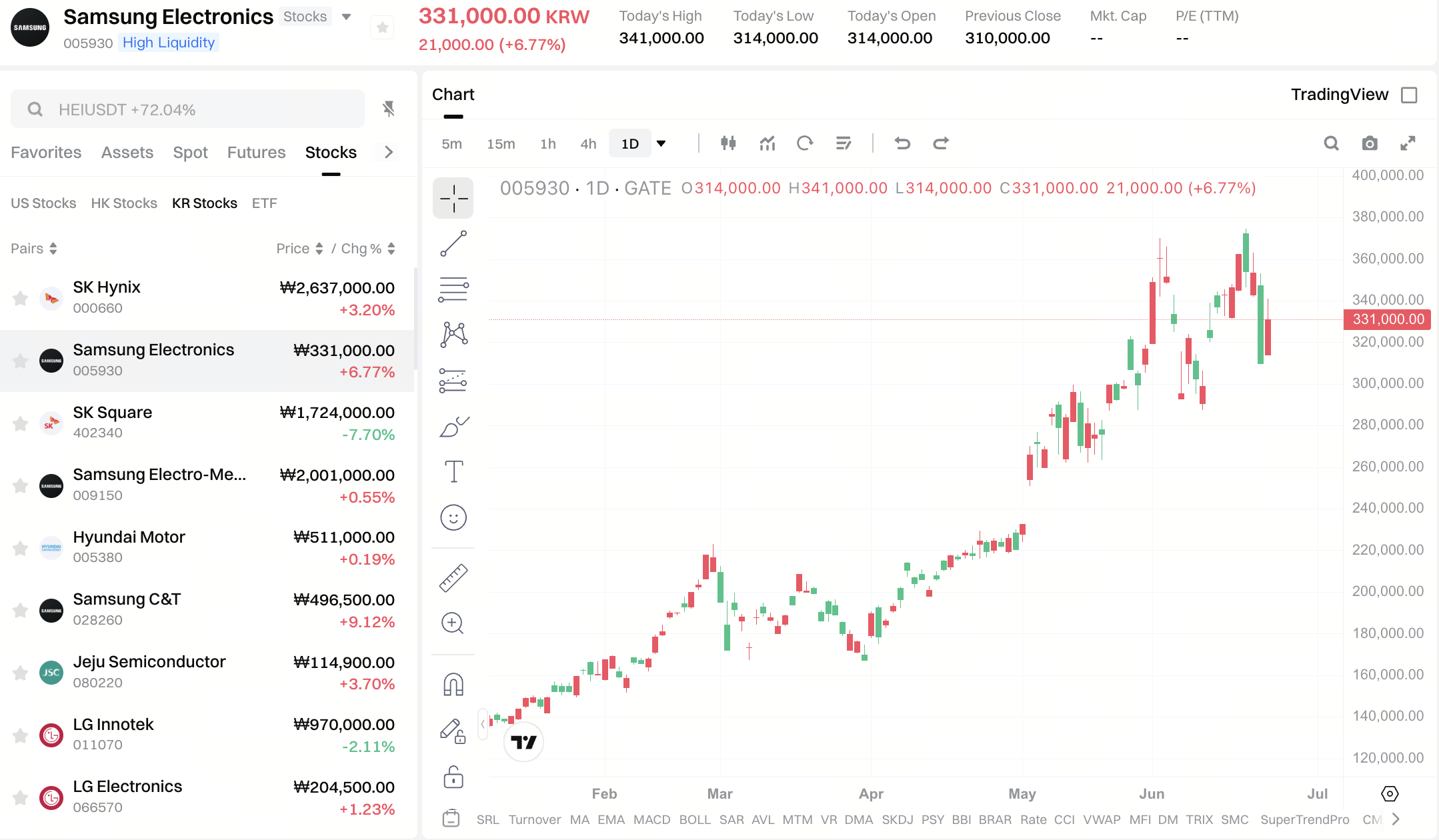
The overall process can be broken down into three steps.
First, download Gate and complete registration and identity verification. Once verified, users can access the stock trading section and view supported stock products.
Second, prepare funds. The platform supports trading with USDT, eliminating the need for a separate USD conversion. Once funds are ready, users can proceed.
Third, search for Samsung Electronics in the stock section and complete the trade. Users can buy, hold, or manage according to their needs. The platform supports fractional shares, allowing users to purchase less than a full share.
From a product mechanism perspective, stock trading corresponds to real stock asset exposure and supports corporate actions such as dividends and stock splits. The entire process resembles a digital stock participation method rather than a traditional cross-border account opening procedure. It should be emphasized that trading stocks on Gate constitutes market participation, does not represent a promise of returns, and does not replace personal risk judgment.
Samsung Electronics’ Long-Term Position in the AI and Global Tech Cycle
The rapid development of AI is reshaping the global technology industry structure, and Samsung Electronics’ position is evolving accordingly. In the past, tech growth came largely from terminal device upgrades and internet service expansion; in the future, more growth may come from computing power infrastructure, data capabilities, and smart device coordination.
This shift is strengthening the connections among semiconductors, memory, displays, and terminal ecosystems.
Because Samsung Electronics possesses both chip and terminal capabilities, it can participate in multiple technological stages. For example, AI models require infrastructure support, while end users still rely on devices for actual usage. This reconnects basic capabilities with consumption capabilities.
At the same time, global supply chain adjustments, regional technology competition, and next-generation computing demands may continue to drive industry evolution.
From a long-term perspective, Samsung Electronics’ importance stems not from any single product but from its ability to participate in multiple key technology nodes. Understanding Samsung Electronics, therefore, is essentially about understanding how future technology infrastructure will create synergies.
Summary
Samsung Electronics is a global technology company spanning semiconductors, consumer electronics, display technology, and terminal ecosystems. Its business structure means it not only participates in the product market but also in the construction of underlying technology capabilities.
Unlike many tech companies that focus on a single direction, Samsung Electronics has long connected chips, devices, and terminal ecosystems through a vertical integration model, giving it dual attributes of manufacturing capability and consumption capability. Understanding Samsung Electronics is not just about knowing a mobile phone brand or a stock symbol; it is about understanding how the global technology industry extends from underlying technology to terminal applications, forming a complete synergy system.
FAQ
What does Samsung Electronics mainly do?
Samsung Electronics’ main business covers semiconductors, smartphones, display panels, consumer electronics, and technology infrastructure.
What Is the Relationship Between Samsung Electronics and Samsung Group?
Samsung Electronics is an important part of the Samsung Group and one of its most globally influential core companies.
Is Samsung Electronics a Semiconductor Company?
Yes, but it is not limited to semiconductors. It also covers consumer electronics and terminal ecosystems.
What Is the Difference Between Samsung Electronics and Apple?
Apple leans more toward a terminal ecosystem platform, while Samsung Electronics participates in both terminal devices and underlying technology capability building.
How to Buy Samsung Electronics Stock Through Gate?
After completing registration and identity verification, use USDT to enter the stock section, search for Samsung Electronics, and complete the trade.
Can I Trade Samsung Electronics With USDT?
Yes, the platform supports using USDT for stock trading without the need for additional USD conversion.
Does Gate Support Fractional Share Trading?
Yes, fractional shares are supported, allowing users to purchase less than a full share.