As the number of Layer 2 networks grows rapidly and on-chain applications become increasingly complex, the Ethereum mainnet faces new challenges. While Rollup scaling has made significant progress, the market's demand for higher Layer 1 performance, a fairer MEV market, and lower transaction costs continues to rise. The emergence of Glamsterdam marks a shift in Ethereum's scaling focus—from purely serving Layer 2 to further optimizing the execution efficiency and resource utilization of the main chain itself.
From a blockchain infrastructure development perspective, Glamsterdam is more than just a performance upgrade—it represents a fundamental redesign of Ethereum's future network architecture. Through protocol-level MEV management, state access optimization, and parallel execution, Ethereum is building a global settlement network that balances security, scalability, and openness, providing a stronger foundation for DeFi, RWA, stablecoins, and next-generation on-chain applications.
What Is Ethereum Glamsterdam?
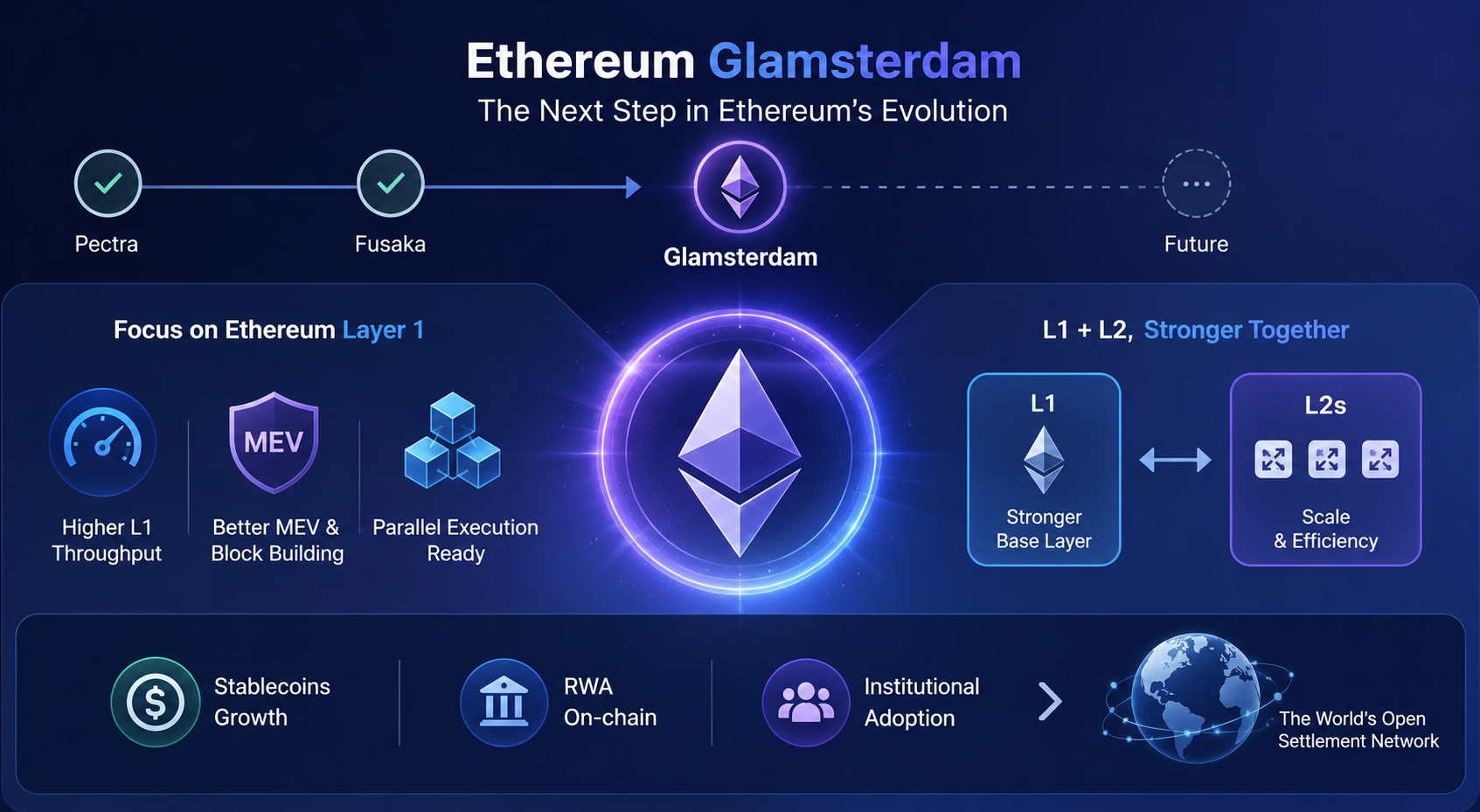
Ethereum Glamsterdam is a major network upgrade planned for 2026, representing the next phase in Ethereum's roadmap after Pectra and Fusaka. Unlike earlier upgrades that focused on account abstraction and Blob scaling, Glamsterdam turns attention back to Ethereum Layer 1 itself. The upgrade targets improving Layer 1 transaction processing capacity, optimizing MEV and block building mechanisms, and preparing for parallel execution and higher future throughput.
Within the Ethereum community, Glamsterdam is seen as a crucial step from a Rollup-centric roadmap toward collaborative Layer 1 and Layer 2 scaling. This means Ethereum is no longer relying solely on Rollups to boost performance—it is now directly enhancing the main chain's execution efficiency and resource utilization, making Layer 1 the essential infrastructure supporting the entire ecosystem's continued expansion.
Based on recent community discussions, Glamsterdam has become a key topic in Ethereum developer meetings. With the growing scale of stablecoins, accelerating RWA tokenization, and increasing institutional adoption, Ethereum aims to further solidify its position as a global open settlement network through this upgrade.
Why Does Ethereum Need Glamsterdam?
Over the past few years, Ethereum's scaling strategy has primarily revolved around Rollups. Layer 2 networks such as Arbitrum, Base, and Optimism have grown rapidly, significantly reducing user transaction costs while increasing overall throughput. The Rollup-centric roadmap has become a key part of Ethereum's long-term scaling strategy.
However, as the ecosystem continues to expand, new challenges have emerged.
-
Ethereum Layer 1 remains the ultimate settlement layer for the entire ecosystem. Whether for stablecoin settlement, institutional asset issuance, or large DeFi protocols, everything depends on the main chain's security. If Layer 1 performance cannot keep pace, the ecosystem's future growth potential will be constrained.
-
The MEV issue has become a growing community concern. In the current block building process, complex relationships have formed among Builders, Relays, and Validators. Some large Builders hold a significant market share, raising concerns about network centralization and censorship risk.
-
Other public chains are also advancing high-performance architectures. Solana has made parallel execution a core advantage, Sui uses an object model to improve state concurrency, and Aptos and Monad are exploring higher-performance execution environments. In this competitive landscape, Ethereum needs to further enhance Layer 1 processing capabilities while maintaining decentralization and security—and Glamsterdam was born from this context.
Two Core Upgrades of Glamsterdam: ePBS and Block Access Lists
ePBS: Embedding PBS into the Protocol Layer
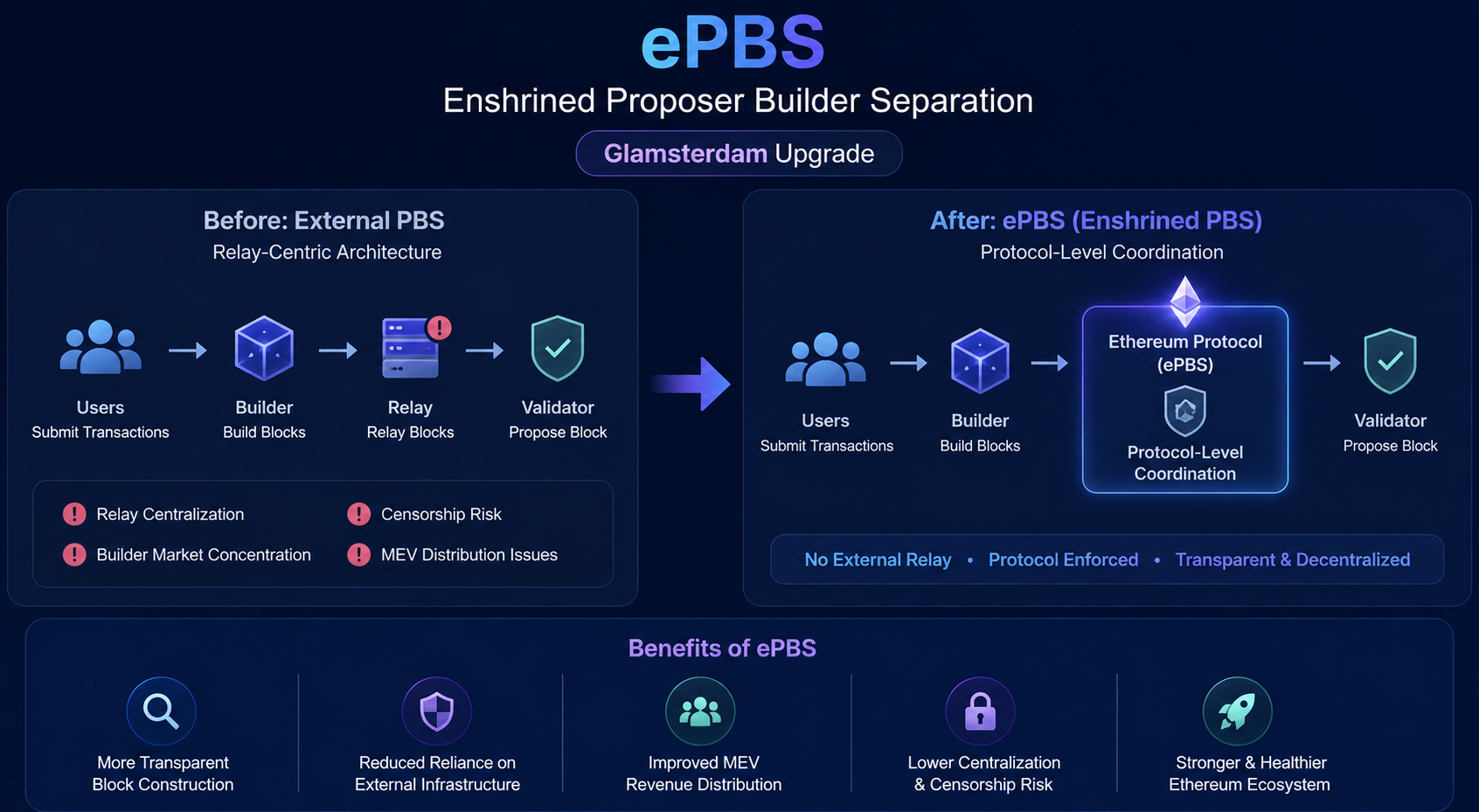
ePBS stands for Enshrined Proposer Builder Separation, and it is one of the most important upgrades in Glamsterdam.
Under the current mechanism, block production typically involves multiple steps: users submit transactions, Builders construct blocks, Relays forward blocks, and Validators propose new blocks. While this model has improved efficiency, issues such as overly centralized Relays, concentrated Builder markets, and censorship risks have emerged.
The goal of ePBS is to embed the PBS mechanism directly into the Ethereum protocol layer. In other words, the collaboration between Builders and Validators no longer depends on third-party Relays—the protocol itself coordinates and manages the entire process.
This change means the block building process will become more transparent, the network's reliance on external infrastructure will be further reduced, and it is expected to improve the MEV revenue distribution mechanism, mitigating the risks of excessive market concentration. For Ethereum, this is not only a technical upgrade but also an important attempt to govern MEV at the protocol layer.
Block Access Lists: Paving the Way for Parallel Execution
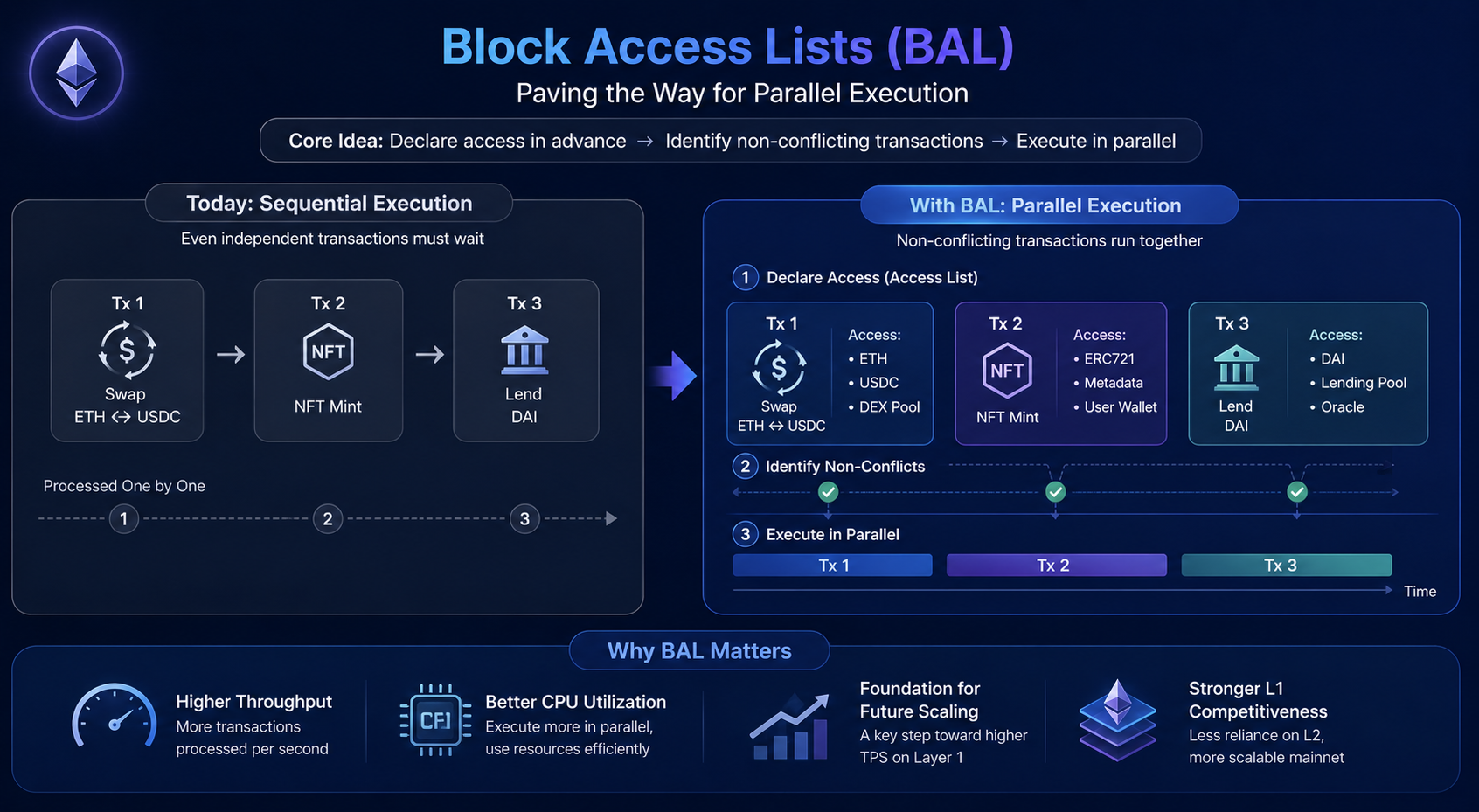
Another widely discussed upgrade is Block Access Lists, or BAL.
Traditional Ethereum uses a sequential execution model, where transactions must be processed one by one in order. Even if two transactions do not affect each other, they cannot be executed simultaneously, which limits the network's overall throughput.
The core idea of Block Access Lists is to pre-declare the accounts and state data a transaction needs to access. For example, one transaction swaps ETH for USDC, while another mints an NFT. Since the data they access differs, the system can determine in advance that there is no conflict and allow them to execute concurrently.
Through this approach, Ethereum can gradually achieve parallel execution capabilities, improving CPU resource utilization and laying the groundwork for higher TPS in the future. This is one of the reasons Glamsterdam is considered a key milestone in Layer 1 scaling.
From a technical perspective, Glamsterdam does not simply increase block size—it enhances network performance through multiple layers of optimization.
-
Increasing Gas Limit: A higher Gas Limit means a block can accommodate more transactions. With continued improvements in hardware performance, the Ethereum community has begun discussing the possibility of gradually expanding block capacity.
-
Parallel Execution: Through Block Access Lists, non-conflicting transactions can run simultaneously, making more efficient use of multi-core CPU resources and thereby increasing overall throughput.
-
ePBS Optimizes Block Building: Protocol-level management of Builder and Validator collaboration helps reduce the time delay for transactions to enter blocks and improves block production efficiency.
-
Pre-declared State Access: Declaring state access ranges in advance also helps nodes read and manage on-chain state data more efficiently, reducing resource waste and making network operation more efficient and stable.
Glamsterdam's Impact on DeFi, Layer 2, and the Digital Asset Ecosystem
For DeFi, higher Layer 1 performance means lower transaction costs and faster confirmation times. DEX slippage is expected to decrease further, lending protocol liquidation efficiency may improve, and stablecoin transfer experiences will be optimized.
For Layer 2, Glamsterdam is not competitive—it is crucial underlying support. Since Rollup data ultimately needs to settle back on the Ethereum main chain, increased Layer 1 throughput will likely reduce Rollup submission costs, further decreasing user fees and enhancing the entire Layer 2 ecosystem's expansion capacity.
At the institutional level, with the continued growth of RWA and stablecoin markets, a higher-performance, more transparent, and fairer Layer 1 network is becoming increasingly important. Through Glamsterdam, Ethereum aims to provide more reliable infrastructure for the global digital asset market and attract more traditional financial institutions to participate in the on-chain ecosystem.
How Does Glamsterdam Differ from Other Public Chain Scaling Routes?
Currently, various public chains are exploring their own scaling solutions. Solana adopts a parallel execution architecture, emphasizing high TPS; Sui uses an object model to improve state concurrency; Aptos introduces Block-STM for transaction parallelism; and Monad attempts to achieve high performance while remaining EVM-compatible.
In contrast, Ethereum's approach is more cautious. It does not abandon decentralization, client diversity, or open verification mechanisms—instead, it gradually improves performance while maintaining these core principles.
This gradual scaling approach, while relatively slower in speed, allows Ethereum to balance security, openness, and performance. The goal of Glamsterdam is not simply to pursue extreme TPS, but to improve overall operational efficiency and user experience while maintaining network trustworthiness.
Where Will Ethereum Go After Glamsterdam?
Glamsterdam will not be the endpoint of Ethereum's roadmap. In the coming years, the Ethereum community continues to advance multiple long-term directions, including Stateless Ethereum, Verkle Tree, Native Account Abstraction, more complete parallel execution mechanisms, and quantum-resistant cryptography research.
Together, these upgrades point to a long-term goal: transitioning Ethereum from a smart contract platform to the global infrastructure for open finance and digital assets. As the stablecoin scale expands, RWA continues to grow, and the on-chain financial ecosystem matures, the performance, security, and openness of Layer 1 will become even more critical.
The role Glamsterdam plays is to help Ethereum take an important step toward the next stage of network evolution while maintaining its decentralization principles.
Summary
As one of the most anticipated protocol upgrades for Ethereum in the coming years, Glamsterdam is not a simple performance optimization—it is a key milestone in Ethereum's systematic upgrade of the Layer 1 architecture. From the redesign of the MEV mechanism via ePBS to Block Access Lists paving the way for parallel execution, Ethereum is attempting to further enhance network scalability and resource utilization while maintaining decentralization and security.
Unlike the past reliance mainly on Layer 2 scaling, Glamsterdam places greater emphasis on improving the main chain's own performance. This means Ethereum's scaling route is entering a new phase—through the coordinated development of Layer 1 and Layer 2, building a large-scale open network capable of supporting global digital assets, stablecoins, RWA, and on-chain financial activities.
As more protocol upgrades are progressively implemented, Glamsterdam is likely to become a critical turning point in Ethereum's journey from a smart contract platform to a global financial infrastructure.
FAQs
1. When will the Ethereum Glamsterdam upgrade be launched?
As of now, Glamsterdam has been included in Ethereum's subsequent upgrade roadmap. The specific launch timeline still needs to be confirmed based on client development, testnet validation, and community consensus.
2. What is the difference between Glamsterdam and Pectra?
Pectra's main focus includes account abstraction optimization, Blob scaling, and validator experience improvements, while Glamsterdam focuses more on Layer 1 scaling, MEV reform, and parallel execution capabilities. They are important upgrades at different stages of Ethereum's development.
3. What is ePBS?
ePBS stands for Enshrined Proposer Builder Separation. It is a protocol-level block building mechanism designed to reduce reliance on third-party Relays, increase block production transparency, and optimize MEV revenue distribution.
4. Why are Block Access Lists important?
Block Access Lists allow transactions to pre-declare the accounts and state information they need to access, helping Ethereum determine which transactions can be executed in parallel. They are considered a key technology for improving TPS in the future.
5. Will Glamsterdam reduce Gas Fees?
One of Glamsterdam's goals is to improve Layer 1 resource utilization and throughput. In the long term, it is expected to alleviate network congestion and improve transaction experiences, but actual fee levels will still be influenced by multiple factors such as network demand.
6. Will Glamsterdam affect Layer 2?
Yes, and the impact is largely positive. Since Layer 2 ultimately still relies on Ethereum for settlement, improvements in main chain performance are expected to further reduce Rollup submission costs and improve overall efficiency.







