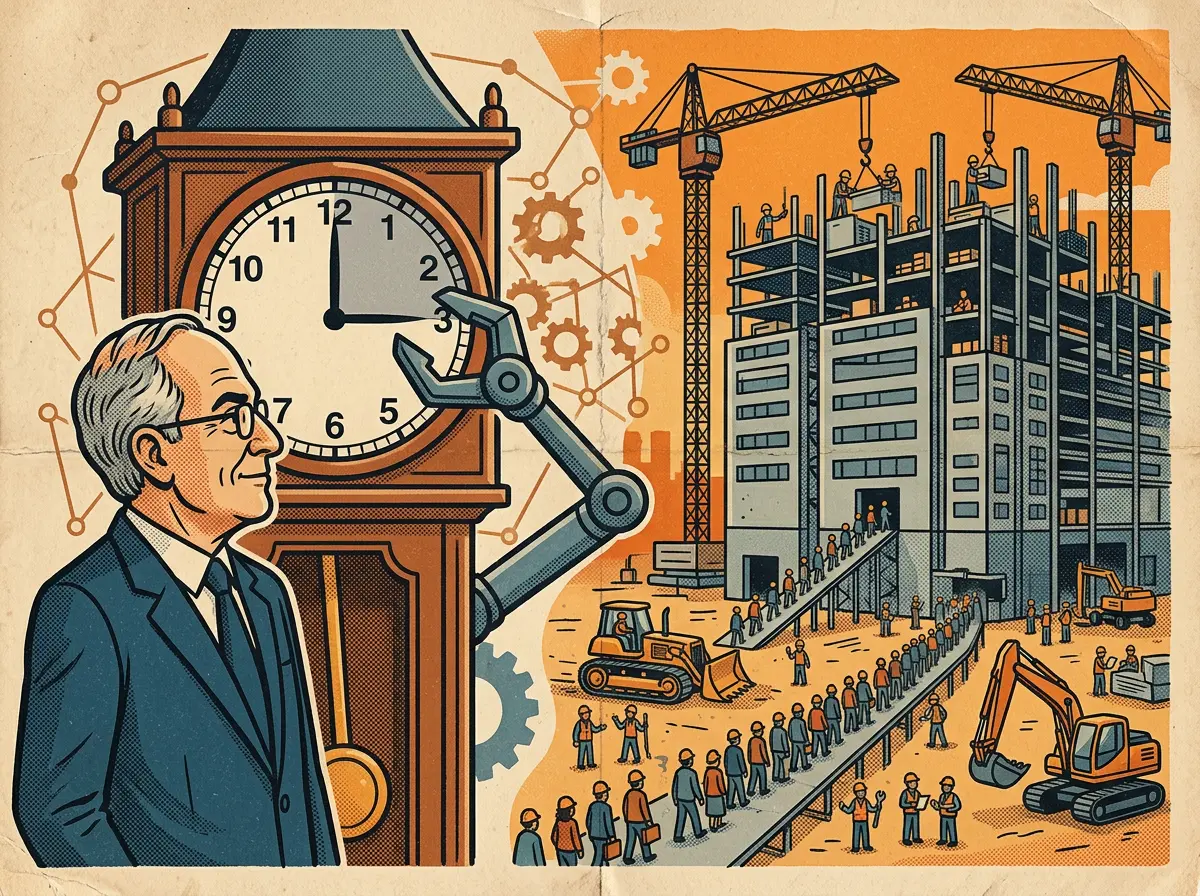
Goldman Sachs CEO David Solomon published a commentary article in The New York Times in May, saying that concerns about AI causing large-scale job displacement are being exaggerated, citing internal Goldman analysis: AI could automate about 25% of existing job hours within the next 10 years, while also confirming that since 2022, U.S. data center construction has already created more than 200,000 construction-industry jobs.
Confirmed job impact data: happened vs. expected
Confirmed impact data: A Stanford University study confirmed that, compared with industries with low levels of automation, hiring for entry-level roles in highly automated fields such as software engineering and customer service has fallen 16%. Tasks that traditionally form the basis of junior analyst work—such as financial modeling, note-taking, and electronic spreadsheet analysis—are increasingly being handled by AI tools. Since 2022, U.S. data center construction has created more than 200,000 construction-industry jobs (Goldman’s estimate). Goldman has deployed AI-assisted tools across its 22,000+ employees (confirmed).
Goldman’s forecast of job impact: Over the next 10 years, AI may automate about 25% of work hours; white-collar industries such as banking, accounting, and law are expected to be significantly affected; Goldman’s internal plans include cutting compliance and account-opening roles while increasing hiring for roles in banking, trading, and asset management; AI is expected to drive demand for three categories of new roles—positions managing AI systems, roles auditing AI decisions, and positions governing AI applications.
Solomon’s three-layer framework
In the article, Solomon proposed a three-dimensional framework to assess AI’s impact on jobs: once daily tasks are automated, human work is optimized, freeing up time for higher-value responsibilities; performance standards within existing roles rise, increasing demand for more complex capabilities; and entirely new job categories for managing, auditing, and governing AI systems emerge. His historical analogies include: the power revolution, the widespread adoption of electronic spreadsheets (which replaced a large number of calculation-type jobs but created more financial analyst roles), and the cycle of job replacement and creation during the internet era. Solomon’s core position is: “Technological progress and cultural change don’t move in sync—just because something can be replaced doesn’t mean it will necessarily be replaced.”
FAQ
What methodology does Goldman’s prediction that “25% of work hours will be automated” rely on?
This figure comes from Goldman’s internal research. The methodology is to analyze the share of typical tasks in each occupation that can be replaced by AI models, then use weighting to calculate the portion of total work hours that can be automated. It’s important to note that this prediction is about “work hours,” not “the number of job positions”—meaning AI could perform 25% of existing work time, not that 25% of jobs will disappear. In the article, Solomon explicitly distinguishes between these two concepts, emphasizing that automation of work hours is more likely to lead to a reshuffling of job functions rather than equal-scale unemployment.
How does the 16% decline in entry-level hiring confirmed by the Stanford study coexist with Solomon’s optimistic argument?
Solomon did not deny that AI has produced real compression effects on certain types of roles—both the Stanford study and Goldman’s own job adjustment plans confirm this. The crux of his argument is the long-term perspective: historically, each major technological wave has come with early job-replacement effects, but ultimately productivity gains and the emergence of new job categories create more employment. He specifically noted that entry-level roles face the most pressure in the short term, but that is a different question from the overall employment trend of the labor market over the long term.
What are Goldman Sachs’s specific plans for adjusting AI-related roles?
In the article, Solomon confirmed two directions: the roles Goldman may cut are data-intensive functions such as compliance and account-opening, because AI tools are continually improving efficiency in handling regulatory reporting and customer onboarding processes; Goldman plans to increase hiring for people-interaction-oriented roles such as investment banking, trading, and asset management—roles that require customer engagement, judgment, and strategic thinking, forming a complementary relationship with AI rather than a substitution relationship. Goldman is currently rolling out AI-assisted tools across its 22,000+ employees, which itself reflects this two-way trend in practice.


