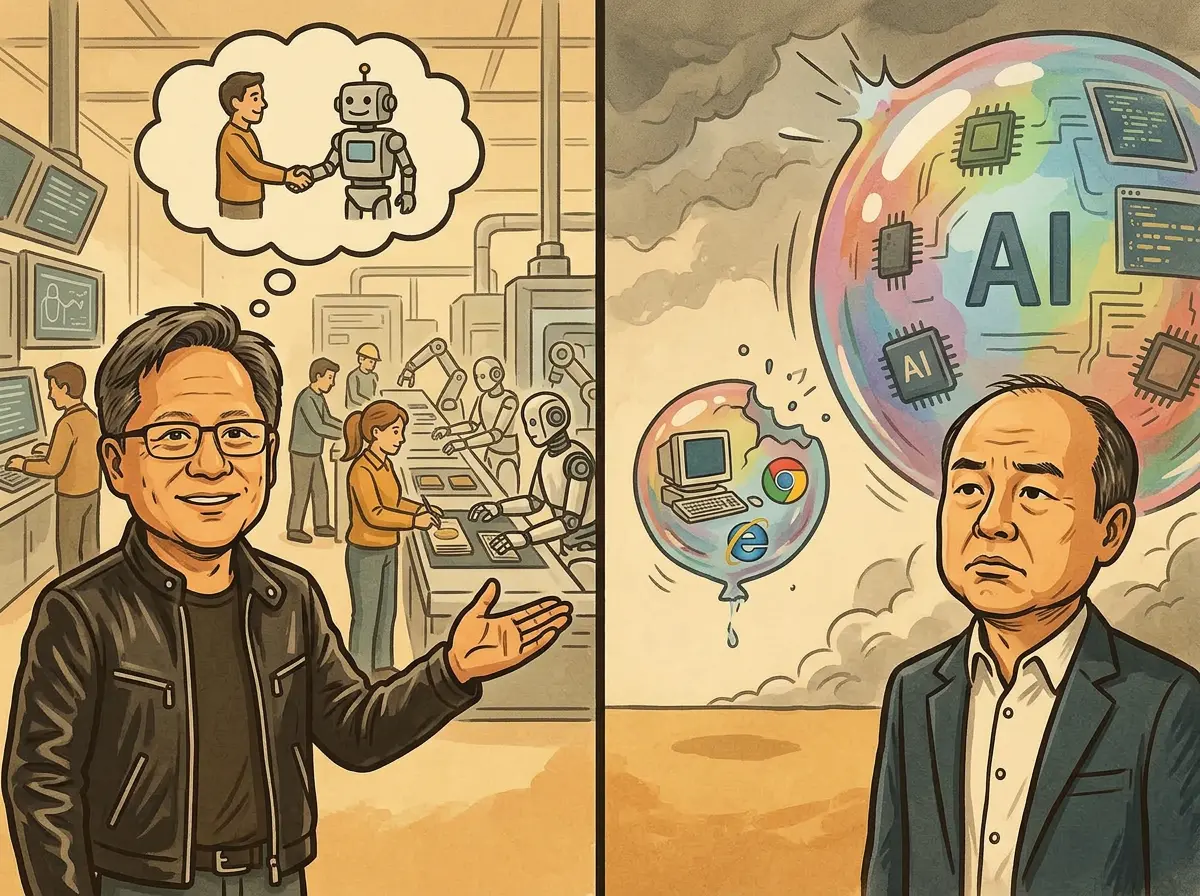
NVIDIA CEO Jensen Huang, SoftBank CEO Masayoshi Son, and Amazon founder Jeff Bezos publicly commented around June 1 on the nature and scale of current AI investment. The three perspectives differ in their frameworks; meanwhile, Amazon reportedly issued an internal warning to employees, asking them to stop using AI for menial tasks. The estimated token-burning cost from the previous month was about $500 million. This year, AI-related capital inflows have reached about $380 billion.
Three executives’ specific characterizations of the AI cycle
In his keynote at NVIDIA GTC Taipei 2026, Jensen Huang directly dismissed the argument that AI leads to job losses, saying: “People are talking about how artificial intelligence will reduce jobs, and that is completely baseless.”
Son, in an interview with CNBC, compared the current AI cycle with the late-1990s internet wave on an order-of-magnitude basis, saying: “I think this is 10 times bigger than the internet bubble—maybe as much as 50 times.”
In a recent speech, Bezos characterized this AI investment cycle as an “industrial bubble, not a financial bubble,” noting that even if there is excessive speculation, when weaker projects fail they still leave behind productive infrastructure.
Amazon token-management warning: $500 million in monthly burn triggers major tech firms to tighten usage
According to reports, David Treadwell, a senior executive at Amazon, issued a directive to stop employees from using AI for menial tasks after estimating that the company’s token-burning cost in one month was about $500 million. Uber, Salesforce, Meta, and Microsoft have all issued internal usage restriction warnings of a similar nature. Free cash flow at hyperscale data center operators is currently approaching its lowest level in about a decade.
Composition of AI capital flows and the $7 trillion investment return gap
This year, the three main sources of AI-related capital are: approximately $140 billion in investment-grade bonds (49% of the total issuance of investment-grade bonds), about $220 billion in venture capital (87% of VC total), and an additional $21 billion in high-yield credit.
VanEck strategist Matthew Sigel provided specific data on AI cost efficiency: a flagship AI model can summarize a 500-page book for about $2.50, while the equivalent service packaged by humans requires $375 to $400 per million tokens. Forecast analyst Will Sommer estimates that hyperscale data centers will need about $7 trillion in revenue over the next three years to achieve a 7% investment return rate.
FAQ
What are the specific grounds for Masayoshi Son’s “50x internet bubble” claim?
In an interview with CNBC, Son made this judgment and proposed an estimated range of 10x to 50x, but did not provide specific measurement benchmarks or quantitative methodologies. This statement reflects his viewpoint rather than being based on publicly published research reports.
After Amazon burns $500 million per month in tokens and issues a restriction warning, does that mean AI commercialization is running into obstacles?
Amazon’s internal warning focuses on prioritizing optimization of token usage, asking employees to stop using AI for “menial tasks,” rather than shutting down AI deployment altogether. Uber, Salesforce, Meta, and Microsoft have all issued similarly worded internal usage restrictions, indicating that cost control has become a common response among major tech companies.
How much revenue does a hyperscale data center need to recoup AI construction investment?
According to forecast analyst Will Sommer’s estimate, hyperscale data centers need about $7 trillion in total revenue over the next three years to reach a 7% investment return rate. This is an estimate figure, and hyperscale data center operators have not officially confirmed adopting this return-rate benchmark.


