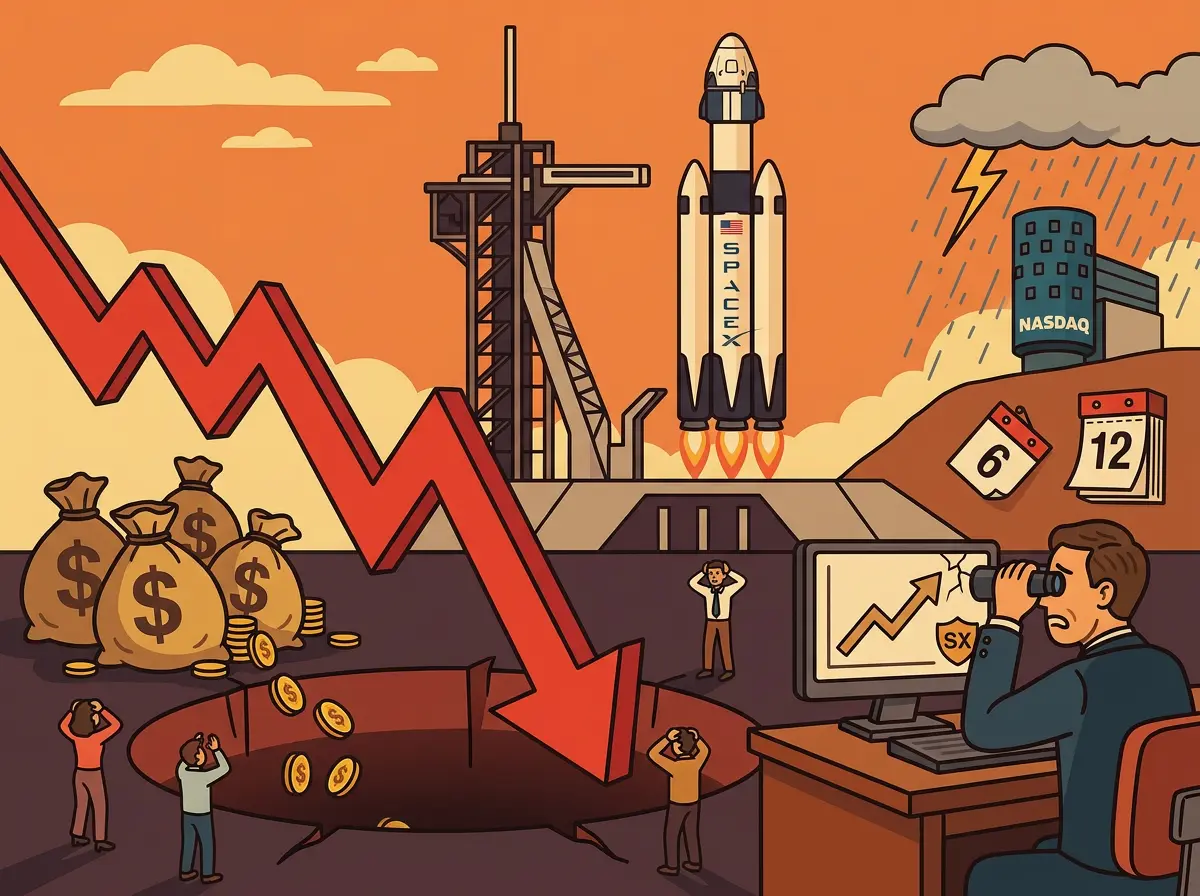
SpaceX has secretly filed an S-1 draft with the U.S. Securities and Exchange Commission (SEC) on April 1 and plans to complete its initial public offering (IPO) on June 12 on Nasdaq under the stock ticker SPCX. The roadshow is expected to kick off around June 4. The S-1 document shows that the company’s revenue in the first quarter of 2026 will be $4.69 billion, with a GAAP net loss of $4.28 billion.
Confirmed IPO Structure: Share Split, Retail Allocation, and Dual-Class Equity
SpaceX completed a 5-for-1 stock split on May 4, 2026 to lower the per-share price and improve accessibility for retail investors; the S-1 document also confirms that this IPO will allocate up to 30% of the issued shares to individual investors, higher than the usual share of comparable large IPOs.
The share structure is divided into two classes: Class A shares carry 1 vote per share and are issued to the public; Class B shares carry 10 votes per share and are held by Musk. This dual-class equity structure allows Musk, while holding about 42% of the equity, to still control 85.1% of the combined voting power. The S-1 document confirms that only Class B shareholders can remove Musk, and that Musk effectively controls the decisions of Class B shareholders. Under Nasdaq rules, SpaceX will be classified as a “controlled company,” which can exempt it from some board independence requirements.
Q1 2026 Financial Data: Breakdown of the Causes Behind $4.69 Billion Revenue and $4.28 Billion Loss
The S-1 document discloses that SpaceX’s first-quarter 2026 revenue will be $4.69 billion, with Starlink satellite internet services as the main source of revenue, and the increased launch frequency of the Falcon 9 rockets also contributing growth momentum. Total revenue for all of 2025 was $18.67 billion, confirming the revenue growth trend into this year’s first quarter.
The main components of the quarterly GAAP net loss of $4.28 billion include: ongoing R&D spending for the next-generation Starship rocket; AI infrastructure buildout costs introduced through the xAI merger completed in February 2026; and continued capital expenditures in reusable rocket technology and the Starshield government contract domain.
Four Major Risk Factors Revealed in the S-1 Filing
Starship technology delays: The development progress of the next-generation rocket directly affects the company’s long-term business model and cost structure
Regulatory hurdles: Approval processes at agencies such as the Federal Aviation Administration (FAA) and the FCC constrain launch plans and Starlink expansion
Continued large-scale capital needs: The S-1 document confirms that the company is in a high capital-consumption stage, and even after going public it will still need continuous financing to support operations
Risk of Musk’s diverted attention: Musk simultaneously serves as Tesla CEO, the leader of xAI, and an adviser to the U.S. Department of Government Efficiency (DOGE); the S-1 document explicitly lists this as a governance risk
FAQ
What practical rights can Class A public shareholders obtain in SpaceX’s IPO?
Class A public shareholders will obtain financial benefits brought by Starlink recurring subscription revenue, Falcon 9 commercial launch business, and Starshield government contracts. In terms of corporate governance, Class A shares only have 1 vote per share, meaning public shareholders’ influence over major corporate decisions is extremely limited compared with Musk’s Class B shares, which have 10 votes per share. SpaceX’s “controlled company” classification further exempts it from some board independence requirements.
After xAI completes its merger with SpaceX in February 2026, what impact will it have on the financial statements?
The S-1 document confirms that the xAI merger is one of the key causes of the $4.28 billion GAAP net loss in the first quarter of 2026, and that the related AI infrastructure buildout brings substantial one-time and ongoing capital expenditures. After the merger, SpaceX’s business scope expands into AI and high-performance computing, creating synergy with the data transmission infrastructure of Starlink satellite internet, but at the same time it also significantly increases operating costs.
How does the size of this IPO compare with the biggest IPOs in history?
SpaceX targets raising $40 billion to $75 billion, with a valuation range of $1.75 trillion to $2 trillion. Saudi Aramco completed a $25.6 billion fundraising in 2019, setting the record for the largest IPO at the time; Alibaba raised $25 billion in 2014, ranking second. If SpaceX completes the high end of its targeted fundraising range, it will surpass the Saudi Aramco record and become the largest IPO in history.


