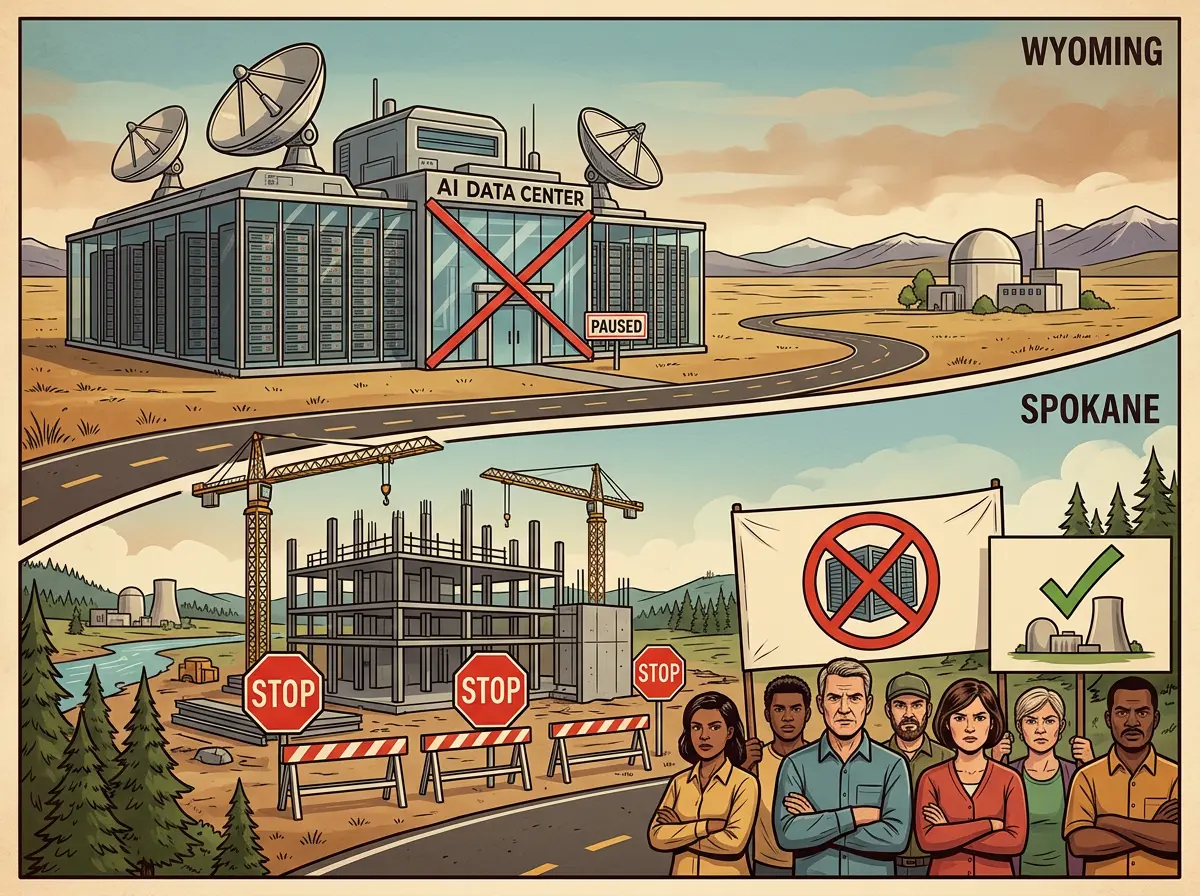
In June, Crusoe, at the customer’s clear request, paused development of the “Emerald Project” data center campus near Cheyenne, Wyoming with an installed capacity of 1.8 gigawatts. A few days later, Avista announced it would pause processing an application for a 500-megawatt data center in Spokane County. There had already been more than 5,000 community complaints, the city council proposed a pause, and there were concerns about taxpayer costs and lingering pollution left at the former Kaiser Aluminum smelting plant site.
Background on the two pause cases in Wyoming and Spokane
Wyoming Emerald Project: At the customer’s clear request, Crusoe paused activities to develop the Emerald Project campus near Cheyenne, Wyoming. Even though the site has existing power infrastructure, the pause could not be avoided.
Spokane County 500-megawatt data center: After Avista received more than 5,000 community complaints, a proposal from the city council to pause, and concerns about taxpayer costs and lingering pollution left at the former Kaiser Aluminum smelting plant site, it announced it would pause processing the application.
A report by ZeroHedge said the two cases once again confirm that even brownfield projects served by utility companies that have existing power infrastructure and intend to provide services cannot escape public sentiment resistance.
Polling data: 71% opposition versus 53% for nuclear power
According to the polling data cited in the article: 71% of Americans oppose building AI data centers in their local area, including 48% who strongly oppose. By comparison, the share opposing building nuclear power plants in the same region is 53%. Acceptance of AI data centers among local residents is even lower than the level of nuclear facilities during the most hotly contested period in history.
Sightline Climate’s April analysis: About half of planned capacity faces delays or cancellations
Based on an analysis released by Sightline Climate in April 2026 (which ZeroHedge had already reported at the time), of the U.S. data center capacity planned to go into operation in 2026, about half faces delays or outright cancellation. Some analyses suggest the cancellation rate for controversial projects is around 40%.
Other resistance cases recorded in the article include: eminent domain disputes over transmission lines sparked in places such as Maryland and Georgia; a plan backed by Brookfield in which Compass exited a major transmission line corridor plan in Northern Virginia; and from Texas to the Midwest, where community protests have led to projects worth billions of dollars being shelved or delayed.
Ripple effects on nuclear stocks: demand-logic assumptions for OKLO, SMR, NNE, CCJ
ZeroHedge’s analysis said that nuclear energy stocks such as Oklo (OKLO), NuScale (SMR), NANO Nuclear (NNE), and Cameco (CCJ), along with the rally in ETFs such as URA, NLR, and NUKZ, are built on the assumption that “the load growth of ultra-large-scale data center demand will translate into financeable nuclear power plant installations.”
When a flagship data center campus is paused or reconfigured, the article said this assumption will face severe tests, and the volatility in nuclear stocks also reflects this uncertainty.
Frequently asked questions
Why is local opposition to AI data centers higher than to nuclear power plants?
Based on the polling data cited in the article, the local opposition rate to AI data centers is 71%, higher than the 53% for nuclear power plants. The article attributes this to compounded concerns about noise, heat dissipation, electricity consumption, water resource use, and the burden of local taxes, as well as the direct impact of interests in the community where the site is located—but it does not provide a more granular breakdown of causes.
Does the pause by Crusoe and Avista mean the projects will be permanently canceled?
According to the report, Crusoe’s Emerald Project was paused “at the customer’s clear request,” without stating it would be permanently canceled. Avista is pausing “application processing.” Both are pauses rather than formal terminations. No details on the next steps have been announced yet.
What is the specific logic for how nuclear stocks are affected by the AI data center pauses?
ZeroHedge’s analysis said the market had previously assigned nuclear stocks elevated valuations, partly based on a logic chain of “AI power demand → large-scale data centers → need for long-term reliable power → growth in nuclear power demand.” When the construction of data centers is blocked by local resistance, the growth assumptions on the demand side are called into question, triggering a reassessment of valuations for nuclear-related stocks and profit-taking.


