CryptoRock

vip
Age 0.7 Year
Peak Tier 0
No content yet
#分享美股交易赢英伟达股票 #存储芯片概念股逆势上涨 Optical communication and semiconductor sectors diverge, with leading stocks experiencing extreme ups and downs!
The optical communication sector has become a major casualty, with several leading stocks falling sharply. Lumentum dropped 5.2%, Coherent fell 4.8%, Applied Optoelectronics (AAOI) declined 6.2%, Credo decreased 5.1%. These optical device and high-speed interconnect chip manufacturers previously surged due to the explosive demand for 1.6T optical modules. This correction is mainly driven by profit-taking and valuation pressures. The semiconductor sector sh
NVDAX1.03%
post-image
  • Reward
  • Comment
  • Repost
  • Share
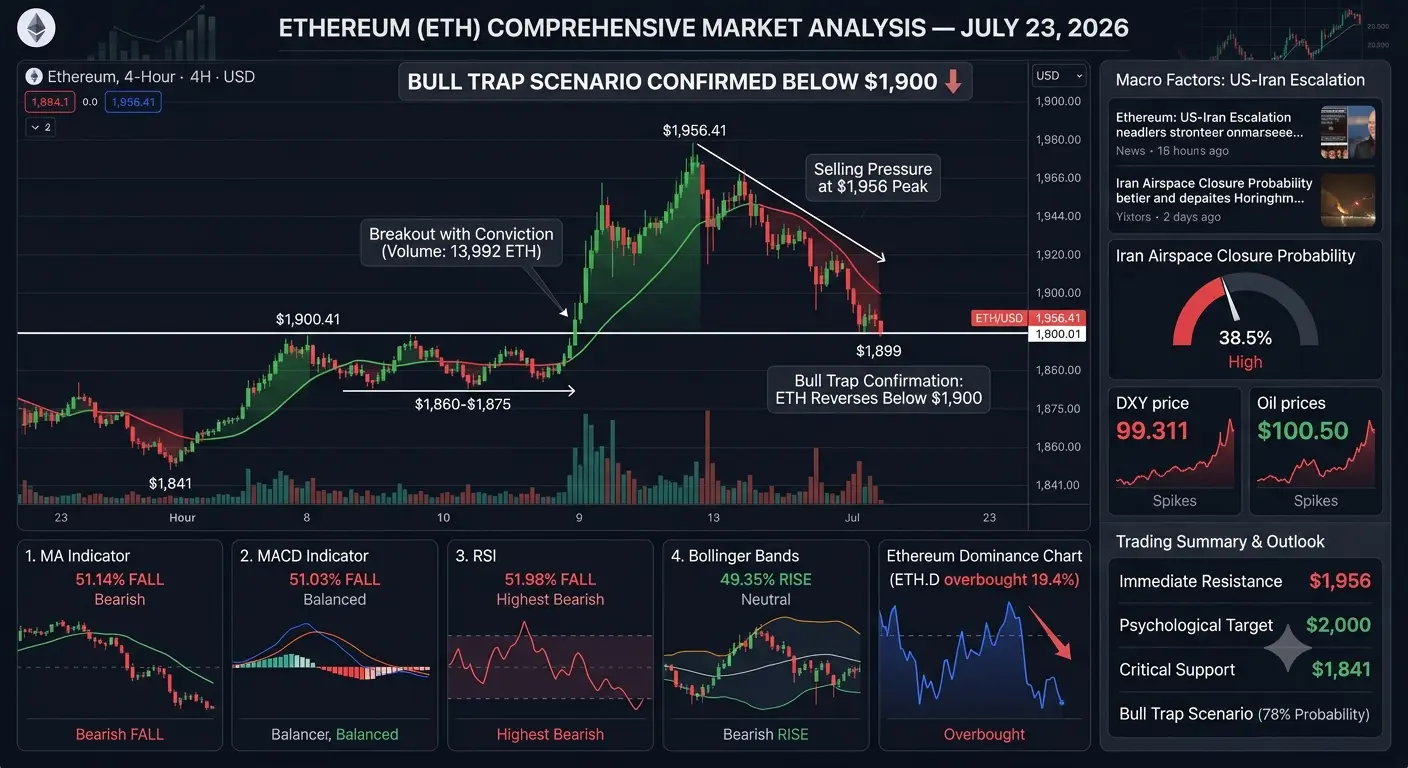
#ETH跌幅超5% ETH: The relative price is still recovering, but the structure looks a bit better than BTC.
ETH today dipped to a low of 1,758, lower than yesterday’s 1,768, but the MACD green bars and RSI at this new low are smaller than before—indicating a small-scale bottom divergence has already appeared.
This causes ETH’s rebound today to be more active than BTC’s, bouncing from 1,758 up to a high of 1,849, nearly a 100-point increase.
The ETH/BTC ratio continued to rise today, still feeling the afterglow of the Standard Chartered report, and market funds are indeed shifting towards ETH.
post-image
  • Reward
  • Comment
  • Repost
  • Share
#ETH跌幅超5% Super Black Swan Attack! 25% Bloodbath in 30 Days! BTC plummets to $61k, is the bull market over or an epic buying opportunity?
The "Black May" in the crypto market just passed, and the "Cruel June" is following closely behind.
If you've been feeling suffocated recently, that's perfectly normal. Since reaching a high of $82,800 on May 6th, Bitcoin has fallen relentlessly without resistance, hitting a new low of $61,300 this year as of today (June 4th).
In one month, a 21,000-point drop, 25% of wealth evaporated.
The once unbreakable "60k belief bottom" has been pierced, and a
ETH-1.26%
BTC-2.64%
post-image
  • Reward
  • Comment
  • Repost
  • Share
#分享美股交易赢英伟达股票 Based on the U.S. stock market data and publicly available information as of Wednesday, June 3, 2026, here is the trend analysis of some U.S. stocks:
1 NVIDIA (NVDA)
Closed down 3.62%, at $214.75, breaking below the 21-day moving average, retracing 7.5% from Tuesday's high during the day.
Technical indicators show a correction phase, with short-term support in the $200-$210 range; a break below could lead to further decline.
2 Microsoft (MSFT)
Fell 3.17%, at $427.34, breaking below the 200-day moving average, with medium- to long-term trend under pressure.
After-hours e
NVDA0.19%
MSFT0.13%
AMZN0.05%
META0.1%
post-image
  • Reward
  • Comment
  • Repost
  • Share
#HYPE创历史新高 Hype reaches a new high, an in-depth analysis of Hype tokenomics
In the same market, the fates are vastly different. Unlike the previous widespread decline, this time only BTC, ETH, and SOL, the mainstream coins, are falling. Altcoins are not following the drop, and some even rise, with Hype performing the most notably, reaching a new high against the trend.
Therefore, this may be the final correction of the mainstream coins, the last leg down.
Core Indicators · June 2026
HYPE's market cap surpasses Dogecoin, entering the top ten. This is not only a shift between meme and DeFi but a
HYPE-9.32%
BTC-2.64%
ETH-1.26%
SOL-4.11%
post-image
  • Reward
  • Comment
  • Repost
  • Share
#预测NBA总冠军赢20,000U 2026 NBA Finals: Knicks vs Spurs — In-Depth Analysis and Predictions
1 Matchup Background
This is a replay of the 1999 Finals — when the Spurs defeated the Knicks in five games to win their first championship. Now, 27 years later, the two teams meet again, but the landscape is vastly different. The Knicks have not reached the Finals since 1999, and New York fans have waited over half a century for a championship. Meanwhile, under Wembanyama’s leadership, the Spurs have returned to the peak in just three years, aiming to start a second dynasty.
2 Key Team Data Comparison
Reg
post-image
  • Reward
  • Comment
  • Repost
  • Share
#分享美股交易赢英伟达股票 U.S. stocks, eight weeks of consecutive gains, IPO queues, what's next
Driven by a strong earnings season, U.S. stocks continue to rebound. Moving forward, market focus may shift to capital expenditures related to artificial intelligence (AI), the returns companies are gaining from these investments, and whether numerous AI and tech sector IPOs will further reinforce the AI investment thesis. Meanwhile, the policy stance changes of new Federal Reserve Chair Kevin Warsh will also become a key market focus.
Let's first look at the macro level:
We expect the U.S. real GDP growth rat
post-image
  • Reward
  • Comment
  • Repost
  • Share
#分享美股交易赢英伟达股票 What is the future of digital currency? Circle: Building trust with US Treasuries, a good business earning interest on interest-free debt
Business Model
Circle is a digital dollar issuer built on blockchain, serving as a payment network, money market fund manager, and crypto infrastructure software. Its profit model is relatively simple: users deposit 1 dollar, Circle issues 1 USDC and holds 1 dollar in reserve, used to purchase short-term US Treasuries, earning interest. After deducting distribution costs, the remaining profit goes to Circle.
The company's revenue mainly comes f
CRCL0.25%
USDC-0.01%
BTC-2.64%
post-image
  • Reward
  • Comment
  • Repost
  • Share
#分享美股交易赢英伟达股票 #STRC跌破95美元 MicroStrategy’s preferred stock STRC has recently fallen below $95, drawing market attention. Based on comprehensive market information and data, the market outlook is as follows:
1 Current Price and Mechanism
STRC is a perpetual preferred stock issued by MicroStrategy, with a par value of $100. It maintains price stability through a floating dividend rate. Recently, the price fell below $95, triggering a mechanism under which the company may raise the dividend rate (if the price is in the $95–$99 range, the dividend rate increases by 25 bps per month; if it falls
BTC-2.64%
post-image
  • Reward
  • Comment
  • Repost
  • Share
#WLD Arthur Hayes predicts the world coin will rise to $10, but data shows a different answer!
On June 3rd, Arthur Hayes set a $10 price target for the world coin. After the news broke, the token price increased by about 20%, rising from nearly $0.38 to approximately $0.46. But to reach the target price, its fully diluted valuation would need to hit $100 billion, while the current market cap is about $1.6 billion.
Of the existing 10 billion WLD tokens, about 3.4 billion are in circulation, with 66% locked up. Last year, the token lock-up period was extended, and the unlock rate in July 202
WLD4.15%
post-image
  • Reward
  • Comment
  • Repost
  • Share
One of the reasons I enjoy following the US stock market is that it offers a real-time view of how innovation, economics, and investor psychology interact with each other.
Every trading day brings new information—earnings reports, economic data, product launches, industry developments, and changes in market sentiment. The challenge is not finding information, but determining which information truly matters over the long term.
I've noticed that many of the market's strongest performers share a few common characteristics. They often operate in growing industries, maintain a competitive advantage
US-17.28%
post-image
  • Reward
  • Comment
  • Repost
  • Share
The US stock market is often viewed through the lens of price charts and daily movements, but I believe some of the most valuable insights come from understanding how businesses create long-term value.
A company’s stock may rise or fall in the short term for many reasons, including market sentiment, economic data, or unexpected news. However, over longer periods, business performance tends to play a much larger role. Revenue growth, profitability, product innovation, and strategic execution are often the factors that determine whether a company can continue expanding over time.
One thing I fin
US-17.28%
post-image
  • Reward
  • Comment
  • Repost
  • Share
One concept that has become increasingly important to me when analyzing US stocks is competitive advantage.
In almost every industry, companies face competition. However, a small number of businesses manage to build advantages that are difficult for competitors to replicate. These advantages can come from strong brands, proprietary technology, large customer networks, economies of scale, or unique business models.
What makes this so important for investors is that competitive advantages often help companies maintain profitability and market leadership over long periods of time. While short-ter
post-image
  • Reward
  • Comment
  • Repost
  • Share
One of the most underrated indicators in the stock market is confidence.
Not just investor confidence, but confidence from customers, employees, business partners, and management teams. Companies that successfully build trust over many years often develop stronger brands, more loyal customers, and greater resilience during challenging periods.
When I analyze a company, I try to look beyond the share price and ask a simple question: Is this business becoming more important to its customers over time? If the answer is yes, that often suggests the company may have a stronger foundation for future
post-image
  • Reward
  • Comment
  • Repost
  • Share
One of the most underrated indicators in the stock market is confidence.
Not just investor confidence, but confidence from customers, employees, business partners, and management teams. Companies that successfully build trust over many years often develop stronger brands, more loyal customers, and greater resilience during challenging periods.
When I analyze a company, I try to look beyond the share price and ask a simple question: Is this business becoming more important to its customers over time? If the answer is yes, that often suggests the company may have a stronger foundation for future
post-image
  • Reward
  • Comment
  • Repost
  • Share
One thing I’ve noticed after following US stocks for a while is that the market doesn’t reward attention—it rewards consistency.
Many investors jump from one idea to another based on headlines, short-term moves, or social media sentiment. But the companies that actually build long-term value usually do so quietly, through steady execution, gradual market expansion, and continuous improvement in their core business.
What I find particularly interesting is how different phases of the market highlight different types of companies. In strong bullish environments, high-growth names often dominate a
post-image
  • Reward
  • Comment
  • Repost
  • Share
One of the most interesting parts of following the US stock market is realizing how differently investors interpret the same information.
A single earnings report, economic release, or company announcement can lead to completely different reactions depending on expectations, positioning, and market sentiment at that moment. This is why the market is often described as a “forward-looking mechanism” rather than a simple reflection of current reality.
What I try to focus on instead is context. Is the market already pricing in optimism or pessimism? Are expectations too high or too low relative to
US-17.28%
post-image
  • Reward
  • Comment
  • Repost
  • Share
One concept I keep coming back to when analyzing US stocks is momentum—not just price momentum, but business momentum.
Some companies don’t just grow; they accelerate. Revenue growth speeds up, user adoption increases, margins improve, and market confidence strengthens at the same time. When multiple positive factors align like this, the market often begins to revalue the company more aggressively.
On the other hand, momentum can slow down just as quickly. Growth rates normalize, competition increases, or macro conditions shift, and suddenly investor expectations adjust downward. This is why I
post-image
  • Reward
  • Comment
  • Repost
  • Share
One of the most important lessons I’ve learned from following US equities is that markets are driven as much by psychology as they are by fundamentals.
Every price movement reflects a mix of fear, greed, expectation, and uncertainty. Even when two companies report similar financial results, their stock reactions can be completely different depending on how investors feel at that moment. This is why sentiment often plays a much bigger role in the short term than many people expect.
What I find particularly interesting is how quickly sentiment can shift. A company or sector that was considered “
US-17.28%
post-image
  • Reward
  • Comment
  • Repost
  • Share
One thing I’ve been thinking about more lately is how quickly the definition of “growth” changes in the US stock market.
A company that was considered high-growth a few years ago might now be viewed as mature, while entirely new sectors can suddenly become the center of attention. This constant reclassification is one of the reasons why the market feels so dynamic and sometimes unpredictable.
What really drives long-term value, in my view, is not just growth itself, but the quality and durability of that growth. Is the company expanding because of a temporary demand spike, or because it has bu
post-image
  • Reward
  • Comment
  • Repost
  • Share
  • Pinned