Mr_Thynk

vip
Age 0.8 Year
Peak Tier 0
No content yet
#STRCFallsBelow95
#STRC
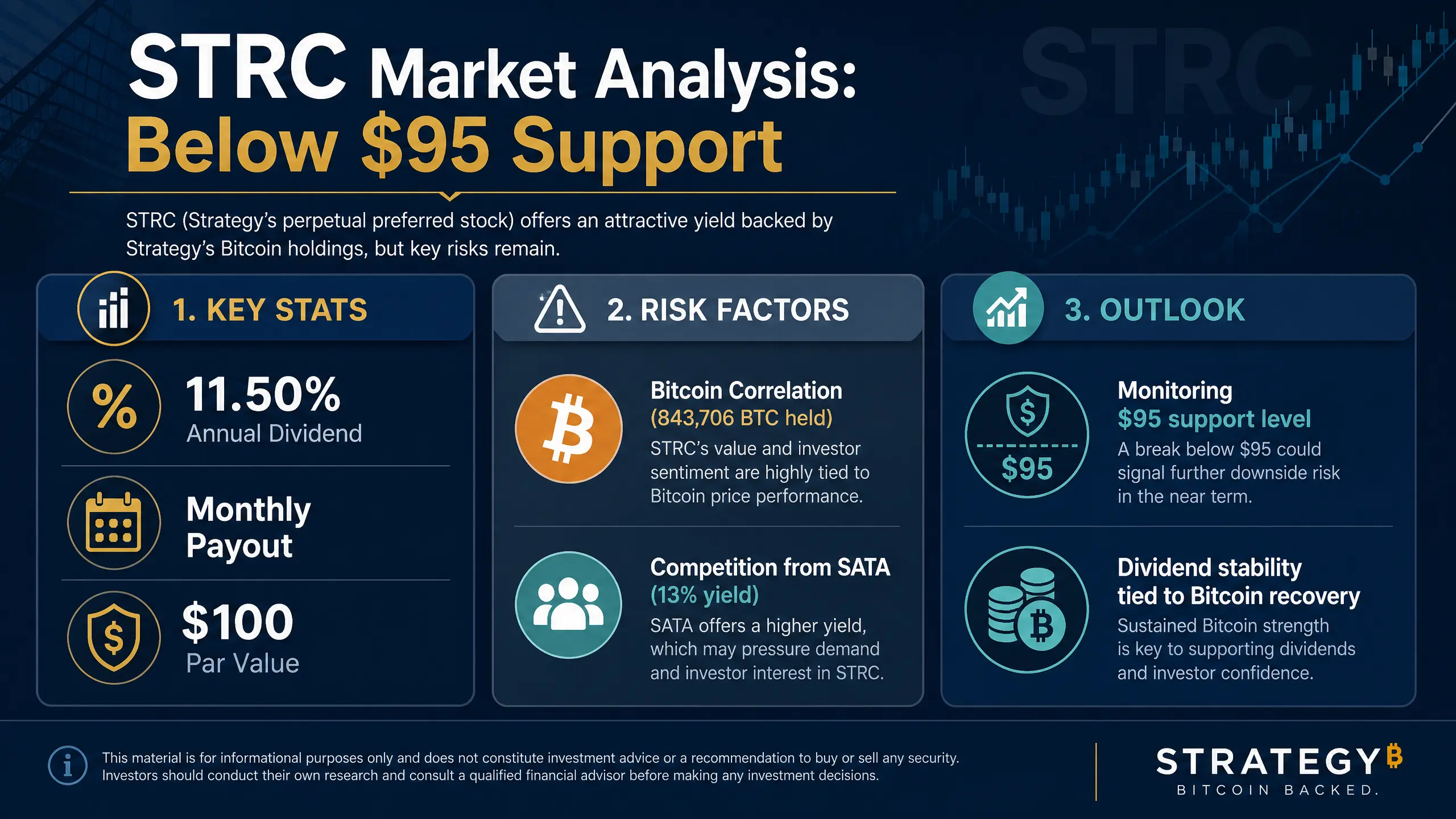
STRC, Strategy's perpetual preferred stock listed on Nasdaq, has fallen below the critical $95 level, raising concerns among income-focused investors. Unlike common stocks, STRC is designed primarily as a high-yield income product rather than a growth investment. The security carries a $100 par value and currently pays an annual cash dividend of 11.50%, distributed monthly. Its dividend rate is adjusted periodically with the goal of keeping the share price close to $100 while reducing long-term volatility.
Preferred shareholders receive dividend payments before common
BTC-2.8%
HighAmbition
#STRCFallsBelow95
#STRC
STRC, Strategy's perpetual preferred stock listed on Nasdaq, has fallen below the critical $95 level, raising concerns among income-focused investors. Unlike common stocks, STRC is designed primarily as a high-yield income product rather than a growth investment. The security carries a $100 par value and currently pays an annual cash dividend of 11.50%, distributed monthly. Its dividend rate is adjusted periodically with the goal of keeping the share price close to $100 while reducing long-term volatility.
Preferred shareholders receive dividend payments before common shareholders and have a higher claim on company assets in the event of bankruptcy. Because of these characteristics, most investors purchase STRC for its steady income stream rather than for capital appreciation.
Why Did STRC Fall Below $95?
The primary catalyst behind STRC's decline is the recent correction in Bitcoin. Strategy's balance sheet is heavily concentrated in Bitcoin, holding approximately 843,706 BTC, making the company's securities highly sensitive to cryptocurrency market movements. During the recent market correction, Bitcoin fell from roughly $82,000 to around $64,300, representing a decline of approximately 21.6%. As Bitcoin weakened, selling pressure spread across all Strategy-related securities, including STRC.
A second factor is increasing competition. Strive Asset Management recently launched its own perpetual preferred security, SATA, which offers daily dividend distributions instead of monthly payments. SATA has maintained a price close to its $100 par value while offering a yield near 13%, significantly above STRC's current 11.50% payout. Investor interest has increasingly shifted toward higher-yield alternatives, creating additional pressure on STRC.
Technical factors have also contributed to the decline. When a preferred security trades materially below par value, quantitative trading models often interpret the move as a sign of weakening market confidence. This can trigger automated selling, stop-loss orders, arbitrage unwinds, and passive fund rebalancing, accelerating downside momentum.
What Happens If STRC Remains Below $95?
A prolonged move below $95 could have meaningful financial consequences for Strategy. Under the security's structure, the company may be required to increase the dividend rate by 0.50% on outstanding shares. Such an adjustment would increase annual dividend expenses by an estimated $53 million.
Additionally, a sustained discount to par value would make future capital raising more challenging. Investors are unlikely to purchase newly issued STRC shares at $100 when existing shares are available in the open market at substantially lower prices. This could reduce Strategy's flexibility to raise additional funds through preferred equity offerings.
Is There a Default Risk?
At present, there is no clear indication of an imminent default risk. Michael Saylor recently confirmed that STRC's dividend rate will remain at 11.50% for June 2026, and the company has not reduced, delayed, or suspended dividend payments.
Strategy continues to maintain one of the largest Bitcoin treasuries in the world, holding approximately 843,706 BTC, representing more than 4% of Bitcoin's maximum eventual supply. As long as Bitcoin avoids a prolonged collapse and capital markets remain accessible, the company's dividend obligations appear manageable.
The company has also proposed increasing dividend payment frequency from monthly to twice monthly, an initiative partly inspired by investor demand for more frequent distributions. Shareholders are currently voting on the proposal, with voting scheduled to conclude on June 8. If approved, the revised payment structure would begin on June 30, with the first distribution under the new system expected on July 15.
Expert Opinions
Market analysts remain divided on STRC's outlook. Benchmark analyst Mark Palmer argues that Strategy's substantial Bitcoin reserves provide significant support for preferred-share dividend financing and strengthen long-term confidence in the security.
Critics remain skeptical. Peter Schiff has repeatedly warned that preferred shareholders face substantial long-term risks if Strategy's Bitcoin-driven financing model encounters stress. He argues that any future dividend suspension could severely impact investor returns and market confidence.
Analysts at Motley Fool highlight two additional concerns. First, inflation gradually reduces the real purchasing power of both the $100 par value and future dividend payments. Second, unlike traditional debt instruments, preferred dividends can potentially be reduced, deferred, or suspended under certain circumstances without triggering a conventional default event, exposing investors to both income and principal risks.
Final Outlook
STRC's decline below $95 is primarily the result of Bitcoin's sharp correction, increasing competition from higher-yield preferred securities, and technical selling pressure. While current default risk appears low, the stock's performance remains closely tied to Bitcoin's trajectory and investor confidence in Strategy's capital structure.
For income-focused investors, the key levels to monitor are the $95 support zone and the company's ability to maintain dividend stability. A recovery in Bitcoin could help STRC move back toward its $100 par value, while continued weakness could increase dividend costs and limit Strategy's future capital-raising flexibility.
@Gate_Square #ShareYourUSStocksWinNvidia #SpaceXTargets1.75TrillionIPO
repost-content-media
  • Reward
  • Comment
  • Repost
  • Share
#分享美股交易赢英伟达股票 Tesla (TSLA): The Electric Vehicle Revolution, Autonomous Driving, Clean Energy, AI, and Robotics A 2026 Deep Dive
The Tesla story in 2026 is no longer just about electric vehicles. It is about the convergence of five transformative forces electric mobility, autonomous driving, clean energy infrastructure, artificial intelligence, and humanoid robotics all under one roof. Few companies in history have attempted to pivot so dramatically across so many frontiers simultaneously. Yet Tesla is doing exactly that, and the data suggests the pivot is working.
Electric Vehicles: The Found
Falcon_Official
#分享美股交易赢英伟达股票 Tesla (TSLA): The Electric Vehicle Revolution, Autonomous Driving, Clean Energy, AI, and Robotics A 2026 Deep Dive
The Tesla story in 2026 is no longer just about electric vehicles. It is about the convergence of five transformative forces electric mobility, autonomous driving, clean energy infrastructure, artificial intelligence, and humanoid robotics all under one roof. Few companies in history have attempted to pivot so dramatically across so many frontiers simultaneously. Yet Tesla is doing exactly that, and the data suggests the pivot is working.
Electric Vehicles: The Foundation That Built the Brand
Tesla delivered over 358,000 vehicles in Q1 2026 while producing more than 408,000. In Europe, the comeback has been striking April 2026 sales surged 67.2% year-over-year to 9,169 units, with year-to-date figures reaching 67,389, a 61.7% increase from the same period in 2025. EVs now command nearly 20% of the European market, and Tesla is reasserting its position even as Chinese competitors like BYD accelerate their own expansion.
The global EV landscape is intensifying. Legacy automakers are scaling their electric fleets, and new entrants from China are capturing share with aggressive pricing. Tesla's response has been multifaceted: refreshed model lineups, continued cost engineering at its Gigafactories, and a strategic emphasis on software differentiation over hardware alone. The vehicle business remains Tesla's revenue backbone, but it is no longer the sole narrative.
Autonomous Driving: From Feature to Fleet
Full Self-Driving (FSD) has reached version 14.3.3 as of May 2026, rolling out with the Spring Update in software version 2026.14.6.6. This build introduces refined tracking of uninterrupted FSD usage and advances the camera-based vision system that Tesla has bet on since removing radar and ultrasonic sensors.
The bigger milestone: the Cybercab robotaxi. On May 28, 2026, Elon Musk shared footage of a Cybercab autonomously driving itself out of Giga Texas no human intervention, no remote operator, navigating a real factory environment. This is the clearest signal yet that Tesla's robotaxi ambitions are moving from concept to hardware reality. Commercial deployment is planned, with robotaxi operations already reported across 15 major cities contributing to Tesla's AI services revenue.
Not without controversy. A Reuters investigation raised questions about the methodology behind Tesla's FSD safety statistics, and data labelers involved in training the AI system have reportedly expressed doubts about the technology's readiness. A class-action lawsuit emerged in China over FSD marketing claims, seeking damages tied to the gap between consumer expectations and actual functionality. These headwinds are real, and they underscore that autonomy even at version 14 remains a work in progress with legal and regulatory dimensions that cannot be brushed aside.
Still, the direction is unmistakable. FSD is evolving from an add-on feature into a platform a recurring software revenue layer atop millions of deployed vehicles. Tesla's AI services segment generated an estimated $18.2 billion in high-margin revenue in 2026, and FSD monetization is the engine behind much of that figure.
Clean Energy: The Fastest-Growing Division
If the EV segment has faced cyclical pressure, the energy storage business has been Tesla's most consistent growth engine. In 2025, Tesla deployed a record 46.7 GWh of energy storage products a 48% year-over-year increase. Q4 2025 alone saw 14.2 GWh deployed, and Q1 2026 continued the momentum with 8.8 GWh.
Revenue from energy generation and storage climbed to $12.7 billion in 2025, up 27% year-over-year. Tesla expects to recognize $4.96 billion in deferred revenue from energy projects already underway in 2026 more than double the 2025 figure. Megapack is the flagship: it contributed $1.1 billion of the storage division's $3.8 billion in gross profit for full-year 2025. Megapack 3 and the new Megablock solution are set for production at Megafactory Houston this year, further scaling the product line.
The strategic significance is profound. Energy storage now drives nearly a quarter of Tesla's gross profit. It is less cyclical than automotive sales, benefits from structural demand tied to grid modernization and AI data center power needs, and carries margins that improve as manufacturing scales. Even Ford has entered the arena with Ford Energy, targeting 20 GWh annual deployments by late 2027 validation that the market Tesla built is now attracting serious competition.
AI: The Software Layer That Rewrites the Business Model
Tesla's 2026 financial profile tells the story of a company fundamentally reshaping what it sells. Total revenue reached $96.8 billion, with net income of $12.4 billion a 47% year-over-year increase. The standout: $18.2 billion in AI-driven services revenue, encompassing FSD subscriptions, robotaxi operations, and Tesla Bot manufacturing partnerships.
This is the pivot the market has been debating for years. Tesla is transitioning from a company that primarily sells physical hardware at automotive margins to one that layers high-margin, recurring software revenue atop a massive installed base. The FSD subscription model, the robotaxi fleet, the Dojo supercomputer training pipeline these are not side projects. They represent the future profit center that justifies a P/E ratio of roughly 400x, a valuation that traditional metrics struggle to explain but that makes sense if you view Tesla as an AI platform company with a hardware distribution network.
The Dojo supercomputer deserves attention. Purpose-built to train Tesla's neural networks using proprietary data from billions of real-world driving miles, Dojo gives Tesla a data and compute advantage that no other automaker currently replicates. Every vehicle on the road is a data-collection node. Every FSD intervention feeds the training loop. This flywheel more data, better models, more capable autonomy, more subscribers, more data is the structural logic behind Tesla's AI bet.
Robotics: Optimus and the Long-Term Option
The Optimus humanoid robot has entered its third generation. Tesla plans to unveil Optimus Gen 3 in 2026, featuring an updated hand design and improved manipulation capabilities. The Gen 3 version is in final stages of completion, targeting an S-ramp start in Summer 2026 with a path toward 1 million units of annual capacity and iterative yearly revisions.
Optimus is the longest-dated, highest-uncertainty, highest-potential-return item in Tesla's portfolio. If it works at scale capable of general-purpose tasks in manufacturing, logistics, and eventually domestic settings the market opportunity dwarfs anything in automotive or energy. But the timeline is uncertain, the technical challenges are formidable, and the path from prototype to mass production is unproven. Tesla's own history with the Model 3 "production hell" offers a cautionary parallel.
Still, the progress is tangible. Videos show Optimus performing factory tasks, walking with improved stability, and demonstrating fine motor skills. The VLA (Vision-Language-Action) AI architecture that powers Optimus shares foundational technology with FSD, creating R&D synergies that reduce incremental cost. Optimus is not a moonshot disconnected from the rest of Tesla it is an extension of the same AI and hardware integration philosophy.
Putting It Together: The Convergence Thesis
What makes Tesla singular in 2026 is not any single product line. It is the convergence. The same AI team trains FSD and Optimus. The same battery engineering powers vehicles and Megapacks. The same manufacturing logic scales Gigafactories for cars and robots. The same data pipeline feeds Dojo from both the road and the factory floor.
Revenue of $96.8 billion. Net income of $12.4 billion. Stock price around $424. AI services at $18.2 billion. Energy storage approaching $13 billion annually and growing faster than any other segment. FSD at version 14.3.3, robotaxi in pilot across 15 cities. Optimus Gen 3 approaching production. Cybercab driving itself out of the factory.
This is a company that has moved from "car manufacturer" to "physical AI conglomerate." The risks are real FSD litigation, regulatory uncertainty around autonomy, EV market cyclicality, execution risk on Optimus, and a valuation that demands flawless execution across all five frontiers. But the data supports the direction, and 2026 is the year the pivot moved from narrative to numbers.
What to Watch Next
- Megapack 3 production ramp at Megafactory Houston the single most predictable growth driver
- Cybercab commercial robotaxi launch timeline and city-by-city deployment pace
- Optimus Gen 3 S-ramp progress through Summer and Fall 2026
- FSD regulatory approvals in key markets, especially outside the US
- Quarterly AI services revenue trajectory the metric that validates the valuation
Tesla in 2026 is not the company it was in 2020. It is not even the company it was in 2024. The question is no longer whether the pivot is happening. The question is whether Tesla can execute across five simultaneous revolutions without breaking the one that built the brand the electric vehicle that changed transportation forever.
repost-content-media
  • Reward
  • Comment
  • Repost
  • Share
#ShareYourUSStocksWinNvidia
NVIDIA: THE BACKBONE OF THE AI REVOLUTION
Artificial Intelligence continues to reshape industries, and Nvidia remains at the center of this transformation. From data centers to cloud computing and AI model training, the company's technology powers many of today's most advanced innovations.
WHY NVIDIA STANDS OUT
• Dominant position in AI accelerators.
• Strong demand from cloud providers.
• Growing enterprise AI adoption.
• Expanding ecosystem beyond gaming.
KEY INVESTMENT THESIS
The AI market is still in its early stages. As businesses continue integrating AI in
NVDA-0.2%
Falcon_Official
#Gate正式推出股票交易 Pure Storage ($PSTG) — AI Infrastructure Storage Play
1. Company Overview
Pure Storage is a high-performance data storage specialist focused on all-flash enterprise storage solutions. The company is positioned at the center of the modern AI infrastructure cycle, where data throughput, latency reduction, and scalable storage architectures are becoming critical bottlenecks for large-scale AI workloads.
Unlike traditional storage vendors, Pure Storage emphasizes software-defined storage, flash-first architecture, and subscription-based models, enabling enterprises to manage massive AI datasets more efficiently.
2. Market Context (As of 04.06.2026)
The current market narrative around PSTG is being driven by one dominant theme:
AI growth is no longer limited by compute — it is increasingly constrained by data movement and storage efficiency.
With hyperscalers, enterprise AI adoption, and generative AI training pipelines expanding, storage demand is shifting toward:
High-bandwidth data access
Low-latency flash storage systems
Scalable, cloud-integrated storage infrastructure
Cost-efficient data lifecycle management
Pure Storage is directly exposed to this structural shift.
3. Core Investment Thesis
PSTG is being re-rated by the market as an AI infrastructure enabler, not just a traditional storage vendor.
Key thesis points:
AI workloads require massive parallel data throughput
Legacy HDD-based storage creates bottlenecks in AI training cycles
Flash-based architectures improve model training efficiency
Subscription + Evergreen storage model improves recurring revenue visibility
This positions PSTG as a picks-and-shovels beneficiary of AI expansion.
4. AI Data Bottleneck Opportunity
One of the biggest constraints in AI scaling is:
Data ingestion speed into GPU clusters
Dataset preprocessing latency
Storage-to-compute mismatch
Pure Storage addresses this via:
High-speed NVMe-based flash systems
Data reduction technologies (compression + deduplication)
Unified storage architecture for hybrid cloud environments
This makes it strategically aligned with AI data pipelines, especially in:
Large Language Model (LLM) training
Enterprise AI deployment
Cloud-native analytics workloads
5. Growth Drivers
1. AI Infrastructure Expansion Enterprise AI adoption is accelerating demand for high-performance storage.
2. Subscription Revenue Model Recurring revenue base increases predictability and valuation stability.
3. Hybrid Cloud Adoption Enterprises shifting between on-prem + cloud need unified storage layers.
4. Data Explosion AI training datasets are scaling exponentially, requiring faster and denser storage systems.
6. Competitive Positioning
PSTG competes with legacy storage players, but differentiates through:
Fully flash-based architecture
Strong software layer integration
Simplicity in deployment vs traditional enterprise storage stacks
This simplicity + performance combo is a key adoption driver in modern IT environments.
7. Key Risks
Despite strong narrative momentum, risks remain:
Heavy competition from hyperscalers building in-house storage solutions
Pricing pressure in enterprise hardware cycles
Macro IT spending slowdown risk
Dependence on enterprise AI capex continuation
8. Market Sentiment (Event-Driven View)
As of the latest 04 June 2026 snapshot, PSTG is being actively discussed in the market as part of the AI infrastructure second wave where focus is shifting from GPUs alone to the supporting data ecosystem.
This “picks-and-shovels expansion phase” typically benefits:
Storage providers
Networking infrastructure
Data pipeline optimization companies
PSTG is positioned in the data backbone layer of AI systems, which is increasingly becoming a critical investment theme.
9. Outlook
If AI infrastructure spending continues to broaden beyond compute into storage and data optimization layers, PSTG stands to benefit from:
Higher enterprise adoption of flash-first systems
Expanding subscription revenue base
Increased penetration in AI-heavy industries
Long-term structural demand growth for high-speed storage
However, valuation sensitivity to tech cycles and enterprise spending trends will remain key volatility drivers.
10. Conclusion
Pure Storage is evolving from a traditional storage hardware company into a strategic AI data infrastructure player.
The key market takeaway is:
AI scalability is no longer just about GPUs it is about how fast and efficiently data can move, be stored, and be accessed.
PSTG sits directly in that bottleneck solution layer, making it a structurally relevant name in the ongoing AI infrastructure cycle.
repost-content-media
  • Reward
  • 1
  • Repost
  • Share
MasterChuTheOldDemonMasterChu:
Just charge forward 👊
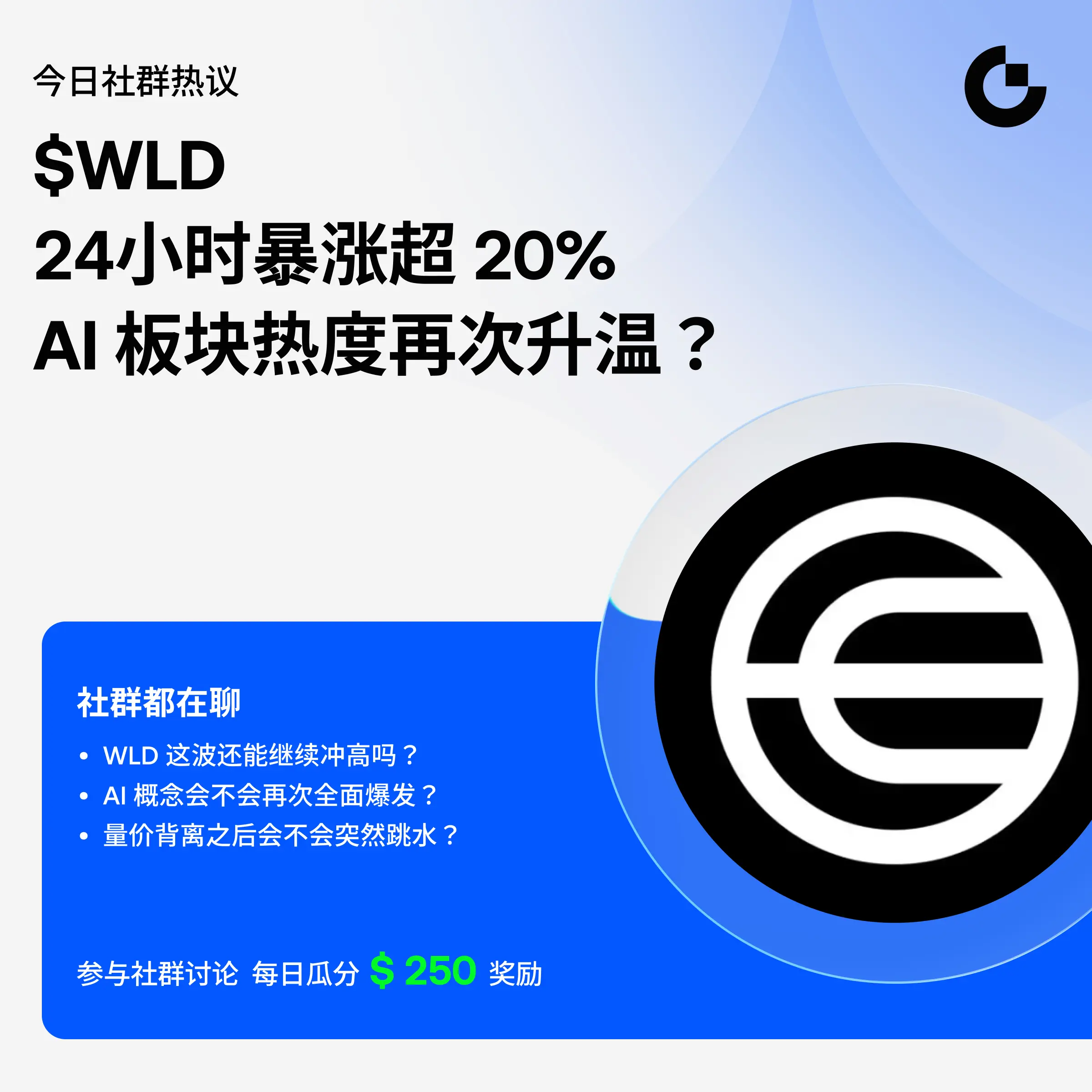
🚨 Today's community buzz: $WLD 24-hour surge over 20%, is the AI sector heating up again?
📈 AI concept attention clearly rising
📈 Technical analysis shows "volume-price divergence" risk
The community is discussing:
🔥 Can WLD continue to rise sharply?
🔥 Will the AI concept explode again across the board?
🔥 Will there be a sudden plunge after volume-price divergence?
🎁 Join community discussions
Participate daily for a chance to win a 250U contract position experience voucher!
👉 Real-time market discussions at Gate Hot Chat Community 👇
https://gate.onelink.me/Hls0/group?chatroom=group&
WLD-2.59%
GateSquare
🚨 Today's community buzz: $WLD 24-hour surge over 20%, is the AI sector heating up again?
📈 AI concept attention clearly rising
📈 Technical analysis shows "volume-price divergence" risk
The community is discussing:
🔥 Can WLD continue to rise sharply?
🔥 Will the AI concept explode again across the board?
🔥 Will there be a sudden plunge after volume-price divergence?
🎁 Join community discussions
Participate daily for a chance to win a 250U contract position experience voucher!
👉 Real-time market discussions at Gate Hot Chat Community 👇
https://gate.onelink.me/Hls0/group?chatroom=group&ref=VVhBVA9a&ref_type=105
repost-content-media
  • Reward
  • 3
  • Repost
  • Share
discovery:
To The Moon 🌕
View More
#预测NBA总冠军赢20,000U NBA FINALS 2026: WHY I'M BACKING THE SPURS
The NBA Finals have reached the stage where every possession matters, and every adjustment can change the outcome of the series. While a significant portion of prediction market participants are already backing the Spurs, I believe the market still has good reasons for favoring them.
WHY THE SPURS HAVE THE EDGE
The Spurs have demonstrated remarkable consistency throughout the season. Their success has not depended on one explosive performance or a single superstar carrying the team. Instead, they have built a balanced system featurin
GateSquare
📢 Gate Square | Polymarket 6/4 Special Prediction: NBA Finals—Who Will Win, the Knicks or the Spurs?
The NBA Finals are in full swing! Currently, in the Polymarket prediction market, 66% of users are betting on the Spurs, and 35% of users are backing the Knicks. This is a battle of powerhouses—who do you think will ultimately lift the trophy?
🎁 Everyone Shares the Prize: Participate in the Knicks vs Spurs spotlight game prediction and split a huge prize pool of 20,000 USDT!
👉️ https://www.gate.com/zh/campaigns/5030
🎁 Square Exclusive Benefits: Draw 10 users who post high-quality content—each will receive $5 in tokens!
📝 Participation Guide:
Post with #预测NBA总冠军赢20,000U and choose any of the following ways to participate:
🔹 Method A: Predict the championship-winning team you’re rooting for, and attach the event card
🔹 Method B: Share your trading screenshots and your trading ideas and opinions
📍 Note: When choosing Method A, you must attach the corresponding Polymarket event card in the currency icon on the post page for your participation to be valid.
Join now: https://gate.onelink.me/Hls0/prediction?page=detail&event_ticker=543443&source=cex
repost-content-media
  • Reward
  • 1
  • Repost
  • Share
discovery:
2026 GOGOGO 👊
#ETHPlunges5PercentBelow1800 ETHEREUM AT A CRITICAL DECISION ZONE
The recent market correction has pushed Ethereum into one of the most important price ranges of 2026. After heavy selling pressure across the crypto market, ETH dropped below the $1,800 level and entered the $1,700-$1,800 accumulation zone.
At the time of this analysis, ETH is trading around the mid-$1,700s, a region that many traders are closely watching for signs of either a reversal or further downside.
WHY THIS PRICE RANGE MATTERS
The $1,700-$1,800 area is not just another support level.
It represents a key psychological and
ETH-3.94%
GateSquare
📢 Gate Plaza | 6/4 Hot Topic: #ETH跌幅超5%
On June 4th, the crypto market continued to decline. ETH dropped 5.58% in 24 hours, falling below $1,800, with a low of $1,734; BTC also came under pressure, breaking below the $63,000 mark. As a result, the total liquidation amount across the network in 24 hours astonishingly exceeded $1.1 billion, with longs suffering heavy losses. In the current market situation, do you choose to hold steady, adjust your positions, or buy the dip?
🎁 Share your trades for a chance to win one of 5 lucky draw prizes and share a $1,000 position experience voucher!
💬 This week's discussion:
1️⃣ Trend analysis: BTC / ETH future trend analysis and price predictions.
2️⃣ Practical operations: Asset allocation and response strategies under extreme market conditions.
Share now: https://www.gate.com/post
📅 Deadline: 6/6 18:00 (UTC+8)
repost-content-media
  • Reward
  • 2
  • Repost
  • Share
discovery:
To The Moon 🌕
View More
#ETHPlunges5PercentBelow1800
ETH data: Last price ~$1,780, 24h change -5.14%, 24h low $1,716.88, open $1,876.77. Three-day cascade: $2,007 → $1,860 → $1,813 → $1,777 (yesterday's close). ETH hit a low of $1,716.
BTC data: Last price ~$63,622, 24h change -5.07%, 24h low $61,381, open $67,020. Three-day cascade from $73,684 → $71,406 → $66,756 → $64,144 → $63,622.
Key drivers from news: Strategy's first BTC sale ($2.5M), record spot BTC ETF outflows exceeding $3.2B, Mt. Gox $739M transfer, stalled Iran negotiations/rising oil, AI/IPO rotation (SpaceX, Anthropic), r
ETH-3.94%
BTC-2.8%
EagleEye
#ETHPlunges5PercentBelow1800
ETH data: Last price ~$1,780, 24h change -5.14%, 24h low $1,716.88, open $1,876.77. Three-day cascade: $2,007 → $1,860 → $1,813 → $1,777 (yesterday's close). ETH hit a low of $1,716.
BTC data: Last price ~$63,622, 24h change -5.07%, 24h low $61,381, open $67,020. Three-day cascade from $73,684 → $71,406 → $66,756 → $64,144 → $63,622.
Key drivers from news: Strategy's first BTC sale ($2.5M), record spot BTC ETF outflows exceeding $3.2B, Mt. Gox $739M transfer, stalled Iran negotiations/rising oil, AI/IPO rotation (SpaceX, Anthropic), rising Treasury yields. Total liquidations: $1.1B–$1.8B across the cascade, with longs dominating ($1.57B long vs $215M short).
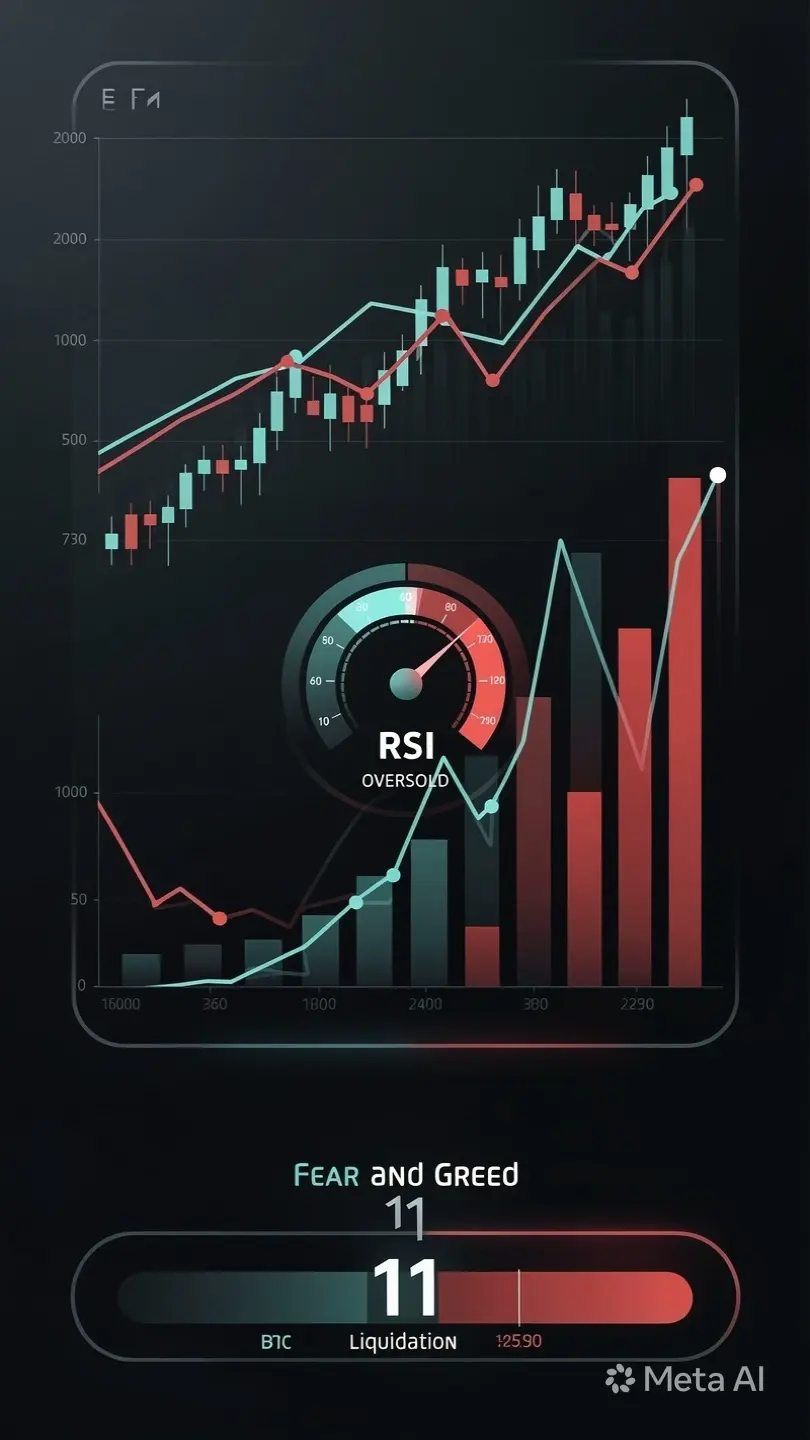
Technical indicators: BTC RSI near 10 (extreme), KDJ shows 80% fall probability. ETH RSI dipped to ~11.48, testing classical TBO support at ~$1,846. Fear & Greed Index plunged to 11.
Constraints: No "not" word, no exchange names, no social media platform names, no links, ~3000 characters, English, professional and unique, avoid AI-like patterns.
ETH Plunges Past $1,800 A Billion-Dollar Liquidation Cascade and What Comes Next
June 4th delivered a brutal reckoning to crypto markets. Ethereum shed 5.14% in a single day, crashing through the $1,800 psychological barrier to print a low of $1,717 — a price level unseen since February. Bitcoin mirrored the carnage, tumbling past $63,000 with a 24-hour low touching $61,381. Together, they triggered one of the most devastating liquidation events of 2026: over $1.1 billion in leveraged positions wiped out in 24 hours, with long-side casualties absorbing roughly $1.57 billion against a mere $215 million in short liquidations.
The Anatomy of a Cascade
This was far from a random dip. The sell-off unfolded as a multi-day acceleration — a slow bleed that became a flood. Bitcoin opened the week around $73,684, then methodically staircase-dropped: $71,406, $66,756, $64,144, and finally $63,622. Ethereum's trajectory mirrored the descent — $2,007, $1,860, $1,813, then $1,777 before plunging to the $1,717 nadir. Each level breached triggered fresh waves of forced selling as leveraged longs hit liquidation thresholds, creating a self-reinforcing spiral.
Root Causes It Was Never Just One Thing
Several catalysts aligned to create the perfect downside storm. Strategy, the largest publicly traded Bitcoin holder, sold $2.5 million worth of BTC on Monday — its first-ever publicized sale. That signal alone rattled confidence in the "diamond hands" narrative. Spot Bitcoin ETF outflows then compounded the unease, with the outflow streak crossing $3.2 billion through Tuesday — a record that speaks volumes about institutional retreating.
Meanwhile, Mt. Gox moved $739 million to a fresh wallet address, reviving long-dormant fears of creditor distributions hitting the market. Geopolitical tensions added fuel: stalled US-Iran ceasefire negotiations kept Brent crude climbing for a third consecutive day, feeding risk-off sentiment across all asset classes.
Perhaps the most telling macro signal came from the divergence between crypto and traditional markets. The MSCI All Country World Index set a fresh all-time high on the AI rally. SpaceX filed a confidential IPO. Anthropic reportedly prepared to go public. Capital rotated aggressively from crypto into high-flying AI stocks and IPOs, and the derivatives market reflected that rotation with brutal clarity.
Technical Landscape Deep in the Red
Both BTC and ETH have entered extreme oversold territory. Bitcoin's daily RSI registered around 10 — approaching the February 5th low of 8.95. The Fear & Greed Index collapsed to 11, signaling deep capitulation. KDJ indicators show an 80% probability of continued near-term downside, with only a 20% chance of a bounce. MA and MACD indicators hover near 50/50, suggesting the broader trend remains directionally ambiguous once the panic subsides.
Ethereum tested its classical TBO support near $1,846 with an RSI dipping to 11.48 — marginally below its February trough. The $1,717 low has drawn comparisons to the February liquidation cascade, though the current volume profile (over $1 billion in ETH-related daily turnover) exceeds that earlier episode, suggesting more genuine positioning shifts rather than purely mechanical deleveraging.
The $50,000 strike put expiring June 26 became the most traded options bet on Deribit in the past 24 hours — traders are hedging against a scenario far darker than the current price implies.
Response Strategies — Three Paths Forward
Hold Steady: For those with low-leverage or spot positions, the oversold readings suggest a capitulation zone. RSI readings near 10 have historically marked cyclical bottoms in Bitcoin, though timing the exact reversal remains impossible. If your thesis is long-term and leverage is manageable, weathering the storm can preserve capital for the eventual recovery — provided you can tolerate further drawdowns to the $60,000 or even $55,000 zone that options markets are pricing.
Adjust Positions: Traders carrying leverage above 5x face existential risk in this environment. Reducing position size, moving to isolated margin, or taking partial profits on any remaining gains can free up margin to survive extended downside. The cross-margin mode amplifies contagion risk — one liquidated position can cascade into others. Switching to isolated margin compartmentalizes risk, a crucial adaptation when volatility regimes shift this dramatically.
Buy the Dip: Counter-trend entries carry allure at oversold extremes, yet the macro backdrop remains hostile. ETF outflows continue, geopolitical uncertainty persists, and capital rotation into AI equities shows no sign of reversing. A disciplined dip-buying approach demands waiting for confirmation — a daily close above $65,000 for BTC or $1,850 for ETH — rather than catching falling knives on momentum alone. Scaling in over three to five entries rather than a single all-in bet manages timing risk far more effectively.
What to Watch Next
The battle now centers on whether $60,000 holds for Bitcoin and $1,700 for Ethereum. A breach of either level opens the door to the sub-$55,000 and $1,350 targets that some analysts have flagged. Conversely, a strong reclaim of $65,000 and $1,850 would signal the liquidation cascade has exhausted itself and a relief rally can develop.
Monitor ETF flow data daily — the outflow streak is the single most important institutional signal right now. Track Mt. Gox wallet movements for distribution clues. And watch the DXY: the Dollar Index maintains a strong bullish orientation, which historically pressures crypto further.
This market punishes impatience and rewards preparation. Whether you hold, adjust, or dip-buy, the imperative is the same: size your risk for the worst case, and let the data rather than emotion guide your next move.
repost-content-media
  • Reward
  • 1
  • Repost
  • Share
discovery:
2026 GOGOGO 👊
#ETHPlunges5PercentBelow1800
📢 Gate Plaza | 6/4 Hot Topic: #ETH跌幅超5%
On June 4th, the crypto market continued to decline. ETH dropped 5.58% in 24 hours, falling below $1,800, with a low of $1,734; BTC also came under pressure, breaking below the $63,000 mark. As a result, the total liquidation amount across the network in 24 hours astonishingly exceeded $1.1 billion, with longs suffering heavy losses. In the current market situation, do you choose to hold steady, adjust your positions, or buy the dip?
🎁 Share your trades for a chance to win one of 5 lucky draw prizes and share a $1,000 pos
ETH-3.93%
BTC-2.82%
GateSquare
📢 Gate Plaza | 6/4 Hot Topic: #ETH跌幅超5%
On June 4th, the crypto market continued to decline. ETH dropped 5.58% in 24 hours, falling below $1,800, with a low of $1,734; BTC also came under pressure, breaking below the $63,000 mark. As a result, the total liquidation amount across the network in 24 hours astonishingly exceeded $1.1 billion, with longs suffering heavy losses. In the current market situation, do you choose to hold steady, adjust your positions, or buy the dip?
🎁 Share your trades for a chance to win one of 5 lucky draw prizes and share a $1,000 position experience voucher!
💬 This week's discussion:
1️⃣ Trend analysis: BTC / ETH future trend analysis and price predictions.
2️⃣ Practical operations: Asset allocation and response strategies under extreme market conditions.
Share now: https://www.gate.com/post
📅 Deadline: 6/6 18:00 (UTC+8)
repost-content-media
  • Reward
  • 2
  • Repost
  • Share
discovery:
To The Moon 🌕
View More
#SpaceXTargets1.75TrillionIPO SpaceX Prepares Historic $1.75 Trillion IPO: The Largest Public Offering in Financial History

Elon Musk's SpaceX is poised to shatter all records with its upcoming initial public offering, targeting a valuation of $1.75 trillion that would make it the largest IPO in history. The company has filed with the SEC and plans to debut on the Nasdaq on June 12, with a fixed roadshow price of $135 per share.
**IPO Structure and Valuation:**
SpaceX plans to sell approximately 555.6 million shares at $135 per share, raising approximately $75 billion. The $1.75 trillion valua
HighAmbition
#SpaceXTargets1.75TrillionIPO
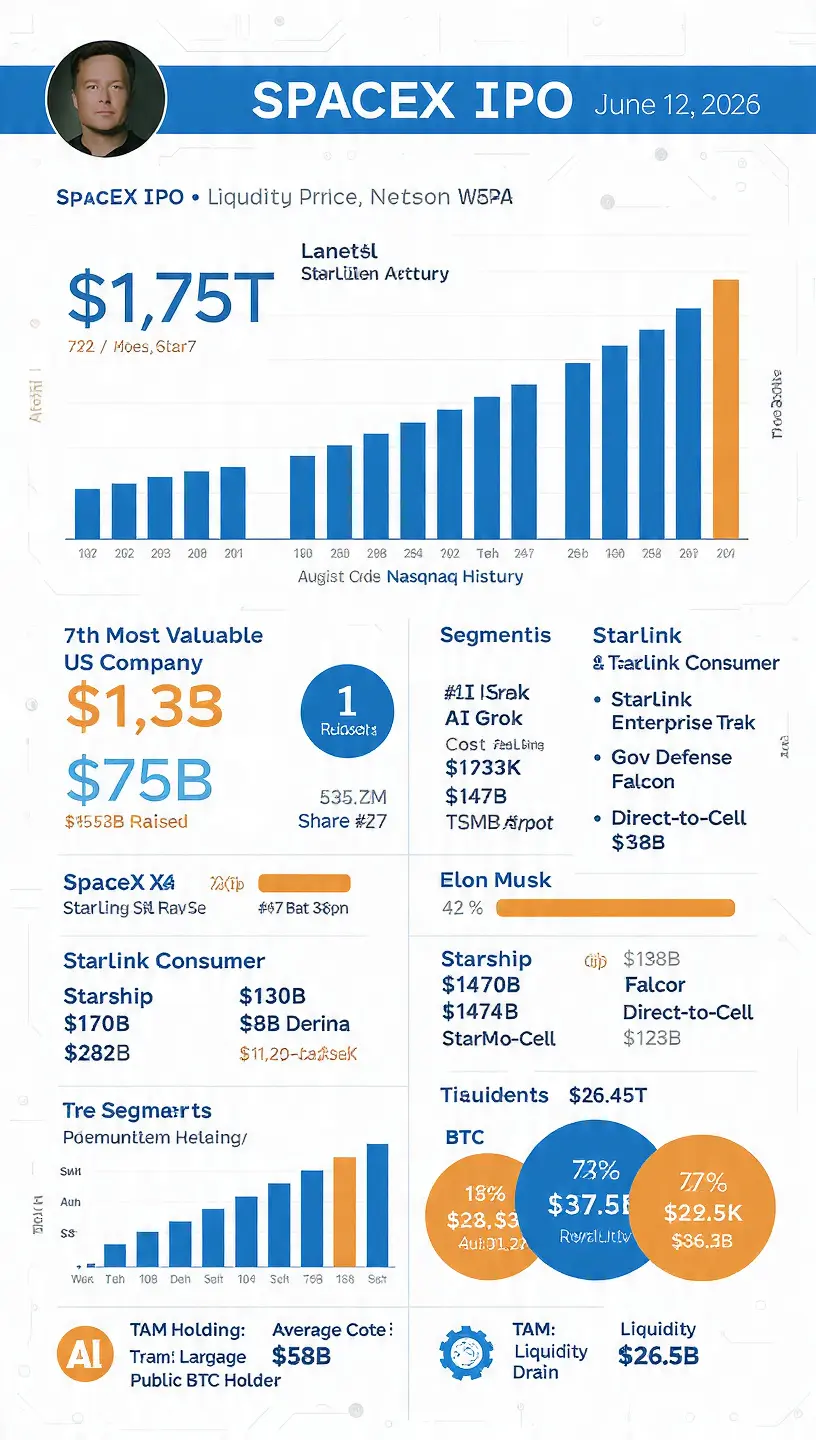
SpaceX is preparing to launch the largest initial public offering in history, targeting a valuation of $1.75 trillion with a fixed share price of $135. The company plans to raise $75 billion by selling approximately 555.6 million shares and is expected to begin trading on Nasdaq on June 12, 2026. This IPO would make SpaceX the seventh most valuable publicly traded company in the United States, surpassing Tesla's market capitalization of approximately $1.6 trillion and sitting just behind TSMC's roughly $2 trillion valuation. It would also eclipse the previous IPO record of $1.7 trillion set by Saudi Aramco seven years ago. Elon Musk, who already holds the title of the world's richest person, would very likely become a trillionaire as a result of this listing. He owns 42 percent of SpaceX's common stock and holds 350 million stock options, which together would be worth approximately $688 billion if the stock maintains its $135 offering price.
The valuation of $1.75 trillion reflects a complex sum-of-the-parts calculation across seven distinct business segments. Starlink Consumer Broadband is estimated at $380 billion, supported by approximately 9.2 million subscribers and trading at roughly 38 times revenue. The xAI and Grok division accounts for $258 billion, anchored by the $250 billion merger between xAI and SpaceX announced in early 2026. Starship Commercial Launch carries a $170 billion valuation as a pre-revenue option value representing the future potential of SpaceX's next-generation rocket system. Starlink Enterprise, Maritime, and Aviation services are valued at $147 billion, while Government and Defense contracts contribute $123 billion backed by a $22 billion contract backlog. The legacy Falcon 9 and Falcon Heavy launch operations are valued at $100 billion, representing 60 to 70 percent of global commercial launches. Finally, Starlink Direct-to-Cell is estimated at $75 billion, bolstered by $17 to $19 billion in EchoStar spectrum assets. The total addressable market that SpaceX describes in its S-1 filing reaches an astonishing $28.5 trillion, with AI representing $26.5 trillion of that figure. However, some analysts suggest that the $1.75 trillion price represents a 29 percent premium over the median forecasted fair value of SpaceX's combined businesses, raising questions about whether investors are overpaying for the Musk brand and the AI narrative layered onto what remains fundamentally a space and connectivity company.
One of the most striking revelations in the SpaceX S-1 filing is the disclosure of Bitcoin holdings. SpaceX disclosed that it holds 18,712 BTC as of March 31, 2026, acquired at an average purchase price of approximately $35,000 per coin, meaning the total acquisition cost was roughly $661 million. At current market prices around $70,000 per BTC, those holdings are now valued at approximately $1.29 to $1.45 billion, making SpaceX the seventh largest Bitcoin holder among publicly traded companies and surpassing Tesla's own treasury allocation. This Bitcoin reserve transforms the SpaceX IPO into something far more than a pure space industry investment. Every investor who buys SpaceX shares on Nasdaq will effectively be gaining indirect exposure to Bitcoin, creating a novel bridge between traditional equity markets and digital assets. The deliberate treasury strategy signals that SpaceX views Bitcoin not as a speculative side bet but as a long-term balance sheet asset, a philosophy consistent with Elon Musk's well documented influence on crypto markets through his public statements and Tesla's prior Bitcoin purchases and acceptance as payment for vehicles.
The impact of the SpaceX IPO on the cryptocurrency market, particularly Bitcoin, operates through several interconnected channels. The first and most immediate concern is liquidity drain. A $75 billion IPO requires investors to allocate enormous sums of capital to purchase SpaceX shares, and this capital must come from somewhere. In the current market environment, the pools of risk-on capital that flow into tech stocks, AI investments, and cryptocurrencies are largely shared. When a mega listing of this scale absorbs $75 billion, it directly competes with Bitcoin and other crypto assets for the same marginal investor dollar. Analysts at CoinDesk have warned that the combined IPO wave of 2026, including SpaceX, OpenAI, and Anthropic, could collectively draw more than $240 billion from the market by year end. This scale of capital absorption could compress the forward looking risk appetite that crypto markets depend on, particularly during periods when institutional flows are already fragile. Bitcoin is currently trading around $70,000, down nearly 50 percent from its all time high of $126,000 reached in October 2025, and already under pressure from spot ETF outflows and Strategy's first disclosed Bitcoin sale. The SpaceX IPO listing on June 12 adds another layer of selling pressure at a time when derivatives markets show open interest at 773,000 BTC with elevated funding rates despite weak spot demand, a dangerous divergence that often precedes deeper corrections.
The second impact channel operates through narrative and sentiment. Elon Musk's dual role as the CEO of both Tesla and SpaceX, combined with his outsized influence on crypto market sentiment through social media posts and public statements, means that the SpaceX IPO will dominate global financial headlines for weeks. During the roadshow period beginning June 8 and the early trading days after June 12, media attention will be intensely focused on Musk, his companies, and the valuation debate. This attention has historically been a double edged sword for Bitcoin. On one hand, the Bitcoin disclosure in SpaceX's filing validates the cryptocurrency as a legitimate treasury asset for one of the world's most ambitious technology companies, reinforcing the narrative that Bitcoin belongs on the balance sheets of major corporations alongside cash and short term investments. On the other hand, if the SpaceX IPO trades poorly in its initial days, the negative sentiment around Musk and his companies could spill over into crypto markets, given the strong correlation between Musk's public perception and Bitcoin price movements observed repeatedly since 2021. A failed or underperforming IPO debut would send a message that even the most hyped technology venture cannot sustain its valuation, and that message could reverberate across all risk assets including Bitcoin.
The third impact channel is structural and relates to the evolving competition between traditional equity markets and crypto markets for investor attention and capital allocation. The SpaceX IPO represents the arrival of a new category of publicly traded asset that blends space infrastructure, satellite connectivity, AI computing, and digital asset exposure into a single equity vehicle. For institutional investors who have been allocating to Bitcoin through ETFs and direct purchases, SpaceX offers an alternative that provides Bitcoin exposure indirectly while also delivering growth potential across multiple secular themes. This could redirect some institutional capital from pure Bitcoin allocations into SpaceX shares, particularly if the stock performs well in early trading and demonstrates that the Bitcoin treasury component is appreciated by the equity market. The Anthropic compute deal, which involves $1.25 billion per month through May 2029 for AI computing capacity at SpaceX's Colossus 1 data center in Memphis, Tennessee, further positions SpaceX as an AI infrastructure company, creating additional competition for the capital that has been flowing into AI themed crypto tokens and Bitcoin mining stocks that have pivoted toward AI computing narratives.
The fourth channel involves the Bitcoin holdings themselves. SpaceX holding 18,712 BTC on its balance sheet creates a unique dynamic. As a publicly traded company, SpaceX will be subject to quarterly reporting requirements, and any change in the value of its Bitcoin holdings will flow through its financial statements. If Bitcoin rises significantly after the IPO, SpaceX's treasury gains will boost its reported earnings and potentially drive its stock price higher, creating a positive feedback loop between Bitcoin appreciation and SpaceX equity value. Conversely, if Bitcoin continues to decline from current levels near $70,000, SpaceX could face treasury losses on its income statement, which might pressure its stock price and in turn reinforce negative Bitcoin sentiment through the Musk association. The fact that SpaceX acquired its Bitcoin at roughly $35,000 per coin means the company still holds substantial unrealized gains even at current prices, but a drop below $35,000 would push the holdings into unrealized loss territory, a scenario that would generate intense media coverage and potentially shake confidence in corporate Bitcoin adoption as a treasury strategy.
Beyond Bitcoin, the broader cryptocurrency market faces additional ripple effects from the SpaceX IPO. Altcoins and smaller crypto assets are even more sensitive to liquidity conditions than Bitcoin, because they trade in thinner markets with smaller buyer pools. When $75 billion is absorbed by a single IPO, the marginal capital that might otherwise flow into Ethereum, Solana, or emerging DeFi protocols is simply not available, and these assets tend to underperform during periods of equity market capital absorption. The crypto market has already experienced a roughly 7.5 percent decline over the past week as Bitcoin slid below $71,000, with analysts warning of potential further downside toward $50,000 support levels if ETF outflows and macro pressures persist. The SpaceX IPO timing, arriving during an already fragile crypto market environment, could amplify the existing downward momentum rather than provide a counterbalancing boost.
Looking at the bigger picture, the SpaceX IPO at $1.75 trillion represents a pivotal moment for the relationship between traditional capital markets and digital assets. It is simultaneously the largest capital raising event in financial history and the most prominent mainstream validation of Bitcoin as a corporate treasury asset. The net effect on Bitcoin and crypto will depend on how the IPO trades in its first weeks, whether the liquidity drain proves temporary or persistent, and whether the Bitcoin disclosure encourages other major companies to follow SpaceX's lead in allocating digital assets to their balance sheets. In the short term, the liquidity competition and sentiment risks suggest caution for crypto investors, as the IPO will absorb capital and attention that Bitcoin needs to recover from its current downtrend. In the longer term, however, the validation of Bitcoin by a $1.75 trillion company may prove to be one of the most significant adoption milestones in the history of digital assets, cementing Bitcoin's role not just as a speculative trading instrument but as a recognized component of corporate treasury management at the highest levels of global finance.#ShareYourUSStocksWinNvidia #DailyPolymarketHotspot @Gate_Square
repost-content-media
  • Reward
  • 2
  • Repost
  • Share
discovery:
To The Moon 🌕
View More
#MemoryStocksRallyAgainstMarket
Memory Chip Supercycle Defies Market Weakness: Micron and Sector Peers Surge on AI Demand Insanity
Memory chip stocks have emerged as the standout performers in an otherwise mixed market environment, with Micron Technology leading a relentless rally driven by insatiable artificial intelligence demand. The sector has decoupled from broader market weakness, posting gains that defy conventional cyclical expectations.
**Micron's Meteoric Rise:**
Micron Technology has transformed from a cyclical memory laggard into an AI infrastructure essential in under a year. Key
MU-0.74%
META-0.07%
MSFT0.09%
AMZN-0.03%
Falcon_Official
#Gate正式推出股票交易 AI Memory & Semiconductor Stocks Outperforming the Market
In the current market cycle, AI memory and semiconductor stocks are significantly outperforming the broader equity market. This trend is not temporary but reflects a structural shift in global technology demand driven by artificial intelligence, cloud computing, and high-performance data infrastructure.
1. Market Theme: Structural Outperformance
The most important observation is the clear divergence between semiconductor stocks and the broader market. While general indices are experiencing mixed momentum, AI-related chip and memory companies continue to show stronger relative performance. This indicates a rotation of capital toward AI infrastructure rather than traditional sectors.
2. Core Growth Logic Behind the Trend
The primary reason behind this outperformance is the explosive growth in artificial intelligence systems. AI models require massive computing power, and that computing power depends heavily on advanced semiconductors and memory systems. Without high-performance chips, AI training and deployment cannot scale effectively.
3. Key Growth Drivers
Several strong fundamental factors are driving demand in this sector:
• Rapid expansion of AI data centers worldwide
• Increasing adoption of High-Bandwidth Memory (HBM) technologies
• Growing deployment of GPUs for AI training and inference
• Continuous expansion of cloud computing infrastructure
• Rising semiconductor content per AI server generation
Each new generation of AI systems requires more advanced chips, higher memory capacity, and faster data processing, which directly benefits this sector.
4. Why Semiconductor Stocks Are Leading the Market
Semiconductor and memory stocks are outperforming because they sit at the core of the AI ecosystem. Every major AI platform depends on chips for computation and memory for data processing. This creates a strong demand cycle where supply struggles to keep up with rapid adoption.
Additional supporting factors include:
• Strong long-term demand visibility from hyperscalers
• Increasing complexity of AI infrastructure
• Limited global supply of advanced chips
• Strategic importance of semiconductor manufacturing
• Institutional capital rotation into AI hardware leaders
5. Market Structure Insight
This cycle is fundamentally different from previous tech cycles. It is not driven by short-term speculation but by real infrastructure buildout. AI is becoming a foundational layer of global technology, and semiconductors are the backbone of that transformation.
Memory and semiconductor companies are therefore not just participating in growth—they are enabling it.
6. Risk Factors to Consider
Despite strong momentum, investors should remain aware of risks:
• Semiconductor industry cyclicality over time
• Supply chain constraints and production bottlenecks
• High valuation sensitivity in growth sectors
• Potential short-term corrections after strong rallies
• Global macroeconomic uncertainty
These factors can create volatility even in strong structural uptrends.
7. Final Conclusion
AI memory and semiconductor stocks are outperforming the broader market because they represent the core infrastructure of the artificial intelligence revolution. Demand for compute power, memory bandwidth, and AI data processing continues to accelerate, creating a long-term structural growth cycle.
This makes the semiconductor sector one of the strongest and most strategically important areas in the current global market environment, with sustained attention from both institutional and retail investors.
Overall Insight: AI is not just driving software innovation it is redefining hardware demand, and semiconductors are at the center of this transformation.
#MemoryStocksRallyAgainstMarket
repost-content-media
  • Reward
  • 1
  • Repost
  • Share
discovery:
To The Moon 🌕
#STRCFallsBelow95
Strategy's STRC Preferred Shares Slip Below Key Support Levels as Cash Reserve Concerns Mount
Strategy's perpetual preferred stock, known as STRC or Stretch, has fallen below the critical $100 par value threshold, trading around $95 and raising significant concerns among investors about the company's financial health and dividend sustainability. This development marks a pivotal moment for Michael Saylor's bitcoin-centric enterprise strategy.
**Price Action Analysis:**
STRC slipped below its $100 target price following a turbulent period in cryptocurrency markets. The preferr
BTC-2.8%
Falcon_Official
#STRCFallsBelow95
Strategy's Series A Perpetual Stretch Preferred Stock STRC has broken below the $95 threshold for the first time since its dividend-adjustment framework was codified, and the implications stretch far beyond a single ticker.
As of June 4, 2026, STRC is trading at $94.65, down over 2% from its previous close of $96.71 and slipping well under the $100 par value that has anchored this product's design since inception. This is not a routine dip. The $95 level is a structural tripwire: Strategy's own updated framework stipulates that if the five-day volume-weighted average price falls below $95.00, management will recommend a dividend rate increase of 50 basis points. That mechanism designed to protect holders by boosting yield when price compression threatens now activates for the first time in the security's history, raising the question of whether 12.00% will be enough to restore confidence or merely confirm that the floor is cracking.
The proximate cause is Bitcoin's accelerating selloff. BTC crashed below $63,000 on June 4, its lowest level since late February, marking a 14% decline this week and a 21% plunge over four weeks. Over $1.5 billion in crypto long positions were liquidated in a single 24-hour window. The 30-day implied volatility index on Deribit spiked to 53.17, its highest since early April, and put options at the $50,000 strike for June 26 expiry became the most traded contract a stark signal that traders are pricing in further deterioration, not a bounce.
This cascading pressure feeds directly into STRC's weakness. Strategy holds 843,076 Bitcoin at an average cost that has now drifted underwater as BTC trades below the $75,699–$76,052 acquisition range. The company reported a $12.54 billion net loss for Q1 2026 as Bitcoin slid from roughly $87,000 to $68,000 during the quarter. A rebound above $80,000 in April briefly buoyed hopes, but the current crash to $63,000 has erased that recovery and pushed Strategy's entire BTC stack into unrealized loss territory once again.
The narrative turning point came on June 1, when Strategy disclosed in an SEC filing that it had sold 32 Bitcoin at an average price of $77,135 per coin roughly $2.5 million to fund preferred stock dividend obligations. This broke the company's long-standing "never sell your Bitcoin" doctrine. Michael Saylor had foreshadowed the move during an earnings call in May, framing it as financially prudent and intended to "inoculate the market." The market, however, did not take the inoculation well. Analysts noted that selling just 32 BTC a token amount relative to Strategy's 843,076-coin hoard paradoxically damaged confidence more than a larger, more decisive sale might have. One observer characterized it succinctly: Saylor tried to save STRC by signaling willingness to sell BTC, and cratered it all in the process. The preferred stock he aimed to stabilize dropped below $95 within days.
Simultaneously, competitive pressure has intensified from Strive's SATA preferred stock, which offers a 13.00% annualized dividend rate against STRC's 11.50%. Strategy held the STRC rate at 11.50% for the fourth consecutive month as of June 1, after the stock's monthly VWAP managed $99.62 in the prior period. That number will not repeat this month. With STRC now sub-$95, the dividend adjustment framework's automatic recommendation to boost the rate by 50 basis points would bring it to 12.00% still below SATA's 13.00%. Whether Strategy chooses to increase further, perhaps matching or exceeding SATA, will be a defining decision. The tension is clear: a higher dividend rate restores yield appeal but pressures cash flow at a moment when Bitcoin is underwater and capital markets access is uncertain.
Broader macro forces are compounding the strain. CNBC data shows Bitcoin trailing the Nasdaq-100 by the widest margin since March 2019 a 70-percentage-point divergence as institutional capital rotates into AI equities and high-profile IPOs including SpaceX and Anthropic. U.S.-listed spot Bitcoin ETFs have recorded 13 consecutive days of outflows, signaling that institutional appetite for BTC exposure is fading even as equity markets hit record highs. Geopolitical risk adds another layer: oil prices remain elevated amid the ongoing U.S.-Iran confrontation, and Brent crude near $98 per barrel threatens inflation persistence that could keep Federal Reserve policy tighter for longer a historically hostile environment for risk assets, particularly crypto.
Strategy's countermeasure has been the creation of a $1.44 billion cash reserve, announced to reassure investors that preferred dividend and interest payments remain covered without requiring further Bitcoin liquidations. Saylor pitched this as the next phase of Strategy's evolution toward becoming the world's leading issuer of "Digital Credit." Meanwhile, the company deployed $1.38 billion of that reserve to retire $1.5 billion of 2029 convertible bonds a liability management move that reduces near-term refinancing risk but also consumes liquidity precisely when balance sheet flexibility matters most.
For STRC holders, the calculus is unambiguous. A $94.65 price on a $100 par security paying 11.50% produces an effective yield of approximately 12.14% above the nominal rate but not competitively distinctive versus SATA's 13.00% at or near par. If the dividend adjustment framework delivers the anticipated 50bp increase, the effective yield at current prices would approach 13.19%. That math may attract yield-seeking buyers and provide a natural price floor, but only if confidence in Strategy's ability to sustain payments remains intact. The 32-BTC sale, though small in absolute terms, has introduced a new variable: the possibility however remote that deeper Bitcoin liquidations could follow if market weakness persists. Each incremental sale erodes the asset base backing STRC's dividends and amplifies the negative feedback loop analysts have flagged.
The $95 threshold breach is therefore both a technical event and a psychological inflection. It is the first time the dividend adjustment framework has been triggered, the first time Saylor's "inoculate" thesis has been tested by the market's response, and the first time STRC holders face a genuine convergence of Bitcoin price risk, competitive yield pressure, and macro-driven institutional rotation away from crypto. Whether the framework's 50bp lever is sufficient to pull STRC back above $95 and restore the par-value anchor that enables continued ATM issuance a critical capital pipeline for Bitcoin accumulation will determine the next chapter not just for STRC, but for Strategy's entire capital structure architecture.
One number defines the stress: $94.65. Below $95 for the first time. The framework responds. The market watches. Strategy decides.
repost-content-media
  • Reward
  • 2
  • Repost
  • Share
discovery:
To The Moon 🌕
View More
#微策略出售32枚比特币 "Never sell Bitcoin," then he sold 32 coins
On June 1, Strategy filed an 8-K with the SEC, disclosing the sale of 32 bitcoins from May 26 to 31, at an average price of $77,135, totaling about $2.5 million. After the sale, the company still holds 843,706 BTC, with a total cost basis of $63.87 billion, an average of $75,699 per coin.
The 32 coins represent 0.004% of the total holdings; $2.5 million is equivalent to Strategy’s average daily purchase volume over the past 12 months. From a financial perspective, this transaction is almost meaningless. But what it breaks is far great
Ryakpanda
#微策略出售32枚比特币 "Never sell Bitcoin," then he sold 32 coins
On June 1, Strategy filed an 8-K with the SEC, disclosing the sale of 32 bitcoins from May 26 to 31, at an average price of $77,135, totaling about $2.5 million. After the sale, the company still holds 843,706 BTC, with a total cost basis of $63.87 billion, an average of $75,699 per coin.
The 32 coins represent 0.004% of the total holdings; $2.5 million is equivalent to Strategy’s average daily purchase volume over the past 12 months. From a financial perspective, this transaction is almost meaningless. But what it breaks is far greater than the amount realized; since buying Bitcoin for the first time in August 2020, Strategy has only sold once, in December 2022, when it sold 704 BTC for $11.8 million at an average of $16,776, aiming for tax-loss harvesting, then bought back 810 coins two days later at a lower price. That sale was essentially a tax maneuver, not a genuine reduction of holdings.
But this time is different; the $2.5 million is explicitly marked for paying preferred stock dividends, and Strategy has no plans to buy back.
Dividend bill begins to mature
Starting early 2025, Strategy issued preferred stocks intensively: STRK with an 8% annual yield, STRF with 10%, STRD with 10%, and STRC with 11.5%. The four series are layered, and the company has paid over $693 million in dividends so far.
The logic behind these preferred stocks is that investors give money to Strategy, which uses it to buy Bitcoin, then pays fixed-rate dividends using cash reserves and operational income. When Bitcoin rises, the mNAV premium widens, allowing Strategy to continue issuing new shares for financing. When Bitcoin falls or stagnates, the dividend obligations remain, but the financing window narrows.
MicroStrategy’s Bitcoin accumulation pace
By December 2025, Strategy had established a $2.25 billion cash reserve dedicated to covering dividends and debt payments, which could last about 30 months at the current pace. But by May 31, 2026, this reserve had fallen to $900 million, having depleted $1.35 billion in six months.
In the Q1 earnings call, Strategy CEO Phong Le publicly listed "disciplined sale of Bitcoin" as one of its capital management tools for the first time. Few paid attention at the time, but in hindsight, it was a preview of the sale of 32 BTC.
Saylor posted a tweet on February 2, 2025, saying "Never sell your bitcoin," which was widely retweeted after the 8-K disclosure. He later only discussed STRC’s product positioning, stating that Strategy’s goal is to make STRC the world’s best credit tool, completely sidestepping the topic of selling coins.
On that day, MSTR’s stock fell about 6%, Mizuho maintained a buy rating but lowered the target price from $320 to $265. Most analysts believe the $2.5 million sale has little financial impact, but the core significance lies in the signal: if cash reserves continue to deplete with unchanged dividend obligations, future sales might not stop at 32 coins.
A $100 million text game on Polymarket
Strategy’s sale also triggered a prediction market on Polymarket.
The question was whether Strategy would sell Bitcoin before May 31. The market has traded over $111 million so far. The 8-K shows the transaction occurred between May 26 and 31, with the timestamp recorded as "May 31, 2026, 4:00 PM Eastern Time." But the 8-K was only filed with the SEC on June 1, and the public only learned about it after the deadline.
Buyers of "Yes" say the transaction occurred before the deadline, as the 8-K explicitly states May 31; buyers of "No" argue there was no public information confirming the sale before the deadline, so according to the rules, it should be No. After two No proposals were challenged, the dispute escalated to UMA token voting arbitration.
Polymarket then added a note stating, "Consensus from MSTR, on-chain data, or reliable reports has not confirmed that Strategy sold Bitcoin within the market’s specified time frame. Confirmations outside the specified time frame do not meet the requirements."
Behind this dispute is a deeper issue with Polymarket’s arbitration mechanism. A May survey by The Wall Street Journal found that in most of Polymarket’s dispute markets, over half of the UMA voting power is concentrated in the top 10 wallets, about 60% of active voters can be linked to Polymarket accounts, and roughly one in five disputes involves voters holding the disputed contract position. Since 2026, Polymarket has generated over 1,150 dispute markets, surpassing the total for all of 2025.
It’s not just Strategy selling; Bitcoin has fallen below $72k!
Strategy’s 8-K disclosure coincided with a generally weak market environment, with Bitcoin dropping below $72,000 on June 1, reaching the lowest level since April 13. CoinShares data shows that last week, digital asset investment products saw net outflows of $1.67 billion, the second-largest weekly outflow in 2026. For May, Bitcoin spot ETFs experienced net outflows of $2.3 billion, the largest monthly outflow this year. Digital asset management has shrunk to about $141 billion, the lowest since the start of the year.
Strategy sold 32 coins, but it’s not the first Bitcoin treasury company to act. Q1 data shows selling has become a collective behavior. MARA Holdings sold 15,133 BTC from March 4 to 25, cashing out about $1.1 billion, mostly used to repurchase convertible bonds maturing in 2030 and 2031. Riot Platforms sold 3,778 BTC during the same period, raising $289.5 million, reducing holdings from 19,223 to 15,680 BTC, an 18% decrease. David Bailey’s Nakamoto Holdings sold 284 BTC in March, about 5% of its holdings. Empery Digital sold 370 BTC in April to repay loans. Genius Group liquidated its last 84 coins to pay off $8.5 million in debt.
In Q1 alone, MARA, Riot, and Nakamoto sold over 19k BTC combined. On-chain data from CryptoQuant shows that at the end of March, Bitcoin’s apparent demand dropped to a negative 63,000 coins, indicating a deep market contraction where overall selling pressure significantly exceeds buying.
Some companies are not just selling coins but outright abandoning the treasury model. Forum Markets (formerly ETHZilla) liquidated about $114 million worth of ETH at the start of the year, shifting to tokenization services. VivoPower initially planned to build an XRP treasury but shifted to data centers and AI infrastructure in February, disposing of all XRP holdings.
On May 28, French semiconductor company Sequans Communications confirmed it had fully repaid its convertible bonds by selling its Bitcoin holdings, and plans to gradually liquidate the remaining 658 BTC. The company’s peak Bitcoin holding was 3,234 coins.
Sequans previously announced it would hold over 3,000 BTC as long-term reserves, but that "long-term" lasted less than a year. Its stock (ticker SQNS) has fallen 77% this year, with a five-year decline of 97%. The business model of Bitcoin treasury companies was validated during the 2025 rally, as rising coin prices pushed up mNAV premiums, allowing them to issue new shares or convertible bonds to buy more coins, creating a positive feedback loop. After the market peaked in October last year, this flywheel reversed. Falling prices compressed premiums, financing windows narrowed, and dividend and debt obligations remained unchanged, making coin sales the most direct liquidity source. According to Bitwise, by the end of Q1, listed companies held about 1.15 million BTC, representing 5.47% of the total supply. This scale itself poses a risk: if multiple treasury companies are forced to sell simultaneously, they are both the largest buyers and potentially the most concentrated selling pressure.
Few companies are still buying; Strive bought about 1,944 BTC in May, spending around $150 million, and Metaplanet bought 5,075 BTC in early April. Strategy itself was still buying in May, accumulating over 25k BTC that month, worth more than $2 billion.
Spending $2 billion to buy while taking out $2.5 million for dividends shows that Strategy is still far from a liquidity crisis. But the signal from selling 32 coins is that even the biggest hodlers are beginning to see selling as a tool in their toolbox.
repost-content-media
  • Reward
  • 3
  • Repost
  • Share
discovery:
To The Moon 🌕
View More
Thanks for sharing this information 🙏
Ryakpanda
#Polymarket每日热点 Predictions for IPOs before 2027: Major Tech Companies
1 High Certainty (Files Submitted or Clear Timeline)
Company
1 SpaceX
Status S-1 filed
Expected Time June 12, 2026
Valuation Expectation $1–1.75 trillion
2 Anthropic
Status Confidential IPO filing submitted
Expected Time 2026
Valuation Expectation $350 billion+
3 OpenAI
Status Planning IPO but may be delayed
Expected Time May be delayed until 2027
Valuation Expectation $1 trillion+
2 Moderate Certainty
Company
1 Discord
Status Market forecast
Expected Time 2026-2027
Valuation Expectation $15 billion (55% probability)
2 Stripe
Status Multiple delays, still planning to go public, expected time 2026-2027
Valuation Expectation $65 billion+
3 Databricks
Status Planning IPO
Expected Time 2026-2027
Valuation Expectation $43 billion+
3 Other Potential IPO Candidates Worth Watching
Cerebras Systems - Completed IPO in May 2026, raised $5.5 billion
Reddit - Already listed, but discussions are ongoing
Shein - Fast fashion e-commerce, planning IPO but facing regulatory challenges
Skims - Kim Kardashian’s brand, valued at about $4 billion
4 Key Analysis
SpaceX (Most Certain)
Has officially filed S-1, expected to go public on June 12
Annual revenue around $44 billion, expected to achieve operational profit in Q2 for the first time
Market forecasts show an 88-94% probability of IPO before 2027
Anthropic vs OpenAI
Anthropic is moving faster, has submitted confidential documents, expected to turn a profit in Q2.
OpenAI may be delayed until 2027 due to doubts about valuation framework and cash flow sustainability.
Discord
Market forecasts show a 55% probability of reaching a $15 billion valuation.
But compared to SpaceX and others, IPO certainty is lower.
Stripe & Databricks
Both companies have been talking about IPO since 2019, with multiple delays.
Market expectations for their IPOs in 2026-2027 are cautious.
Summary
Companies most likely to complete IPOs before 2027, ranked:
1 SpaceX (Almost certain, June 2026)
2 Anthropic (High probability, 2026)
3 Discord (Moderate probability)
4 Stripe/Databricks (Multiple delays in history, higher uncertainty)
5 OpenAI (May be delayed until after 2027)
repost-content-media
  • Reward
  • 3
  • Repost
  • Share
discovery:
To The Moon 🌕
View More
#Gate正式推出股票交易 #Gate美股. JPMorgan Chase (JPM) Digital-Era Banking Leadership
JPMorgan Chase Is Building the Bank of the Future And Spending $20 Billion to Do It
The largest bank in the United States by assets $4.2 trillion just delivered Q1 2026 results that reaffirm its dominance: net income of $16.5 billion, EPS of $5.94 (beating estimates by $0.44), managed revenue of $50.5 billion up 10% year-over-year, and return on tangible capital of 23%. Investment banking fees surged 28% year-over-year with 9.8% global wallet share, markets revenue climbed 20% with fixed income up 21%, and the bank main
Falcon_Official
#Gate正式推出股票交易 #Gate美股. JPMorgan Chase (JPM) Digital-Era Banking Leadership
JPMorgan Chase Is Building the Bank of the Future And Spending $20 Billion to Do It
The largest bank in the United States by assets $4.2 trillion just delivered Q1 2026 results that reaffirm its dominance: net income of $16.5 billion, EPS of $5.94 (beating estimates by $0.44), managed revenue of $50.5 billion up 10% year-over-year, and return on tangible capital of 23%. Investment banking fees surged 28% year-over-year with 9.8% global wallet share, markets revenue climbed 20% with fixed income up 21%, and the bank maintained its #1 position in U.S. deposits, investment banking fees, and asset management. These are not marginal improvements they are industry-leading margins in every major business line.
$19.8 Billion Tech Budget: The AI Bank Is Real
JPMorgan is boosting its 2026 technology budget by nearly $2 billion to $19.8 billion — a roughly 10% increase over 2025. Two thousand staff are now dedicated entirely to AI development, operating over 600 active AI production models across the enterprise. The bank's annual AI investment has reached $2 billion as part of this broader technology commitment. CEO Jamie Dimon has signaled that JPMorgan could deploy $10–20 billion on acquisitions, and the recent launch of Chase's digital consumer banking offering in Germany debuting a fee-free digital savings account demonstrates that the bank's ambitions extend well beyond U.S. borders.
Q2 Trading Revenue: Another Banner Quarter
Dimon indicated that Q2 2026 markets revenue could rise approximately 11% year-over-year, which would mark the second-best quarter ever for that business. Combined with Investment Banking fees growing at double-digit rates and Banking & Payments average loans up 10% year-over-year, the picture is one of a financial institution compounding advantages across every vertical trading, lending, payments, asset management, and now consumer digital banking internationally.
Digital Banking Expansion: Germany as the Beachhead
The official launch of Chase in Germany represents JPMorgan's latest international consumer banking push, entering one of Europe's largest economies with a fee-free digital savings account. This follows earlier consumer banking launches in the UK, and signals a systematic strategy to build global digital retail banking infrastructure leveraging the same technology stack and AI capabilities that power the wholesale bank. The intersection of $4.2 trillion in balance sheet strength, $19.8 billion in technology investment, and global retail expansion creates a competitive moat that no other bank can replicate at this scale.
The Investment Case
JPMorgan Chase is not just the biggest bank it is the most technologically advanced bank, investing $20 billion annually to embed AI into every process, expanding into new geographies with digital-first consumer products, and generating $50+ billion in quarterly revenue while maintaining a 23% return on tangible capital. At current valuations, JPM offers exposure to the financial sector's strongest compounder at a time when AI-driven efficiency gains and global digital expansion are accelerating, not plateauing.
repost-content-media
  • Reward
  • 2
  • Repost
  • Share
discovery:
To The Moon 🌕
View More
#Gate正式推出股票交易 #Gate美股. Oracle (ORCL) Cloud Infrastructure & Enterprise AI
Oracle Is Not Catching Up in Cloud It Is Rewriting the Enterprise AI Infrastructure Playbook
Q3 FY2026 results delivered a clear message: Oracle's cloud transformation has crossed the inflection point. Total revenue of $17.2 billion rose 22% year-over-year in USD, with organic total revenue growth exceeding 20%. Non-GAAP EPS of $1.79 climbed 21%. But the real story lies in the cloud segments: combined cloud revenue surged 44% to $8.9 billion, infrastructure-as-a-service revenue rocketed 84% to $4.9 billion, and multiclou
ORCL-0.23%
Falcon_Official
#Gate正式推出股票交易 #Gate美股. Oracle (ORCL) Cloud Infrastructure & Enterprise AI
Oracle Is Not Catching Up in Cloud It Is Rewriting the Enterprise AI Infrastructure Playbook
Q3 FY2026 results delivered a clear message: Oracle's cloud transformation has crossed the inflection point. Total revenue of $17.2 billion rose 22% year-over-year in USD, with organic total revenue growth exceeding 20%. Non-GAAP EPS of $1.79 climbed 21%. But the real story lies in the cloud segments: combined cloud revenue surged 44% to $8.9 billion, infrastructure-as-a-service revenue rocketed 84% to $4.9 billion, and multicloud database revenue exploded 531% year-over-year. AI infrastructure revenue grew 243% not incremental improvement, but a structural step-function in demand.
RPO: The $553 Billion Future Revenue Pipeline
Oracle's Remaining Performance Obligations hit $553 billion at the end of Q3, up 325% year-over-year and $29 billion higher sequentially a staggering backlog of contracted future revenue overwhelmingly tied to cloud and AI projects. This RPO figure represents the largest future revenue pipeline in Oracle's history and signals that hyperscalers, enterprises, and governments are committing to multi-year Oracle cloud infrastructure at unprecedented scale. Contracts with OpenAI, xAI, Meta, NVIDIA, and AMD underscore the breadth of Oracle's AI infrastructure positioning.
$90 Billion FY2027 Revenue Target — And the Path to $200 Billion
Management raised its fiscal 2027 revenue outlook by $1 billion to $90 billion, signaling 34% growth and handily beating the analyst consensus of $86.6 billion. Longer-term, Oracle's trajectory suggests it could approach $200 billion in annual revenue by 2028 a transformation from a legacy database vendor into a hyperscaler-tier cloud infrastructure company. FY2026 capital expenditure guidance stands at $50 billion against $67 billion in revenue, with $30 billion raised through investment-grade bonds and mandatory convertible preferred stock to fund the data center buildout. Free cash flow pressure from heavy capex is real over $11 billion negative but it is a deliberate investment cycle mirroring the infrastructure buildouts that propelled Amazon and Microsoft to cloud dominance.
AI Database & Inferencing: The Enterprise Differentiator
Oracle's AI database capability — allowing customers to vectorize private enterprise data and securely connect it with multiple leading LLMs represents a unique differentiator in the emerging AI inferencing market. Where hyperscalers focus on training infrastructure, Oracle is building the bridge between enterprise data sovereignty and AI reasoning, positioning itself as the leader in the inferencing segment that will ultimately be far larger than training as enterprise AI deployment scales. The U.S. Department of Defense contract to deploy AI on classified networks across 10 government cloud regions confirms Oracle's positioning for the most demanding security environments.
The Investment Framework
Oracle is executing the most aggressive cloud infrastructure buildout in its history, with $553 billion in contracted future revenue, 84% IaaS growth, 531% multicloud database growth, and a $90 billion FY2027 revenue target that exceeds analyst expectations. The capex-intensive phase suppresses near-term free cash flow, but the RPO backlog provides unprecedented revenue visibility. Oracle is not merely competing in cloud it is carving out a differentiated position as the enterprise AI infrastructure and inferencing platform, with a revenue trajectory that could double within two years. For investors who recognize that AI infrastructure spending is a multi-year supercycle, ORCL offers exposure to one of its most rapidly scaling beneficiaries.
DYOR👍
#GateSquare
repost-content-media
  • Reward
  • 4
  • Repost
  • Share
discovery:
To The Moon 🌕
View More
Gate Square "Stock Trading Sharing Challenge" is in full swing
Post content related to US stocks with the hashtag #Gate正式推出股票交易 for a chance to win Nvidia stock rewards.
Event Highlights
- Top 1–3: Each wins $50 worth of Nvidia stock
- Daily Best Trading Analysis (7 winners): Each wins $20 worth of Nvidia stock
- Sunshine Award for 100 people + Newcomer First Post Award for 100 people: Each wins $2 worth of Nvidia stock
Gate stocks support direct trading of stocks and ETFs on major exchanges like NASDAQ and NYSE using USDT, connected to compliant brokers, with real dividends autom
NVDA-0.2%
Falcon_Official
Gate Square "Stock Trading Sharing Challenge" is in full swing
Post content related to US stocks with the hashtag #Gate正式推出股票交易 for a chance to win Nvidia stock rewards.
Event Highlights
- Top 1–3: Each wins $50 worth of Nvidia stock
- Daily Best Trading Analysis (7 winners): Each wins $20 worth of Nvidia stock
- Sunshine Award for 100 people + Newcomer First Post Award for 100 people: Each wins $2 worth of Nvidia stock
Gate stocks support direct trading of stocks and ETFs on major exchanges like NASDAQ and NYSE using USDT, connected to compliant brokers, with real dividends automatically credited.
📅 Event duration: June 1, 16:00 to June 8, 23:59 (UTC+8)
Event details https://www.gate.com/announcements/article/51466
#Gate正式推出股票交易 #Gate美股
repost-content-media
  • Reward
  • 3
  • Repost
  • Share
discovery:
To The Moon 🌕
View More
#WinGoldBarsWithGrowthPoints
💰 Gold bars are waiting for you to draw! New users have a 100% chance to win, so do it now!
Gate Plaza Growth Points 19th Grand Celebration, increased prize pool, full of sincerity!
Start drawing directly 👉 https://www.gate.com/activities/pointprize?now_period=19
Why must you participate?
1️⃣ Very low threshold: Browse posts, reply to comments, and earn points without trading.
2️⃣ Guaranteed for newcomers: New friends complete tasks, 100% winning rate!
3️⃣ Hardcore prizes: 10g gold bars, Gate Inter Milan jerseys, VIP cards, and more for you to "grab"
XAUUSD0.11%
BTC-2.8%
ETH-3.94%
GT-3.55%
Falcon_Official
#WinGoldBarsWithGrowthPoints
💰 Gold bars are waiting for you to draw! New users have a 100% chance to win, so do it now!
Gate Plaza Growth Points 19th Grand Celebration, increased prize pool, full of sincerity!
Start drawing directly 👉 https://www.gate.com/activities/pointprize?now_period=19
Why must you participate?
1️⃣ Very low threshold: Browse posts, reply to comments, and earn points without trading.
2️⃣ Guaranteed for newcomers: New friends complete tasks, 100% winning rate!
3️⃣ Hardcore prizes: 10g gold bars, Gate Inter Milan jerseys, VIP cards, and more for you to "grab".
Details: https://www.gate.com/announcements/article/51388
#BTC #ETH #GT
repost-content-media
  • Reward
  • 2
  • Repost
  • Share
MasterChuTheOldDemonMasterChu:
Just charge forward 👊
View More
  • Pinned