USDT fixed investment in S&P 500 is a recurring allocation method that uses USDT to purchase an S&P 500 ETF at scheduled intervals, with the goal of spreading entries across different market conditions.
The concept matters because stablecoins are increasingly used as a bridge between digital asset balances and traditional market products. Gate describes its stock service as supporting U.S. stocks and ETFs with USDT, including ETF products and fractional access, subject to account and product rules.
From a digital asset perspective, USDT gives crypto users a dollar-denominated funding asset that can connect crypto balances with ETF exposure. This does not remove market risk, but it can simplify the funding path for users who already hold stablecoins.
What Does USDT Fixed Investment in S&P 500 Mean?
USDT fixed investment in S&P 500 means setting a planned schedule to buy an S&P 500 ETF with USDT rather than making one large purchase at a single market price.
An S&P 500 ETF is an exchange-traded fund designed to track the performance of the S&P 500 index, which represents a broad group of large U.S. companies. Instead of selecting one stock, the user gains exposure to an ETF that reflects a basket-based index strategy.
In this context, “fixed investment” usually refers to regular investment or dollar-cost averaging. The user chooses a recurring amount, such as a fixed USDT value, and applies it at regular intervals. The purpose is not to predict short-term price movement, but to create a disciplined process for gradual exposure.
This model is different from short-term trading. A recurring ETF plan focuses on consistency, position sizing, and review, while short-term trading usually depends more on timing, technical signals, or active market decisions.
Why Use Cryptocurrency Fixed Investment in ETF Allocation?
Cryptocurrency fixed investment in ETF allocation can be useful for users who already manage assets in stablecoins and want to understand how traditional ETF exposure may fit within a broader asset framework.
Stablecoins such as USDT are commonly used as quote and settlement assets in crypto markets. When a platform supports stock or ETF access with USDT, users may not need to convert funds into fiat currency before reaching supported ETF products. Gate’s stock materials describe USDT as the settlement method and show that users can buy and sell supported stocks and ETFs directly with USDT.
This structure may reduce operational friction, but it does not change the economic nature of the ETF. The ETF still follows the performance of its underlying index, and the user still faces equity market risk, ETF tracking differences, liquidity conditions, and platform-specific rules.
| Approach |
Funding asset |
Typical focus |
Main consideration |
| Traditional brokerage ETF purchase |
Bank fiat balance |
Direct securities account access |
Bank transfer, brokerage account, currency conversion |
| USDT-based ETF purchase |
USDT balance |
Crypto-to-ETF funding path |
Stablecoin risk, platform rules, eligible regions |
| One-time ETF purchase |
Fiat or USDT |
Immediate exposure |
Entry price concentration |
| Recurring ETF purchase |
Fiat or USDT |
Gradual exposure |
Requires discipline and periodic review |
The table shows that USDT changes the funding path, not the basic market exposure. A recurring S&P 500 ETF plan remains linked to U.S. equity market movements.
How USDT Fixed Investment in S&P 500 Works on Gate
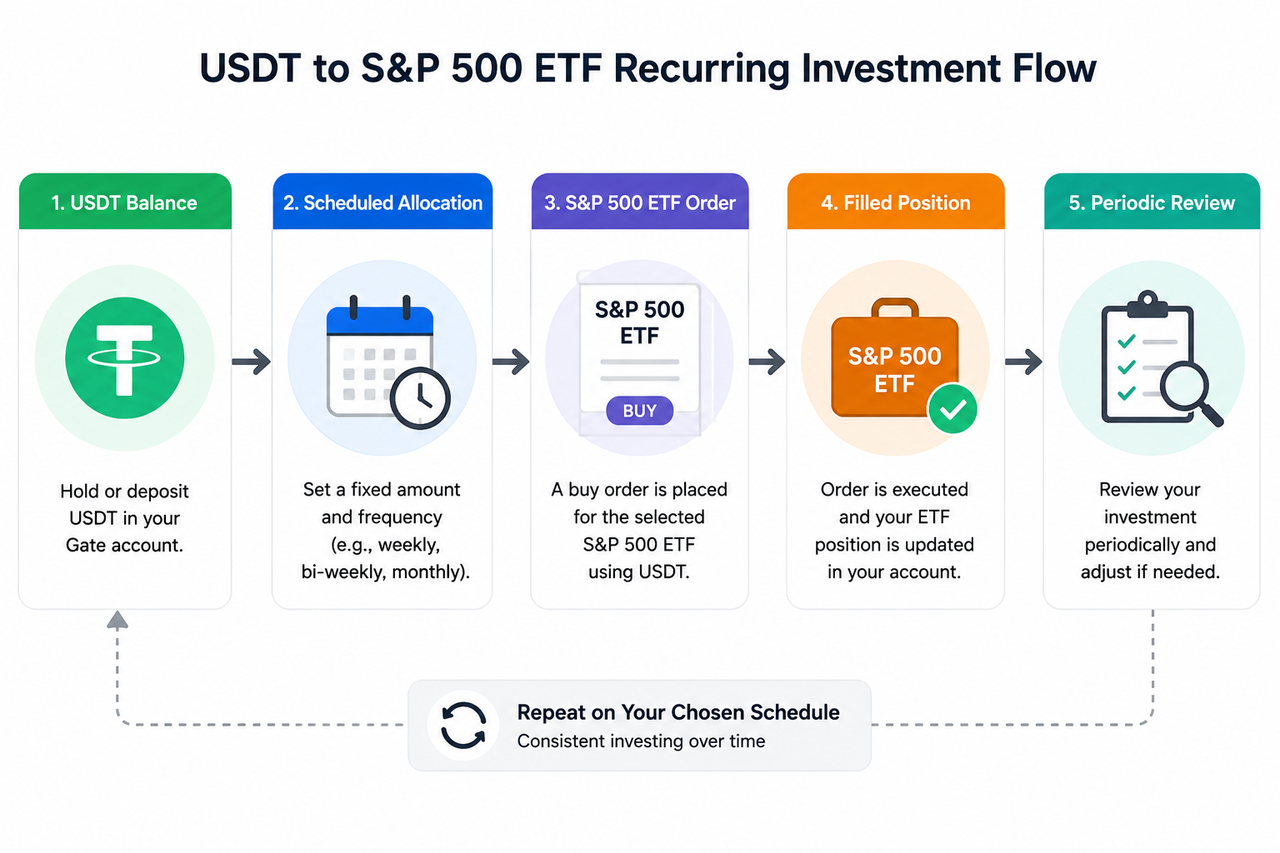
USDT fixed investment in S&P 500 works by combining a stablecoin funding balance, an ETF search and order process, and a recurring schedule managed by the user.
Gate’s stock trading page states that the service supports global stocks and ETFs with USDT, 10,000+ tradable stocks and ETFs, and fractional share access starting from 0.01 shares. It also displays SPY, the State Street SPDR S&P 500 ETF Trust, in its market preview, although users should always confirm real-time availability and product details in the interface before placing any order.
A general workflow may look like this:
-
Complete required account checks and eligibility requirements.
-
Hold or deposit USDT in a supported Gate account.
-
Transfer USDT to the relevant stock account if required.
-
Search for the intended S&P 500 ETF by ticker or name.
-
Enter a purchase amount or supported quantity.
-
Repeat the process according to a chosen schedule.
-
Review position size, risk exposure, fees, and market conditions.
Users comparing product structures may also review how Gate Stocks trading differs from tokenized stocks, CFDs, and futures-based products. Product type matters because ownership, execution, rights, fees, and risk sources can differ.
[Image: User action vs system process in USDT ETF purchase]
Alt text: User and system steps for buying an S&P 500 ETF with USDT on Gate.
Image description: A two-column diagram. The left side shows user actions: prepare USDT, search ETF, choose amount, review order. The right side shows system processes: account transfer, market routing, order execution, position update.
How to Set Up a Regular Investment Strategy with USDT
A regular investment strategy with USDT should begin with a clear schedule, a defined amount, and a review rule rather than a price prediction.
A practical framework includes four decisions. First, choose the ETF target and verify the ticker carefully. Second, define the recurring amount in USDT. Third, choose the interval, such as weekly, biweekly, or monthly. Fourth, decide how often to review the plan, such as every quarter, after major personal financial changes, or when platform rules change.
For users new to the workflow, the operational logic overlaps with buying U.S. stocks with USDT on Gate, including account preparation, USDT funding, asset search, order review, and position monitoring.
A recurring strategy should also include boundaries. A user may define a maximum allocation to equity ETFs, keep a separate liquidity reserve, and avoid placing orders without checking market status, estimated cost, and fee information. Gate’s materials note that U.S. market rules and trading hours affect order execution, so orders may not always execute immediately outside supported sessions.
Advantages of USDT Fixed Investment in S&P 500 ETF Allocation
USDT fixed investment in S&P 500 ETF allocation may offer process-level advantages for eligible users who already hold stablecoins.
The first advantage is gradual market entry. By dividing purchases over time, a user reduces the reliance on a single entry price. This does not guarantee a better result, but it can make the process less dependent on short-term timing.
The second advantage is simplified funding for crypto-native users. Gate’s stock page describes USDT settlement and direct ETF access within the platform, meaning eligible users may not need a separate overseas brokerage flow for supported products.
The third advantage is portfolio visibility. A user who manages crypto assets and ETF positions in one environment may find it easier to monitor overall allocation. However, convenience should not be confused with lower risk.
Users studying asset structure may also compare crypto-based stock trading models with traditional brokerage models, especially around funding paths, account access, and platform rules.
Risks and Limitations of USDT Fixed Investment in S&P 500
USDT fixed investment in S&P 500 carries risks from both the ETF market and the digital asset funding path.
The S&P 500 ETF may decline when U.S. equities fall. Index ETFs reduce single-company concentration, but they do not eliminate market risk. Interest rates, inflation, corporate earnings, liquidity, and macroeconomic shocks can all affect ETF prices.
USDT introduces stablecoin-related risks. Although USDT is designed to track the U.S. dollar, stablecoins may face reserve, liquidity, redemption, counterparty, and regulatory risks. Gate’s USDT stock guide also lists stablecoin risk, platform risk, execution risk, market risk, and regulatory risk as considerations for users buying U.S. stocks with USDT.
Platform rules also matter. Availability may depend on jurisdiction, account status, KYC completion, product support, and current service rules. Gate’s announcement says users must complete KYC and meet accessibility requirements in their jurisdiction before accessing stock trading services.
| Risk type |
What it means |
Practical review point |
| ETF market risk |
S&P 500 ETF prices can rise or fall |
Review allocation size and time horizon |
| Tracking risk |
ETF performance may not perfectly match the index |
Check ETF structure, fees, and issuer information |
| Stablecoin risk |
USDT may face liquidity, reserve, or regulatory issues |
Avoid treating stablecoins as risk-free cash |
| Execution risk |
Orders depend on market hours, spreads, and liquidity |
Review order details before submission |
| Platform and regional risk |
Services vary by region and account eligibility |
Confirm current rules in the interface |
The main limitation is that recurring investment is a discipline tool, not a protection mechanism. It can smooth entry points, but it cannot prevent losses.
Summary
USDT fixed investment in S&P 500 is a recurring ETF allocation method that uses USDT as the funding asset for periodic purchases of an S&P 500 ETF. It connects a crypto-denominated balance with traditional ETF exposure, making it relevant for users who already hold stablecoins and want to understand a structured, recurring approach.
On Gate, supported U.S. stocks and ETFs can be accessed with USDT by eligible users, subject to product availability, KYC, market rules, and regional requirements. Users should distinguish spot stock and ETF access from U.S. stock spot vs futures structures, because leverage, settlement, ownership, and risk profiles may differ.
This content is for educational purposes only and does not constitute investment advice. Digital assets involve market, liquidity, smart contract, platform, execution, and regulatory risks.
FAQs
What is USDT fixed investment in S&P 500?
USDT fixed investment in S&P 500 is a method of using USDT to buy an S&P 500 ETF at regular intervals. It is commonly associated with dollar-cost averaging, where purchases are spread over time instead of concentrated in one transaction.
Is USDT fixed investment in S&P 500 the same as buying the index directly?
USDT fixed investment in S&P 500 usually means buying an ETF that tracks the S&P 500, not buying the index itself. An index is a benchmark, while an ETF is a tradable product designed to follow that benchmark.
Can cryptocurrency fixed investment in ETF products reduce risk?
Cryptocurrency fixed investment in ETF products may reduce reliance on one entry price, but it does not remove market risk. ETF prices can still fall, and USDT-based funding adds stablecoin and platform-related considerations.
Does Gate support ETF purchases with USDT?
Gate states that its stock service supports U.S. stocks and ETFs with USDT, including fractional share access and ETF products. Availability may depend on account status, region, market hours, and current platform rules.
What should be checked before setting up USDT fixed investment in S&P 500?
Users should check ETF ticker accuracy, account eligibility, USDT balance, trading hours, estimated fees, order details, and risk exposure. The plan should also include a review schedule and a clear allocation limit.







