Most public blockchains treat identity as an application-layer patch: wallet addresses remain anonymous, KYC is handled off-chain, and Agent identities are fragmented across contracts on multiple chains. Concordium takes a different path by binding accounts to verified individuals or business entities at the protocol level, then leveraging zero-knowledge proofs (ZKP) to separate “meeting certain conditions” from “disclosing personal information.” This architecture forms a shared foundation for Agent Registry, Verify and Access, and enterprise-grade PayFi scenarios.
From a digital asset perspective, Concordium addresses the question: In an era where Agents and on-chain settlement operate in parallel, how can trust verification be embedded at the protocol layer—while avoiding permanent exposure of sensitive identity data on the ledger?

What Is Concordium? Which Identity and Trust Issues Does It Solve?
Concordium positions itself as “Verified Humans. Verified Agents. One Protocol.”—verified individuals, verified Agents, unified protocol. The challenge isn’t Agent execution, but the lack of a verifiable accountability chain: counterparties cannot confirm whether a real person or entity has authorized an Agent, nor can they perform compliance checks without compromising privacy.
| Pain Point |
Common Status |
Concordium’s Approach |
| Agent can act but is hard to hold accountable |
Agent can trade and sign, but identity is fragmented |
Anchor Agent to a verified Concordium account |
| Compliance and privacy conflict |
KYC data is often centralized on platform databases |
Use ZKP to prove attributes; raw data stays off-chain |
| Fragmented cross-chain Agent identity |
Each chain registers separately, lacks mutual recognition |
Agent Registry supports cross-chain verification signals |
Protocol-level identity and zero-knowledge proof are key to understanding Concordium’s distinction from other public chains: identity is not an optional DApp module, but an integral part of account creation and governance.
How Does Protocol-Level Identity Work? How Does Zero-Knowledge Proof Verify Attributes Without Revealing Data?
Protocol-level identity in Concordium means accounts are linked to real-world entities verified through third-party identity issuance at creation. The blockchain does not store passport numbers, addresses, or other plaintext information; instead, identity objects and cryptographic proofs allow accounts to present evidence of “meeting certain conditions” when necessary.
Zero-knowledge proofs enable selective disclosure. For example, the system can confirm if an account holder is over 18, resides in a specific jurisdiction, or meets certain investment qualifications—without writing supporting documents to the blockchain. Solutions like Verify and Access provide yes/no signals to applications or Agents, while keeping on-chain records minimal.
| Step |
On-Chain Visible Data |
Off-Chain/Proof Layer Data |
| Account creation |
Account address, identity object reference |
KYC/KYB completed by identity issuer |
| Attribute verification |
ZKP verification result (yes/no) |
Original documents and personal information |
| Subsequent interactions |
Transactions, Agent registration records |
Proof generated as needed, not permanently public |
Unlike the traditional “KYC on CEX, then mark address as verified” model, Concordium embeds identity lifecycle into consensus and account models, so any action relying on the account—including Agent registration—naturally carries a traceable authorization source.
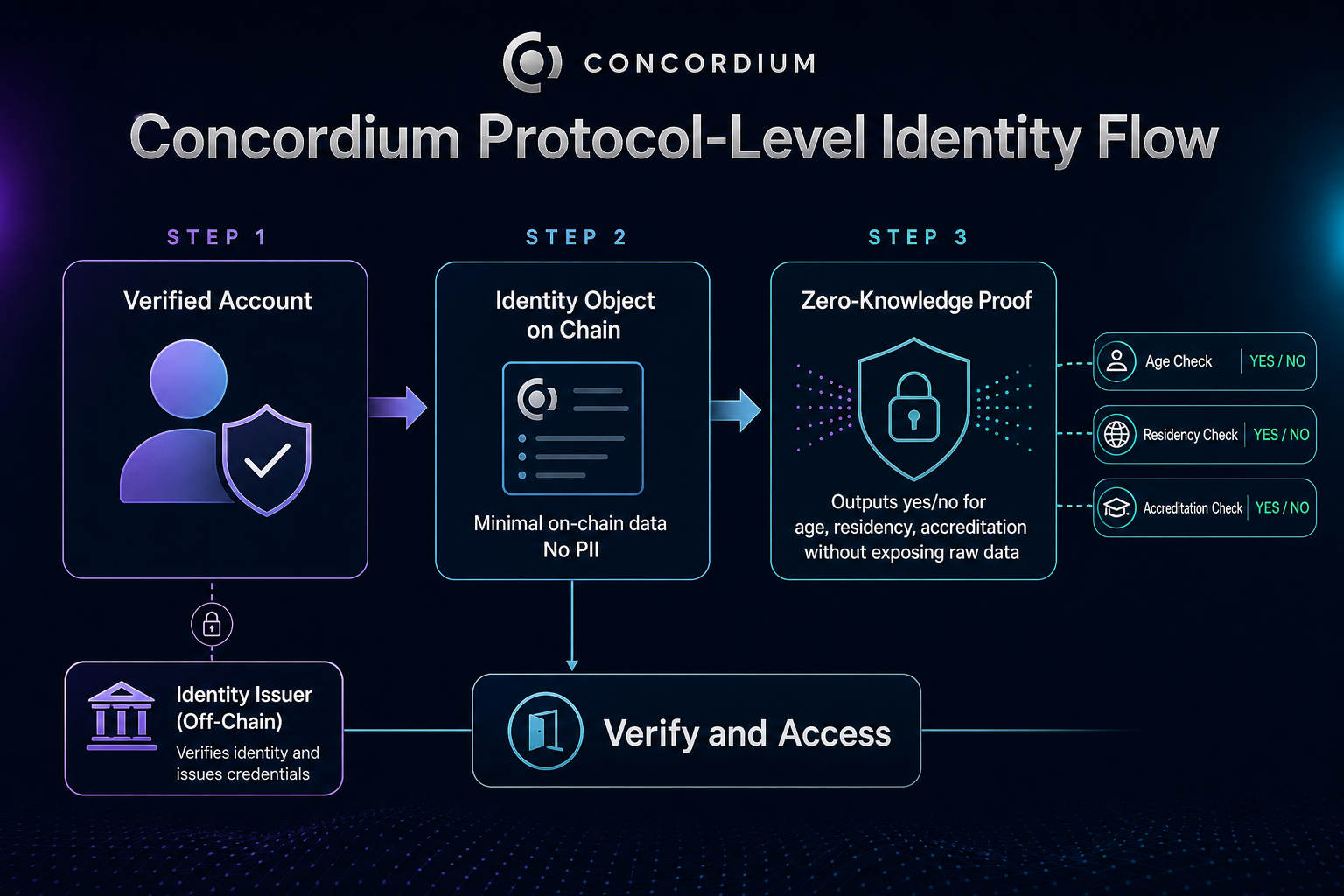 Figure 1. Concordium protocol-level identity flow: relationship between verified accounts, identity objects, and zero-knowledge attribute proofs.
How Is AI Agent Identity Established? What Are Agent Registry and Verified Badge?
As AI Agents become economic actors—calling APIs, initiating payments, signing on-chain transactions—the identity question evolves from “is this a real person” to “who does this Agent represent?” Concordium’s Agent Registry provides each Agent with an on-chain, discoverable, transferable, and verifiable identity anchor, linked to a verified account.
Key components include: CIS-8004 Agent Registry (mints Agents as on-chain NFTs and links Agent Cards), CIS-8 External Key Registry (binds Concordium accounts to external public keys like Ethereum and Solana), and Verified by Concordium Badge (shows counterparties that an Agent is protocol-level verified). The Agent Card is a JSON document describing an Agent’s name, capabilities, and service endpoints, anchored by an on-chain SHA-256 hash for integrity.
Agent Registry registration and verification flow details the end-to-end process from account setup, Agent registration, external key binding, to badge display. For developers, MCP Server exposes Registry operations as tools callable by Agents, streamlining trust checks within Agent frameworks.
Concordium highlights cross-chain Agent identity: Agents on Ethereum, Solana, and other chains don’t need to migrate entirely, but can obtain verification signals and badges through Concordium. This positions Concordium as “identity and accountability infrastructure,” rather than requiring all Agent workloads to run on Concordium.
What Role Does the CCD Token Play in the Network?
CCD is Concordium’s native token, mainly used for three network functions: paying transaction fees, participating in staking and consensus security, and serving as the unit of account and settlement for protocol-level economic activities. Concordium also promotes Protocol-Level Tokens—some token capabilities are built into the protocol, not exclusively dependent on smart contracts.
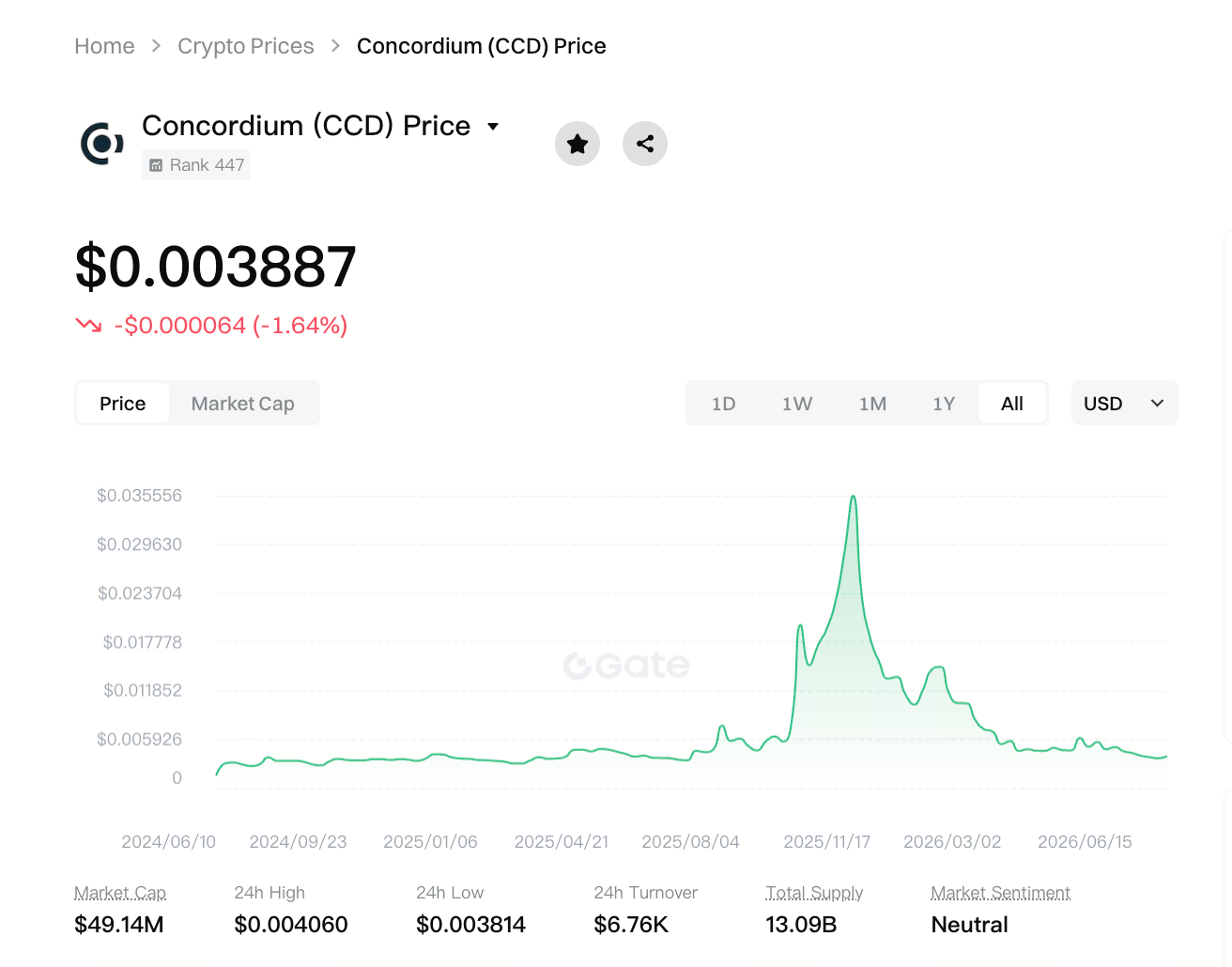
CCD should be seen as the operational and incentive vehicle for network participation, not a standalone investment narrative. Users and developers using Agent Registry, Verify and Access, or PayFi settlement tools may have transaction fees sponsored by operators via mechanisms like Sponsored Transactions, reducing the need for Agents or users to hold CCD. Specific rates and staking parameters follow current network rules; this section does not discuss yield or price.
What Scenarios Is Concordium Suited For? Agent Economy, PayFi, and Compliant Settlement
Concordium’s public use cases fall into four broad categories. First, AI Agent developers and framework teams: adding verifiable identity and badges to Agents, reducing integration costs. Second, enterprises and high-trust industries: in finance, healthcare, legal, etc., requiring spending controls, audit trails, and identity assurance. Third, developers of existing protocols: expanding via cross-chain verification and protocol-level token tools without rewriting the entire stack. Fourth, native crypto protocols: using Verify and Access for streamlined authorization signals.
At the settlement layer, Concordium also mentions x402 (HTTP pay-per-call), Protocol-Level Locks, and Sponsored Transactions to support Agent payments, usage-based billing, and enterprise-grade controlled settlement. Public performance metrics include approximately 1,990 TPS, 2.5-second block time, and instant finality, emphasizing predictable costs and rapid confirmation—ideal for high-frequency Agent interactions.
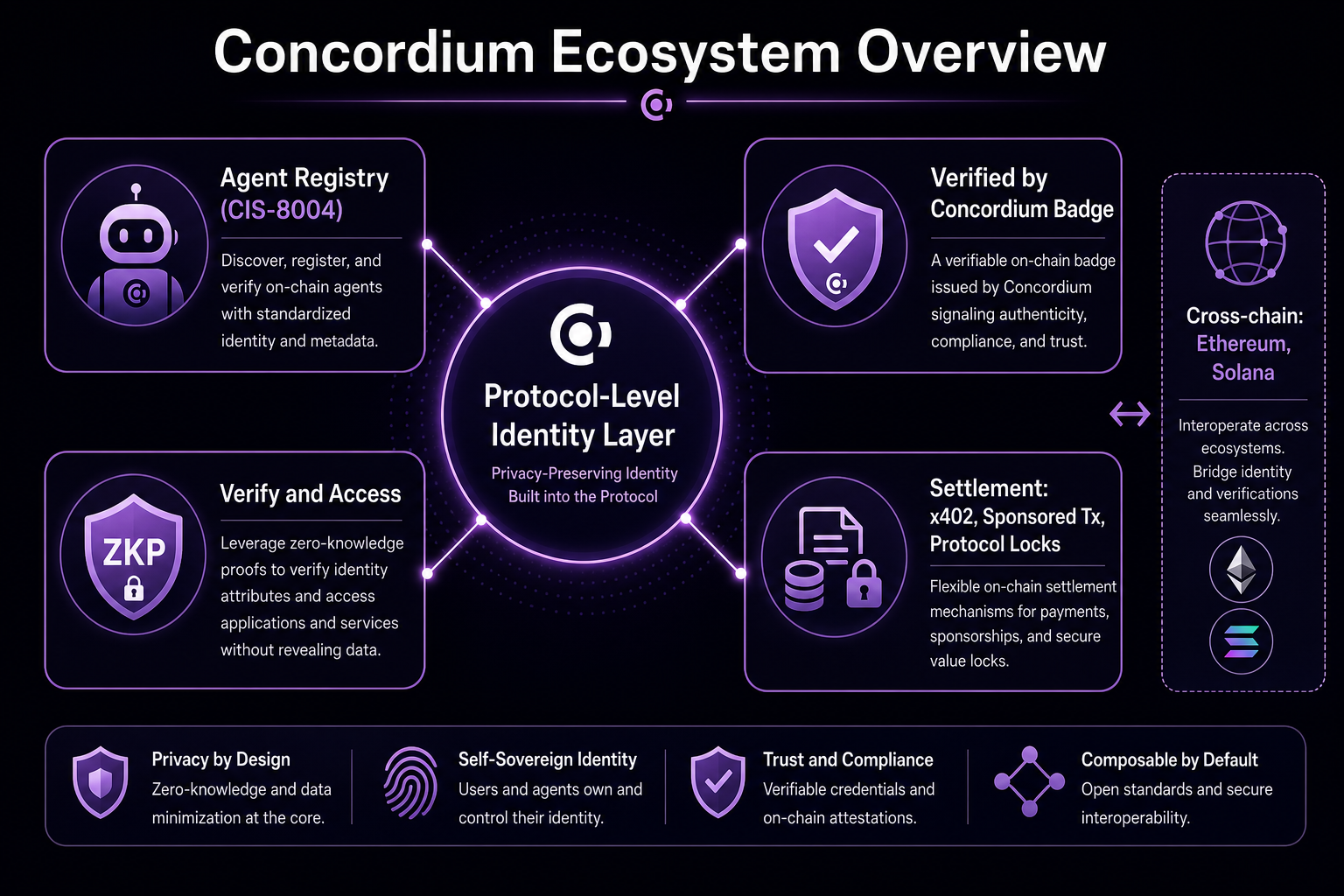 Figure 2. Concordium ecosystem overview: protocol-level identity, Agent Registry, Verify and Access, and settlement tools.
How Is Concordium Different From Worldcoin and Similar Solutions?
Identity solutions follow several parallel paths. World ID and similar approaches focus on proving “this is a unique human”—addressing Sybil and bot risks. Concordium focuses on “who is responsible for an account or Agent’s actions”—addressing accountability and authorization. These approaches answer different questions and may complement each other in the Agent economy.
Concordium’s official FAQ also compares ERC-8004, which defines what an Agent “is,” while Concordium adds “who authorizes and who is responsible” as an accountability layer. The Concordium vs Worldcoin comparison systematically contrasts proof targets, privacy paths, and applicable scenarios.
| Dimension |
World ID Solutions |
Concordium |
| Core Issue |
Is it a unique human? |
Who is responsible for actions? |
| Typical Output |
Proof of humanity |
Verified account + Agent authorization chain |
| Agent Context |
Sybil resistance |
Agent bound to authorizer |
What Are the Advantages and Risks of Using Concordium or Holding CCD?
Advantages include Concordium’s integration of identity, privacy proof, and Agent verification in a unified protocol stack, reducing redundant application-layer development. For enterprise and RegTech scenarios, protocol-level ID and ZKP offer an auditable, privacy-preserving compromise. For Agent developers, Registry and Badge provide interoperable trust signals.
Risks and limitations remain. Identity issuance depends on third-party Identity Issuers, whose coverage and compliance standards affect usability. Cross-chain verification increases integration and learning costs. The Agent Registry ecosystem is still early stage; industry consensus will determine whether badges become a trust standard. CCD, as a native token, carries typical public blockchain risks—network usage, staking unlocks, and market liquidity—which must be distinguished from protocol mechanism risks.
Summary
Concordium’s key distinction lies in protocol-level built-in identity and accountability, extending to Agent Registry, Verify and Access, and PayFi settlement tools. CCD is the network’s native functional token, serving roles in fees and staking. Understanding Concordium requires grasping both “privacy-friendly attribute proof” and “verifiable authorizer behind the Agent.”
FAQ
What Is Concordium (CCD)?
Concordium is a Layer 1 public blockchain that binds accounts to verified individual or entity identities at the protocol level, supporting zero-knowledge proof verification of attributes such as age and residency without exposing raw data. CCD is its native token, used for fees and network participation. The current public narrative also emphasizes its role as verifiable identity and accountability infrastructure for AI Agents.
How Does Concordium Verify Identity?
Concordium accounts are linked to real-world entities via an identity issuance process at creation. On-chain storage includes identity objects and cryptographic references, not plaintext personal information. When an application needs to confirm an attribute, the account holder can generate a zero-knowledge proof, and only the result—whether the condition is met—is revealed.
What Is the Concordium Agent Registry?
Agent Registry is Concordium’s on-chain Agent identity system, based on standards such as CIS-8004, registering Agents as discoverable and verifiable on-chain entities and describing capabilities and endpoints via Agent Card. Registry connects Agents to verified Concordium accounts, allowing counterparties to check the authorizer behind the Agent and recognize them via Verified by Concordium Badge.
How Does Concordium Differ From Worldcoin?
World ID focuses on proving the user is a unique real human, mainly for Sybil resistance. Concordium focuses on proving who is responsible for a given account or Agent’s actions, emphasizing accountability and authorization chains. The former answers “is it a person,” the latter answers “who is responsible,” addressing different trust layers in the Agent economy.
What Is the Purpose of the CCD Token?
CCD is primarily used to pay transaction fees on the Concordium network, participate in staking and consensus security, and serve as the native unit for protocol-level economic activities. In some cases, fees may be paid by third parties through Sponsored Transactions. CCD’s specific mechanism parameters follow public network rules.
What Risks or Limitations Are There in Using Concordium?
Key limitations include: identity issuance depends on third-party providers, coverage varies by region; cross-chain Agent verification requires additional integration; industry adoption of Registry and Badge is still forming. Risks also include typical public blockchain concerns—smart contract, key management, and native token liquidity. Users should distinguish between protocol mechanism risks and application-layer implementation risks before using the platform.







