Bitcoin (BTC) retreated to around $62,000 on July 9, after the U.S. Federal Reserve (Fed) released the minutes of the June 16-17 FOMC meeting. The 12 voting members unanimously approved maintaining the federal funds rate target range at 3.50%-3.75% and officially removed the phrase "accommodative bias" from the statement, directly triggering a sell-off in U.S. stocks.
FOMC June Meeting Minutes Highlights: Interest Rate 3.50%-3.75%, Removal of Accommodative Bias
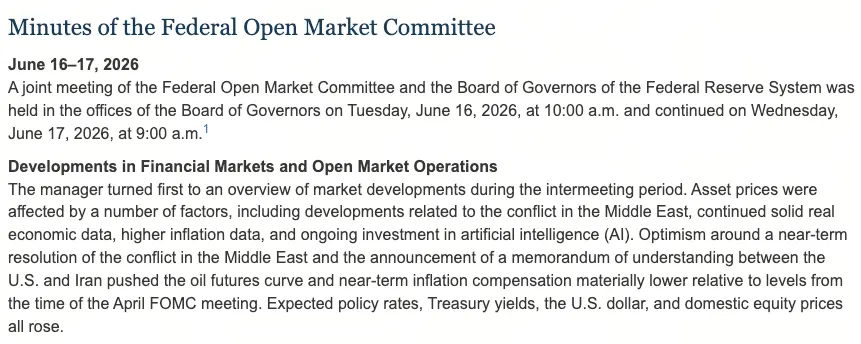 (Source: Federal Reserve website)
According to the June 16-17 FOMC meeting minutes, the main policy decisions and assessments are as follows: the 12 members unanimously agreed to keep rates at 3.50%-3.75% and maintain ample reserves in the banking system; the post-meeting statement officially removed the previous language hinting at an "accommodative bias," instead stating "they will strive to achieve price stability."
Members pointed out three major inflation drivers:
Middle East Conflict: especially the Strait of Hormuz crisis impacting energy supply
Tariff Policies: leading to higher import costs passed on to consumer prices
AI Investment Boom: driving strong private final demand, increasing supply-demand imbalance
Members also emphasized that the "upside risks to inflation remain high," and if inflation remains elevated long-term, it could alter corporate wage-setting and pricing behaviors.
PCE Inflation Data and Rate Hike Scenarios: 3.8% in April, Market Pricing Rate Hike in 2027
Based on the inflation data revealed in the FOMC minutes, the April PCE year-over-year increase was 3.8%, with core PCE at 3.3%; estimates for May worsened, with the total index projected to rise to 4.1% and core to 3.4%, both well above the Fed’s 2% long-term inflation target.
Policy outlook shows divided estimates: most believe that if inflation eases smoothly, rates could stay steady or be cut; however, the minutes clearly state that if inflation remains high due to AI demand, Middle East conflicts, or tariffs, the Fed "may need to restart rate hikes."
Market pricing data from the minutes indicates that the market has begun to price in a possible rate hike once in mid-2027.
Middle East Conflict Escalates: Trump Says U.S.-Iran Ceasefire "Has Ended," Oil Prices Rise, Stocks Sell Off
On July 8, 2026, Trump stated at the NATO Ankara Summit press conference that the U.S.-Iran ceasefire "has ended," and he may launch strikes against Iran again that evening; Trump called Iran "scum" and characterized continued dealings with Iran as "a waste of time."
The U.S. Central Command announced that U.S. forces previously struck over 80 Iranian targets, including air defense systems, command and control networks, radar sites, anti-ship missile capabilities, and small vessels, following attacks on three commercial ships passing through the Strait of Hormuz. These events quickly pushed up international oil prices, triggered a sell-off in U.S. stocks, strengthened the dollar, and caused gold to fall, prompting investors to reassess risks of supply disruptions through the Strait of Hormuz and global inflation rebound.
Frequently Asked Questions
What hawkish signals did the Fed send in the June FOMC minutes?
According to the June minutes, the Fed took three hawkish actions: a unanimous 12-0 vote to keep rates at 3.50%-3.75%; officially removed the "accommodative bias" language; and explicitly stated that if inflation persists, "rate hikes may need to be resumed." The market has begun pricing in a possible rate hike once in mid-2027; the specific policy path will depend on subsequent Fed meetings.
What is the latest level of U.S. inflation data?
Based on the FOMC minutes, April’s PCE year-over-year increase was 3.8%, with core PCE at 3.3%; estimates for May rose further, with total PCE projected at 4.1% and core at 3.4%, both well above the Fed’s 2% target. The three main inflation sources are identified as Middle East conflicts (energy supply shocks), rising tariffs, and AI investment demand.
How does the Middle East conflict impact the market, and will it worsen inflation?
Reports indicate that U.S. strikes on Iranian targets, along with Trump’s declaration that the U.S.-Iran ceasefire "has ended," caused oil prices to rise and U.S. stocks to sell off. The Strait of Hormuz is a critical global energy transit route, and the FOMC minutes explicitly list Middle East conflicts as one of the main "upside risks" to current inflation. Market trends in oil and other assets will depend on real-time data.


