A nearly 7% single-day rally is not common for an asset-management giant on the “hundred billion” scale like BlackRock. What is the market pricing in? The answer points to BlackRock’s 2026 Q2 earnings report released before the July 15 open—a set of comprehensive numbers that beat expectations, and a business story being reshaped: BlackRock is no longer just an asset manager, but a provider of infrastructure for global capital markets. From five dimensions—earnings fundamentals, ETF business growth, the strategic value of spot Bitcoin ETFs, RWA tokenization plans, and the macro environment—here’s the logic chain behind the sharp surge in BlackRock’s share price.
Earnings Beat: $15.3 trillion AUM and Broadly Exceeding Performance
On July 15, BlackRock released its 2026 second-quarter earnings report, with core figures coming in across the board above market expectations.
Assets under management (AUM) reached a record $15.3 trillion, up 22% from the same period last year and up 10.4% quarter over quarter from $13.89 trillion. Since the start of 2026, AUM has increased by more than $1 trillion.
On the profitability side, adjusted EPS was $13.91, far above the consensus analyst expectation of $12.57. Revenue was $7.08 billion, up 31% year over year, also beating the market expectation of $6.72 billion. Adjusted operating income grew 39% to $2.92 billion. Adjusted operating margin expanded from 43.3% in the year-ago quarter to 45.9%, the highest level in nearly five years.
In terms of capital flows, second-quarter net inflows from clients totaled $192 billion, far exceeding $68 billion in the same period last year and $130 billion in the first quarter. Net inflows over the past 12 months totaled $868 billion, and organic base management fees grew 10% year over year. Net inflows for the first half totaled $321 billion, setting a historical record.
BlackRock also announced that its 2026 share repurchase program would be increased from $1.8 billion to $2.0 billion, and it repurchased $450 million worth of shares in the second quarter. CEO Larry Fink said in the earnings statement: “Market fundamentals are solid and support is sufficient, with new technologies improving profit margins and earnings momentum. Our growth momentum is accelerating, and I’ve never been as optimistic about future growth.”
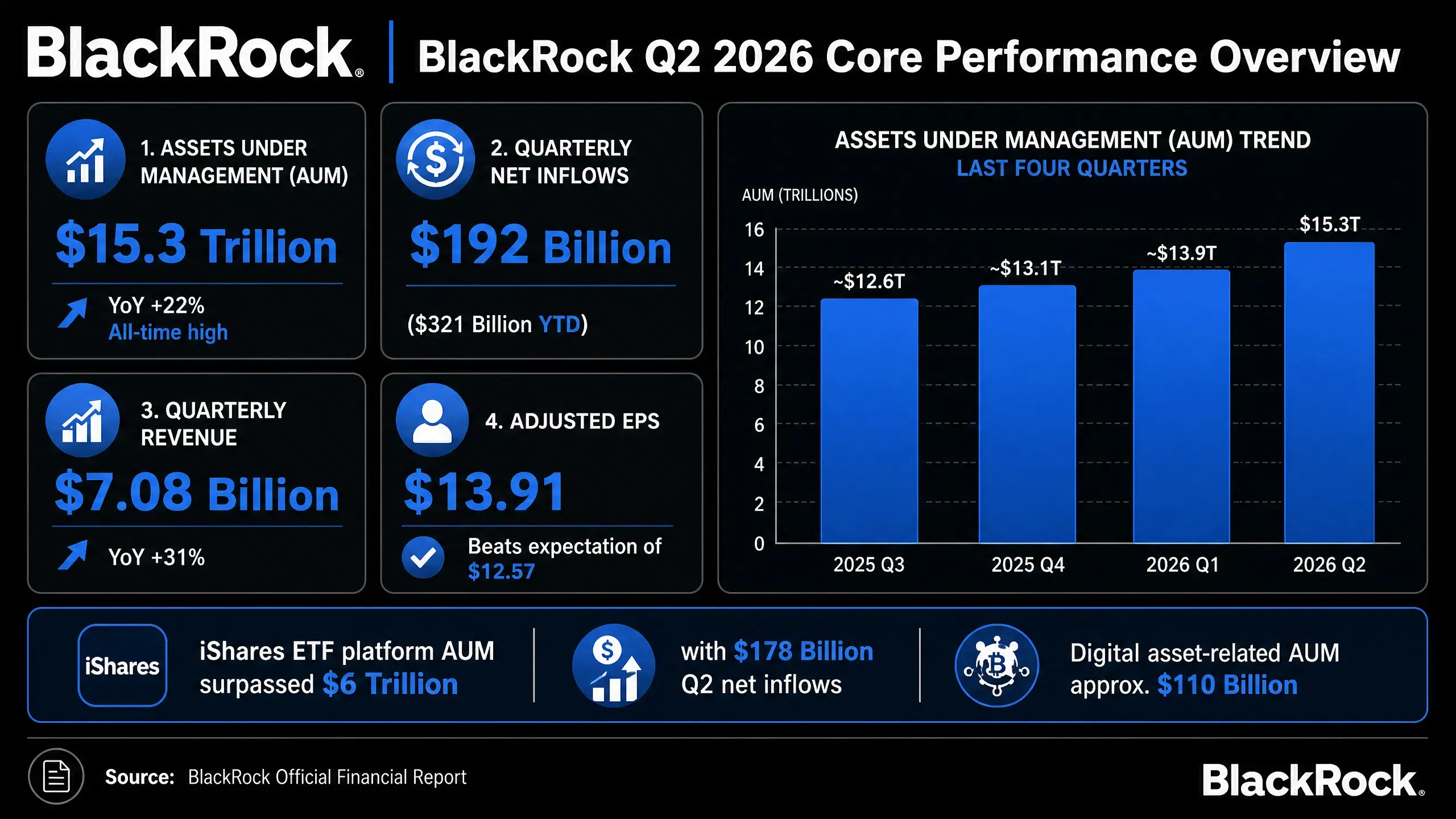
BlackRock 2026 Q2 core performance snapshot
ETF Business: $178 billion of Quarterly Net Inflows and iShares’ Dominance
In recent years, BlackRock’s growth logic has shifted from traditional active asset management to ETFs, index funds, and alternative assets. In the second quarter, the iShares ETF platform generated $178 billion in net inflows, accounting for the overwhelming majority of total net inflows for the quarter.
More specifically, core equity ETFs saw net inflows of $85 billion, and index bond ETFs recorded net inflows of $61 billion. Fixed-income strategies attracted $92 billion in net inflows that quarter, while equity products contributed $71.6 billion. Long-term investment products recorded net inflows of $199 billion, exceeding the $170 billion average analyst expectation from a Bloomberg survey.
The market is repricing BlackRock’s valuation logic. It is no longer merely a passive asset manager dependent on market up-and-down moves, but rather infrastructure for the flow of global capital—from retail to institutions, from equities to bonds, from traditional assets to digital assets—where money enters global markets through BlackRock’s ETF pipeline. This “pipeline” business model offers higher income predictability and lower marginal costs, which is the core logic behind analysts’ average BLK target price of $1,274 and 14 out of 17 analysts recommending “Buy.”
Spot Bitcoin ETFs: From “Alternative Assets” to Institutional Allocation Tools
Spot Bitcoin ETFs are the most closely watched part of BlackRock’s digital asset strategy.
As of July 16, 2026, BlackRock’s iShares Bitcoin Trust (IBIT) currently holds about 720,000 BTC, with assets under management of about $60 billion. Although, since 2026 began, spot Bitcoin ETF assets overall have seen net outflows of roughly $5.5 billion and total AUM is about $74 billion, IBIT still maintains a leading position in the market.
The strategic significance of Bitcoin ETFs lies in how they change the way institutional investors gain Bitcoin exposure. In the past, investors had to manage wallets and private keys themselves, facing complex issues such as custody security and tax compliance. Now, institutions can buy IBIT directly through traditional brokerage accounts to obtain Bitcoin price exposure using familiar ETF structures. This means Bitcoin is shifting from an “alternative asset” toward an “institutional asset allocation tool.”
During the earnings call for the second quarter, BlackRock CFO Martin Small disclosed that the company’s digital asset AUM fell to $49 billion, down about 40% from a year earlier, mainly dragged by BTC and ETH price pullbacks. However, BlackRock reiterated its 2030 revenue target for crypto-related business of $500 million. This stance of “price declines, but strategy unchanged” signals management’s confidence in the long-term value of digital assets.
RWA Tokenization: BUIDL and the Next Growth Curve
From ETFs to on-chain assets, BlackRock is building the next-generation infrastructure for asset management—RWA (real-world assets) tokenization.
BlackRock USD Institutional Digital Liquidity Fund (BUIDL) is the core vehicle for this strategy. As of July 14, 2026, BUIDL’s on-chain AUM was about $2.93 billion, continuously setting new historical highs. BUIDL has been deployed on multiple public chains including Ethereum, Avalanche, and Solana. Tokenization issuance is handled by Securitize, and BNY Mellon provides custody. On Ethereum, the locked-in value exceeds $1 billion. On Avalanche, assets doubled week-on-week in July to about $900 million. On Solana, on-chain size exceeds $550 million.
BUIDL mainly invests in U.S. Treasuries, repurchase agreements, and cash equivalents, maintains a net asset value of $1 per share, and offers an annualized yield of about 3% to 5%. In 2026, Moody’s rated BUIDL’s AUM of $2.58 billion as AAA-mf, its highest rating for tokenized money market products.
BUIDL’s expansion is becoming an important case of the integration of traditional finance and blockchain. As more DeFi protocols use BUIDL as collateral and liquidity assets, its use cases are extending beyond institutional cash management to on-chain financial infrastructure. As of April 2026, the total value of tokenized RWA worldwide has surpassed $29 billion, including tokenized U.S. Treasuries rising from about $380 million in 2023 to $13.4 billion. BlackRock holds an early-mover advantage in this rapidly expanding market.
Macro Environment: A Double Boost from Cooling Inflation and Rate-Cut Expectations
BlackRock’s stock rise is not an isolated event; the macro backdrop provides important support.
Data released on July 15 showed that U.S. June CPI declined 0.4% month over month, the first time it has recorded negative month-over-month growth since 2020. June PPI fell 0.3% month over month as well, also below market expectations. The sustained cooling of inflation significantly reduced market concerns about the Fed raising rates.
Based on CME “FedWatch” data, the probability that the Fed will hold rates steady in July is 88.8%. The probability of cumulative rate hikes totaling 25 basis points is only 11.2%. New York Fed President John Williams said inflation may have already peaked and that monetary policy is currently at an appropriate level. White House economic adviser Hassett was even more direct, saying “there is really no reason to raise rates now,” and expected that if the data trend continues, the Fed would “think in reverse,” meaning it would cut rates.
A fall in interest rates means lower funding costs, higher equity valuations, and a reset in the pricing of growth assets. As the world’s largest asset manager, BlackRock directly benefits from AUM expansion and growth in performance-fee income driven by the rise in risk assets. In the second quarter, the S&P 500 rose 15%, which is one of the key forces behind BlackRock’s AUM growth.
In addition, in its 2026 mid-year global investment outlook, BlackRock proposed an investment theme of “AI scarcity,” arguing that AI investment is moving from large language models toward “embodied AI,” and advising investors to focus on supply-chain bottlenecks such as power, chips, and data centers. As a key driver of AI infrastructure investment, BlackRock also benefits from increased market activity and capital inflows brought by the AI investment wave.
Risk Factors
Although BlackRock’s growth logic is clear, it still faces multiple uncertainties.
ETF fund flows may slow down. Since the start of 2026, spot Bitcoin ETF aggregate net outflows are about $5.5 billion. If BTC prices continue to churn or if institutional risk appetite declines, IBIT’s inflow pace may slow further, directly affecting digital-asset-related revenue.
Interest-rate environment still has uncertainties. Even though inflation data has cooled recently, factors such as geopolitical conflicts in the Middle East could drive a rebound in energy prices. If inflation heats up again and the Fed keeps rates high, it would suppress equity valuations and demand for alternative assets.
Digital asset regulatory changes. U.S. crypto regulatory policy, stablecoin regulations, and RWA regulatory frameworks are still evolving. Although countries like Japan are pushing forward with crypto ETF frameworks, the SEC’s regulatory stance in the U.S. remains uncertain, which could affect the pace of expansion of BlackRock’s digital asset business.
Liquidity risk in private markets. In recent years, BlackRock has spent about $28 billion to acquire Global Infrastructure Partners, HPS Investment Partners, and Preqin to expand its private markets business. Its non-traded private credit fund HLEND faced redemption requests accounting for 13.3% of shares in the second quarter. The company met only the standard quarterly redemption cap of 5%. This event highlights potential risks from liquidity mismatches in private markets.
Conclusion
BlackRock’s stock gained 6.63% in a single day to $1,093.40, driven by multiple factors working together: an earnings report that beat expectations, strong ETF business growth, continued inflows into spot Bitcoin ETFs, market recognition of its RWA tokenization rollout, and improvements in the macro environment.
From $15.3 trillion in AUM to $178 billion in quarterly ETF net inflows, to $293 million in on-chain assets for BUIDL—these figures jointly depict a company evolving from an “asset management firm” into “infrastructure for global capital markets.” As CEO Larry Fink put it: “The more customers we help participate in the market, the stronger our own growth momentum becomes.”
For investors, BlackRock’s value re-rating is fundamentally a repricing of its “asset pipeline” business model. ETFs provide scale and efficiency; Bitcoin ETFs open a new track for digital assets; and RWA tokenization points to the next stop in asset management. Of course, this growth path is not without obstacles—volatile fund flows, regulatory uncertainty, and liquidity risk in private markets are all variables that need ongoing attention.
FAQ
Q1: Why did BlackRock’s stock jump 6.63% on July 16?
The direct catalyst was the broadly above-consensus 2026 Q2 earnings report released on July 15: AUM reached $15.3 trillion, a record high; EPS was $13.91, far above the expected $12.57; revenue rose 31% year over year to $7.08 billion; and Q2 net inflows were $192 billion. The company also increased its 2026 share repurchase authorization to $2.0 billion.
Q2: How large is BlackRock’s Bitcoin ETF IBIT currently?
As of July 16, 2026, IBIT currently holds about 720,000 BTC, with AUM of about $60 billion.
Q3: What is BlackRock rolling out in the RWA tokenization space?
BlackRock’s core RWA product is the BUIDL fund. As of July 14, 2026, its on-chain AUM reached $293 million. The fund invests in U.S. Treasuries and repurchase agreements, has been deployed on multiple public chains including Ethereum, Avalanche, and Solana, and received Moody’s AAA-mf—the highest rating.
Q4: What ratings and target prices do analysts have for BLK stock?
Based on a survey of 17 analysts by S&P Global, BLK has a consensus rating of “Buy” with an average target price of $1,274. Morgan Stanley set a $1,383 target and maintained a “Overweight” rating, and Barclays raised its target price to $1,340.
Q5: What are BlackRock’s main risks?
Key risks include: ETF fund flows could slow due to market volatility; inflation resurfacing could lead the Fed to keep high rates and pressure asset valuations; U.S. crypto regulatory policies remain uncertain; and there is liquidity-mismatch risk in private markets business—its HLEND fund is currently facing redemption pressure.