
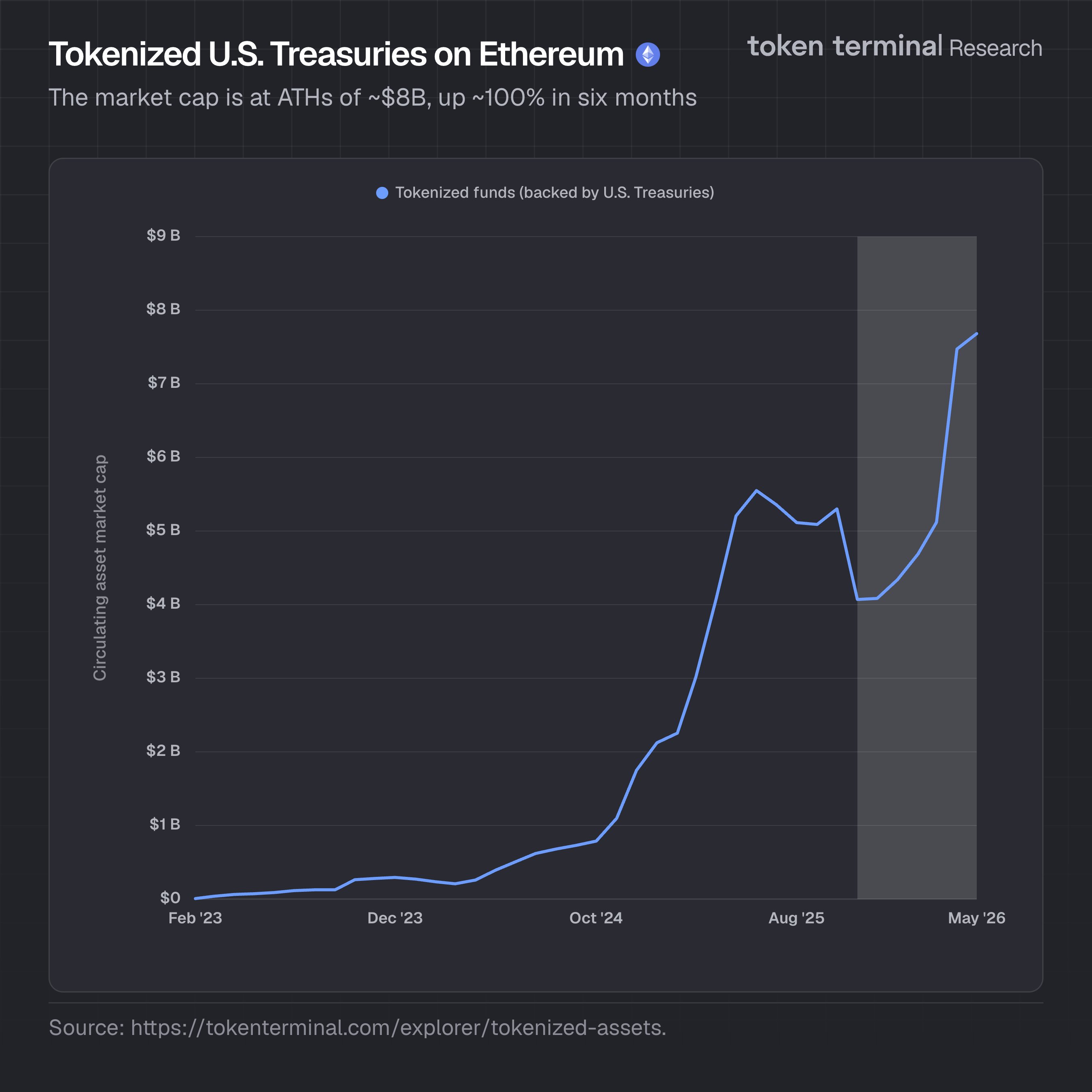
Token Terminal published data on X on May 6 showing that the total market value of tokenized U.S. Treasuries deployed on Ethereum has risen to about $8 billion, reaching a historical high; over the past six months, it has grown by about 100%. On the same day, Ethereum co-founder Joseph Lubin said at Consensus Miami 2026 in Miami that global economic tokenization is now inevitable.
Tokenized U.S. Treasuries Market Value Data and Key Protocols
(Source: Token Terminal)
According to data published by Token Terminal on X on May 6, the market value of tokenized U.S. Treasuries on Ethereum reached about $8 billion, a historical high, and grew by about 100% over the past six months. Key contributing protocols include: BUIDL (Securitize), JTRSY (Centrifuge), iBENJI (Franklin Templeton), WTGXX (WisdomTree), USDY (Ondo Finance), and USTB (Superstate).
Joseph Lubin’s Remarks at Consensus Miami 2026
According to coverage of Consensus Miami 2026, Joseph Lubin said on Tuesday during a fireside chat with The Rollup founder Robbie Klages: “We are entering a world where basically the entire economy will be tokenized.” He also said, “We’re now mature enough to attract traditional financial institutions and regulators.”
Based on Lubin’s remarks at the conference, Ethereum’s early design allowed anyone to issue tokens without building a new blockchain from scratch, giving it a structural advantage as traditional financial institutions move toward putting stablecoins, treasuries, and other real-world assets on-chain.
In his talk, Lubin described ETH as a “trust asset,” and said that overall activity across the Ethereum ecosystem (including Layer 2 networks) consumes ETH: “Every one of these different networks’ transactions will consume Ether.” He also introduced that modular, composable technology is designed to allow transactions across multiple networks to be executed within a shared system.
Lubin said that recent turmoil in the decentralized finance space reflects that this technology is still developing, and that the ecosystem is strengthening through collaboration.
Frequently Asked Questions
When did Token Terminal publish Ethereum tokenized Treasuries data? What was the growth rate?
According to data published by Token Terminal on X on May 6, 2026, the market value of Ethereum tokenized U.S. Treasuries reached about $8 billion, a historical high, and grew by about 100% over the past six months. Key contributing protocols include BUIDL (Securitize), iBENJI (Franklin Templeton), and USDY (Ondo Finance), among others.
What core statements did Joseph Lubin make at Consensus Miami 2026?
According to coverage of Consensus Miami 2026, during a fireside chat in Miami on Tuesday, Lubin said that global tokenization has moved from the experimental stage to an inevitable stage; Ethereum is mature enough to attract traditional financial institutions and regulators; and Layer 2 networks and modular composability technologies further expand the ecosystem’s capacity.
How does Lubin describe ETH’s role in the tokenized ecosystem?
According to coverage of Consensus Miami 2026, Lubin described ETH as a “trust asset,” noting that activity across all networks in the Ethereum ecosystem consumes ETH, including transactions on Layer 2 networks.


