On July 22, 2026, U.S. Senate Republicans formally released the latest revised version of the CLARITY Act (the Digital Assets Market Structure Act). This 616-page draft, for the first time at the federal legislative level, explicitly bans the President, Vice President, members of Congress, federal judges, and other senior public officials—and their spouses—from issuing or sponsoring digital assets for profit during their terms in office. This is the first time in U.S. legislative history that clear red lines have been drawn for a president’s involvement in crypto activities.
The timing of this legislative move is worth noting. Just weeks earlier, U.S. President Trump’s 2025 financial disclosure filings showed he earned roughly $1.2 billion to $1.4 billion in revenue from crypto-related businesses. Critics say that, on the one hand, the President pushes policies favorable to the crypto industry, while on the other, his family businesses reap massive income from them—blurring the line between public power and private interests. The release of the new draft is a direct institutional response to this controversy.
Why the new draft is coming out now
The legislative process for the CLARITY Act has taken more than a year. On July 17, 2025, the bill passed the U.S. House with a high vote of 294 in favor and 134 against, winning cross-party support from 78 Democratic members. On May 14, 2026, the Senate Banking Committee advanced the bill by a vote of 15 to 9. However, the bill then stalled during the full Senate vote stage, with the core dispute being ethical rules for digital asset activity by public officials.
The release of the new draft signals that Republicans’ core bottom line on crypto policy is now clearly defined. The ethics provision was negotiated with the White House and Republican Senators such as Cynthia Lummis, but it has not yet received formal recognition from Democrats. As Congress’s August recess period approaches (August 7 is a hard deadline), the legislative window is rapidly narrowing.
Who does the new draft’s core ban cover?
The ethical framework established by the new draft has a fairly broad scope. The restricted “public officials or employees” include the President, Vice President, members of Congress, federal judges, and other senior government officials—and their spouses are also included within the restrictions. The bill does not create a new definition; it instead adopts the existing federal ethics definitions.
During their terms in office, covered individuals are prohibited from “issuing or sponsoring digital assets for compensation.” The bill’s definition of “issuance” includes creating, minting, launching, or controlling the initial sale or distribution of a digital asset. The definition of “sponsor” is even broader: providing funding for a token, organizing it, or publicly endorsing it all fall under this category, including the use of a person’s name, likeness, or official position in related creation or promotion.
Notably, this is not a complete ban on holding cryptocurrencies. The bill explicitly allows regulated individuals to continue holding digital assets as investments, but they must comply with existing disclosure and conflict-of-interest requirements. Also, sales of crypto assets worth more than $1,000 must be disclosed.
Why the ban includes a sunset clause
One of the most controversial designs in the new draft is the “sunset clause” attached to the moral prohibition—these restrictions automatically expire at noon on January 20, 2029. That date happens to coincide with the end of Trump’s second term.
This temporary setup has triggered strong criticism from Democrats. On July 22, seven Democratic senators issued a joint statement opposing the bill’s current text, saying the draft falls short in areas including “ethics rules for elected officials, consumer protection, illegal finance, conflicts of interest, and market integrity.” Democrats argue that the restriction is “temporary” and not durable—set to expire in 2029 rather than being a permanent institutional arrangement.
Another core dispute is enforcement authority. The new draft assigns enforcement power to the U.S. Department of Justice, rather than to state attorneys general. Democrats insist that state attorneys general should have the authority to enforce ethics limits on federal officials, while Republicans argue that the Attorney General, as the top enforcement authority, should lead. This disagreement is a major obstacle to bipartisan negotiations.
How the new draft reshapes the stablecoin yield landscape
Beyond the ethics provisions, the stablecoin yield provisions are also a far-reaching component of the new draft. The bill bans paying interest or rewards on idle payment stablecoin balances, but allows rewards tied to actual activities such as trading or staking.
The industry impact of this provision should not be underestimated. Currently, interest-bearing USDC and USDT products are key sources of underlying yield for a large number of DeFi and CeFi protocols. Once the ban takes effect, business models built on “earning interest by holding” would face structural contraction in returns.
Banking industry reactions to this provision are also worth watching. The American Bankers Association and 76 state banking organizations jointly pressured the Senate, estimating that if this provision is not tightened, bank deposits could flow out by $1.3 trillion. Crypto companies counter that banning third parties from paying interest on stablecoins would constitute anti-competitive conduct. This is a battle between traditional banking and the crypto industry over where trillions in capital flow.
What protections do non-custodial developers and customer assets receive?
While strengthening regulation, the new draft also includes protective provisions for specific groups in the industry. The bill fully preserves the core spirit of the Blockchain Regulatory Certainty Act (BRCA), explicitly stating that non-custodial software developers and blockchain infrastructure providers will not be viewed as money transmitters merely for maintaining decentralized networks. In addition, the Keep Your Coins Act is fully incorporated, safeguarding individuals’ absolute right to self-custody crypto assets.
In protecting customer assets, the bill requires that when a trading platform or custodian goes bankrupt, customer assets be more strictly segregated to ensure they do not become part of the bankruptcy estate. This provision directly responds to the painful lesson from past collapses of trading platforms, where customer funds and company assets became mixed.
Additionally, the new draft adds a chapter targeting enforcement against cryptocurrency-related crimes, increasing funding support for investigations by states and localities, and requiring stablecoin issuers to freeze, seize, destroy, or reissue tokens in accordance with the law. The bill also extends the anti–money laundering requirements of the Bank Secrecy Act to digital asset brokers, dealers, and exchanges.
How likely is the new draft to pass?
Data from prediction market Polymarket shows the probability that the CLARITY Act becomes law by the end of 2026 has fallen from the 82% high reached on February 19 this year to around 42%. Former CFTC Chair Christopher Giancarlo said at the Eastern Economic Summit that the odds of passage are lower than 50%.
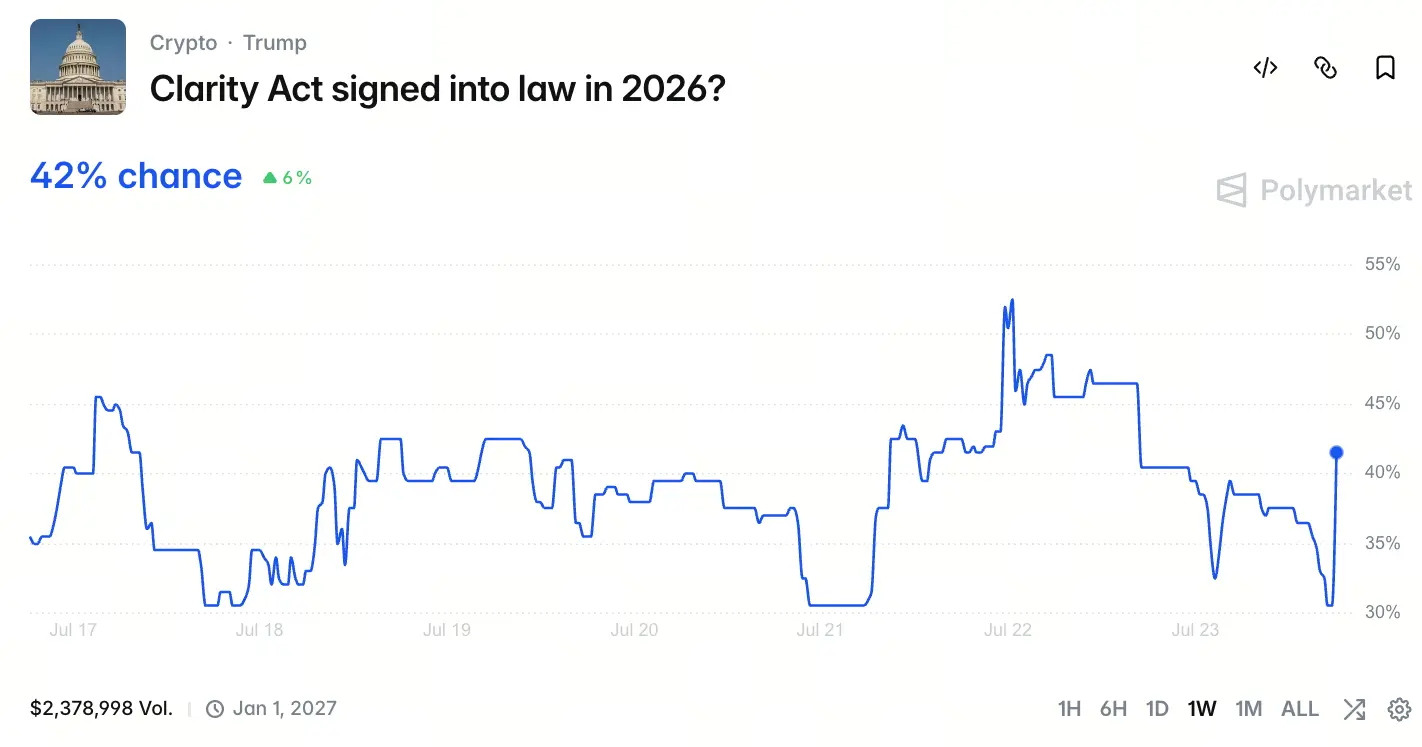
The legislative reality challenge lies in votes. Republicans in the Senate hold only 53 seats. The bill needs 60 votes to break through a protracted debate. Two Democratic senators, Gallego and Alsobrooks, who supported the bill in the Banking Committee vote, have publicly signed statements opposing the current text—meaning Republicans will still need to win at least 8 Democratic votes. The death of Senator Lindsey Graham and Mitch McConnell’s absence due to illness further weaken Republicans’ practical vote advantage.
Time is also a harsh variable. With the Senate recess on August 7, there is less than two weeks left for legislation. If the bill fails to pass before the August recess, the next legislative window may have to wait until 2027, when the factor of midterm elections would further increase the difficulty of getting both parties to reach an agreement.
How the new draft would affect the digital asset industry landscape
Whether or not the bill ultimately passes in 2026, the release of the new draft itself has already sent a clear signal: America is trying to build a more clearly defined regulatory framework for digital assets. The bill’s core goal is to draw a clear line between “securities” regulated by the SEC and “commodities” regulated by the CFTC based on the degree of decentralization of digital asset networks.
From an industry impact perspective, the new draft would hit the “political token” track most directly. Once a ban on presidents issuing tokens takes effect, pathways for public officials to issue digital assets using their influence in office would be completely blocked. Crypto trading platforms would also be barred from listing assets issued or sponsored by covered federal officials.
From a broader perspective, institutions such as a16z Crypto have continued pushing for the CLARITY Act, arguing that it removes barriers to entry and provides traditional finance with a clear compliance path to participate. Improved regulatory clarity could clear obstacles for institutional capital to enter, while provisions such as the stablecoin yield ban may reshape the underlying logic of certain business models.
In the short term, legislative uncertainty itself is a market risk. But in the long run, a thoroughly negotiated bill that balances regulatory strength with industry protections may have more institutional staying power than legislation rushed through.
Frequently Asked Questions (FAQ)
Q: Who does the CLARITY Act new draft prohibit from issuing digital assets?
A: The new draft prohibits the President, Vice President, members of Congress, federal judges, and other senior public officials—and their spouses—from issuing or sponsoring digital assets for profit during their terms in office.
Q: Is this ban permanent?
A: No. The ban includes a sunset clause and will automatically expire at noon on January 20, 2029.
Q: Does the new draft prohibit officials from holding cryptocurrencies?
A: No. The bill explicitly allows regulated individuals to continue holding digital assets as investments, but they must comply with existing disclosure and conflict-of-interest requirements.
Q: What does the new draft say about stablecoin yields?
A: The bill bans paying interest or rewards on idle payment stablecoin balances, but allows rewards tied to real activities such as trading or staking.
Q: What protections does the new draft provide for non-custodial developers?
A: The bill clearly states that non-custodial software developers and blockchain infrastructure providers will not be considered money transmitters merely for maintaining decentralized networks.
Q: How likely is it that the bill passes in 2026?
A: Prediction market Polymarket shows a passage probability of about 42%. Former CFTC Chair Giancarlo believes the odds are below 50%. The bill must gain 60 votes in the Senate before the August 7 recess.


