In late May, the international crude oil market saw a round of sharp price fluctuations. As of May 28, Gate market data showed WTI crude oil was temporarily quoted at $91 per barrel. Earlier, oil prices that had been pushed up by a Middle East geopolitical conflict quickly fell back on the back of news related to US-Iran negotiations. Market expectations for the Strait of Hormuz’ navigation outlook are rapidly adjusting, and a new round of price games is already underway.
In a highly uncertain environment, how to systematically parse the core variables affecting WTI crude oil prices has become key to understanding the direction of the market.
How prediction markets price WTI’s May price trend
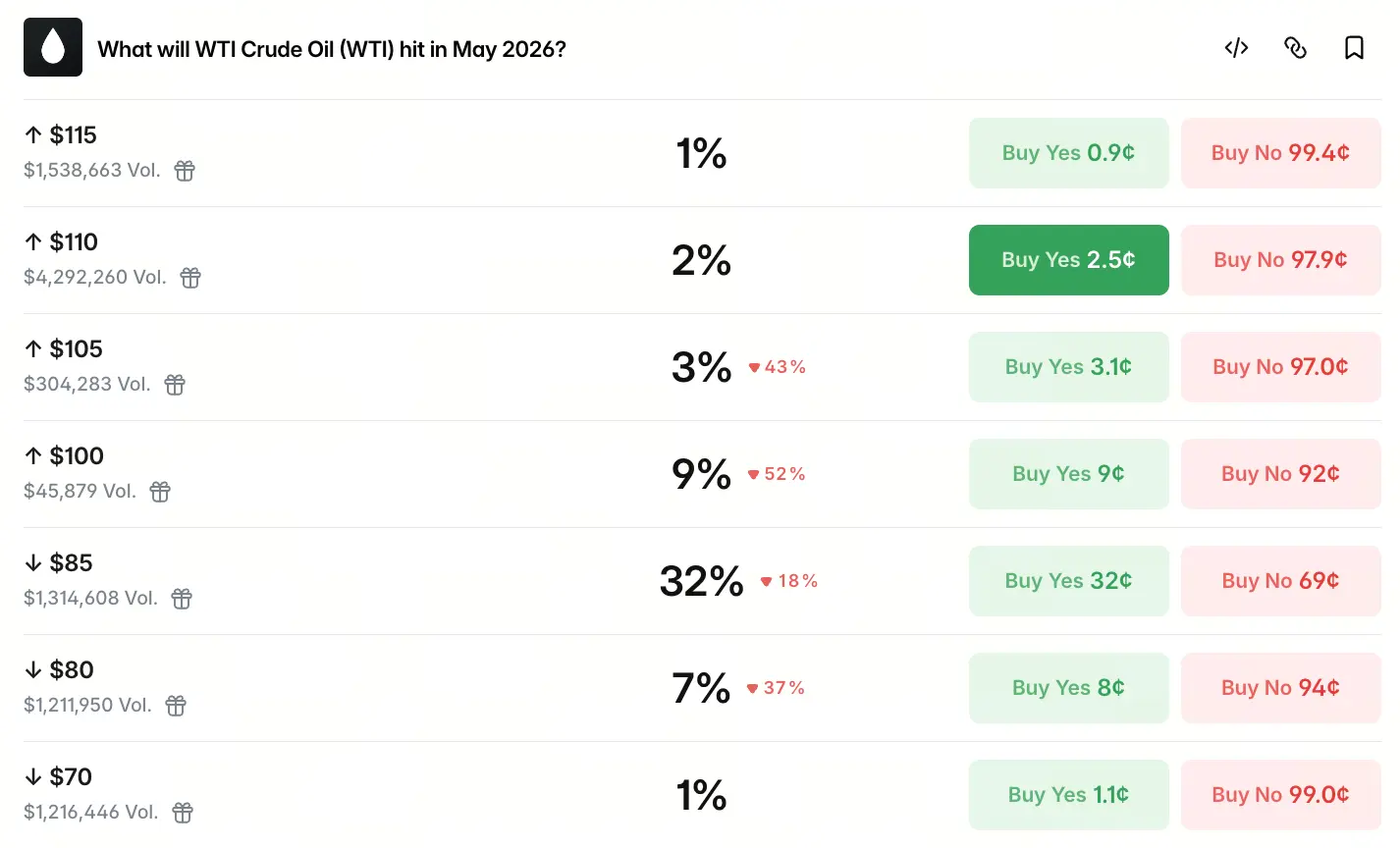
Prediction markets convert scattered market information into a quantifiable probability distribution through capital bets. Polymarket data shows that as of late May, the market’s bets on WTI’s May price range displayed a clear asymmetric distribution: the probability of falling below $85 was 28%, below $80 was 7%, below $70 was 1%; while the probability of breaking above $100 was 9%, above $105 was 4%, and above $110 was 2%.
点击参与预测
This probability distribution reflects two key features: first, the market’s pricing center of gravity is clearly tilted downward— the probability of falling to $85 is significantly higher than for other price targets; second, the tail probabilities are relatively dispersed, with both extreme upside (above $110) and extreme downside (below $70) assigned low probabilities, indicating that the market’s current judgment range has relatively narrowed. This distribution in itself is not a prediction result, but a structural reflection of collective judgments by market participants.
Why geopolitical factors remain the core pricing logic for today’s oil market
Since the end of February 2026, when the US-Iran conflict broke out, geopolitical factors have taken over the oil market’s pricing power. This round of oil price fluctuations has moved beyond the traditional supply-and-demand fundamentals logic and entered a typical mode dominated by geopolitical risk premia. The Strait of Hormuz handles about 20% of the world’s seaborne oil shipping volume; daily crude oil shipments passing through exceed 13.6 million barrels. The strait’s navigability status directly determines the world’s effective crude supply capacity.
On May 27, a “preliminary unofficial document” regarding a framework memorandum of understanding between Iran and the United States was disclosed. It covers arrangements for passage through the Strait of Hormuz and adjustments to regional military deployments. Although this news initially triggered a fast pullback in oil prices, the market remains cautious about whether the strait can truly achieve comprehensive and rapid opening. Analysts pointed out that even if the two sides sign the memorandum of understanding, restoring the strait to pre-war passage conditions would take at least 3 to 6 months, making a complete opening in the short term almost impossible. This means the geopolitical risk premium is unlikely to dissipate fully in the near term.
Do supply-and-demand fundamentals form a floor for oil prices
From the supply side, global crude oil supply capacity suffered real losses during the conflict. Data shows that crude oil production in countries in the Gulf region fell by about 14 million barrels per day compared with before the conflict; in April, crude oil production among OPEC member countries fell by nearly 10 million barrels per day cumulatively compared with February. At the same time, Russian crude oil facilities were hit by drone attacks; in April, oil production decreased by 300,000 barrels per day month-over-month. These supply losses are not short-term reversible, forming a structural support for oil prices.
Inventory data further confirms this view. For the week ending May 15, US API crude oil inventories decreased by 9.11 million barrels, far exceeding the expected decline of 3.361 million barrels; over the same period, EIA inventories fell by 7.863 million barrels, also significantly above expectations. Continued inventory drawdowns mean the tight supply situation in the spot market remains in place, providing oil prices with some downside cushioning.
What signals are released by technical patterns and capital flows
From a technical perspective, WTI crude oil is positioned at a sensitive point where it is choosing a medium-term direction. Starting from the 2025 April low of $54.7, the price is currently at the Gann 2/1 line level (about $92). If WTI crude oil subsequently effectively breaks below $92, the medium-term uptrend will be declared over, entering a downward channel with the peak on March 9, 2026 at $114.6 as the starting point.
Regarding capital flows, WTI crude oil futures’ non-commercial net long positions reached a phase high of 233,620 contracts in the week of March 24, then continued to decline, falling to 169,877 contracts in the week of May 12—a cumulative decrease of about 27%. This trend suggests that institutional capital maintains a relatively rational view of the subsequent development of the Middle East situation. It has not continued adding net long positions. This indicates that market participants are cautious in the current high-volatility environment.
How institutions view the long and short direction in the oil market
There are clear disagreements among major investment banks about their views on oil prices. Goldman Sachs previously raised its 2026 Brent average price forecast from $77 to $85, and WTI from $72 to $79. For short-term forecasts, Goldman raised its Brent average forecasts for March and April from $98 to $110. By contrast, institutions such as JPMorgan are more pessimistic. Their earlier baseline forecast showed Brent crude could fall to $58 in 2026, and WTI would be another $4 lower on that basis. This divergence itself reflects the market’s high uncertainty: different institutions have different assumptions about the speed of supply-demand repair, the evolution path of geopolitical risks, and the pace of inventory drawdowns.
At the same time, it’s important to note that the global crude oil market does not have “broad-based absolute supply shortages.” Instead, it shows a clear “structural tightness” across different regions and products. Overall, the market is still in a “tight balance” state. The essence of disagreements among institutions is their differing expectations on whether this “tight balance” can be maintained.
Understanding the possible boundaries of WTI’s May price through multiple scenarios
Taken together, there is room for multiple scenario simulations of WTI’s May price path. In a bullish scenario, if US-Iran negotiations hit a stalemate, navigation obstacles in the Strait of Hormuz persist, and inventory continues to draw down, oil prices could find support at current levels and rebound toward the $95 to $100 range.
In a bearish scenario, if the two sides make substantive progress under the memorandum of understanding framework, the market would accelerate the unwinding of the geopolitical risk premium. The current market probability of prices falling into the $85 range is 28%, reflecting that some market participants are pricing in this scenario.
In a base scenario, high uncertainty in geopolitics and the supply-demand tight balance interweave. WTI is likely to trade within the broad $85 to $100 range. The core driver of short-term price volatility will still be the latest progress in navigation through the Strait of Hormuz, rather than traditional supply-and-demand fundamentals.
FAQ
Q: What kind of relationship exists between WTI crude oil and the cryptocurrency market?
WTI crude oil and crypto assets show some risk-asset linkage at the macro level. When expectations for global liquidity change or geopolitical risks heat up significantly, both may exhibit stage-wise volatility in the same direction. However, this linkage is not a constant mechanism. Oil prices are more constrained by physical supply and demand and geopolitics, while crypto assets are also affected by factors such as regulatory expectations and technical cycles.
Q: Can Polymarket’s prediction data be used directly as a basis for trading decisions?
Polymarket’s bet probabilities reflect collective judgments by market participants, but its data is not a prediction result and does not constitute any trading advice. Users should consider information across multiple dimensions—geopolitics, supply-and-demand fundamentals, and technical factors—then make prudent judgments based on their own risk tolerance. Prediction market data can be used as an auxiliary analytical tool, but should not be used as a single basis for decision-making.
Q: After the Strait of Hormuz resumes navigation, will WTI’s price immediately return to pre-conflict levels?
Most likely, it will not. Even if both sides sign agreements, the strait will need at least 3 to 6 months to be fully opened. Also, global crude oil supply capacity has suffered real losses of about 14 million barrels per day in this conflict, and the restoration of this supply will take longer. Therefore, the geopolitical risk premium may gradually narrow, but it is difficult to eliminate completely.


