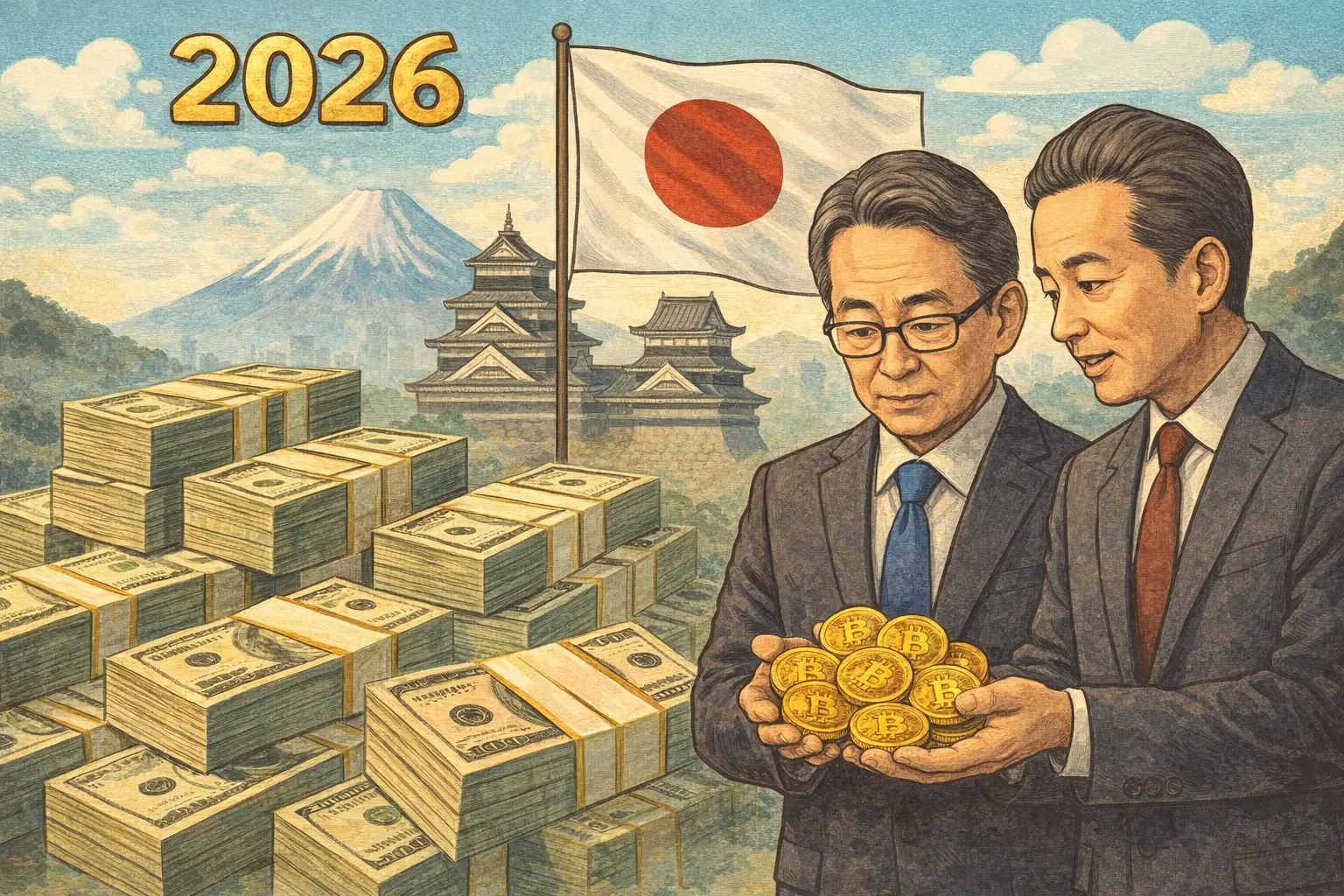
Japanese newspaper Nikkei reported on June 18 that the National Business Corporate Pension Fund Plan, headquartered in Okayama, will launch cryptocurrency investments during fiscal year 2026. It will allocate about 1% of its assets to multi-currency passive cryptocurrency funds, managed by a large hedge fund. This will be one of the first retirement funds in Japan to officially establish a position in cryptocurrencies. The fund covers about 1,200 small and medium-sized enterprises, with assets under management of about 21.3 billion yen.
Basic information on the National Business Corporate Pension Fund Plan
Based on public information: The National Business Corporate Pension Fund Plan (formerly the Okayama Prefecture Machinery and Metals Industry Welfare Retirement Fund established in 1971, renamed in 2022); manages assets of about 21.3 billion yen; about 1,200 small and medium-sized enterprise members and over 20,000 participants; a defined benefit structure, guaranteeing an annual interest rate of 1.2% or higher; funding ratio of more than 140%, and effective equity ratio of more than 30%, with a solid financial position.
Planned shift in asset allocation: In fiscal year 2025, it is yen 80%, US dollars 15%, and others 5%; in fiscal year 2026, it plans to adjust to yen 70%, advanced-country currencies 10%, and the remaining 5% diversified into emerging-market currencies, gold, and cryptocurrencies, with each of the three asset categories accounting for about 1.67%.
Tsubasa Iguchi’s investment logic: de-dollarization and bitcoin’s low correlation
In an interview, Tsubasa Iguchi said plainly that the dollar “may lose its status as the world’s reserve currency,” so he chose not to increase his holdings of the dollar and instead uses cryptocurrencies as a currency diversification tool. He noted that bitcoin has extremely low correlation with the U.S. dollar index and offers independent value from currency diversification.
He said he has studied the cryptocurrency market for about six years and believes the “market has become mature,” because the investor base continues to deepen. The fund is currently also researching funds that engage in various cryptocurrency arbitrage trades, and it does not rule out further expansion of allocations in the future.
Simultaneous advancement of Japan’s regulatory framework: amendments to the Financial Instruments and Exchange Act, and OSE bitcoin futures plans
Japan’s regulatory efforts and market infrastructure are being pushed forward in tandem with institutional market entry:
· On June 11, 2026, the House of Representatives passed an amendment to the Financial Instruments and Exchange Act in a plenary session, transferring cryptocurrencies from the Payment Services Act to the Financial Instruments and Exchange Act framework, providing a more complete basis for investment supervision;
· The Financial Services Agency plans to classify cryptocurrencies as “specified assets” in 2028, allowing investment trusts to be formally included in allocations;
· On June 11, the president of the Osaka Exchange (OSE), Akira Tagaya, disclosed to Nikkei that it plans to launch bitcoin futures contracts in 2028 (aligned with the demand for legalizing spot ETFs);
· On the tax side, it is expected to shift from an integrated income taxation system to a separate taxation system (tax rate 20%).
Follow-up moves by securities firms: statements from SBI, Rakuten, Nomura, Daiwa, and SMBC Nikko
According to a May report by Nikkei, SBI Securities and Rakuten Securities have announced plans to sell investment trusts that include cryptocurrencies. Large retail-facing brokerages such as Nomura, Daiwa, and SMBC Nikko said they will evaluate follow-up actions after the system is finalized. This series of signals, coordinated across three lines—legislation, the derivatives market, and distribution channels—marks that Japan’s cryptocurrency market is officially transitioning from being driven by retail investors toward institutionalization.
FAQ
Does the fund’s cryptocurrency allocation comply with Japan’s current pension fund regulatory requirements?
According to the report, the amendment to Japan’s Financial Instruments and Exchange Act was passed in the House of Representatives on June 11, 2026, bringing cryptocurrencies into a more complete investment supervision framework. The Financial Services Agency plans to classify cryptocurrencies as “specified assets” in 2028. Because the fund’s allocation plan begins in fiscal year 2026, the specific compliance pathway still depends on the finalization of the regulatory framework.
Why is the low correlation between bitcoin and the U.S. dollar index attractive to this fund?
According to Tsubasa Iguchi, the fund originally holds mainly Japanese yen (80%) and also holds U.S. dollars (15%). Amid concerns that the U.S. dollar could lose its role as a reserve currency, bitcoin—because it has almost no correlation with the U.S. dollar index—is seen as an asset that can hedge currency risk when the dollar depreciates, rather than a traditional high-risk speculative asset.
What is the timeline for the Osaka Exchange (OSE) to launch bitcoin futures?
According to the statements made by OSE president Akira Tagaya during an interview with Nikkei on June 11, 2026, it plans to launch bitcoin futures contracts in 2028. The timing aligns with the schedule under which the Financial Services Agency plans to legalize bitcoin spot ETFs, in order to meet the hedging needs of institutional investors.


