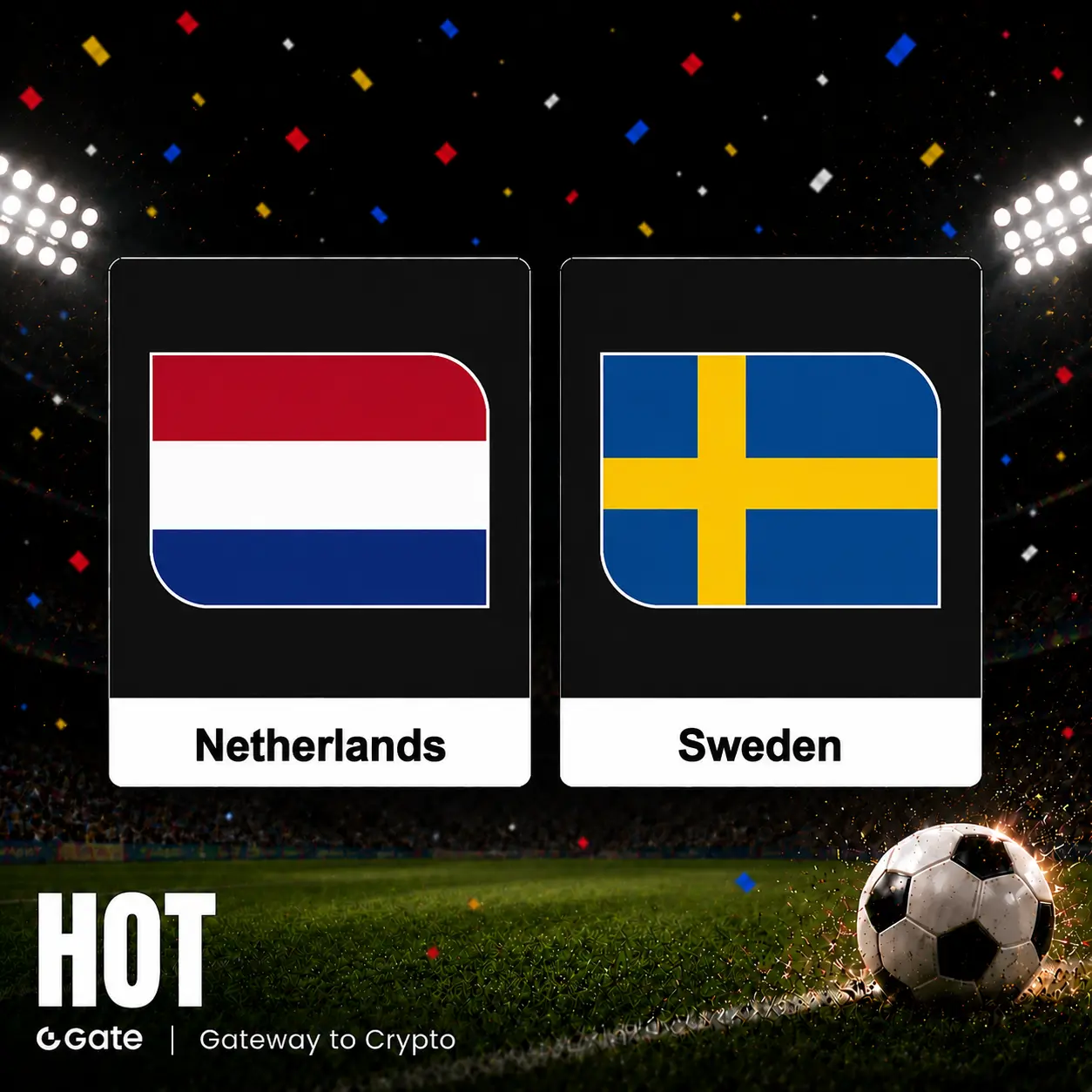
What market logic does this probability distribution reflect, and why is the capital so clearly skewed toward the Netherlands?
Why the first-round performance created sharply different market expectations
In the Netherlands’ first match against Japan, they led twice but were equalized twice, finishing 2-2. With only 1 point so far, their qualification situation has already become passive. Sweden, meanwhile, faced Tunisia in their first match and won big 5-1, holding 3 points and 4 goal difference, currently topping the group.
Judging purely by the first-round results, Sweden’s form was clearly better. However, the distribution of funds in the prediction market shows a completely opposite pattern—Netherlands are being backed with nearly a 60% probability.
This phenomenon—where results deviate from expectations—is precisely the core feature that distinguishes prediction markets from a simple interpretation of past results. The market isn’t pricing “who played better in the last match,” but “who has a stronger logic for winning in this game.” Although the Netherlands failed to win in the first round, their control of the game and ability to create chances are still there; Sweden’s big win also partly benefited from Tunisia’s loose defense, limiting its reference value.
How qualification scenarios shape both teams’ match strategies
Qualification scenarios are the key variable for understanding where the funds are flowing.
For the Netherlands, there is no way back. If they fail to beat Sweden, the final round will place them in an extreme back-against-the-wall situation. That “must-win” mentality means the Netherlands will maintain high-intensity attacking pressure from the start. Markets typically assign a higher probability premium to the side that “must win,” because the主动 attacking side has a natural advantage in creating scoring opportunities.
Sweden, however, is in a completely different situation. With 3 points and a +4 goal difference, a draw would essentially lock in their qualification advantage. Sweden can opt for a more conservative tactical posture—compress the defense and wait for counterattacking chances. But this strategy also means Sweden is voluntarily giving up part of its control over the match, letting the Netherlands take charge of the tempo.
From a game theory perspective, the side that “must win” in a match often has a higher winning probability than the side that “can accept a draw”—not necessarily because the former is stronger, but because the latter’s strategy space is partially compressed. The Netherlands’ 58% win rate in the prediction market largely reflects this asymmetry in fighting spirit.
What gap exists in squad strength and tactical style
In terms of squad configuration, the Netherlands and Sweden show distinctly different structures.
The Netherlands are ranked 8th in the world, with a total squad value of about €750 million. Captain Van Dijk anchors the back line, De Jong serves as the midfield organizing core, and attackers like Gakpo and Malen bring top-league experience. The team is balanced across all three lines, with particularly strong control in the midfield and backfield.
Sweden’s total squad value is about €400 million. Up front, they have two main finishers—Isak and Gyökeres—who together contributed 5 goal involvements in the first round. But their defensive line lacks a commanding presence, showing an obvious “heavy on the head, light on the tail” characteristic.
Tactically, the Netherlands average 60.2% possession and 14.3 shots per game, while Sweden averages 50.1% possession and 9.8 shots per game. The Netherlands’ attacking advantage is built on “more shots” rather than “higher conversion.” The Netherlands average 6.5 shots for 1 goal, while Sweden averages 7.5 shots for 1 goal—an efficiency gap that is not particularly large.
The real gap is in defense. The Netherlands concede 8.3 shots per game, and they lose 1 goal per every 10.4 shots faced. Sweden concedes 13.0 shots per game, and they lose 1 goal per every 6.5 shots faced. Sweden’s ability to withstand pressure in defense is nearly 40% weaker than the Netherlands’.
Can head-to-head history provide reference for predictions?
The two teams have met 20 times in history: the Netherlands have 9 wins, 4 draws, and 7 losses, slightly ahead. In their last 5 head-to-head meetings, the Netherlands have 3 wins, 1 draw, and 1 loss. Sweden has won only 1 of their last 7 matches against the Netherlands.
However, historical data needs careful interpretation. The teams’ most recent head-to-head in an official match is already some time ago, and squad turnover limits the reference value of past results. More importantly, all previous meetings were not held at neutral venues for this World Cup (in Houston, United States). The neutral-venue environment weakens home advantage, further reducing the predictive power of historical head-to-head data.
The pricing logic of prediction markets for historical data is usually “moderate reference, but not dominant.” Head-to-head history can provide a basic reference framework, but when fundamentals change significantly (squads, form, fighting spirit), the weight of historical data declines accordingly.
How the prediction market’s probability distribution forms
The core mechanism of a prediction market is “voting with capital.” Participants buy or sell shares of a given outcome, pushing the price toward the true probability. When a large amount of capital believes the Netherlands are more likely to win, the Netherlands’ share price rises, and the corresponding probability increases as well.
The 58% Netherlands win rate, 24% draw probability, and 21% Sweden win rate given by the Gate prediction market essentially reflect a collective judgment formed by market participants after integrating and evaluating all available information. This judgment combines multidimensional inputs—fighting spirit, form, squad strength, tactics, and history—and expresses it through the flow of capital.
It’s worth noting that prediction market probabilities are not “predictions of match results,” but the pricing of “winning likelihoods for each side under current information conditions.” As more information is disclosed before the match (such as likely starting lineups, injuries, etc.), the probability distribution will keep adjusting dynamically.
During the 2026 World Cup, crypto prediction markets saw explosive growth. By the start of the group stage, Polymarket’s World Cup champion prediction market cumulative trading volume had already exceeded $3 billion. Gate’s prediction market product cumulative trading volume has surpassed $251 million. Sports events have become the largest trading category for prediction markets. Such a massive pool of capital implies that the market price signals contain relatively high information content, effectively diluting irrational noise.
Where the market disagreement lies
Although the Netherlands are backed by the market with a 58% probability, Sweden’s 21% win rate and the 24% draw probability are also not to be ignored. The market is not one-sidedly betting on the Netherlands—there is significant disagreement.
The first source of disagreement is the stability of the Netherlands’ defense. In their last five international matches, the Netherlands conceded goals in each. In the first round, Japan equalized in the late stage of the game via high balls. Against Sweden’s attacking pressure from Isak and Gyökeres, whether the Netherlands’ back line can stay fully focused throughout the match is in doubt.
The second source of disagreement is Sweden’s counterattacking efficiency. Sweden isn’t afraid of physical duels and distributes its attacking threats, a style that directly targets weaknesses in the Netherlands’ defense. If Sweden can score in the first 30 minutes—since the Netherlands conceded an average of 0.5 goals in the first half, about double in the second half—the match script could be completely rewritten.
The third source of disagreement is the odds setup. Some analysis suggests that this match’s line was “opened too shallow”—it appears to show proper respect for the Netherlands, but in practice it makes the Netherlands easier for the market to enter, raising suspicions of a trap. This means some market participants believe the current probability distribution may be over-reflecting the Netherlands’ advantage.
The existence of these disagreements is exactly what shows that the prediction market’s 58% probability is a balanced price reached through sufficient game-theory contestation, not a simple outpouring of market sentiment.
What the market’s capital tilt implies for the crypto industry
The prediction market capital distribution for Netherlands vs. Sweden offers the crypto industry several noteworthy observation angles.
First, prediction markets are becoming an efficient mechanism for pricing sports information. Compared with traditional sports betting, the price discovery process in prediction markets is more transparent. Any participant can trade based on publicly available information, pushing prices toward real probabilities. This mechanism is especially effective in large-scale events like the World Cup, where information is highly public.
Second, the capital flow direction in crypto prediction markets itself is becoming a valuable information product. A 58% Netherlands win rate is not just a number—it incorporates the collective judgment of thousands of market participants. For investors focusing on the intersection of sports events and crypto assets, the price signals from prediction markets can serve as one reference dimension for decision-making.
Third, the World Cup is becoming a catalyst for crypto prediction markets to break into mainstream view at scale. Tens of billions of funds’ worth of participation, and users in the million-level range, are moving prediction markets from a crypto niche into the mainstream spotlight. Gate, as the world’s first centralized exchange with access to a decentralized prediction platform, holds an early-mover advantage in this process.
FAQ
Q1: How are the probability data in Gate prediction markets derived?
The probabilities in prediction markets are determined by participants’ buying and selling actions. When more capital buys shares of a particular outcome, that outcome’s price rises, and the corresponding probability increases accordingly. Gate prediction markets aggregate trading data from global participants, reflecting the market’s collective judgment on event outcomes in real time.
Q2: Why, after Sweden’s big 5-1 win in the first round, does the market still favor the Netherlands?
Prediction market pricing is not about “who performed better in the last match,” but about “who is more likely to win this game.” Even though the Netherlands were forced into a draw in the first round, the “must-win” fighting spirit, higher squad value, and stronger defensive data form the core logic behind why the market favors them. Sweden’s big win benefited in large part from the opponent being weaker, limiting its reference value.
Q3: Does a 58% probability mean the Netherlands will surely win?
No. 58% means the market believes the Netherlands has roughly a six-in-ten chance of winning. There is still more than a four-in-ten chance of a draw or a Sweden win. Prediction markets provide probability judgments, not certain outcome predictions.
Q4: How is crypto prediction markets different from traditional sports betting?
Crypto prediction markets run on blockchain smart contracts, with transparent trading and automated settlement, so any user can participate in pricing. Traditional sports betting is run by bookmakers setting the odds, and users can only passively accept them. The price discovery process in prediction markets is more decentralized and market-driven.
Q5: Where can I view Gate prediction market real-time data?
Users can view real-time probability distributions and trading data for events in Gate’s Prediction Markets section. During the 2026 World Cup, Gate has launched coverage of key match prediction markets across the entire tournament schedule.