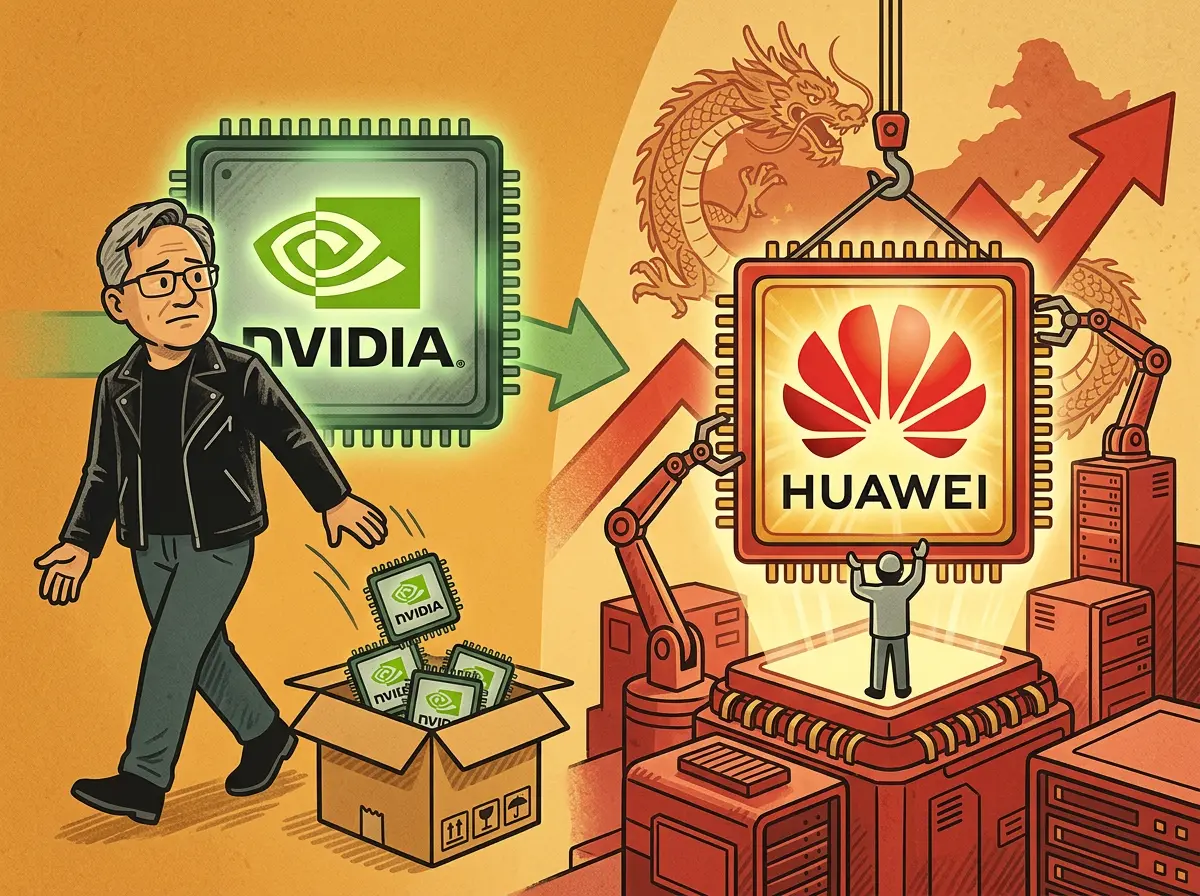
NVIDIA CEO Jensen Huang said in a CNBC interview on May 20 that NVIDIA has essentially ceded the China AI chip market to Huawei. When Huang made the remarks, NVIDIA also released its Q1 FY2027 financial report the same day, with revenue up 85% year over year to $81.6B. The Trump administration told NVIDIA in April that exporting chips to China and certain countries requires permits, causing NVIDIA to effectively exit the China market.
Export Controls and China’s Return: Huang’s Formal Statement to CNBC
In the interview, Huang clearly said that NVIDIA has told all analysts and investors that they should “have no expectations” regarding approvals for selling advanced chips to China. He described the current state of the Chinese market as follows: “China’s demand is very large. Huawei is extremely strong. They set a record last year, and their local chip company ecosystem has also been developing well, because we already pulled out of that market. We have actually basically handed that market over to them.”
In the same interview, Huang said that despite the very low chance of approvals, NVIDIA still hopes to return to the China market: “We would be very happy to serve that market. We have a lot of customers there, many partners, and we’ve been operating there for 30 years.”
H200 Chip Export Status: Some Chinese Firms Approved, but the Scope of Relaxation Is Unclear
Reuters reported last week that some Chinese companies, including Alibaba, Tencent, ByteDance, and JD.com, have been approved by the U.S. Department of Commerce to purchase H200 chips. Huang himself previously attended President Trump’s China delegation itinerary last week in an unofficial capacity, but this visit did not provide clear confirmation on whether NVIDIA’s H200 chips could enter the China market. A U.S. trade representative confirmed that chip export controls were not a topic discussed in last week’s U.S.-China talks. In its financial report, NVIDIA also did not give any specific expectations regarding the timing or scale of future approvals for the China market.
AI “Five-Layer Cake” and supply-chain capital allocation
Huang said NVIDIA’s top priority for its continuously growing cash reserves is to help suppliers meet surging demand: “Because every time we can deliver growth of several hundred billions of dollars, we have to support our supply chain so that they can support our growth.” He described the growth opportunities for the AI industry as covering a “five-layer cake”: energy, chips, infrastructure, models, and applications. Huang said, “The idea that companies can scale up by multiples is not impossible.”
Frequently Asked Questions
When will export controls for NVIDIA’s China AI chip market formally take effect?
In April 2026, the Trump administration told NVIDIA that exporting chips to China and certain countries requires permits. This measure effectively makes NVIDIA exit the China market, and NVIDIA’s Q2 FY2027 outlook therefore explicitly excludes China data center compute revenue.
Does Huang’s “have no expectations” mean NVIDIA is permanently giving up the China market?
In the same interview, Huang clearly said that NVIDIA is still “very happy to serve that market,” and said there are “many customers and partners in China” and that NVIDIA has “been operating there for 30 years.” The “have no expectations” wording is about predictions for recent approval outcomes, not a statement that the market is being abandoned.
If some Chinese companies have been approved to buy H200 chips, does that mean the export control policy has been loosened?
Reuters reported that companies such as Alibaba and Tencent have received individual approvals from the Department of Commerce. However, a U.S. trade representative confirmed that chip export controls were not a topic discussed in last week’s U.S.-China talks, and NVIDIA in its financial report also did not provide any specific expectations for scenarios involving any broad relaxation of controls.


