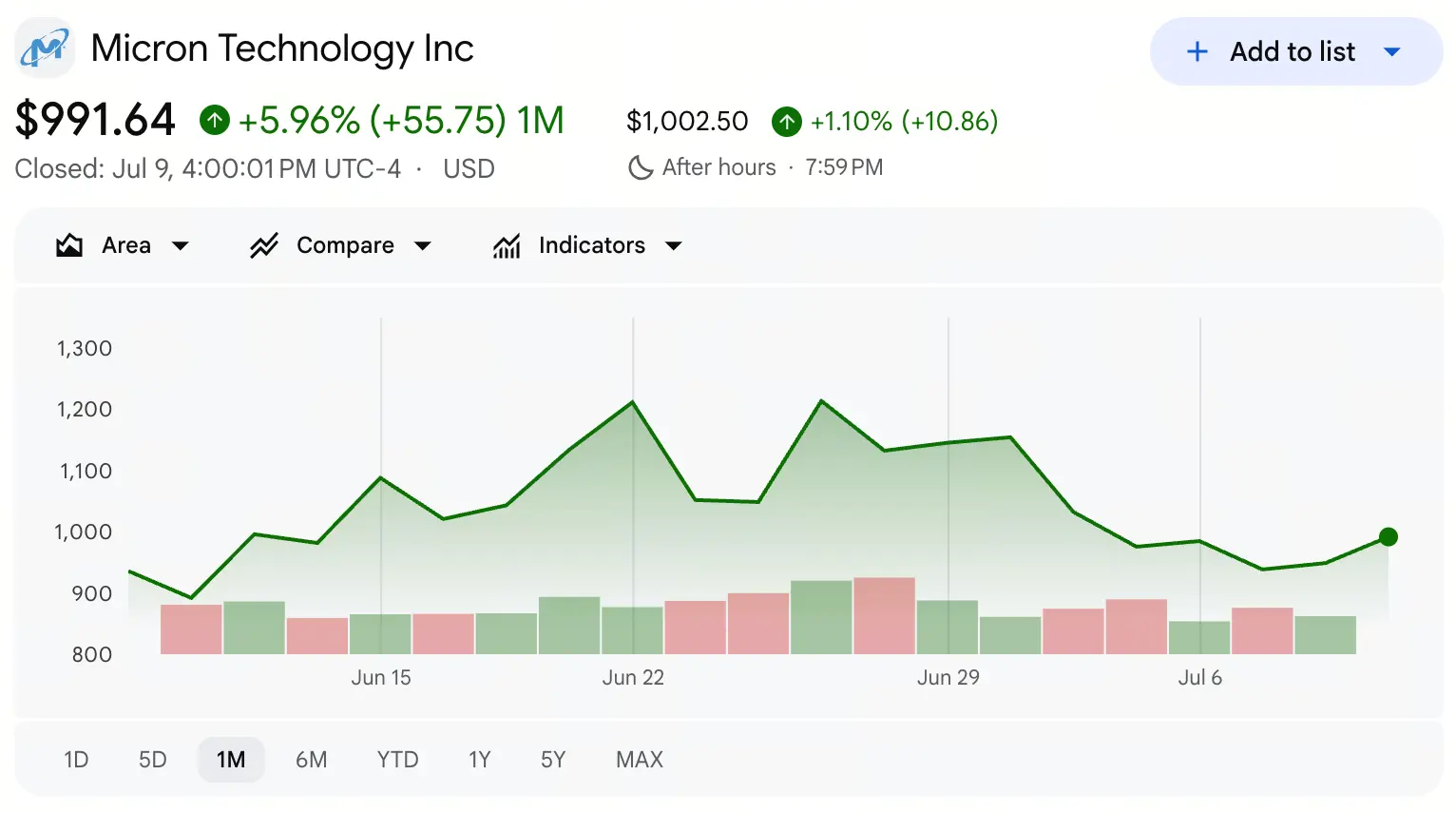
On July 10, 2026, Micron Technology (MU) became the focus of the U.S. semiconductor sector. The stock reached an intraday high of $1,035.50, with an increase of over 6%, and ultimately closed at $991.64, up $42.84 for the day, a 4.52% gain. With a trading volume of approximately 40.8 million shares and over $41 billion in trading value, this sharp rise followed by a pullback sparked intense market discussion about the future of storage chips.

What was the direct catalyst for the surge?
Micron’s rally on July 10 was not an isolated event. The Nasdaq Composite rose 1.30%, and the Philadelphia Semiconductor Index gained over 3%, continuing the upward trend in chip stocks. Micron’s increase ranked among the top in the storage sector—SanDisk up 7.59%, Western Digital up 5.04%, Seagate Technology up 3.50%.
The immediate news trigger was Micron’s announcement of a significant expansion of its domestic manufacturing capacity in the U.S. The company increased its previously announced U.S. expansion plan from $200 billion to $250 billion, adding $50 billion to its commitment. The projects include multiple new factories in New York, Idaho, and Virginia, with total spending expected to extend through 2035. Additionally, Micron announced a separate $3 billion allocation to strengthen the domestic semiconductor supply chain, including a $500 million strategic financing to Taiwan’s GlobalWafers and a ten-year raw material supply agreement.
This expansion signal clearly indicates industry implications: amid the AI infrastructure boom, demand for storage chips is experiencing explosive growth, with leading manufacturers willing to lock in capacity expansion over a decade.
What does this expansion investment mean for the industry?
The $250 billion long-term capital expenditure plan is unprecedented in semiconductor history, conveying several key messages.
First, storage chip manufacturers’ demand outlook has shifted from “cyclical recovery” to “structural growth.” Micron is not the only company making long-term expansion decisions—Samsung previously stated customers have begun pre-ordering capacity for 2027, expecting the supply-demand gap to widen further by then. The consensus among industry leaders on ramping up capacity suggests a fundamental change in the supply-demand logic of the memory market.
Second, the expansion is highly focused on AI-related capacity. High-bandwidth memory (HBM) is the core driver of this expansion. Micron’s HBM business has consecutively broken $1 billion in quarterly revenue for two quarters, with HBM4 shipped in volume to Nvidia’s new GPU generation, and full capacity booked for the year. The “crowding out” effect of AI on storage capacity is reshaping the entire supply structure—capacity is tilting toward high-margin HBM, leading to a contraction in traditional DRAM and NAND supply.
Are the fundamentals supporting the current valuation?
Micron’s financial data provide quantitative support for this logic. In fiscal Q3 2026 (ended May 28, 2026), Micron reported revenue of $41.46 billion, up 73.8% quarter-over-quarter and 346% year-over-year, far exceeding the market expectation of $35.84 billion. GAAP net profit was $28.24 billion. Gross margin was 84.6%, significantly above expectations.
In terms of product mix, DRAM contributed $31.3 billion, accounting for 76% of total revenue, with average selling prices increasing over 60% quarter-over-quarter; NAND contributed $9.9 billion, 24% of total revenue, with average prices up over 80% QoQ.
More notably, the forward guidance indicates that the company expects Q4 revenue of $49-51 billion (midpoint $50 billion), a 21% sequential increase; non-GAAP gross margin of 86%; and EPS of $30-32. If achieved, Micron will set a new record for the single-quarter revenue in the global semiconductor industry.
Furthermore, Micron has signed 16 strategic customer agreements (SCA), locking in prices and capacity for 3-5 years. About half or more of the company’s revenue is expected to come from these agreements, with a $22 billion financial commitment, securing potential future revenue of $100 billion. The long-term contract mechanism helps smooth out the inherent cyclicality of the storage industry.
What is the current supply-demand landscape for storage chips?
The memory market is currently experiencing unprecedented tightness.
Price-wise, according to TrendForce, contract prices for DRAM in Q2 2026 are forecasted to rise 58-63% quarter-over-quarter, and NAND prices are expected to increase 70-75%. UBS further predicts that DDR contract prices will rise 32% in Q3 2026 and another 18% in Q4; NAND contract prices are expected to rise 30% in Q3 and 12% in Q4.
On the demand side, global memory sales have hit a record high of $74.6 billion, up 31.7% QoQ; DRAM sales reached $48 billion, NAND sales $25.8 billion. UBS estimates HBM demand will grow 90% in 2026 and another 77% in 2027. UBS believes that the DRAM market will at least remain structurally undersupplied until Q2 2028.
Supply constraints are also significant. Capacity shifts toward HBM have led to a contraction in traditional DRAM and NAND supply. In Q2 2026, server DRAM contract prices increased 50-55% QoQ. Samsung has indicated that customers have already begun pre-ordering capacity for 2027. All these signals point to a conclusion: the supply-demand mismatch in the memory market is evolving from “short-term shortage” to a “mid-term structural gap.”
What is the market focus of controversy?
Despite strong fundamentals, Micron’s stock price has not moved in a single direction. Since reaching a high on June 25, the stock has fallen about 23%. On July 8, Micron dropped 4.7% in one day, with the entire storage sector falling in tandem. The market’s turning point lies in the shift of investor focus from earnings itself to a more fundamental question—whether the supercycle for storage is nearing its peak.
There is clear disagreement on Wall Street. UBS analyst Nicolas Gaudois set a target price of $1,625, viewing the recent decline as a buying opportunity and expecting DRAM prices to rise 32% in Q3 2026. Bank of America reaffirmed a buy rating with a target of $1,550, stating that storage chip valuations at only 10 times earnings are severely undervalued. Citigroup raised its target to $1,400. Over the past three months, there have been 29 buy ratings, 1 hold, and no sells, with an average institutional target of $1,564.
However, cautious voices also exist. Bernstein believes that despite recent strong performance, memory prices’ gains will significantly narrow by Q3 2026. Overly high valuations are beginning to trouble investors, raising concerns that the market may have already peaked. The rapid rise of open-source models in China has also sparked some worries about the sustainability of AI capital expenditures.
How to weigh short-term volatility against long-term logic?
In the short term, Micron’s high stock volatility has reasonable basis. The stock has risen about 230% this year and approximately 650% over the past year. After such a large rally, any doubts about demand sustainability or valuation levels could trigger profit-taking. Bank of America characterizes this correction as a “summer reset” rather than a trend reversal, expecting a rebound in the fall. Historically, the seasonal pattern of the SOX index shows an 11% decline in Q3, aligning with the weakest period.
The longer-term logic is clearer. Global cloud AI capital expenditures are projected to approach $1.5 trillion in 2027, a 50% increase. Micron’s long-term contracts lock in substantial revenue streams for the coming years, and its capacity expansion plans are laid out over a decade, reflecting management’s firm confidence in sustained demand.
Key scenarios to watch include: whether quarterly increases in DRAM and NAND prices continue as expected; whether HBM capacity expansion can keep pace with AI chip iterations; and whether long-term contract pricing mechanisms can effectively buffer the impact of spot market price fluctuations on earnings. The evolution of these variables will determine the height and duration of the supercycle.
FAQ
Q: What was the direct reason for Micron’s surge on July 10?
A: Micron announced that its U.S. domestic expansion plan was increased to $250 billion, adding $50 billion to the original commitment, and allocated an additional $3 billion to strengthen the supply chain. This news reinforced market confidence in the sustained demand for AI storage.
Q: How did Micron’s latest earnings perform?
A: In fiscal Q3 2026, revenue was $41.46 billion, up 346% year-over-year, with a gross margin of 84.6%, exceeding expectations. The Q4 guidance projects revenue of $49-51 billion, gross margin of 86%, and EPS of $30-32.
Q: What is the current supply-demand situation for storage chips?
A: Tight supply-demand conditions persist. Q2 DRAM contract prices rose 58-63% QoQ, NAND increased 70-75%. UBS forecasts that DRAM shortages will last at least until Q2 2028.
Q: What is Wall Street’s outlook for Micron’s future?
A: Major institutions maintain buy ratings. Bank of America’s target is $1,550, UBS’s is $1,625, Citigroup’s is $1,400. But Bernstein and others express concerns about slowing price increases.
Q: How can Gate trade Micron and other U.S. stocks?
A: Gate has launched real U.S. stock spot trading, allowing users to trade Nasdaq and NYSE stocks and ETFs directly with USDT, without opening traditional brokerage accounts. Currently, Gate supports trading over 10,000+ U.S. stocks.


