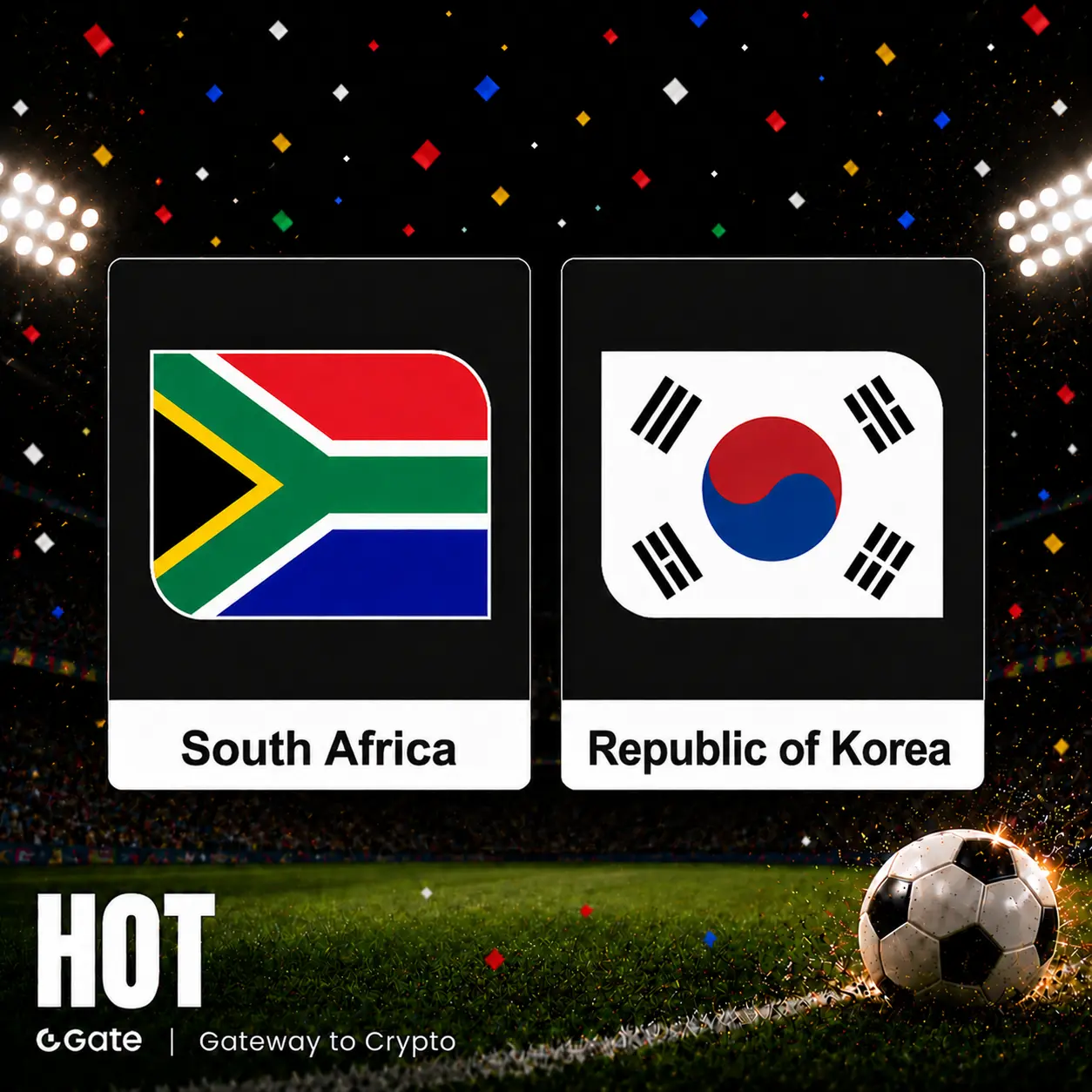
These figures are not凭空 generated; they represent the collective consensus formed by market participants after integrating all public information—both teams' performances in the first two rounds, injuries, tactical styles, and qualification scenarios. This analysis delves into the logic behind these three prices, explaining why the market priced them as such, and what this pricing means for investors and spectators alike.
59% for South Korea: Clear advantage but not overwhelming
The South Korea win contract leads at nearly 60%, reflecting the market's dual recognition of their overall strength and tactical initiative. In the group stage, South Korea defeated the Czech Republic in the first round, losing only narrowly to Mexico in the second while not being outplayed. This team has a mature attacking and defensive system and multiple key players active in top European leagues, with rich tournament experience. In contrast, South Africa has one draw and one loss in the first two rounds, with only 1 point and zero goals from open play—their only goal came from a penalty.
More critically, the qualification scenario creates tactical asymmetry. South Korea currently has 3 points, ranking second in the group; they only need to avoid defeat to secure qualification (Mexico has 6 points and has already advanced, while the Czech Republic has 1 point with a goal difference disadvantage). This means South Korea can adopt their most comfortable strategy—solid defense and counterattack: compress space, patiently wait for opponent mistakes, and use forward speed to create threats. South Africa, on the other hand, must go all out for victory; even a draw would likely see them eliminated (depending on the other match result and their goal difference). A team forced to attack often exposes more gaps at the back, which is exactly the rhythm South Korea's counterattack system thrives on.
The market's 59% does not mean South Korea is a sure winner, but acknowledges a fact: the stronger side also has the freedom to choose their tactics, while the weaker side must play in a way that does not suit them. This structural advantage is often amplified in football, making a probability close to 60% reasonable.
18% for South Africa: Underestimated resilience or harsh reality?
The South Africa win contract at only 18 cents implies the market sees their upset probability as less than one in five. Is this pricing too pessimistic? To answer this, we need to assess South Africa's actual competitiveness.
South Africa's biggest strength in this tournament is defensive resilience. Against stronger opponents, they maintain a compact formation, using physical duels and cover to limit the opponent's attacking space. Their draw against the Czech Republic in the previous match is a typical example—they allowed over 60% possession but limited the number of genuine goal-scoring chances. However, defensive stability alone is not enough to secure victory, especially when the team needs to score.
South Africa's biggest weakness is attacking creativity. In their first two matches, they hardly created high-quality shots from open play; the midfield and forward players were rough in passing quality and final-ball selection. The lack of a consistent goal scorer means the team lacks a means to fight back when trailing. And when they must push forward aggressively in this match, the space behind their defensive line will increase significantly—exactly the area South Korea's forward line excels at exploiting.
The market's 18% probability essentially weighs two scenarios: "South Africa's defense drags the game into a stalemate" versus "South Africa's forced attack leads to a collapse." The former could result in a draw (already partially covered by the 25% draw price), while the latter most likely leads to a South Korean victory. Therefore, the independent probability of a South African win is compressed to a low level—a judgment with solid logical basis.
The 25% draw: An overlooked middle ground
The draw contract at 25 cents sits in the middle of the three options, but it may be the most worth examining. From South Korea's perspective, a draw is enough to secure qualification, so they would fully accept a low-scoring, slow-tempo match. From South Africa's perspective, a draw is almost equivalent to elimination, so they must take risks to attack.
These two contrasting objectives create an interesting tug-of-war: South Africa tries to speed up the game, while South Korea tries to slow it down. If South Africa's attacking efficiency is insufficient to break through South Korea's defense, and South Korea's counterattacks struggle against a compact defense, the match could fall into a prolonged stalemate. The 25% draw probability reflects the market's acknowledgment of this "stalemate" and also implies a consensus on both teams' low attacking conversion rates.
Notably, the draw probability is higher than the South Africa win probability, indicating the market believes South Africa is more likely to hold South Korea to a draw than to win outright—this is logical because a draw only requires solid defense, while a win requires scoring. This subtle difference further demonstrates the precision of market pricing.
Prediction market pricing efficiency: Information aggregation and emotional filtering
A trading volume of $1.59 million is not huge, but for a single World Cup group match market, it is sufficient to generate meaningful signals. The core advantage of prediction markets is that they require participants to put real money behind their opinions, naturally filtering out emotional biases found in opinion polls.
Compared to traditional sports betting support rates (e.g., South Korea often accounts for over 70% of bets), the prediction market's 59% is clearly more cautious. This gap may stem from two factors: first, prediction market participants tend to trade based on rational analysis rather than emotional preference; second, the market pricing already incorporates the important outcome of a draw, while traditional handicap odds often blur the independent probabilities of win/draw/loss. Therefore, prediction market prices can be seen as risk-adjusted probability estimates, valuable for information interpretation.
Of course, markets are not always right. An 18% probability means there is still roughly a one-in-five chance for South Africa—that is the uncertainty of football. Prediction prices reflect the average of collective wisdom, not a prophecy of the final result.
From pricing to decision: How to use market information
For users following this match, understanding the logic behind prediction market pricing is more meaningful than simply knowing "who is favored." On one hand, price differences can help assess the expected direction of the game—for example, if significant injuries or weather changes occur before the match, prices will fluctuate rapidly, allowing sharp observers to capture updated assessments. On the other hand, pricing itself is a risk management tool; investors can use their independent judgment to find discrepancies between market pricing and personal views.
But no matter how the market prices it, the match will ultimately be decided on the pitch. Prediction markets provide a probabilistic framework, not a deterministic answer. Whether South Africa can create a miracle, or South Korea can calmly advance, all logical deductions must face the test of 90 minutes of play.
FAQ
How does the prediction market's price convert to probability?
The contract price (in cents) directly corresponds to the implied probability of the event. For example, the South Korea win contract at 59 cents means the market estimates their win probability at approximately 59%. Note that the sum of probabilities for the three options is usually slightly above 100%; the excess reflects market depth (liquidity) and bid-ask spread, which can be considered transaction costs.
If South Africa takes the lead in the first half, how will market prices change?
Market prices will react in real time to match events. If South Africa unexpectedly leads, the South Korea win contract price will drop significantly, while the draw and South Africa win contract prices will rise. The magnitude of change depends on remaining time and the state of play; typically, the leading side's win probability may jump above 40%, but exact figures require real-time data.
What does a draw mean for each team's qualification scenario?
If the match ends in a draw, South Korea would have 4 points and be virtually certain to qualify (the Czech Republic could also reach 4 points but with a likely inferior head-to-head record; basic guarantee). South Africa would have only 2 points and would likely be eliminated (unless Mexico beats the Czech Republic by a huge margin and other extreme scenarios). Therefore, a draw is an acceptable result for South Korea but near-elimination for South Africa—this is the core reason for their tactical differences.
Does prediction market trading volume affect price credibility?
Generally, higher trading volume means the price contains more information. $1.59 million in total volume is not negligible for a single market and likely reflects diverse opinions. However, it is still advisable to combine with other information sources (e.g., starting lineups, weather) and not treat market pricing as absolute truth.