 :
:





#MarchNonfarmPayrollsIncoming
⚡ INTRODUCTION — A MARKET AT THE CONFLUENCE OF MACRO AND GEO-POLITICAL SHOCKS
April 2026 is proving to be a month where traditional patterns of market behavior are being tested, stretched, and redefined. Traders are operating in a multi-layered, high-volatility environment, one where U.S. macroeconomic data, energy supply disruptions, and geopolitical escalations converge to create a complex web of interdependencies. The March Non-Farm Payrolls (NFP) report released on April 3 — coinciding with Good Friday, a U.S. market holiday — has acted as the first major catalyst, yet it cannot be interpreted in isolation. The headline number of +178,000 jobs added, a sharp beat over forecasts of -65,000 to +70,000, initially suggested a strong labor market; however, once stripped of the 76,000 healthcare strike reversal jobs, the true picture reveals a labor market that is teetering between slow-bleed weakness and fragile stability, still grappling with structural pressures such as declining labor force participation, stagnating manufacturing employment, and elevated long-term unemployment, which now accounts for nearly 40% of the unemployed workforce searching for work beyond 15 weeks.
This distorted reading, when combined with the ongoing U.S.-Iran conflict, has created a market dynamic unlike any seen in prior cycles: oil prices have surged to WTI $112.13 (+0.52% daily, +18% month-to-date) and Brent $110.58 (+1.42% daily, +25% since late February), crypto markets have become the primary arena for real-time macro price discovery, and institutional players are forced to navigate extremely thin liquidity conditions, resulting in exaggerated intra-day moves and elevated volatility indices.
1. NFP — THE SIGNAL BEHIND THE HEADLINE
The Non-Farm Payrolls report is the market’s most critical labor indicator, published monthly by the U.S. Bureau of Labor Statistics. Its release sets off a chain reaction across equities, FX, commodities, and crypto markets. The three numbers every trader watches — headline jobs added, unemployment rate, and average hourly earnings (AHE) — collectively shape the market’s expectation of Fed policy and broader macro trends.
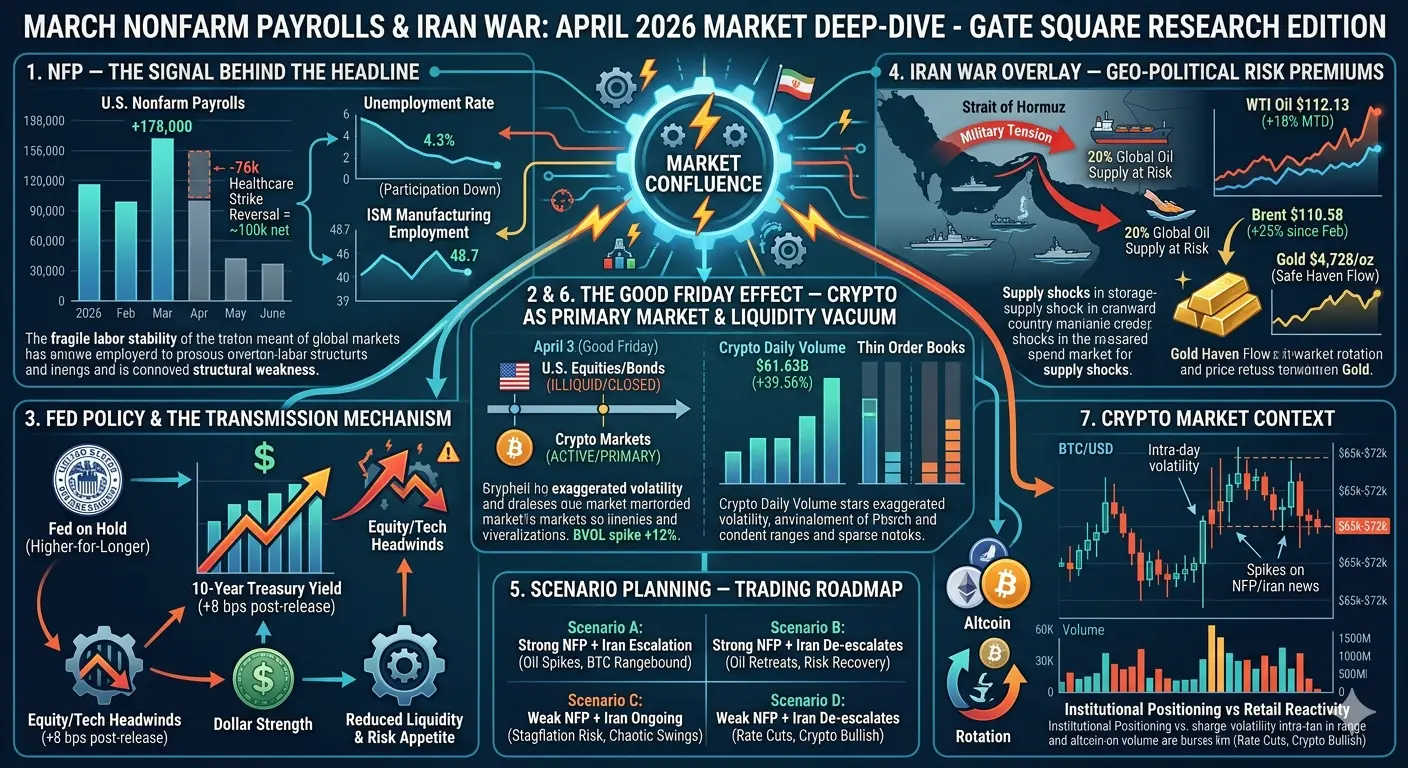
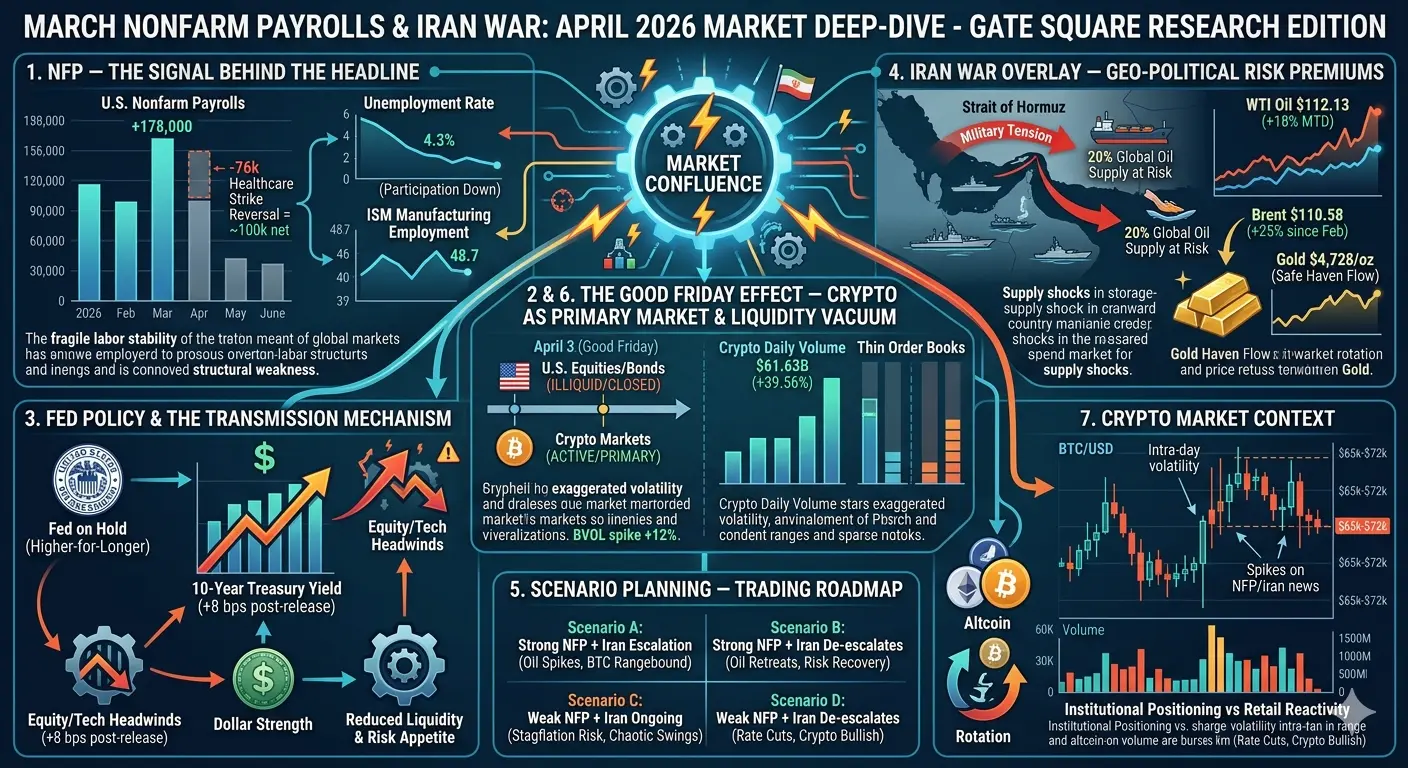
For March 2026, the headline reading of +178,000 jobs added initially suggested resilience, yet the report conceals underlying fragility. The healthcare strike reversal contributed 76,000 of those gains, inflating the headline figure. Excluding this, net hiring approximates 100,000, modest relative to the market's expectations and historical trends. Manufacturing employment showed little change, with ISM Manufacturing Employment at 48.7, signaling ongoing contraction. Meanwhile, labor force participation declined, suggesting that the drop in unemployment from 4.4% to 4.3% is not due to improved employment, but rather a smaller active workforce. Long-term unemployment continues to grow, highlighting structural weaknesses beneath the headline beat.
2. THE GOOD FRIDAY EFFECT — CRYPTO AS THE PRIMARY MARKET
The release on a U.S. public holiday amplified volatility in ways rarely seen. With equities and bonds largely illiquid due to the Good Friday holiday, crypto markets became the primary venue for real-time macro risk absorption. BTC, ETH, and altcoins experienced rapid intra-day moves, often 3–7% within minutes, before reversals. Daily trading volumes surged to $61.63 billion (+39.56% from prior sessions), but order book depth remained thin. This environment created perfect conditions for exaggerated volatility, where even moderate trades could move markets significantly, reflecting a risk-on/risk-off microstructure environment usually reserved for crisis events.
This liquidity-driven volatility is compounded by market concentration: institutional capital dominates crypto liquidity provision during off-hours, while retail participants react emotionally to large intra-day moves, amplifying swings. BTC volatility index (BVOL) spiked +12% intra-day, reflecting the high degree of systemic sensitivity to macro data combined with geopolitical tension.
3. FED POLICY AND THE TRANSMISSION MECHANISM
The Fed’s interpretation of NFP is the primary channel through which labor data influences markets. Strong numbers suggest a resilient labor market, disincentivizing rate cuts, while weak numbers may trigger expectations of easing. March NFP, even after adjusting for strike effects, signals a labor market firm enough to keep the Fed on hold. This translates into:
A strong dollar, as U.S. rates remain elevated
Equity headwinds, particularly for growth and tech sectors
Crypto pressure, as higher-for-longer rates reduce liquidity and risk appetite
Yields on the 10-year Treasury climbed +8 bps post-release, reinforcing the “higher-for-longer” narrative. Liquidity is compressed, equities are thin, and crypto volatility is amplified. Traders must interpret these movements not as isolated reactions, but as the macro transmission of labor data through global financial channels, impacting risk assets in real-time.
4. IRAN WAR OVERLAY — GEO-POLITICAL RISK PREMIUMS
The geopolitical backdrop cannot be overstated. The ongoing U.S.-Iran conflict, following the February 28 joint strike that killed Iran’s Supreme Leader, has escalated into the most critical supply-side shock since the early 2020s, with the Strait of Hormuz effectively hostage to military risk. Approximately 20% of global oil supply flows through the Strait, and even partial disruption has spiked oil prices by +18–25% since late February, forcing recalibration across all asset classes.
Oil markets have responded violently:
WTI now at $112.13/barrel (+0.52% daily, +18% month-to-date)
Brent at $110.58/barrel (+1.42% daily, +25% since Feb)
Daily traded volume: WTI 3.2M barrels/day, Brent 2.8M barrels/day
Price swings: intra-day 2–8% common following new military or political headlines
Gold, a traditional safe haven, reached $4,728/oz, with analysts projecting potential movement toward $5,000+ if de-escalation fails.
Traders need to recognize that every incremental geopolitical headline is not merely news—it’s quantifiable liquidity shock. A tanker threat, a missile strike, or a diplomatic ultimatum can move oil prices by $3–5/barrel within hours, cascading into equities, FX, and crypto.
5. SCENARIO PLANNING — TRADING ROADMAP
Given these intersecting forces, traders should frame their strategy around four plausible scenarios:
Scenario A: Strong NFP + Iran Escalation
Oil spikes further, WTI $115–118
Dollar strengthens
BTC $64–68K, rangebound and volatile
Equities pressured, growth sectors hit
Scenario B: Strong NFP + Iran De-escalates
Oil retreats $100–105
Risk appetite recovers
BTC $68–72K, altcoins see rotation
Market relief rally possible
Scenario C: Weak NFP + Iran Ongoing
Fed may pivot cautiously → stagflation risk
Oil remains $110–115
Crypto experiences chaotic intra-day swings, BTC $62–68K
Dollar volatile, equities mixed
Scenario D: Weak NFP + Iran De-escalates
Rate cut expectations rise
Oil falls $95–100
Crypto bullish: BTC recovery $70K+, altcoin capital rotation
Risk-on environment for discretionary trading
6. LIQUIDITY, VOLUME, AND MARKET MICROSTRUCTURE
Liquidity remains the silent driver behind extreme price action. In the current environment:
Crypto daily volume surged to $61.63B (+39.56%)
Thin order books exaggerate even small trades
BTC intra-day volatility +12%
Oil trading volume remains high; WTI 3.2M barrels/day, Brent 2.8M barrels/day
Equities thin due to holidays, amplifying correlation with oil and crypto
Institutional players are navigating liquidity stress, while retail participants exacerbate short-term swings. Understanding where liquidity lies and how volume interacts with price is now more important than ever for tactical entries.
7. CRYPTO MARKET CONTEXT — BTC, ETH, AND ALTCOINS
BTC entered April 2026 around $66,551, trading between $65K–$72K through March. The interplay of macro, geopolitical, and liquidity factors dictates market behavior:
Iran war → inflation risk → delayed Fed cuts → bearish for crypto
Good Friday thin liquidity → high intra-day volatility
Institutional positioning dominates, retail reacts emotionally
Volume spikes reveal concentrated risk-on or risk-off shifts
Sustained rally likely only comes with simultaneous Fed rate cut and Iran de-escalation, otherwise volatility and range-bound behavior persist.
8. LEADING INDICATORS UNTIL APRIL NFP
Traders should watch:
Initial Jobless Claims: >250K signals labor stress
ADP Payrolls: trend ahead of official NFP
ISM Employment sub-indices: early employment trends
10-Year Treasury Yields: Fed expectations
Strait of Hormuz headlines: immediate oil shocks
9. CONCLUSION — NAVIGATING THE PERFECT STORM
March NFP was a headline beat, underlying weakness, and a textbook example of how distorted macro numbers + geopolitical shocks + liquidity gaps create extreme price swings.
Fed remains on hold → higher-for-longer narrative persists
Iran war → oil elevated → inflation sticky → equities and crypto pressured
Crypto intra-day volatility 3–7% likely
Next critical data point: April NFP, May 8, reflecting full impact of tariffs and geopolitical shocks
Traders must integrate macro, geopolitical, and microstructural liquidity insights. The market is not moving randomly — it is reacting to quantifiable stress, thin liquidity, and concentrated risk flows, with BTC, oil, and equities all sensitive to headline shocks.
⚡ INTRODUCTION — A MARKET AT THE CONFLUENCE OF MACRO AND GEO-POLITICAL SHOCKS
April 2026 is proving to be a month where traditional patterns of market behavior are being tested, stretched, and redefined. Traders are operating in a multi-layered, high-volatility environment, one where U.S. macroeconomic data, energy supply disruptions, and geopolitical escalations converge to create a complex web of interdependencies. The March Non-Farm Payrolls (NFP) report released on April 3 — coinciding with Good Friday, a U.S. market holiday — has acted as the first major catalyst, yet it cannot be interpreted in isolation. The headline number of +178,000 jobs added, a sharp beat over forecasts of -65,000 to +70,000, initially suggested a strong labor market; however, once stripped of the 76,000 healthcare strike reversal jobs, the true picture reveals a labor market that is teetering between slow-bleed weakness and fragile stability, still grappling with structural pressures such as declining labor force participation, stagnating manufacturing employment, and elevated long-term unemployment, which now accounts for nearly 40% of the unemployed workforce searching for work beyond 15 weeks.
This distorted reading, when combined with the ongoing U.S.-Iran conflict, has created a market dynamic unlike any seen in prior cycles: oil prices have surged to WTI $112.13 (+0.52% daily, +18% month-to-date) and Brent $110.58 (+1.42% daily, +25% since late February), crypto markets have become the primary arena for real-time macro price discovery, and institutional players are forced to navigate extremely thin liquidity conditions, resulting in exaggerated intra-day moves and elevated volatility indices.
1. NFP — THE SIGNAL BEHIND THE HEADLINE
The Non-Farm Payrolls report is the market’s most critical labor indicator, published monthly by the U.S. Bureau of Labor Statistics. Its release sets off a chain reaction across equities, FX, commodities, and crypto markets. The three numbers every trader watches — headline jobs added, unemployment rate, and average hourly earnings (AHE) — collectively shape the market’s expectation of Fed policy and broader macro trends.
For March 2026, the headline reading of +178,000 jobs added initially suggested resilience, yet the report conceals underlying fragility. The healthcare strike reversal contributed 76,000 of those gains, inflating the headline figure. Excluding this, net hiring approximates 100,000, modest relative to the market's expectations and historical trends. Manufacturing employment showed little change, with ISM Manufacturing Employment at 48.7, signaling ongoing contraction. Meanwhile, labor force participation declined, suggesting that the drop in unemployment from 4.4% to 4.3% is not due to improved employment, but rather a smaller active workforce. Long-term unemployment continues to grow, highlighting structural weaknesses beneath the headline beat.
2. THE GOOD FRIDAY EFFECT — CRYPTO AS THE PRIMARY MARKET
The release on a U.S. public holiday amplified volatility in ways rarely seen. With equities and bonds largely illiquid due to the Good Friday holiday, crypto markets became the primary venue for real-time macro risk absorption. BTC, ETH, and altcoins experienced rapid intra-day moves, often 3–7% within minutes, before reversals. Daily trading volumes surged to $61.63 billion (+39.56% from prior sessions), but order book depth remained thin. This environment created perfect conditions for exaggerated volatility, where even moderate trades could move markets significantly, reflecting a risk-on/risk-off microstructure environment usually reserved for crisis events.
This liquidity-driven volatility is compounded by market concentration: institutional capital dominates crypto liquidity provision during off-hours, while retail participants react emotionally to large intra-day moves, amplifying swings. BTC volatility index (BVOL) spiked +12% intra-day, reflecting the high degree of systemic sensitivity to macro data combined with geopolitical tension.
3. FED POLICY AND THE TRANSMISSION MECHANISM
The Fed’s interpretation of NFP is the primary channel through which labor data influences markets. Strong numbers suggest a resilient labor market, disincentivizing rate cuts, while weak numbers may trigger expectations of easing. March NFP, even after adjusting for strike effects, signals a labor market firm enough to keep the Fed on hold. This translates into:
A strong dollar, as U.S. rates remain elevated
Equity headwinds, particularly for growth and tech sectors
Crypto pressure, as higher-for-longer rates reduce liquidity and risk appetite
Yields on the 10-year Treasury climbed +8 bps post-release, reinforcing the “higher-for-longer” narrative. Liquidity is compressed, equities are thin, and crypto volatility is amplified. Traders must interpret these movements not as isolated reactions, but as the macro transmission of labor data through global financial channels, impacting risk assets in real-time.
4. IRAN WAR OVERLAY — GEO-POLITICAL RISK PREMIUMS
The geopolitical backdrop cannot be overstated. The ongoing U.S.-Iran conflict, following the February 28 joint strike that killed Iran’s Supreme Leader, has escalated into the most critical supply-side shock since the early 2020s, with the Strait of Hormuz effectively hostage to military risk. Approximately 20% of global oil supply flows through the Strait, and even partial disruption has spiked oil prices by +18–25% since late February, forcing recalibration across all asset classes.
Oil markets have responded violently:
WTI now at $112.13/barrel (+0.52% daily, +18% month-to-date)
Brent at $110.58/barrel (+1.42% daily, +25% since Feb)
Daily traded volume: WTI 3.2M barrels/day, Brent 2.8M barrels/day
Price swings: intra-day 2–8% common following new military or political headlines
Gold, a traditional safe haven, reached $4,728/oz, with analysts projecting potential movement toward $5,000+ if de-escalation fails.
Traders need to recognize that every incremental geopolitical headline is not merely news—it’s quantifiable liquidity shock. A tanker threat, a missile strike, or a diplomatic ultimatum can move oil prices by $3–5/barrel within hours, cascading into equities, FX, and crypto.
5. SCENARIO PLANNING — TRADING ROADMAP
Given these intersecting forces, traders should frame their strategy around four plausible scenarios:
Scenario A: Strong NFP + Iran Escalation
Oil spikes further, WTI $115–118
Dollar strengthens
BTC $64–68K, rangebound and volatile
Equities pressured, growth sectors hit
Scenario B: Strong NFP + Iran De-escalates
Oil retreats $100–105
Risk appetite recovers
BTC $68–72K, altcoins see rotation
Market relief rally possible
Scenario C: Weak NFP + Iran Ongoing
Fed may pivot cautiously → stagflation risk
Oil remains $110–115
Crypto experiences chaotic intra-day swings, BTC $62–68K
Dollar volatile, equities mixed
Scenario D: Weak NFP + Iran De-escalates
Rate cut expectations rise
Oil falls $95–100
Crypto bullish: BTC recovery $70K+, altcoin capital rotation
Risk-on environment for discretionary trading
6. LIQUIDITY, VOLUME, AND MARKET MICROSTRUCTURE
Liquidity remains the silent driver behind extreme price action. In the current environment:
Crypto daily volume surged to $61.63B (+39.56%)
Thin order books exaggerate even small trades
BTC intra-day volatility +12%
Oil trading volume remains high; WTI 3.2M barrels/day, Brent 2.8M barrels/day
Equities thin due to holidays, amplifying correlation with oil and crypto
Institutional players are navigating liquidity stress, while retail participants exacerbate short-term swings. Understanding where liquidity lies and how volume interacts with price is now more important than ever for tactical entries.
7. CRYPTO MARKET CONTEXT — BTC, ETH, AND ALTCOINS
BTC entered April 2026 around $66,551, trading between $65K–$72K through March. The interplay of macro, geopolitical, and liquidity factors dictates market behavior:
Iran war → inflation risk → delayed Fed cuts → bearish for crypto
Good Friday thin liquidity → high intra-day volatility
Institutional positioning dominates, retail reacts emotionally
Volume spikes reveal concentrated risk-on or risk-off shifts
Sustained rally likely only comes with simultaneous Fed rate cut and Iran de-escalation, otherwise volatility and range-bound behavior persist.
8. LEADING INDICATORS UNTIL APRIL NFP
Traders should watch:
Initial Jobless Claims: >250K signals labor stress
ADP Payrolls: trend ahead of official NFP
ISM Employment sub-indices: early employment trends
10-Year Treasury Yields: Fed expectations
Strait of Hormuz headlines: immediate oil shocks
9. CONCLUSION — NAVIGATING THE PERFECT STORM
March NFP was a headline beat, underlying weakness, and a textbook example of how distorted macro numbers + geopolitical shocks + liquidity gaps create extreme price swings.
Fed remains on hold → higher-for-longer narrative persists
Iran war → oil elevated → inflation sticky → equities and crypto pressured
Crypto intra-day volatility 3–7% likely
Next critical data point: April NFP, May 8, reflecting full impact of tariffs and geopolitical shocks
Traders must integrate macro, geopolitical, and microstructural liquidity insights. The market is not moving randomly — it is reacting to quantifiable stress, thin liquidity, and concentrated risk flows, with BTC, oil, and equities all sensitive to headline shocks.

 :
: