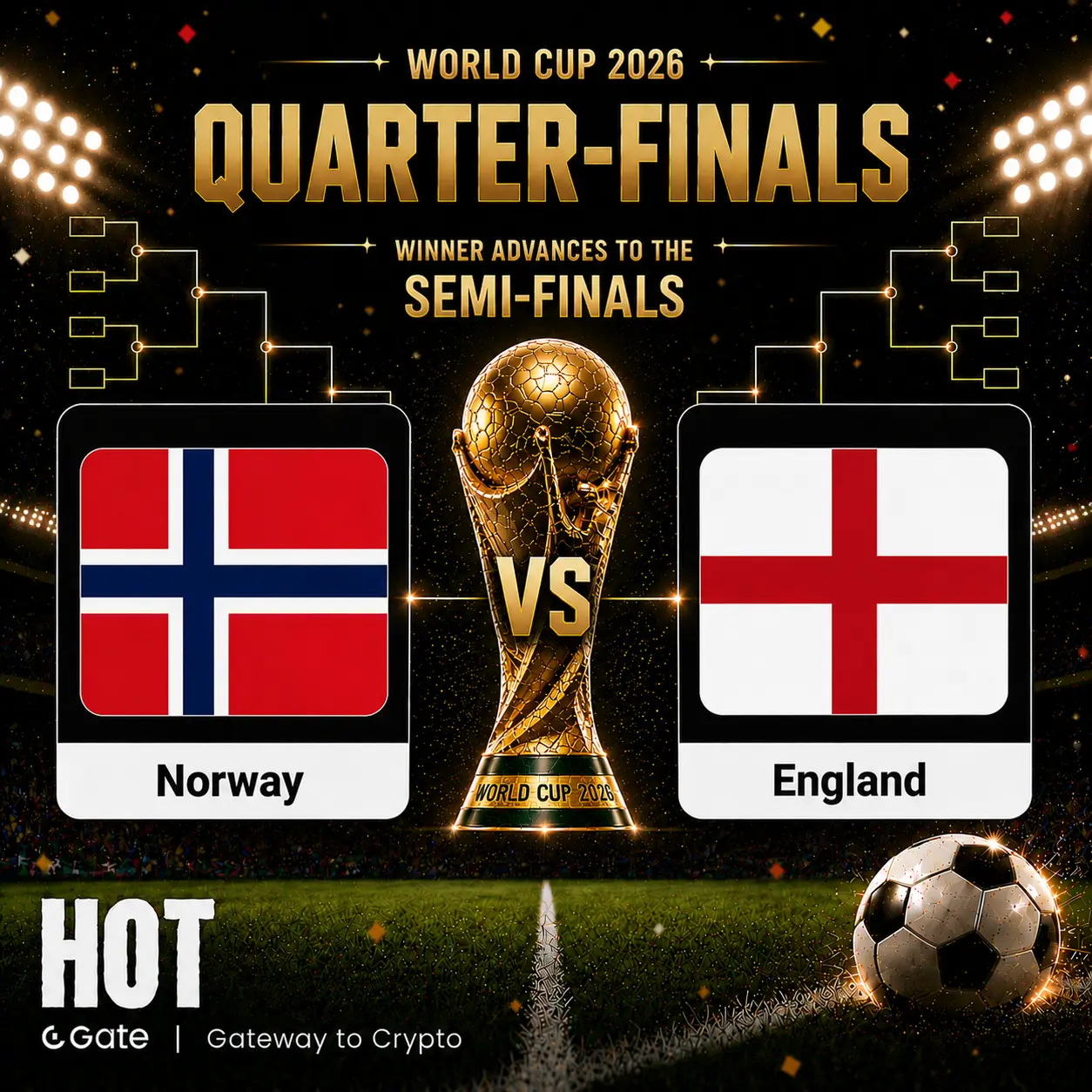
How prediction markets price the outcome of a soccer match
The core logic of prediction markets is fundamentally different from traditional sports analysis. Traditional analysis relies more on experts’ judgment and historical data extrapolation, whereas price movements in prediction markets reflect collective wisdom formed by large numbers of participants voting with real money. The price of each share directly corresponds to the market’s assessment of the probability that the event will occur. This means that the three numbers—24% for Norway, 26% for a draw, and 51% for England—are not a simple conversion of odds, but a dynamic consensus formed after the market accounts for all available information, including team form, injury situations, tactical styles, and head-to-head history.
From this perspective, the data in prediction markets is itself a form of high-quality information aggregation. It does not depend on any single analyst’s view, but rather the equilibrium outcome after countless market participants engage in strategic competition.
What the 51% England win rate is really pricing
With a 51% win probability assigned by the market, England is viewed as the more heavily favored side in this matchup. The key support for this assessment lies in England’s squad depth and experience in major tournaments.
In terms of squad structure, England has high-quality options across positions. Midfield control, attacking creativity and finishing, and multiple substitutes on the bench who can change the course of the match together form England’s core competitiveness. In the high-pressure knockout environment, squad depth often determines whether a team can maintain intensity in the later stages of the game—this is one of England’s most significant advantages over Norway.
In addition, England’s experience accumulated on big-stage occasions cannot be overlooked. Even though they advanced only 3 times in their past 10 World Cup quarterfinals, compared with Norway’s first time reaching the last eight, England’s players are unquestionably more psychologically prepared to deal with the pressure of knockout football. Opta’s supercomputer, in 25,000 pre-match simulations, likewise gave England a 50.4% probability of winning in regular time—an assessment that aligns with the prediction market and data model.
Norway’s 24% upset probability—has the market underestimated them?
Norway’s 24% win probability makes them the “underdog” in this match. But that number in itself is already a strong endorsement of Norway’s performance across the tournament. For a team making its first-ever run to the World Cup quarterfinals to be assigned nearly a quarter-chance of winning in the prediction market is unusual by definition.
Norway’s confidence first comes from efficiency and directness in attack. In this World Cup, Norway scored 12 goals across 5 matches, averaging 2.4 goals per game—one of the top figures among all eight quarterfinalists. More importantly, Norway’s attacking play is not entirely dependent on individual brilliance—wing progression and rapid transitions have formed a clear tactical system.
Ahead of the match, Norway’s coach Solbakken made it clear that the team would not simply sit back to defend. They intend to keep an offensive threat and play at a fast transition tempo. This statement reveals Norway’s tactical orientation: they do not plan to passively absorb pressure; instead, they want to drag the game into a high-speed transition phase—an area where they are comfortable. Norway hopes to pull the game into a rapid transition tempo, while England hopes to keep it within their own controlled rhythm. This tempo battle will largely determine where the match goes.
Haaland vs. Kane: two entirely different striker philosophies
The duel between Haaland and Kane is the most closely watched personal matchup in this game. Both put up astonishing numbers in the 2025-26 season: Kane, for Bayern and England, made 63 appearances and scored 73 goals; Haaland, for Manchester City and Norway, made 64 appearances and scored 58 goals. But beneath these figures are two completely different philosophies of central striking.
Haaland’s style can be summed up as a “pure finisher.” In this World Cup, he scored 7 goals from just 18 shots, and his 39% shot conversion rate is the highest single-World Cup record since 1986 for tournaments with 15+ shots per player (since Leincar). He does not need lots of touches—he only needs to be in the right place at the right time. He has scored in 14 consecutive official matches for the national team, netting 27 goals in that stretch—this kind of continuity is proof of terrifying strength.
Kane represents a different path. Within the same period, he completed 139 take-ons, nearly double Haaland’s number, with a take-on success rate as high as 59.7%. He drops deep, links the attack, pulls at the defensive line, and then delivers the final blow with his finishing. Kane’s role is not only to score but also to initiate and organize the offense. In the 2025-26 season, at club level, Kane contributed 61 goals and 7 assists, while also creating 92 scoring opportunities—such an output level goes beyond the traditional boundaries of a classic No. 9.
Midfield battles and defensive concerns—who will show cracks first
In any high-level matchup, the deciding factors are often not up front, but in midfield. Norway’s midfield core, Ødegaard, and England’s Declan Rice will directly face off in this match. Rice’s task is clear: limit Ødegaard’s runs into half-spaces, while cutting off the passing lines to Haaland. If Norway’s midfield cannot effectively deliver the ball into Haaland’s feet, then Norway’s most threatening weapon will be significantly blunted.
On England’s side, Bellingham has already scored 4 goals in this World Cup, and the connection between him and Kane is one of England’s most lethal offensive weapons. Whether Norway’s back line can limit the link-up between this pair will be another key matchup.
The stability of the defense is a shared concern for both teams. Norway conceded 9 goals in 5 matches, and defensive vulnerabilities may be magnified in the knockout stage. England’s defense also revealed weak points in their match against Mexico. Combined with Wensa’s red-card suspension and injury concerns for some players, neither team’s back line is unbreakable. This shared “attack-strong, defense-weak” characteristic could turn the match into an open end-to-end contest.
Head-to-head history and psychological factors—who holds the hidden edge
From historical data, England has achieved 7 wins, 3 draws, and 2 losses in 12 meetings between the two sides. However, it’s worth noting that this is the first time the two teams have met in the main stage of a world tournament, so the reference value of their head-to-head record needs to be discounted.
Psychologically, Norway as the “dark horse” may actually carry less pressure. They have already created the best record in their team history, and every victory is an extra reward. England, by contrast, as a traditional powerhouse, carries higher external expectations and greater pressure to advance. Ahead of the match, Haaland said, “The pressure is all on England.” That both forms part of the psychological battle and reflects objective reality.
The deeper logic behind market disagreement
Gate prediction market data shows England at 51% to win, 26% for a draw, and 24% for Norway to win. This distribution highlights several notable traits.
First, although England is favored, a 51% probability is far from a “sure win.” That means the market sees a close contest rather than a one-sided matchup. Second, the draw probability is as high as 26%, significantly above the typical expectation for knockout draws, reflecting market worries that neither side can decisively separate the two teams within 90 minutes. Knockout tactics tend to be cautious, while defensive vulnerabilities exist for both teams—together, this makes a draw a relatively likely scenario.
This probability distribution itself is the most direct portrayal of how complex this match is in the eyes of the market.
Summary
The quarterfinal between Norway and England is a collision between “dark horse sharpness” and “powerhouse depth.” Norway has a super finisher like Haaland who can change the flow of a match single-handedly, along with a clear and efficient rapid-transition system; England has deeper squad reserves, richer major-tournament experience, and a multidimensional attacking core built around Kane and Bellingham.
The probability distribution provided by the Gate prediction market—Norway 24%, draw 26%, England 51%—objectively reflects the market’s view of this matchup: England is the more favored side, but nowhere near a guaranteed victory. The final outcome may hinge on a single key moment—an effective defensive counterattack, a set-piece execution, a goalkeeper’s crucial save, or a flash of brilliance from a superstar.
For those watching this match, the prediction market’s real-time data offers a perspective different from traditional event analysis. It does not rely on any single viewpoint but on collective judgment formed by market participants “voting” with capital—and that judgment is one of the most valuable pieces of information.
FAQ
Q: How are Gate prediction market probability data derived?
In a prediction market, the share price directly reflects the market’s assessment of the probability that a given event will occur. Users express their judgment about match outcomes by buying and selling shares, and the price moves in real time as buying and selling forces interact. Therefore, the three sets of data—Norway 24%, draw 26%, England 51%—are the equilibrium prices formed by collective trading among market participants.
Q: In this World Cup, who scored more goals—Haaland or Kane?
As of July 11, 2026, Haaland has scored 7 goals in this World Cup, while Kane has scored 6. They rank in the first and second tiers, respectively, in the race for the Golden Boot.
Q: How do the two teams’ qualification paths differ?
Norway advanced as group runners-up, then eliminated Côte d’Ivoire and Brazil in succession, marking the first time in team history that they reached the World Cup quarterfinals. England advanced after defeating the host Mexico. Norway’s path is that of a “dark horse,” while England follows the traditional route of a strong team.
Q: What is the biggest highlight of this match?
The head-to-head duel between top-class center forwards Haaland and Kane is the biggest highlight. In the combined 2025-26 season, the two scored over 130 goals, representing two distinctly different striker philosophies. Additionally, the midfield battle between Ødegaard and Rice, and the tempo contest between the two teams, will also be key factors in determining the outcome.