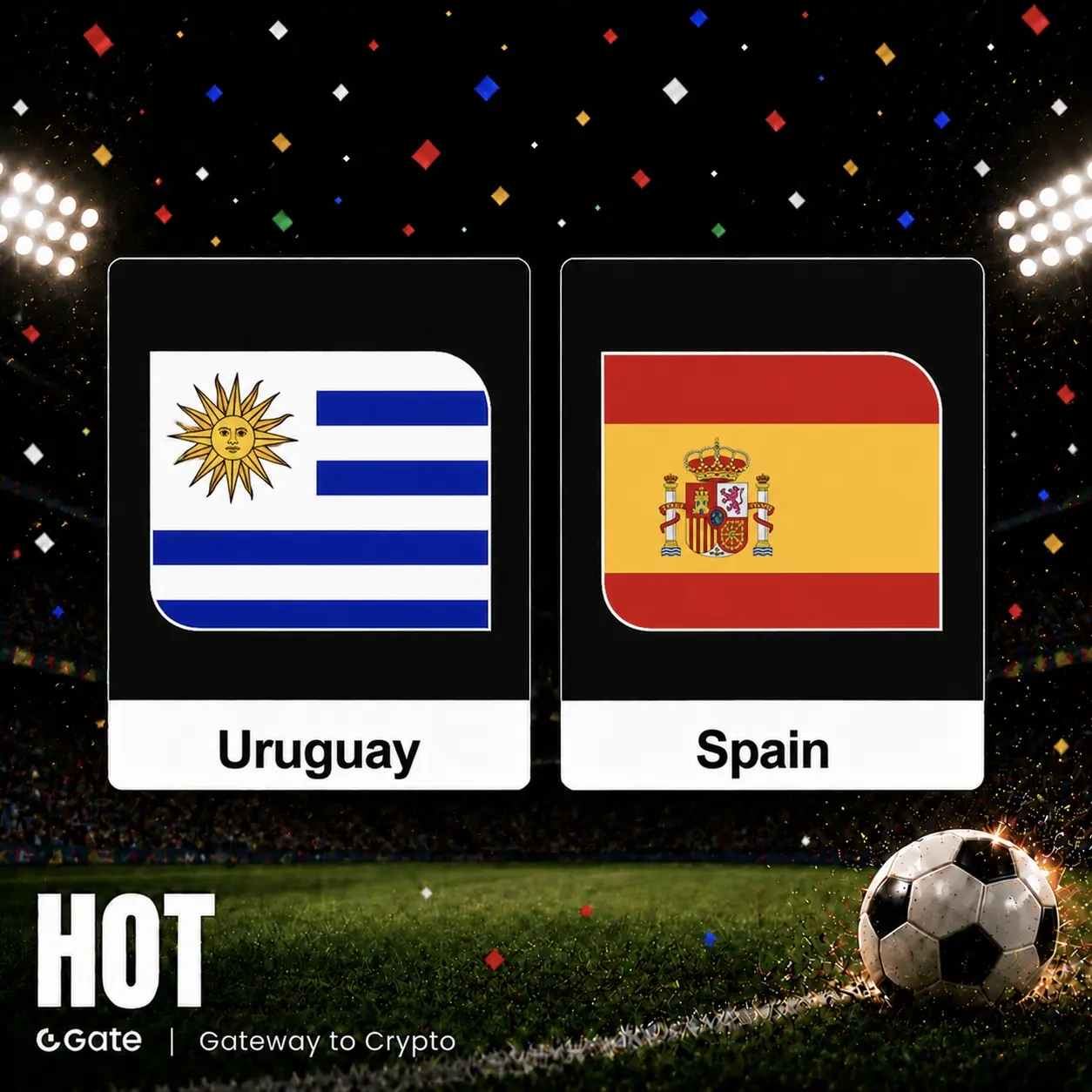
Why does a match with a gap in paper strength still retain such significant asymmetric betting space in the prediction market? How did the Group H standings shape the two teams' vastly different match motivations? What tactical countermeasures and anti-countermeasures exist between Spain's possession system and Uruguay's defensive counterattack? From four dimensions — standings situation, market pricing, tactical matchups, and key variables — we dissect the full picture of this Group H marquee match and attempt to explain the underlying logic behind the prediction market divergence.
Group H Standings: Who Craves Three Points More, Who Fears Defeat More
As the third round of group stage approaches, Group H presents a classic "one superpower, many mixed" landscape. Spain leads with 1 win and 1 draw, 4 points; Uruguay and Cape Verde both have 2 points; Saudi Arabia is at the bottom with 1 point. All four teams still have a chance to advance, but their respective situations and options vary greatly.
Spain's path is the most comfortable. A draw secures the group top spot — even a loss, given the 4-point base, virtually guarantees a top-two finish (under the expanded 48-team format with 12 groups, the top two from each group and the eight best third-place teams advance; 4 points almost locks in advancement). But for Spain, the difference between first and second is critical: Group H runner-up faces Group J winner in the first knockout round, and Argentina has essentially secured top spot in Group J. Avoiding the heavy title favorite Argentina is an unspoken but very realistic strategic goal for Spain in this match.
Uruguay's situation is entirely different and far more dangerous. After two draws, 2 points means they must win to keep their fate firmly in their own hands. A draw leaves Uruguay on 3 points, and under the 2026 expanded format, whether 3 points suffice to be one of the eight best third-place finishers is highly uncertain — it depends on the final points of other group third-placers, something Uruguay cannot control. A loss means outright elimination, with no need to wait for other results.
This standings situation directly dictates the two teams' match motivation curves: Uruguay must attack, must score, must win; Spain can accept a draw but does not want to lose, especially not to lose the top spot. This asymmetry of motivation is the first key to understanding all tactical reasoning and market pricing for this match. At the same time, the result of the other match in the group (Cape Verde vs. Saudi Arabia) will dynamically affect both sides' real-time mentality — if Cape Verde takes an early lead, Uruguay's win pressure increases further; if Saudi Arabia takes a surprise lead, the value of a draw for Uruguay rises somewhat.
Prediction Market Win Probability Changes: Pricing Logic for 61%, 26%, and 15%
The core pricing from Gate prediction market before the match: Spain win probability 61%, draw 26%, Uruguay win probability 15%, total volume about $2.38 million. This set of data needs cross-comparison with multiple reference frames to be accurately interpreted.
Compared to Kalshi prediction market data — Spain 66%, draw 23%, Uruguay 13% — the two differ by 5 percentage points on Spain's win probability and 2 percentage points on Uruguay's win probability. The 61% vs. 66% gap reflects different market participants assigning different weights to the same set of fundamental information, especially the valuation of Uruguay's "do-or-die explosiveness," a hard-to-quantify factor.
Compared to the model prediction from Spanish media MARCA based on Elo rating system — Spain 71.4%, draw 14.6%, Uruguay 14% — the prediction market's Spain win probability is about 10 percentage points lower, while the draw probability is over 11 percentage points higher. This difference is particularly notable. Under the Elo rating system, Spain leads Uruguay by about 283 points, which is the underlying numerical basis for Spain's high win probability. But prediction market pricing is not merely a mapping of strength comparison — it also incorporates multiple hard-to-quantify but real factors such as match motivation intensity, tactical style compatibility, on-field variables (red/yellow cards, injuries, fitness), and market sentiment.
A 61% win probability means the market believes Spain's chances exceed 60%, but it's by no means overwhelming. The 26% draw probability is also non-negligible — a draw is a highly acceptable result for Spain, and not entirely worthless for Uruguay (if Cape Verde does not win, 3 points still have a decent chance to advance as group runner-up). Uruguay's 15% win probability corresponds to an implied odds of about 6.67 to 1. The market considers the upset probability not high, but far from negligible — in football, a 15% win probability corresponds to an occurrence frequency of about once every 6.7 matches, which is not a rare event.
A volume of $2.38 million indicates this match is one of the most liquid offerings in the day's prediction market. Behind high liquidity is sufficient divergence among market participants in both directions — the ongoing tug-of-war between Spain's fundamental advantage and Uruguay's desperate survival desire is the core driver of volume expansion. On-site fund flows and immediate reactions after the starting lineup announcement may further perturb this pricing.
Tactical Matchup: Possession Patience vs. Counterattack Sharpness
The tactical matchup between Uruguay and Spain is another core dimension for understanding market divergence and match direction. The two teams' styles almost represent two entirely different philosophical systems in modern football.
Spain has shown strong defensive stability in this tournament — they have not conceded a single goal yet. Since the 21st century, Spain's clean sheet rate in World Cup matches is 48%, a figure among the top in international football. After an unexpected 0-0 draw with Cape Verde in the first round, Spain routed Saudi Arabia 4-0 in the second, with Yamal scoring his first national team goal and Oyarzabal scoring a quick brace in the 21st and 24th minutes. The team's possession system and midfield organization (centered on Rodri and Pedri) often gain more vertical space and passing penetration when facing opponents that need to press forward.
Uruguay's tactical logic shows a stark contrast. Two draws (both 0-0 against Iran and Cape Verde) exposed efficiency issues in attack — insufficient finishing ability up front and limited creativity in midfield. Uruguay's traditional strength lies in defensive counterattacks and physical duels. Their double center-backs (Araújo and Giménez) have strong defensive capabilities, fast wingers like Pellistri, and the impact of striker Darwin Núñez. But the core premise of this tactical system is to first solidify defense, draw the opponent forward, and then gain counterattack space.
However, when Uruguay must aim for a win, being forced to increase attacking proportion means the risk of exposing the defense rises, and this is exactly the situation Spain excels at exploiting — high possession pressure, channel runs, and quick transitions from defense to attack. This tactical situation of "having to attack proactively" inherently conflicts, irreconcilably, with Uruguay's most comfortable playing style. Conversely, if Uruguay can score first, the match quickly enters their most comfortable rhythm — dropping deep, waiting for counters, wasting time. Thus, the timing and ownership of the first goal almost determine which side controls the tactical initiative for the rest of the match.
From matchup details, Spain's possession advantage may force Uruguay to engage in high-intensity, continuous running and pressing without the ball, a huge physical test. Uruguay's counterattack efficiency depends on whether Núñez's speed and physicality can effectively exploit the space behind Spain's high defensive line (especially the gaps left by full-backs advancing). This set of tactical contradictions is the root of the structural divergence in prediction markets — Spain's fundamentals are more stable and system more mature, but Uruguay's willpower and physical intensity in a back-against-the-wall situation are variables that no model can precisely quantify.
Biggest Variables: First Goal, Discipline Risk, and On-Field Mentality
In this match, three key variables could decisively influence the final outcome, all highly unpredictable.
Timing and ownership of the first goal is the primary watershed affecting match direction. If Spain scores first, Uruguay's situation rapidly deteriorates — they need at least two goals to turn the match around, forcing them to push further forward and expose more defensive space, exponentially increasing Spain's counterattack opportunities. If Uruguay scores first, the match's openness suddenly rises — Spain must respond offensively, while Uruguay can retreat to their most comfortable defensive counterattack rhythm, using physical challenges and tactical fouls to disrupt Spain's possession flow. The earlier the first goal occurs, the greater the impact on match momentum; if it's still 0-0 at halftime, the psychological battle in the second half becomes even more nuanced.
Red/yellow cards and discipline risk is another non-negligible variable. Uruguay is known for physical play and tough defense; with the need to fight for a win, the frequency of fouls and card risk naturally increase. If reduced to a man down, Uruguay's already difficult win task becomes nearly impossible. For Spain, avoiding unnecessary bookings in non-critical areas is equally important — squad completeness for the knockout stage is a deeper strategic consideration; core players (like Rodri and Yamal) missing due to yellow card accumulation would directly affect subsequent matches.
The dynamic shift in risk appetite of both teams is also worth close attention. Spain has a "not to lose, aim to win" motivation, but being overly conservative might allow Uruguay to gain attacking confidence and possession time, thereby reducing Spain's own attacking threat. Uruguay has a "must win" pressure, but blindly pushing forward could be punished by Spain's quick passing and flank attacks. In the final 30 minutes, if the score remains tight, the risk appetites of both sides will undergo subtle but crucial shifts — Spain may lean more toward accepting a draw (provided Cape Verde is not leading by a large margin), while Uruguay will have to take increasingly greater attacking risks, even at the expense of defensive stability. This asymmetric evolution of risk appetite is a core logic behind the draw probability being priced at 26% (11 percentage points higher than Uruguay's win probability).
Market Dimensions and Dynamic Indicators Worth Watching
Beyond the traditional win-draw-loss market, several derivative dimensions also offer high observation value, especially for participants monitoring real-time changes in prediction markets.
Both Teams to Score (BTTS) market has special analytical value in this match. Uruguay must score to achieve their win goal, while Spain's attacking firepower was well demonstrated against Saudi Arabia (4 goals). The BTTS odds pricing reflects the market's expectation of match openness — Uruguay's attacking need and Spain's counter threat point toward a relatively high probability of both teams scoring. However, Uruguay's two previous goalless performances cast a shadow over this expectation, so price fluctuations in this market may be more volatile than win-draw-loss.
Real-time advancement probability changes is another dynamic monitoring dimension. As the match progresses, Uruguay and Spain's real-time advancement probabilities will fluctuate dramatically with score changes, red/yellow cards, and even score changes in the other group match. For participants focused on knockout stage matchups, the result of this match not only decides the immediate fate of the two teams but also reshapes the entire cross-elimination matchup pattern between Group H and Group J — Group H winner vs. Group J runner-up, Group H runner-up vs. Group J winner (Argentina). The premium on group top spot far exceeds the group stage itself.
Win probability curve during the match is also worth tracking. Prediction market win probabilities are not static data — on-site fund flows, confirmation of starting lineups (especially Uruguay's forward selection and Spain's midfield configuration), and the attacking/defensive posture in the first 15 minutes can trigger real-time, non-linear adjustments. The 61% pre-match win probability is just a starting point; the real game unfolds after kickoff, especially in the 5-10 minutes after a goal, when market pricing often overreacts, providing observers a window to understand market sentiment and information efficiency.
FAQ
Does Uruguay still have a chance to advance if they draw?
Yes, but it depends on the points of other group third-place teams. Uruguay would have 3 points after a draw. In the expanded 48-team format, 3 points could potentially be enough to become one of the eight best third-place finishers, but their fate is not in their own hands; there is considerable uncertainty. Therefore, Uruguay must strive for a win.
If Spain loses, are they directly eliminated?
No. Spain currently has 4 points. Even with a loss, they retain 4 points. Under the rule where the top two from each group advance, 4 points almost certainly guarantees a top-two finish (unless other teams in the group overtake them, which is highly unlikely). But a loss would cost Spain the group top spot, potentially leading to a first knockout match against Argentina.
Why does the prediction market give Spain a 61% win probability and not higher?
Because the market considers not only the strength gap but also Uruguay's strong win motivation, the high probability of a draw (26%), and the inherent uncertainty of football. 61% means the market believes Spain has a good chance but not a guaranteed win, reflecting reasonable respect for Uruguay's defensive resilience and counterattack threat.
What specific impact does this match have on the knockout stage matchups?
Group H winner faces Group J runner-up in the round of 32; Group H runner-up faces Group J winner (essentially confirmed as Argentina). If Spain finishes first, they avoid Argentina; if they drop to second, they might face the heavy title favorite in the first knockout round, significantly increasing the difficulty of advancement.
Why is the draw probability (26%) significantly higher than Uruguay's win probability (15%)?
Because a draw is a highly acceptable result for Spain (secures top spot), and Uruguay might also accept a "risky draw" later in the match due to fitness or risk considerations, rather than forcing the issue and risking a loss. Under certain conditions, the motivations of both sides converge, making a draw a more likely scenario than a Uruguay win.